
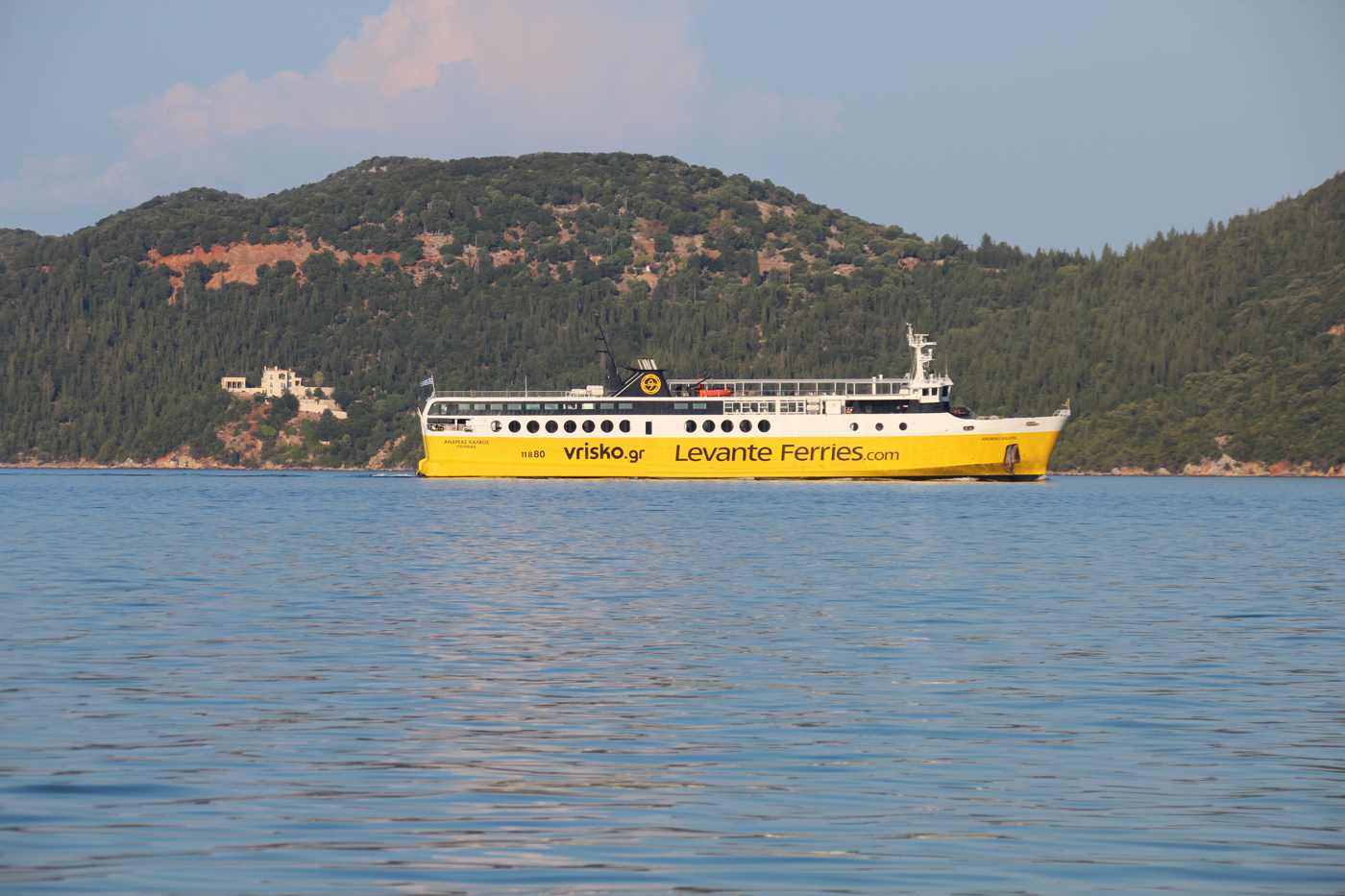
Kefalonia sits in the Ionian Sea off western Greece. Two routes carry every visitor there: the air route into Kefalonia Airport and the sea route into the island’s ferry ports. The airport, coded EFL, lies about 9 km south of Argostoli and handles domestic flights from Athens through the year, with scheduled and charter services from across Europe in summer. Ferries sail from Kyllini and Patras in the Peloponnese and from Astakos on the western mainland, landing at Poros, Sami, Argostoli or Lixouri. The right combination depends on where you start, whether you drive, and which corner of the island you sleep in. Plan the whole trip with Greece Tours.
Choosing between plane and ferry shapes the rest of the trip. A flight from Athens takes about an hour in the air and drops you 9 km from the capital. It also leaves you without a car unless you rent one on arrival. A ferry crossing runs between about 90 minutes and three hours depending on the port pair. Carries your vehicle. Lands you at a harbour up to about 50 km from your accommodation. Ferry links also connect Kefalonia with Ithaca through the year and, in the warm months, with Zakynthos and Lefkada, which makes island-hopping across the Ionian straightforward.
What are the main ways to reach Kefalonia from Athens and the rest of Europe?
Two routes serve Kefalonia: flights into Kefalonia Airport, about 9 km south of Argostoli, and ferries from Kyllini, Patras or Astakos on the mainland into the island ports of Poros, Sami, Argostoli and Lixouri.
Air travel puts you on Kefalonia fastest. The hop from Athens covers about 320 km and takes around 55 minutes in the air. The runway at Minies sits about 9 km from the capital, so the transfer into town runs about 15 minutes. Argostoli, Lassi and the southern beaches all lie inside a 20-minute drive of the terminal. Sea travel trades speed for flexibility: a ferry carries your own car, motorbike or camper. Which matters on an island of about 773 square kilometres where beaches, caves and mountain villages spread far apart. Visitors who fly into Kefalonia rent a vehicle at the terminal instead, and the fleet books out early in August.
Drivers from Athens reach the ferry quays in about three hours. Kyllini lies about 300 km west along the motorway through Corinth and Patras, and the crossing from there to Poros runs about 90 minutes. Patras sits about 215 km from Athens and sends longer sailings toward Sami. Astakos, about 320 km northwest by way of the Rio-Antirrio bridge, serves the same east-coast port on a crossing of roughly two and a half hours. Sailings load cars, motorbikes, campers and coaches on the same deck. Each of these routes lands you on the island with a vehicle already aboard, which removes the rental step and the queue at the airport desks.
Season decides how wide the choice is. Winter traffic narrows to the domestic Athens flights and a reduced ferry programme, with Kyllini to Poros and Astakos to Sami carrying the bulk of vehicles and passengers. From late spring the picture widens: European charters land at EFL, extra sailings appear on the Kyllini and Patras routes, and the seasonal links toward Zakynthos and Lefkada open. Kefalonia keeps its air link with Athens through every month of the year. Travellers arriving outside the warm months plan around fewer departures per day and watch the forecast, because northwest winds close the exposed crossings for hours at a time.
Combining both routes works well on a longer trip. One common pattern flies into EFL, tours the island by rental car. Then leaves by ferry from Sami to Ithaca or from Poros to Kyllini for the drive back to Athens. Kefalonia sits at the centre of the Ionian chain. About 5 km west of Ithaca at the narrowest point of the strait. The hop between the two takes around 30 minutes. Seasonal ferries toward Zakynthos from Pesada and toward Lefkada from Fiskardo extend the same idea across three or four islands. Pesada lies about 12 km south of the capital, and Fiskardo about 50 km north of it.
What flights land at Kefalonia Airport (EFL)?
Kefalonia Airport, coded EFL, sits about 9 km south of Argostoli at Minies, beside the village of Svoronata. Domestic flights link it with Athens through the year, while summer brings scheduled and charter arrivals from airports across Europe.
Kefalonia Airport stands on the flat coastal strip at Minies, next to Svoronata and about 9 km south of the capital. One terminal handles arrivals and departures, with car-rental desks, a cafe and a taxi rank outside the door. The drive north into Argostoli takes about 15 minutes on a straight coastal road. Lassi and the beaches of Makris Gialos and Platis Gialos lie about 7 km away. Skala, in the far southeast, sits about 40 km from the terminal, a drive of roughly 45 minutes on the southern road. Sami, on the opposite coast, lies about 30 km away, roughly 40 minutes by car.
Domestic flights connect Athens with Kefalonia through the whole year. The route covers about 320 km and stays in the air for roughly 55 minutes, which makes it the quickest way onto the island from the capital. Athens is the only Greek airport with a year-round link to Kefalonia. Frequency rises in the warm months, when the route adds extra rotations and the terminal works close to capacity between morning and early evening. Passengers connecting from a long-haul arrival in Athens leave a comfortable gap, because the domestic gates sit at the far end of that building and baggage does not transfer automatically between two separate tickets.
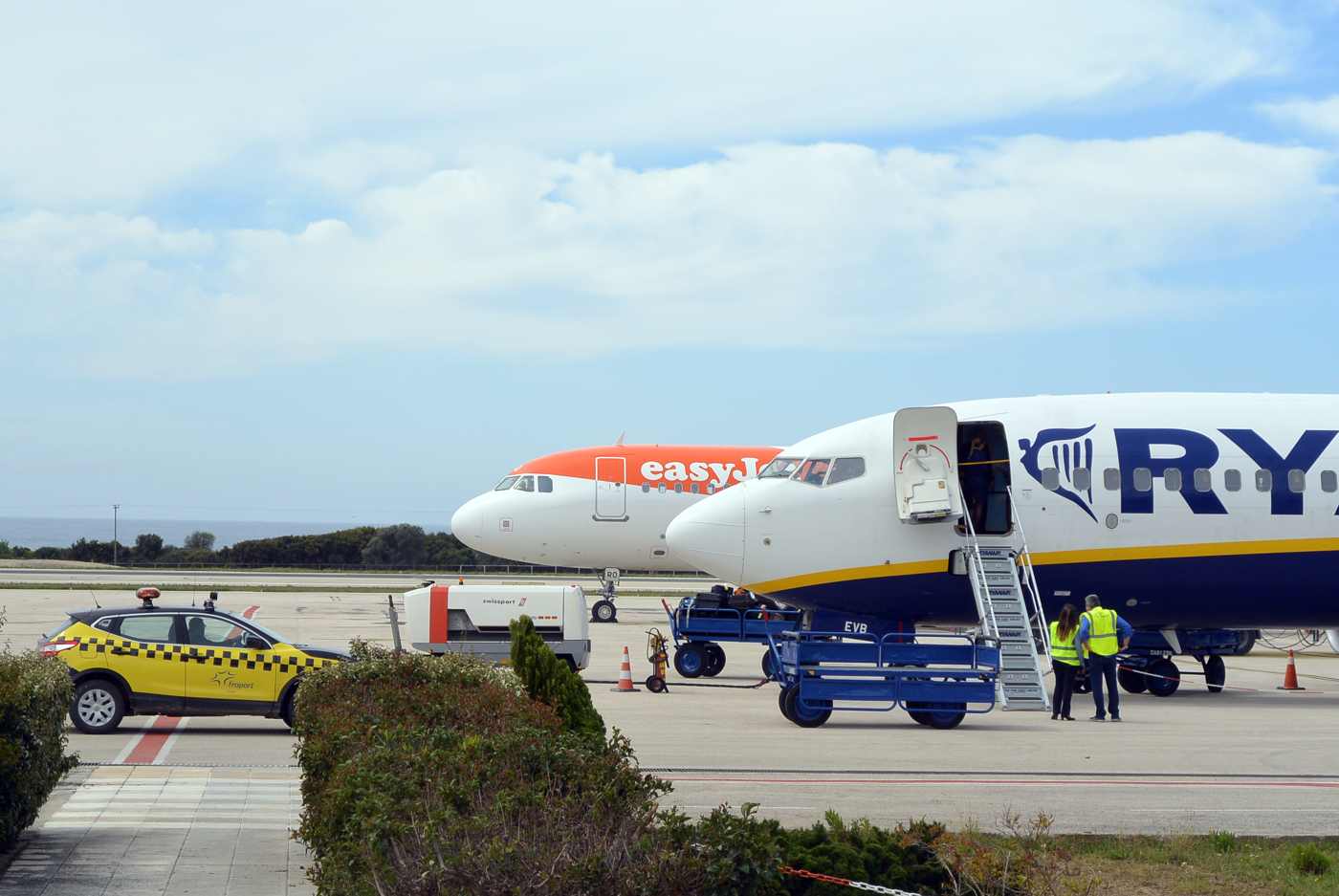
European services turn EFL into a busy summer airport. Scheduled and charter flights arrive from the United Kingdom, Italy, Germany, the Netherlands, Poland, Austria and the Nordic countries between late spring and mid-autumn. Weekend rotations carry the heaviest loads. Charter loads reach the building in blocks, so the terminal fills and empties in waves. Aircraft park on an open apron and passengers walk across to the doors, so arrival flows move quickly once the queue at passport control clears. Traffic drops sharply in late autumn, when the European programme ends and the airport returns to the Athens service alone.
Ground transport from the terminal rewards a little planning. Rental desks sit inside the arrivals hall and the fleet books out fast in July and August, so a reservation beats walking up. Taxis wait outside and cover the run to Argostoli, Lassi or Lourdas in 15 to 35 minutes. The rank empties quickly once a charter lands, so arrange a transfer in advance. Buses do not serve the terminal directly, which leaves the KTEL station in the capital as the hub for routes to Sami, Fiskardo, Skala and Lixouri. Drivers heading north to Myrtos beach or Assos allow about 75 minutes from the airport gate.
Which mainland ports run ferries to Kefalonia?
Three mainland ports feed Kefalonia: Kyllini in the northwest Peloponnese sails to Poros and, seasonally, to Argostoli; Patras connects toward Sami on a longer crossing; and Astakos in Aitoloakarnania links to Sami on the island’s east coast.
Kyllini, on the northwest tip of the Peloponnese, is the busiest gateway to Kefalonia. The port sits about 300 km from Athens and about 75 km southwest of Patras, reached by motorway and then a short country road through farmland. Crossings from Kyllini to Poros on the southeast coast take around 90 minutes. A second Kyllini route runs to Argostoli in the warm months on a longer sailing of roughly two and a half hours. The same quay also serves Zakynthos, so read the boarding-lane signs before you drive on. Vehicles load through the stern ramp, and drivers who arrive 45 minutes early clear the ticket check without pressure.
Patras adds a second Peloponnese option with a longer sea leg. The city lies about 215 km from Athens on the motorway and about 75 km northeast of Kyllini on the same coast. Patras doubles as the country’s main gateway to Italy, so its harbour works on a large scale. Sailings from Patras toward Sami cross the mouth of the Gulf of Patras and take roughly three hours, landing on the east coast of the island. Travellers already moving to or from Italy use this port to fold Kefalonia into a wider route, since the Italian services and the Ionian ones work out of the same waterfront.
Astakos, a compact harbour in Aitoloakarnania on the western mainland, gives the shortest drive to anyone coming from central or northern Greece. The town sits about 320 km from Athens by way of the Rio-Antirrio bridge and about 260 km from Ioannina. The crossing to Sami takes roughly two and a half hours and calls at Piso Aetos on Ithaca along the way, which turns one ticket into a two-island link. The route threads out past the low Echinades islets. The quay is small, parking beside it is limited, and drivers queue on the road along the water before the ramp opens.
Route choice follows your starting point and your base on the island. Kyllini works for southern Greece and for a holiday in Skala, Lourdas or Katelios, since Poros lies about 12 km from Skala. Patras and Astakos both land at Sami, which suits Melissani, Drogarati, Antisamos and the drive north to Fiskardo, about 45 km away. Drivers coming down from Epirus or Thessaloniki save around two hours by using Astakos instead of doubling back to Kyllini. Foot passengers plan around the KTEL bus times out of each port. Vehicle space fills days ahead in August, so book the crossing before the accommodation.
Which port on Kefalonia fits your route: Poros, Sami, Argostoli or Lixouri?
Poros suits arrivals from Kyllini and the south coast, Sami handles Patras, Astakos and Ithaca traffic on the east, Argostoli receives the seasonal Kyllini crossing, and Lixouri works as the local link across the bay.
Poros sits on the southeast coast below steep hills and takes the Kyllini traffic. The harbour is small, with a single ramp, a line of cafes and a beach of grey pebbles beside it, and the road out climbs quickly toward the interior. Skala lies about 12 km south, Sami about 25 km north, and the capital about 40 km west across the island on a winding road of around 50 minutes. The track up to the Atros monastery ridge starts above the village. Arrivals who plan to stay in the southeast reach their base within 20 minutes, which makes Poros the practical landing point for that half of Kefalonia.
Sami, on the east coast facing Ithaca, is the second port and the busiest for long crossings. Ferries from Patras and Astakos dock at the town quay, and the short link to Piso Aetos on Ithaca leaves from the same berths, taking about 30 minutes. The Melissani cave lies about 3 km north, the Drogarati cave about 4 km southwest, and Antisamos beach about 4 km east over the headland. Agia Efimia, a second harbour used by yachts, sits about 9 km north along the coast road. Argostoli lies about 25 km west, roughly 35 minutes across the central spine of the island.
Argostoli receives the seasonal Kyllini crossing at a quay on the town waterfront, steps from the De Bosset bridge and the main square. Landing in the capital removes the transfer entirely, because hotels, the KTEL bus station, banks and the market all stand within walking distance of the ramp. The Katavothres sea mills stand about 2 km north of the quay, where seawater runs into the rock. The port lies about 9 km north of the airport. About 40 km from Poros and about 25 km from Sami. A car unloaded here reaches the south and west inside 40 minutes. Loggerhead turtles patrol the harbour beside the fishing boats.
Lixouri handles a different job. The ferry across the bay from Argostoli to Lixouri covers about 2.5 km of water in around 20 minutes and runs through the day. Replacing a road loop of about 30 km around the lagoon. The Lixouri berth sits in the middle of the town seafront. Cars and foot passengers both travel, which makes it the practical way to reach Xi beach, Petani and the rest of the Paliki peninsula. Choosing a port comes down to arithmetic: match the mainland harbour nearest your start with the island harbour nearest your bed. Then confirm the sailing time before you commit to the drive.
Which ferries connect Kefalonia with Ithaca and the other Ionian islands?
Ferries link Kefalonia with Ithaca from two ports: Sami on the east coast and Fiskardo in the north. Seasonal routes also connect the island toward Lefkada and Zakynthos, making Ionian island-hopping practical from a single base.
Sami sits about 25 km east of Argostoli and works as the island’s main ferry gateway. Crossings from Sami reach Ithaca in around 30 to 45 minutes, and the same port handles mainland sailings. The harbour front holds parking, a row of ticket offices and cafes within 100 metres of the ramp. Drivers board with the car, so a rental crosses to Ithaca and returns the same day. Foot passengers walk on and pick up a taxi or a bus on the Ithaca side. Tickets sell at the port kiosk before boarding. Sailings cluster in the morning and late afternoon, and frequency rises across the warm months.
Fiskardo lies about 50 km north of Argostoli at the island’s northern tip, and its small harbour handles the second Ithaca link. Boats from Fiskardo cross toward the northern side of Ithaca in around 30 minutes, which suits travellers staying at Assos, Divarata or Emblisi. The quay sits inside the village itself, so passengers step off among the pastel Venetian houses and reach a taverna within two minutes. Parking near the waterfront fills early in the peak weeks, and drivers leave the car about 300 metres uphill instead. Crossings from this northern port concentrate in the warm months rather than running at the same rate through the year.
Seasonal sailings extend the network north toward Lefkada and south toward Zakynthos, which turns Kefalonia into a working hub for Ionian island-hopping. The northern chain pairs with Fiskardo and Ithaca, letting travellers reach three islands inside one week without returning to the mainland. Southern links point at Zakynthos, roughly 50 km away across open water, and match a base at Skala or Lourdas in the south of Kefalonia. Mainland routes leave from Sami and Poros on the east coast toward Kyllini, Patras and Astakos. Frequencies concentrate in summer, so a chain built outside that window leans on the mainland ports.
Planning an Ionian chain around Kefalonia starts with the car question, because vehicle space on the smaller island boats runs out first in August. Reserving the crossing before arrival protects the slot, while foot passengers keep more flexibility on departure times. Distances stay short: Sami to Ithaca covers around 20 km of water, and the Argostoli drive to Sami runs about 25 km over a mountain road. Allowing 45 minutes for that drive plus 30 minutes at the port keeps the connection safe. Building the trip around one base instead of three hotels cuts packing days and adds hours on the water.
How do you get from Kefalonia Airport or the port to your resort?
Kefalonia Airport sits about 9 km south of Argostoli, around 15 minutes by road. Taxis queue outside the terminal, pre-booked transfers meet arrivals inside the hall, and the car-hire desks stand in the same small building.
Kefalonia Airport, coded EFL, occupies flat ground near Svoronata on the south coast, about 9 km from Argostoli town. The terminal handles arrivals in one hall, so the walk from the aircraft steps to the taxi rank takes under five minutes. Lassi and the Makris Gialos and Platis Gialos beach strip lie about 7 km from the runway, close to 12 minutes by car. Skala in the southeast stands around 40 km east, and Sami on the east coast about 30 km northeast. Fiskardo, at the northern tip, sits about 59 km from the terminal and takes close to 90 minutes on winding roads.
Taxis wait at a marked rank outside the arrivals door and run on the meter or on a fixed island rate agreed before departure. The ride into Argostoli covers 9 km and ends in the town centre beside the Lithostroto pedestrian street. Runs to Skala take about 50 minutes and runs to Fiskardo close to 90 minutes. Travellers heading north therefore weigh a taxi against collecting a rental at the airport. Card payment works in a large share of the vehicles, and carrying cash removes the question entirely. Late arrivals meet a thinner rank, and a phone booking placed from the hall closes that gap within about 20 minutes.
Pre-booked transfers meet passengers inside the hall with a name board and load luggage straight into a car or minibus. Groups of four or more, and families needing child seats, gain the most from this because one vehicle carries everybody. Confirming the exact resort address in advance matters, since hotel clusters spread across Lassi, Svoronata, Skala, Sami and Lourdas. Reading up on where to stay in Kefalonia before booking the transfer keeps the two decisions aligned. Transfer vehicles also serve the ports, meeting a boat at Sami or Poros and driving guests across the island to the far coast. Fixing the return pickup time at the same booking removes any rush on departure day.
Car-hire desks operate inside the terminal, and collection happens in the car park about 50 metres from the door. Reserving before arrival matters most in July and August, when the fleet serving a 773-square-kilometre island runs thin. Small engines handle the mountain roads, and air conditioning earns its keep on the climb toward Mount Ainos at 1,628 metres. Drivers reach Argostoli in 15 minutes, Sami in about 35 minutes and Fiskardo in around 90 minutes. Fuel stations cluster around Argostoli, Lixouri, Sami and Skala, while the northern stretch past Divarata carries fewer pumps, so filling up early prevents a detour.
How do you get around Kefalonia once you have arrived?
A rental car remains the practical way to move around Kefalonia, because bus routes stay limited and the island covers about 773 square kilometres. The Argostoli to Lixouri ferry crosses the bay and saves a long inland drive.
Kefalonia’s road network links the main towns with paved routes, though the mountains force long curves and slow average speeds. A car opens the viewpoints above Myrtos at Divarata, the isthmus village of Assos below its Venetian castle, and Petani on the Paliki peninsula. None of those three sit on a bus corridor. Argostoli to Sami covers about 25 km and takes 35 minutes, while Argostoli to Fiskardo runs about 50 km and needs around 90 minutes. Parking exists at every major beach, and the Myrtos car park fills before midday in August. Driving the northern cliff road after dark demands care, since lighting stays sparse.
Bus services on Kefalonia centre on the Argostoli terminal and reach Sami, Poros, Skala, Lixouri and Fiskardo. Departures on each line stay few, so a day trip built on buses spends more time waiting than exploring. Fares run low and the coaches stay comfortable, which suits a single transfer between a hotel and the capital rather than a touring day. Services thin further outside the summer months, when passenger numbers drop across the island. Travellers without a car pair one bus leg with a taxi for the return, or join an organised excursion that collects guests from the resort door instead.
The Argostoli to Lixouri ferry crosses the bay in around 20 minutes and carries cars, scooters and foot passengers. Driving around the head of the gulf instead covers about 35 km and takes close to an hour, so the boat saves most of a morning. Lixouri opens the Paliki peninsula, where Xi beach shows red-orange sand and Petani lies under high cliffs on the west side. The Argostoli ramp stands on the waterfront a short walk from the De Bosset bridge and the Napier Garden. Sailings repeat through the day, with the widest gaps early in the morning and late in the evening.
Scooters and quad bikes rent in Argostoli, Lassi, Skala and Lixouri, and they suit short coastal runs rather than the climb up Mount Ainos. Boat trips fill another gap, reaching Melissani and the coves near Fiskardo from the water. Planning the week around clusters cuts driving time. Sami, Antisamos, Melissani and Drogarati sit within 8 km of one another, and the list of things to do in Kefalonia groups by region for that reason. Taxis handle short hops between a resort and the nearest village. Drivers at the Argostoli rank quote a fixed rate for a half-day tour of the north coast.


When do flights and ferries to Kefalonia run at their fullest?
Flights and ferries to Kefalonia reach their peak across the summer season, when direct international services and inter-island sailings run at their densest. Domestic flights from Athens and mainland ferry routes carry the traffic through the quieter months.
Direct international flights into Kefalonia Airport concentrate in the summer season, when scheduled and charter services arrive from across Europe. The domestic link from Athens operates through the year and takes about 55 minutes in the air, which keeps the island reachable once the direct routes pause. Arrivals cluster at midday and in the evening during the peak weeks, so the single hall fills and the car-hire queue lengthens. Reserving the rental and the transfer in advance removes both waits. Travellers landing outside the summer window connect through Athens and stand in Argostoli within about four hours of leaving the capital.
Ferry frequency follows the same curve, rising through the warm months and falling back afterwards. Mainland crossings from Kyllini, Patras and Astakos operate across the year at reduced levels, while the Ithaca links from Sami and Fiskardo carry their heaviest traffic in July and August. Inter-island routes toward Lefkada and Zakynthos run mainly inside the summer season, so an autumn chain leans on the mainland ports instead. Sea conditions in the Ionian stay calm through summer mornings, and afternoon wind reshuffles departures on the exposed routes. Checking the operator’s own schedule the evening before a crossing settles the plan without guesswork.
Choosing between a flight and a ferry follows the region of the base. Guests staying in Lassi, Argostoli or Svoronata gain most from the airport, 9 km from the town. Travellers based at Sami, Agia Efimia or Fiskardo prefer a mainland crossing, because the port drops them within 30 km of the bed. A Zakynthos or Lefkada leg suits the north and the east coast, where Fiskardo and Sami handle the boats. Drivers bringing a car from the mainland skip the hire desk entirely and reach any village on the island within 90 minutes of rolling off the ramp.
Arrival timing shapes the first day more than the route does. A midday landing leaves the afternoon for the Argostoli waterfront and the Katavothres sea mills, both within 3 km of the town centre. Late-evening arrivals in the peak weeks meet a thinner taxi rank, and a pre-booked transfer covers that gap. Booking the car, the crossing and the first two nights together prevents a scramble at the port. Return legs deserve the same margin: the drive from Fiskardo to the airport runs about 59 km and takes close to 90 minutes before check-in even opens.
Frequently Asked Questions
How far is Kefalonia Airport from Argostoli and the main resorts?
Kefalonia Airport sits about 9 km south of Argostoli, a drive of roughly 15 minutes on a straight coastal road. Lassi and the Makris Gialos beach strip lie about 7 km from the runway, close to 12 minutes by car. Sami on the east coast stands around 30 km away, near 45 minutes through the hills. Skala in the southeast covers about 40 km and takes close to 50 minutes. Fiskardo at the northern tip lies about 59 km from the terminal, with a drive near 90 minutes on winding cliff roads. Taxis, pre-booked transfers and car-hire desks all operate at the airport, so every transfer starts inside the same small hall.
Guests basing themselves in the north collect a rental at arrivals rather than paying for the long taxi run.
Can you travel from Kefalonia to Ithaca by ferry?
Ferries connect Kefalonia with Ithaca from two ports. Sami, about 25 km east of Argostoli, runs the main crossing and reaches Ithaca in around 30 to 45 minutes over roughly 20 km of water. Fiskardo, at the northern tip about 50 km from the capital, offers the second link toward the northern side of Ithaca with a crossing near 30 minutes. Both boats take cars, scooters and foot passengers, so a rental crosses and returns inside a single day. Morning departures give the longest time on Ithaca, leaving hours for Vathy, Kioni and Frikes before the return leg. Sailings run most often through the warm months and reduce afterwards, and the Fiskardo route in particular concentrates in summer.
Reserving vehicle space ahead protects the slot during the busiest weeks of August.
Do you need a rental car in Kefalonia?
A rental car makes the practical difference on Kefalonia, because the island spreads across about 773 square kilometres and bus routes stay limited. The viewpoints above Myrtos at Divarata, the castle village of Assos. Petani on the Paliki peninsula and the Mount Ainos national park road at 1,628 metres all sit away from the bus corridors. Argostoli to Sami covers about 25 km in 35 minutes. Argostoli to Fiskardo about 50 km in around 90 minutes, so a car turns each of those into a half-day rather than a full day. Car-hire desks operate inside the airport terminal, 9 km from Argostoli, and collection happens about 50 metres from the arrivals door.
Travellers staying inside Argostoli or Lassi for a beach week manage with taxis, buses and boat trips instead.
How does the Argostoli to Lixouri ferry work?
The Argostoli to Lixouri ferry crosses the bay in around 20 minutes and carries cars, scooters and foot passengers between the two largest towns on Kefalonia. Driving around the head of the gulf instead covers about 35 km and takes close to an hour. The boat saves most of a morning on any Paliki day trip. The Argostoli ramp stands on the town waterfront within a short walk of the De Bosset stone bridge and the Napier Garden. On the far side, Lixouri opens the Paliki peninsula, where Xi beach shows red-orange sand and Petani lies below high cliffs on the west coast.
Sailings repeat through the day, with the widest gaps early in the morning and late in the evening. Tickets sell at the quay before boarding.
Which Kefalonia port suits an arrival from the Greek mainland?
Sami on the east coast handles the largest share of mainland arrivals, sitting about 25 km from Argostoli and within 8 km of Melissani, Drogarati and Antisamos beach. Poros, further south on the same coast, serves a second mainland route and lands travellers close to Skala and the southern beaches. Mainland crossings depart from Kyllini, Patras and Astakos, and they operate across the year at reduced levels outside summer. Guests basing themselves at Sami, Agia Efimia or Fiskardo gain the most from arriving by sea, because the port drops them within 30 km of the accommodation.
Drivers bringing their own car skip the hire desk entirely and reach any village on Kefalonia within 90 minutes of rolling off the ramp at either port.
Can Kefalonia be combined with Zakynthos or Lefkada?
Kefalonia works as a hub for Ionian island-hopping, with seasonal sailings running north toward Lefkada and south toward Zakynthos, roughly 50 km away across open water. Ithaca sits closest of all, reached from Sami in around 30 to 45 minutes and from Fiskardo in about 30 minutes. Three islands fit inside one week without a mainland return. These inter-island routes concentrate in the summer season and thin out afterwards, when a chain built in autumn relies on the mainland ports of Kyllini, Patras and Astakos instead. Vehicle space on the smaller boats sells out first in August, so a car crossing needs booking ahead.
Building the trip around one base on Kefalonia, then taking day crossings, cuts packing days and adds hours on the water.