
The Castle of Kefalos stands as a testament to the strategic importance of Kos in medieval times. This ruined fortress, perched on a rocky hill, offers a glimpse into the island’s storied past. Plan the whole trip with Greece Tours.
Built by the Knights Hospitaller, the castle served as both a watchtower and refuge. Its stone walls, gateway, and cisterns remain, providing insight into its historical significance and architectural prowess.
What is the Castle of Kefalos on Kos?
The Castle of Kefalos, called Palaiokastro, is a ruined medieval fortress on a rocky hill above Kefalos village at the southwest end of Kos. The Knights Hospitaller built it as a watchtower and refuge.
The Castle of Kefalos, known locally as Palaiokastro, crowns a rocky hill about 40 to 43 kilometres southwest of Kos Town, the capital of Kos. The fortress sits directly above the modern village of Kefalos at the island’s southwest tip. Knights of the Order of Saint John, based on Rhodes, raised the walls to control the southwest corner of the island. The ridge gave them a clear line of sight across Kefalos bay and out toward the open Aegean. Stone walls, a single gateway and rock-cut cisterns still trace the outline of the medieval circuit. The castle guarded farmland, harbours and the sea lanes that fed the wider Dodecanese defensive network the Knights held for generations.
Visitors today read that whole system in one hilltop view.
The fortress commands Kefalos bay and the sea lanes running toward Nisyros and the island of Astypalaia. Lookouts on the ridge spotted sails long before they reached the coast of Kefalos. The Knights used that warning time to shelter farmers and livestock behind the walls during raids. The castle worked as a signal station, passing alerts along the chain of Dodecanese strongholds by fire and smoke. The southwest position also protected the approach to the ancient harbour below the hill. Control of this corner meant control of the grain, salt and shipping that moved through the bay.
The ruined circuit still shows how the builders matched the fortress to the shape of the rock and the reach of the horizon. That match made the walls hard to storm.
Rock-cut cisterns near the summit collected rain for the garrison and the settlement around it. Foundations of houses and two chapels spread across the plateau inside the walls. The gateway funnelled everyone through one narrow point, easy for a handful of guards to hold. Builders used the grey local stone, laying it in thick courses that still stand chest-high in places. The circuit followed the natural cliff on the seaward side, so the rock itself formed part of the defence. Paths inside the walls linked the water stores, the living quarters and the lookout points. The layout shows a working community, not a bare tower.
Every structure on the hill answered a daily need: water, shelter, worship or watch over the bay below. The plan reads clearly across the open summit today.
The summit gives a sweeping view over Kefalos bay and the farmland of the southwest. On a clear morning the cone of Nisyros stands out across the water. The height let the Knights track every boat that entered or left the bay. The same view now rewards walkers who climb from the village to the ruins. Wind sweeps the exposed ridge, so the stone stays bare and the sightlines stay open. The theatre and temple foundations of ancient Astypalaia lie on the slope just below the castle. From one spot on the wall a visitor takes in medieval fortress, ancient city and open sea together.
That layered outlook explains why the builders chose this hill above every other point on the coast. The panorama alone repays the short climb from the village.
Who were the Knights Hospitaller that built the Castle of Kefalos?
The Knights Hospitaller, the Order of Saint John, were a medieval military and hospital order based on Rhodes. They built the Castle of Kefalos to hold the southwest of Kos and guard its sea approaches.
The Knights Hospitaller began as the Order of Saint John, a brotherhood that ran a pilgrims’ hospital in Jerusalem. The order grew into a military force that defended Christian territory across the eastern Mediterranean. Its knights lost the Holy Land and moved to Rhodes, which became the capital of their island state. From Rhodes they governed the Dodecanese, including Kos, and built castles on each island they held. The order combined monastic vows with warfare, and its members answered to a Grand Master. Their fleet patrolled the sea lanes between Rhodes, Kos and the Turkish coast near Bodrum. The Castle of Kefalos belonged to this network of hospitals, harbours and hilltop forts.
The brotherhood ruled these waters for more than two centuries before it moved west to Malta.
The Knights fortified Kos because the island sat on the front line with the Turkish mainland. Their main stronghold was the Castle of Nerantzia at the harbour of Kos Town, guarding the port. Inland they held Antimachia castle, near the centre of the island beside the present airport zone. The Castle of Kefalos closed the southwest corner, covering the bay and the sea toward Nisyros. Each fort watched a stretch of coast and passed warnings to the next by fire and flag. The system let a small garrison defend a long, narrow island about 40 kilometres end to end. Knights and local militia manned the walls and sheltered villagers when raiders appeared offshore.
The three castles together turned Kos into a chain of refuges linked by sightlines and signals.
The order’s engineers designed forts that a small garrison held against larger attacking parties. They placed the Castle of Kefalos on a cliff-backed ridge, so attackers climbed into arrow range. Thick curtain walls, a single gate and rock-cut cisterns gave the defenders water and cover through a siege. The Knights stocked grain and oil inside, letting the fort hold out until relief sailed from Rhodes. Their masons reused ancient blocks from the ruins of Astypalaia lying on the slope below. That habit tied the medieval castle physically to the classical city it overlooked. The builders valued height, water and clear sightlines above decoration, and the plain walls reflect that.
Every choice served defence of the bay and the farmland the southwest villagers worked each season.
The Knights held Kos until an Ottoman advance forced the order to withdraw to Malta. Ottoman rule and later Italian administration left the Castle of Kefalos to fall into ruin. The order’s mark on the island survived in the three castles, the harbour walls and the place names. Kefalos villagers kept using the hilltop chapels long after the garrison left the walls. Historians read the Knights’ presence in the coats of arms carved on stone across the Dodecanese. The Castle of Kefalos remains the clearest sign of that rule at the southwest end of the island. Its ruined circuit records how the brotherhood defended farmers, pilgrims and sea traffic alike.
Walking the walls today, a visitor traces the reach of a military order that once ran these islands.
What remains of the Castle of Kefalos today?
The Castle of Kefalos keeps long stretches of stone wall, one arched gateway and rock-cut cisterns on the ridge. Foundations of houses, chapels and the medieval settlement spread across the summit around them.
The Castle of Kefalos survives as a ring of grey stone walls following the edge of the ridge. Long sections still stand above head height, tracing the full outline of the medieval circuit. The single arched gateway marks the one controlled entrance into the fortress interior. Masons laid the local limestone in thick courses without mortar facings, and the cores hold firm. The seaward side used the natural cliff, so the wall there needed less height to block attackers. Gaps in the circuit show where stone was carried off for houses in the village below. The surviving fabric still reads as a defensive enclosure rather than a scatter of rubble.
From the gateway a visitor follows the wall line around the whole summit in under five minutes on foot.
Rock-cut cisterns rank among the best-preserved features on the summit of the Castle of Kefalos. Workers cut these tanks into the bedrock to catch and hold winter rain for the dry season. Plaster still coats the walls of the deepest cistern, proof of the care taken to stop leaks. Water was the single resource a hilltop fort had no way to carry up during a siege. The cisterns let the garrison and settlement survive weeks cut off from the springs below. Channels once fed rainwater from the rooftops and yards into the covered tanks on the summit. The scale of the stored water shows the number of people the castle sheltered in an emergency.
These quiet tanks explain how a waterless ridge supported a working community for so long.
Foundations of houses and two chapels spread across the plateau inside the walls of the castle. Low stone lines mark rooms, doorways and lanes of the medieval settlement that filled the hill. The chapels kept their curved apses, and traces of painted plaster cling to the sheltered corners. Villagers climbed to worship in these chapels long after the garrison abandoned the walls. The house plots crowd close together, a pattern built for defence rather than comfort. Threshing floors and animal pens lay in the flatter ground near the summit of the ridge. The remains show a community that farmed the slopes by day and locked the gate by night.
This blend of homes, chapels and defences makes the site a walled village frozen in stone today.
The ruined state of the Castle of Kefalos leaves the whole plan open to the sky and easy to read. Nothing blocks the walk along the wall line, so the layout of gate, cisterns and chapels stays clear. Wild thyme and low scrub grow between the stones, and goats graze the open ground. The exposed ridge keeps the ruins dry, which has slowed the decay of the standing walls. Signposting stays limited, so the site rewards a slow walk and a close look at the stonework. The bare summit lets the eye move straight from the medieval walls to the ancient theatre below.
This openness turns a short visit into a clear lesson in how a hilltop fort worked. The ruins speak plainly, without reconstruction or crowds to break the view.
What views can be seen from the Castle of Kefalos?
The Castle of Kefalos looks out over the whole Kefalos bay and across open water toward Nisyros and the island of Astypalaia. Mount Dikeos rises about 846 metres inland to the northeast.
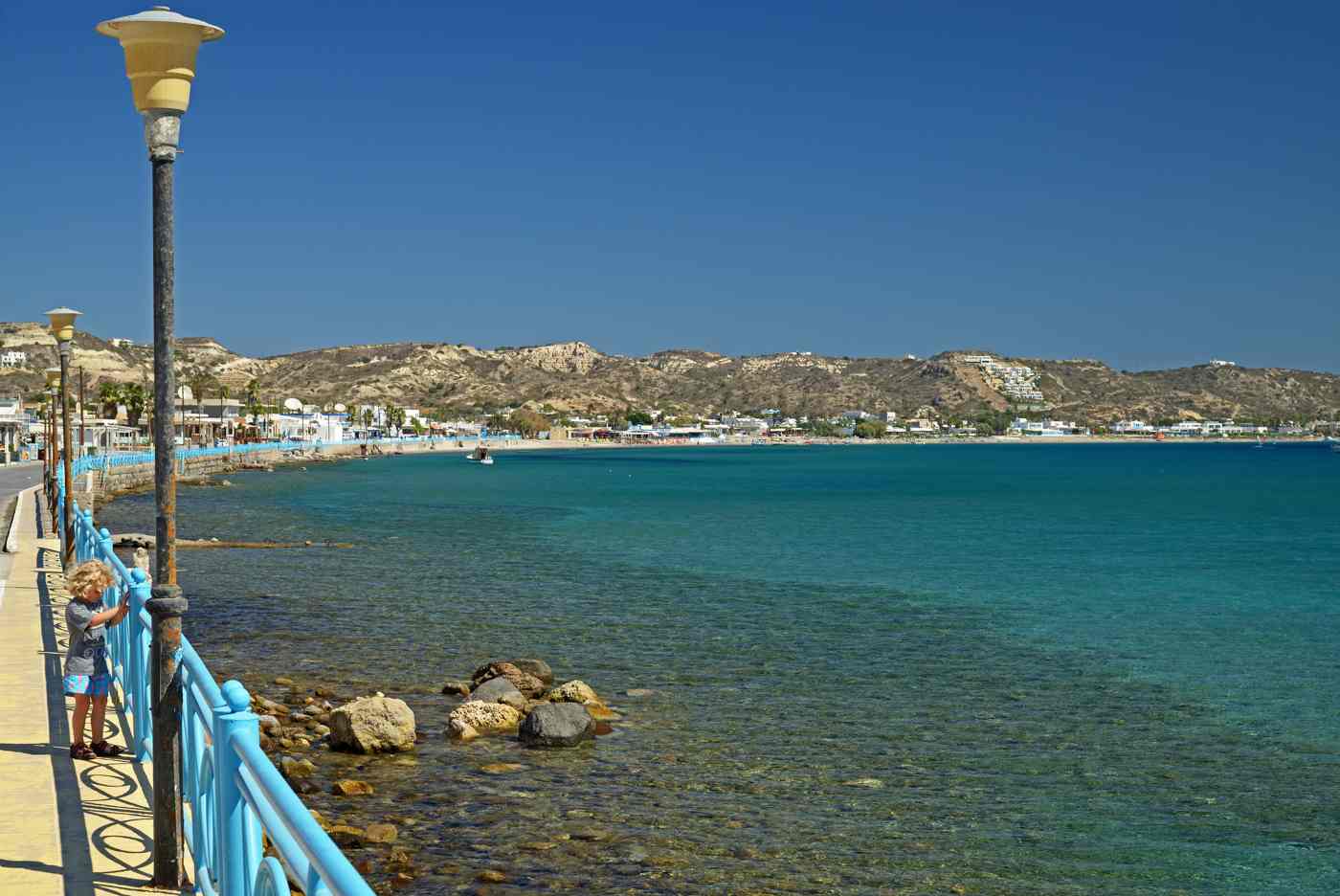
The summit of the Castle of Kefalos opens a wide view over Kefalos bay and the southwest coast. The long sandy arc of the bay curves below, edged by Bubble Beach, Camel Beach and Magic Beach. Boats crossing to Nisyros leave clear wakes on the water, easy to follow from the height. The ridge stands well above the village, so rooftops, fields and shoreline line up in one frame. The Knights valued exactly this reach, which let them count every sail entering the bay. Morning light falls on the eastern slopes, while afternoon sun lights the water toward the open sea. The height also catches the wind, which keeps the air clear and the horizon sharp.
Few points on the southwest coast gather so much of the landscape into a single outlook.
The cone of Nisyros stands out across the water on a clear day, southeast of the castle. The volcanic island rises straight from the sea, an unmistakable shape on the horizon. Beyond it the outline of the island of Astypalaia shows faintly in the western haze. This seaward view was the whole purpose of the fort, which tracked traffic between the islands. Day boats still cross from Kardamena to Nisyros, following the same lanes the Knights watched. The open water carries every approaching vessel into view long before it reaches the bay. Sunset colours the sea and the far islands from this exposed western edge of Kos.
The horizon reaches past 40 kilometres on the clearest evenings, matching the fort’s role as a watchtower over the sea.
Inland the view from the Castle of Kefalos climbs across farmland toward the spine of Kos. Mount Dikeos, the island’s highest point at about 846 metres, rises to the northeast. Terraced fields, olive groves and the low roofs of Kefalos village fill the middle distance. The narrow shape of the island shows plainly, barely two kilometres wide at this end. The ridge lets a visitor turn from sea view to mountain view in a single step. Kamari’s beachfront spreads along the shore directly below the castle hill. This double outlook, sea on one side and mountain on the other, framed the fort’s control of the region.
Every field, road and cove that mattered to the garrison sat within plain sight of the walls high above.
The layered view from the summit ties the site to the whole story of the island. Below the walls the ancient theatre and temple foundations of Astypalaia mark the first capital of Kos. Further off the sea lanes recall the Knights, the Ottomans and the traders who followed. One sweep of the eye covers ancient city, medieval fort and open Aegean, a summary of the history of Kos. The height that served defence now serves visitors reading the landscape below. Wind and clear air keep the panorama sharp through most of the year. The outlook explains, better than any plaque, why three peoples fortified this hill.
Standing on the wall, a visitor sees the reasons written across the bay and the slope beneath. The climb repays every step with this reach.
How is the Castle of Kefalos linked to ancient Astypalaia?
The Castle of Kefalos stands above the ruins of ancient Astypalaia, the first capital of Kos and reputed earlier birthplace of Hippocrates. A small ancient theatre and temple foundations survive on the slope below.
The Castle of Kefalos rises directly above the ruins of ancient Astypalaia, the first capital of Kos. This early city governed the island before the founding of Kos Town on the northeast coast. Tradition names Astypalaia as the earlier birthplace of Hippocrates, before his family moved east. The medieval castle and the ancient city share the same hill, one built above the other. Knights’ masons carried classical blocks up the slope and set them into the fortress walls. That reuse ties the two sites together in stone as well as in place. Excavated foundations on the slope trace streets, houses and public buildings of the old capital.
The pairing lets a single visit span more than a thousand years of island settlement on one ridge.
A small ancient theatre survives on the slope below the Castle of Kefalos. Rows of stone seats curve into the hillside, facing the sea that carried the city’s trade. The theatre held audiences for drama and civic gatherings when Astypalaia ruled the island. Nearby lie temple foundations, low walls that mark the sanctuaries of the classical town. Column drums and worked blocks rest where later builders left them on the slope. The remains show a planned Greek city, with public spaces set above a working harbour. Farmers and archaeologists have turned up pottery and coins across the slope over the years. The theatre and temples give the hill an ancient layer beneath the medieval walls above.
Together they record the long life of the southwest as the island’s early centre of power.
The link between the two sites runs deeper than shared ground on one hill. Astypalaia declined after its people helped found the new capital at Kos Town on the northeast coast. The old city shrank to a village, and the harbour below lost its trade to the larger port. Centuries later the Knights chose the same commanding hill for their fortress. They valued the height and the ancient stone that lay ready for reuse on the slope. The castle rose on the acropolis of the abandoned capital, guarding the bay the old city once ruled. This continuity shows how one strategic hill drew settlers across very different eras.
The southwest kept its importance even as the island’s centre of power moved away to the northeast.
A visit to the Castle of Kefalos naturally includes the ruins spread down the slope. A short walk drops from the medieval gateway to the ancient theatre and temple foundations below. The path passes worked blocks, cisterns and terrace walls that blur the line between the two periods. Standing among the seats of the theatre, a visitor looks up at the fortress on the crest. The two monuments explain each other: the ancient city chose the hill, the Knights reused it. Kefalos bay spreads below both, the reason each generation held this ground. The combined site packs classical, early Christian and medieval remains into one compact ridge.
Few places on the whole island gather this much of the past within five minutes’ walk of each other.
How can visitors reach the Castle of Kefalos from Kefalos village?
Visitors reach the Castle of Kefalos on foot from Kefalos village, climbing a marked track up the rocky ridge. The walk covers a short but steep slope and ends at the fortress gateway.
Visitors reach the Castle of Kefalos on foot from the village of Kefalos at the island’s southwest tip. Kefalos sits about 40 to 43 kilometres from Kos Town, a drive of around 50 minutes. Buses and rental cars run to the village, where the walk up to the ruins begins. A marked track climbs the rocky ridge from the edge of the settlement toward the fortress gateway. The path is short but steep, gaining height quickly over bare ground and low scrub. Walkers pass terrace walls and scattered ancient blocks on the way up the slope. The climb takes roughly 15 to 20 minutes at a steady pace from the village.
Sturdy shoes matter, because the track is uneven and the surface stays loose in places.
The walk up to the Castle of Kefalos rewards each step with a widening view. The rooftops of Kefalos village drop away as the path gains the shoulder of the ridge. Kefalos bay opens below, its beaches and the Kastri islet coming into sight. Wind picks up on the exposed slope, so a light layer helps even on warm days. The track offers little shade, which makes an early or late climb the more comfortable choice. Wild thyme and sage scent the air along the higher stretches of the path. Goats often graze the open ground between the ancient stones and the fortress walls above.
The steady climb prepares the eye for the full sweep waiting at the summit gateway ahead. Each turn of the path opens a wider slice of the bay below.
The route from the village passes the ruins of ancient Astypalaia on the way to the castle. Walkers who start early beat the midday heat and share the hill with others. The gateway marks the top of the climb and the entrance into the medieval enclosure. Inside, level ground lets visitors move between the cisterns, chapels and wall lines with ease. A steady pace up and a slow circuit of the ruins fills about 90 minutes in total. Water is essential, because the summit has no shop, spring or tap for refills. The bare hill offers no facilities, so visitors carry out everything they bring up.
Planning the visit around the heat and the light makes the short climb straightforward and safe. A morning start also frees the afternoon for the beaches below.
A trip to the Castle of Kefalos pairs easily with the rest of the southwest coast. The village of Kefalos below the hill serves food and drinks around its central square. The beaches of Kefalos bay lie five minutes downhill for a swim after the climb. The ancient theatre on the slope adds a second monument to the same outing. The whole excursion slots neatly into the wider list of things to do in Kos. Kamari’s seafront, the day boats to Nisyros and the mountain village of Zia all lie within reach. A single southwest day joins the fortress, a beach and a harbour lunch without a rush.
That flexibility makes the castle an easy addition to a wider tour of the island. The southwest rewards a full unhurried day out.
What nearby beaches can be combined with a visit to the Castle of Kefalos?
The Castle of Kefalos sits above Kefalos bay, minutes from Bubble Beach, Camel Beach, Magic Beach and Agios Stefanos with its basilica ruins and the Kastri islet. Sand and shade line the whole shore.
The Castle of Kefalos overlooks Kefalos bay, home to the best-known cluster of beaches on Kos. The long sandy shore runs below the castle hill, a short drop from the ruins. A morning at the fortress and an afternoon on the sand fit into one southwest day. The bay faces open water, so the beaches catch clear light and steady breezes off the sea. Sunbeds, tavernas and water-sports centres line the busier stretches near Kamari. Quieter coves sit at the western end toward Agios Stefanos and the Kastri islet. The mix lets visitors choose lively sands or empty shore within the same bay.
The short distance between castle and coast makes the pairing the natural plan for the area. A hire car covers the short hop between the ruins and the sand.
Bubble Beach, at the eastern end of Kefalos bay, draws swimmers to warm volcanic springs. Gas rises through the sand and water, sending up strings of bubbles close to the shore. The seabed feels warm underfoot where the springs vent beneath the beach. Sunbeds, a bar and a dive centre sit behind the sand through the busier summer months. The volcanic activity links the beach to nearby Nisyros, the active volcano across the water. Families gather here for the shallow, warm water and the easy access from the road. The beach shows the same geology that shaped the whole southwest corner of the island.
A swim among the bubbles adds a natural curiosity to a day built around the castle above. The warm shallows also suit families with young children.
Camel Beach lies west of Bubble Beach, reached by a short path down from the road. A camel-shaped rock above the cove gives the beach its name and shelters the sand. The bay stays quieter than the main strip, with clear water and a gentle slope into the sea. A single taverna serves the beach, and sunbeds fill only the central stretch of sand. The steep access keeps crowds down and rewards visitors with calm, clean water. Magic Beach sits nearby, a long open sweep of sand facing the afternoon sun. Both coves fall within a short drive of the Castle of Kefalos on the hill above.
The pair suits visitors who want swimming and quiet after the climb through the ruins. Both beaches stay calm through the morning hours.
Agios Stefanos closes the western end of Kefalos bay, below the ruins of an early Christian basilica. Two rows of standing columns from the basilica overlook the sand and the small Kastri islet offshore. Swimmers cross the shallow channel to Kastri, where a tiny chapel stands on the rock. The basilica floors keep patches of mosaic, sheltered behind low fences beside the beach. This corner joins ancient, early Christian and seaside interest in one short stretch of coast. The Castle of Kefalos rises on the ridge directly above, tying the fort to the shore below. A visitor spends a morning on the walls and an afternoon among columns and sea.
The bay packs history and swimming into the same compact southwest setting on Kos. The columns catch the light through the late afternoon.
What is the significance of the medieval settlement within the Castle of Kefalos?
The medieval settlement within the Castle of Kefalos housed the families who farmed the southwest of Kos. Foundations of homes and chapels show that the fortress was a walled village, not only a garrison.
The medieval settlement inside the Castle of Kefalos turned the fort into a walled village. Families who farmed the southwest slopes lived within the circuit, safe behind the stone walls. Foundations of homes crowd the plateau, their rooms and lanes still legible in the low stone lines. The settlement grew because raiders from the sea made the open coast dangerous to live on. Villagers worked the fields by day and locked themselves behind the gate at night. The castle gave them water from the cisterns and worship in the hilltop chapels. This pattern of a fortified village was common across the Dodecanese under the Knights.
The ruins show how defence shaped daily life at the southwest end of Kos for generations. The walled village stands as a record of that danger.
Two chapels stand among the houses inside the walls of the Castle of Kefalos. Their curved apses survive, and traces of wall painting cling to the sheltered stonework. The chapels served the garrison and the villagers who sheltered on the hill during raids. Worshippers climbed to these small churches long after the Knights left the fortress walls. The chapels sit close to the houses, part of the daily round rather than set apart. Faded plaster and carved thresholds mark the care once given to these modest buildings. Their survival shows how faith held the community together through danger and isolation. The chapels give the ruined settlement a human centre beneath the plain military walls above them.
Feast-day services still draw people up to the ridge each year. The chapels remain the settlement’s quiet heart.
House foundations across the summit reveal the tight plan of the fortified village. Rooms open onto narrow lanes, and shared walls join one dwelling to the next. The close packing saved building stone and kept every home within the protected circuit. Storage rooms, ovens and animal pens lay among the houses, marks of a self-sufficient community. Families kept grain, oil and livestock inside the walls to outlast a siege or a raid. The layout put water cisterns within a short walk of every household on the hill. This dense plan matches fortified settlements the Knights protected on Rhodes and the other islands.
The stones record a working village, not a barracks, shaped by the constant threat from the sea. Every household drew on the same cisterns for water through the dry summer.
The settlement faded once the sea grew safe and villagers moved down to modern Kefalos. People left the hilltop homes and rebuilt on the lower ground near the fields and the bay. The chapels drew worshippers back up the slope on feast days for generations afterward. Abandoned houses lost their roofs, leaving the stone foundations that visitors trace today. The move down mirrors a wider shift as coastal life became secure across the Dodecanese. The ruined settlement now records a way of life built entirely around defence. Walking the lanes between the foundations, a visitor reads how fear of raids shaped a whole community.
The Castle of Kefalos preserves that vanished village in clear outline on its windswept ridge. The empty lanes still map the shape of that old community.


How does the Castle of Kefalos fit into the history of Kos?
The Castle of Kefalos marks the medieval chapter in the history of Kos, when the Knights Hospitaller fortified the island. It joined the Castle of Nerantzia in Kos Town and Antimachia castle in one defensive line.
The Castle of Kefalos marks the medieval chapter in the long story of Kos. The island passed from ancient Greek city-states through Roman and Byzantine rule before the Knights arrived. The Order of Saint John fortified Kos as a forward base against the nearby Turkish coast. Their castle at Kefalos held the southwest, while Nerantzia guarded the harbour of Kos Town. The three forts together defended an island barely two kilometres wide at its narrow points. This medieval layer sits above the ancient ruins of Astypalaia on the same hill. The castle records the centuries when the Dodecanese formed a Christian frontier in the eastern Aegean.
Its walls place Kos within the wider history of the Knights across Rhodes and the surrounding islands. The hill carries that medieval mark most clearly of all.
The strategic value of the Kefalos hill runs through every period of the island’s past. Ancient settlers built their first capital here, above a sheltered bay and rich farmland. The height controlled the sea lanes toward Nisyros, Astypalaia and the wider Aegean. Later the Knights chose the same crest for exactly the reasons that drew the first settlers. Control of the southwest meant control of grain, salt and shipping at this end of Kos. The bay gave shelter to boats, and the ridge gave warning of any threat from the sea. Each era read the same advantages in the landscape and fortified the same ground.
The layered ruins show how geography, not chance, shaped settlement across the island’s history. The same hill drew ancient settlers and medieval knights alike to its crest.
The Castle of Kefalos belongs to a set of Knights’ monuments spread across Kos. The Castle of Nerantzia still guards the harbour entrance at Kos Town on the northeast coast. Antimachia castle stands inland near the centre of the island, close to the present airport zone. Coats of arms carved in stone mark the order’s building work at each of these sites. Together the forts trace a defensive line that ran the length of the narrow island. The Knights linked them by sightlines and signals, so a warning crossed Kos in minutes. This network let a small force defend a long coast against raids from the sea.
The Castle of Kefalos anchored the southwest end of that chain of hilltop strongholds. A signal fire on one crest reached the next within minutes.
The fall of the Knights left the Castle of Kefalos to slow decay under later rulers. Ottoman and then Italian administration passed over the hilltop fort as the coast grew peaceful. Villagers carried off stone for new houses, and the walls sank toward their foundations. The site kept its place in local memory through the chapels and the feast-day climbs. Modern Kefalos grew on the lower ground, leaving the castle to the goats and the wind. The ruins now stand as the clearest record of medieval Kos at the island’s southwest tip. They complete a story that runs from the ancient capital below to the resorts along the bay.
The hill holds the whole arc of the island’s past in one compact place. The southwest holds that whole story on a single hill.
What are the highlights of visiting the Castle of Kefalos?
The highlights of the Castle of Kefalos are the ruined walls and gateway, the wide view over Kefalos bay, the cisterns and chapels, and the ancient theatre of Astypalaia on the slope below.
The ruined walls and gateway rank first among the highlights of the Castle of Kefalos. The grey stone circuit follows the ridge, standing head-high across long stretches of the summit. The single arched gate marks the one entrance and frames the first view into the enclosure. Walking the wall line takes only minutes and reveals the full plan of the fort. Masonry laid without mortar facings has held its shape for centuries on the exposed hill. The cliff on the seaward side shows how the builders used the rock as part of the defence. Gaps in the circuit trace where stone left the hill for houses in the village below.
The plain, sturdy walls give the clearest picture of how a Knights’ hilltop fortress worked.
The panorama over Kefalos bay counts among the leading reasons to climb the hill. The summit gathers the beaches, the village, the farmland and the open sea into one sweep. The cone of Nisyros rises across the water, southeast of the fortress walls. Mount Dikeos, the island’s high point at about 846 metres, stands inland to the northeast. The height that served the Knights as a watchtower now serves visitors as a viewpoint. Wind keeps the air clear, so the horizon reaches far past the mouth of the bay. Morning and late afternoon give the softest light for the view over the coast.
This wide outlook, taken from the wall, ties every part of the southwest together in one glance. The viewpoint alone draws walkers up to the exposed summit.
The cisterns and chapels reward a closer look inside the walls of the castle. Rock-cut tanks still hold their plaster lining, proof of the care taken to store winter rain. Two chapels keep their apses, with faint painted plaster in the sheltered corners. Foundations of the medieval houses spread between the water stores and the small churches. These features turn the fort from a bare wall into a legible walled village on the summit. A slow circuit reveals how water, worship and shelter fitted together on the cramped ridge. The details reward visitors who move beyond the gateway and read the ground carefully. Together they show the daily life the Knights and villagers led behind the defences.
The cisterns show how the garrison stored winter rain for the dry months.
The ancient theatre of Astypalaia below the castle completes the highlights of the visit. Curved rows of stone seats face the sea on the slope beneath the medieval gateway. Temple foundations and scattered blocks mark the sanctuaries of the island’s first capital nearby. A short walk drops from the fort to the theatre, spanning centuries in minutes. The pairing lets one outing take in ancient city, medieval fort and open bay together. Kefalos village and its beaches lie just downhill for food and a swim afterward. The compact hill packs classical, early Christian and medieval remains into a single climb. That density makes the Castle of Kefalos a full half-day at the southwest end of Kos.
Classical seats, medieval walls and open sea sit within one short circuit of the hill.
Frequently Asked Questions
What is the best way to explore the Castle of Kefalos?
The best way to explore the Castle of Kefalos is on foot, starting from the village of Kefalos at the island’s southwest tip. A marked track climbs the rocky ridge to the fortress gateway in about 15 to 20 minutes. Sturdy shoes handle the loose, uneven surface, and water matters because the summit has no tap or shop. Early morning or late afternoon avoids the midday heat on the exposed hill. Inside the walls, a slow circuit links the arched gateway, the rock-cut cisterns, the two chapels and the house foundations. A short drop below the ruins reaches the ancient theatre and temple foundations of Astypalaia. The whole visit, climb and circuit together, fills roughly 90 minutes.
A swim at Bubble Beach or Agios Stefanos in Kefalos bay rounds out the day. Combining the fortress, the ancient city and a beach turns the trip into a full southwest outing about 40 kilometres from Kos Town.
Are there guided tours available at the Castle of Kefalos?
Guided tours rarely run directly at the Castle of Kefalos, and visitors usually explore the ruins on their own. The site has no ticket office or fixed opening hours, and access to the hilltop walls stays open. Self-guided exploration covers the gateway, the stone circuit, the cisterns and the chapels within about 90 minutes. Informational signs on the hill stay limited, so a guidebook or map adds useful context about the Knights Hospitaller. Local operators in Kefalos and Kos Town sometimes include the castle within a wider southwest tour. Such trips pair the fortress with the ancient theatre of Astypalaia, the beaches of Kefalos bay and the village square.
A hired guide or driver handles the 40 to 43 kilometre route from Kos Town and the parking below the hill. Walkers who prefer independence reach the ruins easily on the marked track from the village. Either way, the open site rewards those who read the walls and the view slowly and carefully.
Is the Castle of Kefalos suitable for children?
The Castle of Kefalos suits active children who manage a short, steep climb from Kefalos village. The marked track gains height quickly over about 15 to 20 minutes on loose, uneven ground. Older children enjoy exploring the ruined walls, the arched gateway, the cisterns and the hilltop chapels. The open summit gives room to move, and the wide view over Kefalos bay holds their attention. Close adult supervision matters, because the walls run beside steep drops and the stone stays uneven underfoot. Water, hats and sturdy shoes keep the family comfortable on the exposed, shadeless hill. The ancient theatre on the slope below adds a second stop that brings the old city to life.
A swim afterward at Bubble Beach, with its warm volcanic springs, rewards the climb for younger visitors. Families who plan around the heat and carry enough water find the castle a rewarding half-day that mixes history, walking and the beach in one southwest outing.
What visitors bring when visiting the Castle of Kefalos?
Visitors bring sturdy walking shoes first, because the track to the Castle of Kefalos climbs loose, uneven rock. Water ranks next in importance, since the summit has no tap, spring or shop of any kind. A hat and sunscreen guard against the strong sun on the exposed, shadeless ridge. A light layer helps on the windy summit, even on warm summer days above Kefalos bay. A camera captures the view over the bay toward Nisyros and the ruins of the medieval walls. A printed map or guidebook fills the gap left by the limited signs on the hilltop. Swimmers pack swimwear and a towel for Bubble Beach or Agios Stefanos, a short drop below the castle.
A small snack suits the 90-minute visit, since the nearest tavernas sit down in Kefalos village. Everything carried up must come back down, because the bare hill has no bins or facilities. Simple preparation turns the steep climb into a comfortable half-day about 40 kilometres from Kos Town.
How does the Castle of Kefalos compare to other historical sites on Kos?
The Castle of Kefalos represents the medieval side of Kos, unlike the ancient landmarks near Kos Town. The Asklepion and the Plane Tree of Hippocrates connect visitors to the classical age of Greek medicine. The Castle of Nerantzia at the harbour and Antimachia castle inland share the fortress’s medieval story. Kefalos stands apart through its remote hilltop setting and its wide view over the southwest bay. The site combines a Knights Hospitaller fort with the ancient city of Astypalaia on the same ridge. This pairing of medieval walls above a classical theatre exists nowhere else on the island. The Asklepion draws far larger crowds, while the Castle of Kefalos stays quiet and open.
A visitor gains the clearest sense of the island’s layered past by joining both types of site. Together the Asklepion, the town castle and the Castle of Kefalos trace Kos from ancient healing sanctuary to medieval frontier fortress across one compact island.
What is the historical significance of the Castle of Kefalos?
The historical significance of the Castle of Kefalos rests on its role as a Knights Hospitaller stronghold. The Order of Saint John built the fort to hold the southwest end of Kos against sea raids. Its walls guarded Kefalos bay and the lanes toward Nisyros and the island of Astypalaia. The castle joined Nerantzia in Kos Town and Antimachia inland in one defensive line across the island. The stone circuit, arched gateway and rock-cut cisterns record the military engineering of the medieval order. A walled settlement with chapels inside shows that the fort also sheltered the farming community. The castle rose on the acropolis of ancient Astypalaia, the first capital and reputed earlier birthplace of Hippocrates.
That setting binds medieval and classical history on a single hill above the bay. The Castle of Kefalos stands today as the clearest record of the Knights’ rule at the southwest tip of Kos, layered over the island’s earliest capital.
Can visitors access the ancient city of Astypalaia from the Castle of Kefalos?
Visitors reach the ruins of ancient Astypalaia directly from the Castle of Kefalos, since the two sites share one hill. A short walk drops from the medieval gateway to the slope where the ancient city stood. Astypalaia served as the first capital of Kos before the founding of Kos Town on the northeast coast. Tradition names it the earlier birthplace of Hippocrates, before his family moved to the new capital. A small ancient theatre survives on the slope, its stone seats curving toward the sea. Temple foundations and scattered worked blocks mark the sanctuaries of the classical town nearby. The Knights reused stone from these ruins in the fortress walls above, tying the two eras together.
Walking from theatre to fortress spans more than a thousand years within minutes. The combined site lets a visitor read the ancient capital and the medieval castle in one climb above Kefalos bay, about 40 kilometres from Kos Town.