
Agios Fokas stretches southeast of Kos Town, offering a rare dark volcanic shoreline that contrasts with the island\u2019s lighter sands. The beach runs toward the Therma hot\u2011spring cove and blends developed spots with quiet stretches. Plan the whole trip with Greece Tours.
Visitors reach Agios Fokas via a coastal road past Psalidi, encountering hotels, sunbeds, tavernas, and open sand. The water deepens quickly, the meltemi wind arrives in summer afternoons, and the area suits families, swimmers, and wind\u2011surfers alike.
Where is Agios Fokas beach located on Kos?
Agios Fokas stretches about eight to twelve kilometres southeast of Kos Town, reached along the coastal road past the Psalidi seafront before the shoreline runs on toward the Therma hot-spring cove.
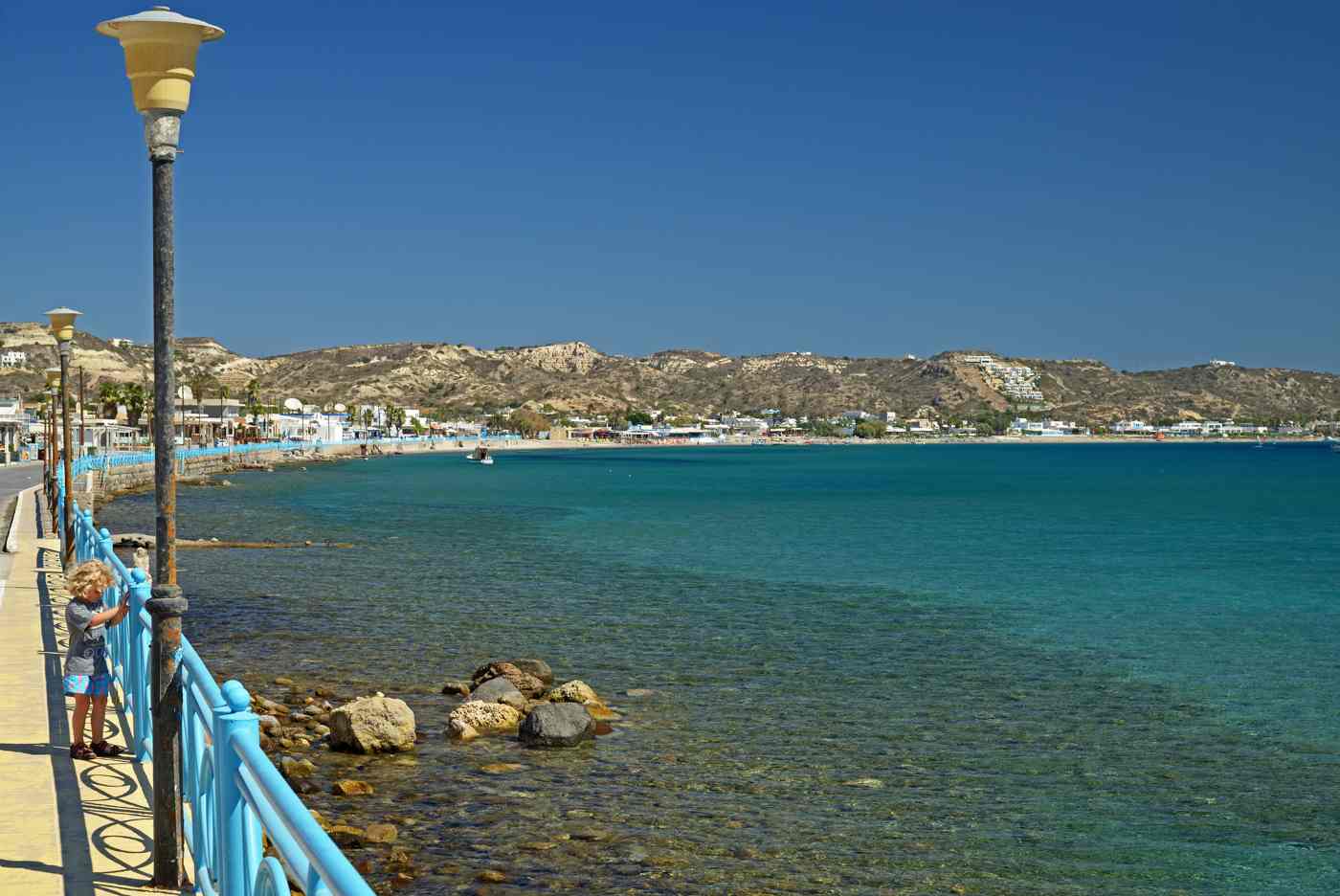
Agios Fokas occupies a long strip of dark grey and black volcanic sand and shingle along the eastern shore of Kos. The colour comes straight from the island’s volcanic geology, the same force that warms the water at nearby Therma. The strip runs for roughly three kilometres, wide enough for sunbathing, walking and swimming without crowding. Parts of the coast carry hotels, sunbeds and tavernas, while other sections stay open and quiet. This shoreline forms one edge of the wider Kos coast, which pairs town beaches with the Asklepion ruins and Mount Dikeos inland. Drivers, cyclists and bus passengers all reach the sand from Kos Town within about half an hour along a single coastal road.
Signposts on the eastern edge of town point the way toward the volcanic shore.
The coastal road leaves Kos Town at the eastern seafront and runs past the Psalidi hotel strip before reaching Agios Fokas. The drive covers about eight kilometres to the first beach access and stretches to twelve kilometres at the far end near Therma. The tarmac stays close to the water, rising over low headlands that open sudden views across the strait toward the Turkish coast near Bodrum. Speed drops through the built-up Psalidi stretch, then eases on the open sections beyond. Parking bays sit beside the northern hotels, holding roughly two hundred cars in peak weeks. Roadside tavernas mark the busier northern end.
The road ends as a rough track past the developed zone, where the quiet dark-sand stretches begin and most day visitors turn back toward the marked bays.
Development concentrates on the northern kilometre of Agios Fokas, where hotels back the sand and sunbed rows fill the summer months. Rental sunbeds and umbrellas cost around two to five euros for the day, set beside tavernas serving grilled fish and Greek salad. The middle section thins out, keeping two or three beach bars between longer open gaps. The southern stretch toward Therma stays undeveloped, a run of dark sand and shingle with no shade and no service. Walkers cross this quiet ground to reach the hot-spring cove on foot. Water depth increases within thirty metres of the shore across the whole beach, so the calm and the busy ends share the same quick drop-off.
This split lets one visit mix organised comfort with empty coastline.
Agios Fokas faces southeast, the last developed coast before Kos narrows toward its eastern cape. Behind the sand runs a low ridge of scrub and holiday complexes, with the Psalidi wetland and its birdlife a short way back toward town. The Asklepion sanctuary sits about four kilometres inland to the west, and Kos International Airport lies roughly twenty kilometres away near Antimachia. The beach catches full morning sun, since the water and the open horizon lie to the east. Afternoon light softens as the meltemi wind builds across the strait. Caf\u00e9s at the town end make a natural start before the sand empties south.
This eastern position keeps Agios Fokas close to Kos Town yet clear of the harbour crowds. A working coast of hotels, open sand and the thermal cove at its far end.
How does the volcanic sand at Agios Fokas differ from other Kos beaches?
The sand at Agios Fokas runs dark grey to near black, a volcanic mix of ash and basalt grains that sets it apart from the golden and pale beaches on the rest of Kos.
Dark volcanic grains give Agios Fokas its colour, formed from ancient ash and fine basalt worn down along the eastern shore. The mineral-rich sand holds heat well, so the surface warms fast under the morning sun and stays firm underfoot. Walkers feel a coarser grip than on soft pale sand, useful for long strolls toward Therma. Other Kos beaches such as Tigaki and Marmari on the north coast show pale quartz sand and shallow lagoons, a clear contrast with this eastern strip. The dark ground also throws the turquoise water into sharp relief, sharpening the line between shore and sea.
This single stretch carries the island’s volcanic signature more plainly than any of the busier northern bays, which draw their sand from softer sedimentary rock.
Iron oxide within the basalt drives the sand’s dark tone, staining each grain a deep grey that reads as black when wet. Grain size holds between roughly 0.2 and 0.5 millimetres, packing into a compact surface that resists the afternoon wind. The same volcanic ridge that feeds this sand rises inland toward Mount Dikeos, the island’s high point at about 846 metres. Heat stored in the dark grains can push the surface three to five degrees above lighter sand at midday, so bare feet feel it near noon. The firmness keeps the beach level after storms, with slower erosion than the loose sand of the salt-pan bays. Grain and colour together record the island’s volcanic past.
This mineral character ties the shoreline directly to the deep geology beneath Kos and the eastern cape.
Clear water reads even brighter against the dark base, since the sand absorbs light instead of scattering it back. Families with young children value the firm footing, which stops small feet sinking on the walk to the shallows. The compact surface also anchors umbrellas and windbreaks against the meltemi, holding poles steady through gusts. Crabs and small molluscs favour the mineral ground, gathering where waves stir food along the waterline. Sea lavender and low salt-tolerant grasses grip the back of the beach, adding thin green fringes above the grey. Snorkellers work the rocky ends of the strip, where the volcanic rock shelters small fish.
This mix of dark sand, rock and clear shallows makes the beach a steady draw for swimmers and curious walkers alike.
The volcanic origin links Agios Fokas straight to the warm water at Therma, one kilometre east along the same coast. Heated groundwater rises through the porous basalt beneath both sites, surfacing at the cove as the hot spring. The dark sand and the warm spring share one cause, the old volcanic activity that shaped the eastern cape of Kos. Geology students and casual walkers note the shift from grey grains to steaming shallows within a short coastal walk. The beach stays a fixed landmark for anyone tracing the island’s volcanic story, from the ash on the shore to the vents offshore. The eastern coast tells its volcanic story in plain view.
This clear cause-and-effect sets the eastern coast apart from the sedimentary bays of the north and the golden coves of the southwest.
What transport options connect Kos Town to Agios Fokas beach?
Cars, the island buses and bicycles all link Kos Town to Agios Fokas along one coastal road, each covering the eight to twelve kilometres in about fifteen to thirty minutes.
Driving offers the quickest route, following the eastern coastal road out past Psalidi to the first beach access in about fifteen minutes. Speed limits sit near fifty kilometres per hour through the built-up stretch and rise on the open coast beyond. Parking bays line the northern hotel zone, holding roughly two hundred cars at the height of summer. Signs mark the turn toward the dark-sand beach, guiding drivers through gentle curves that open onto the strait. The tarmac runs smooth to the developed end, then breaks into a rough track toward Therma that most cars avoid.
Car hire in Kos Town costs around thirty to forty euros a day, and the short distance keeps fuel use low for a half-day visit to the eastern coast.
Island buses on the eastern route leave the Kos Town station at roughly thirty-minute intervals through the summer. The ride covers about eight kilometres and lasts near twenty-five minutes, ending at a marked shelter close to the main beach access. Single fares stay low across Kos, costing around one to two euros bought from the driver or the station kiosk. Buses from the harbour pass the historic Kos Town waterfront, so passengers see the castle and the Plane Tree of Hippocrates before the coast opens out. Drivers call the stops in Greek and English, which keeps first-time visitors clear on where to step off for the dark-sand shore. Buses stay the cheapest way out to the eastern coast.
The service thins in the shoulder months, so timing matters outside July and August.
Cyclists reach Agios Fokas on the flat coastal grid that gives Kos its cycling name, riding a marked lane east from the town centre. The route runs about eight kilometres past Psalidi, climbing a gentle grade before it levels near the sand. Riders cover the distance in around twenty minutes at a steady pace, with sea views along most of the way. Rental shops near the harbour hire bikes for about fifteen euros a day, helmets and locks included. Bike racks near the main access hold up to fifty machines, so cyclists lock up and walk onto the beach.
The car-free lane and low gradient suit families and casual riders, not only trained cyclists, which keeps two wheels a common choice for the eastern coast.
Taxis run across Kos and reach Agios Fokas door to door, with a fare of around twelve euros for the eight-kilometre trip. Drivers take cash and card, and often name the calmer southern stretch for travellers who want space away from the sunbeds. Shared shuttle vans booked ahead cut the cost to roughly five euros a head for groups heading to the beach. Walking suits guests already staying in the Psalidi hotels, who reach the northern sand in twenty to thirty minutes on foot. Every mode keeps to the single coastal road, so traffic stays light outside the midday peak. Fares stay modest for the short eight-kilometre run.
This range of transport means Agios Fokas stays within easy reach whether a visitor drives, rides, rolls or walks from the capital.
How does the proximity of Therma hot-spring cove affect Agios Fokas beach?
Therma hot-spring cove sits about one kilometre east of Agios Fokas, warming the far end of the beach and adding a natural hot-water soak within a short coastal walk of the main sand.
Therma lies roughly one kilometre east of the main Agios Fokas sand, reached on foot along the shore or by the rough coastal track. Warm water rises there from underground vents, holding a temperature near forty degrees where it emerges, cooled by the waves into a bathing range. Visitors dam the shallows with stones to trap the heat, forming a natural pool against the cold Aegean. A short walk links a swim on the dark sand with a soak at Therma beach, so one trip covers both. The cove marks the quiet end of the eastern coast, past the last hotels, where the shoreline turns wild.
This pairing draws walkers who want the beach and the spring in a single afternoon on the volcanic shore.
The heat at Therma and the dark sand at Agios Fokas share one volcanic source beneath the eastern cape. Groundwater warmed deep underground travels up through porous basalt, surfacing at the cove as the hot spring. The same rock that colours the beach grey channels this heated water to the shore. Mineral-rich steam and a sulphur scent hang over the cove, a plain sign of the volcanic system below. The eastern end of Agios Fokas feels marginally warmer on cool mornings, where the thermal outflow drifts along the shore before the sea dilutes it. The shared volcanic source explains both the heat and the colour.
This link turns a single coast into a short lesson in island geology, from ash on the sand to warm water at the rocks a kilometre away.
Therma stays a simple, low-built cove, with a small taverna and changing space near the track rather than a full resort. Parking sits back from the water, and the last stretch runs on foot down to the stones and the warm shallows. The safe, shallow pool suits families and older bathers who want warmth without deep water or strong currents. Walkers from Agios Fokas carry towels along the shore and reach the cove in around ten to fifteen minutes. The rough ground underfoot rewards sturdy sandals over bare feet, since shingle and rock replace soft sand toward the spring. The short walk itself becomes part of the outing.
This basic setup keeps Therma quiet and natural, a counterpoint to the organised sunbed rows at the northern end of the beach.
The pairing of beach and spring lengthens a visit and spreads people along the coast. Tour operators often list Agios Fokas and Therma together, setting the dark volcanic sand against the warm mineral water. Swimmers move between the cool open sea and the hot pool within one short walk, a contrast built into the eastern shore. The warm water draws bathers into the shoulder months, when the open sea cools but the spring holds its heat. This blend of leisure and natural warmth gives the coast a pull beyond a plain swim, tying beach time to the island’s thermal roots. The eastern shore reads as one coastal destination.
The two sites together explain why the eastern shore reads as one destination rather than two separate stops on the Kos map.
What facilities are available for families at Agios Fokas beach?
Agios Fokas suits families through its shallow northern shelf, firm volcanic sand, rental sunbeds and shaded tavernas, with a quiet southern stretch for picnics and space away from the busier hotel end.
The northern end of Agios Fokas slopes gently, with water reaching one metre about thirty metres out, a safe range for young swimmers. Lifeguard cover runs through the core summer months at the busier sections, adding supervision during the middle of the day. The firm volcanic sand cuts the risk of soft footing, so children walk and play without sinking or losing balance. Compact ground also holds sandcastle shapes and anchors light shade tents against the wind. The shallows warm quickly under the morning sun, since the dark sand feeds heat into the first metres of water. The gentle slope anchors the family end of the beach.
This calm northern shelf gives parents a clear, watched zone before the seabed drops toward the deeper central water off the beach.
Rental sunbeds and umbrellas line the hotel end at around two to five euros for the day, set close to the shade of the tavernas. Beach tavernas serve grilled fish, salads and rice dishes, with smaller plates and simple pasta that suit children. Staff bring high chairs on request, and fruit and cold drinks stay easy to find through the afternoon. The short walk between sunbed, water and table keeps young families in one compact zone. Freshwater showers and taps near the main access rinse off the dark sand before the drive back to town. Food, shade and shallow water sit within one short walk.
This cluster of service at the northern end means parents reach food, shade and shallow water without long walks across open ground.
Parking beside the family zone holds around one hundred cars, with marked bays near the main entrance for shorter walks with pushchairs. Signs direct drivers to the closest access, cutting the distance across open sand with young children. Public restrooms near the hotels include changing space and hand-washing taps, cleaned through the season by municipal crews. Separated bins for recycling sit along the front, keeping the sand clear of litter. The layout keeps families off the coastal road, since the sunbed rows and tavernas sit between the car park and the water. The spacing keeps young children well clear of moving cars.
This practical spacing lets parents move between car, shade and shallows on the northern strip without crossing traffic or long stretches of loose ground.
The quiet southern stretch of Agios Fokas gives families open space for picnics and beach games away from the sunbed rows. Parents pitch portable shade on the firm sand, which grips tent poles well through the afternoon breeze. The open eastern horizon frames early sun, so morning visits reward families who arrive before the heat builds. Shingle and dark sand replace service here, so groups carry water, snacks and shade rather than relying on tavernas. Water quality along the coast is tested through the summer, with results posted for parents who want them before swimming. The open south rewards families who value quiet time.
This split between a serviced north and an empty south lets one family choose comfort or calm on the same beach within a short walk.
How does the meltemi wind and Mediterranean climate shape conditions at Agios Fokas beach?
The meltemi wind reaches Agios Fokas on summer afternoons, cooling the air and lifting light waves, while the dry Mediterranean climate brings hot sun-heavy days and mild off-season weather to the eastern coast.
The meltemi blows from the north and northeast across the Aegean, striking the exposed eastern coast of Kos through the summer. At Agios Fokas the wind commonly runs between fifteen and twenty-five kilometres per hour in the afternoon, building after midday. The breeze raises light waves near one metre that break softly along the dark sand, giving the shore a steady rhythm. Morning air often stays calm, so early swimmers meet flat water before the wind rises. The open southeast aspect leaves the beach more wind-exposed than the sheltered lagoons of Tigaki and Marmari on the north coast. The wind sets the rhythm of a summer beach day.
This daily pattern shapes how visitors plan a day, favouring the still mornings for calm swimming and the breezy afternoons for cooler air.
The wind drops the felt temperature by up to four degrees, easing the midday heat on the exposed sand. Sunbathers turn umbrellas to block the gusts, while swimmers meet slightly rougher water toward the afternoon. The breeze also clears haze and airborne pollen, sharpening the view across the strait to Bodrum. Beach bars weigh down chairs and rope their awnings, since the meltemi can lift loose furniture on strong days. Windsurfers use the open water at times, though the shallow inshore shelf keeps Agios Fokas off the main board-sport map. The afternoon trade defines the exposed eastern shore.
This mix of cooler air and firmer wind makes the afternoon a trade, more comfort on the sand against choppier water at the shoreline for less confident swimmers.
Summer on Kos brings dry, sun-heavy days, with daytime highs near twenty-nine degrees and July peaks toward thirty-four. Low humidity keeps the heat bearable, so long spells on the open sand stay manageable with shade and water. Evenings ease to around twenty-four degrees, opening the dark shore to sunset walks once the sunbeds empty. Sea temperature climbs through the season, holding near twenty-four to twenty-six degrees at the height of summer. The steady weather lets visitors plan swimming, walking and boat trips to Nisyros or Kalymnos with little worry about rain. Long dry days carry the beach season right across the whole eastern coast.
This reliable summer pattern underpins the long beach season along the whole eastern coast, from the hotels to the quiet southern sand.
Winter on Kos stays mild, with daytime readings near seventeen degrees and calm seas once the meltemi fades. The beach empties in the cool months, yet the firm sand still carries walkers and birdwatchers along the shore. Rainfall stays light and brief, so the coast road and the sand remain open through the year. Spring warms the air to between eighteen and twenty-four degrees and brings sea lavender and wild thyme into flower behind the beach. Sea temperature climbs from around eighteen degrees in spring toward summer levels, opening early swimming for hardier bathers. The mild off-season keeps the coast open through the year.
This year-round access, warm in summer and quiet in winter, lets Agios Fokas serve both peak crowds and off-season walkers on the same dark sand.
What are the swimming conditions like at Agios Fokas beach?
Swimming at Agios Fokas means clear water that deepens fast, a gentle shelf at the northern end and light meltemi waves toward the south, with depth passing three metres within fifty metres offshore.
Clear water holds visibility near fifteen to twenty metres on calm days, showing the volcanic seabed and small fish below. The northern shelf shelves gently, reaching one metre about thirty metres out, which suits children and cautious swimmers. Past that shelf the seabed drops away, passing three metres within fifty metres of the shore. Strong swimmers reach open water quickly, while beginners keep to the marked shallows near the sunbeds. The dark sand feeds warmth into the first metres, so the inshore water often feels milder than the depth suggests. The drop-off defines the swimming along this eastern shore.
This quick change from shallow shelf to deeper water defines the beach, rewarding confident swimmers while asking care of families near the drop-off along the eastern shore.
Wave height shifts along the beach with the wind and the aspect of each stretch. The central sand takes light meltemi swell, with waves near one metre through the afternoon breeze. The exposed southern end meets larger sets, reaching around one and a half metres on windier days. The calmer mornings flatten the whole shore, so early swims run smooth before the wind builds. Lifeguards at the busier sections watch the swell and flag the water when it climbs beyond safe limits for weaker swimmers. Each stretch offers its own kind of water each day. This range along one beach lets swimmers pick their spot, the calm northern shallows or the livelier southern water.
According to the day’s wind and their own confidence in the sea.
Sea temperature holds near twenty-four to twenty-six degrees through July and August, warm enough for long swims. The Therma outflow a kilometre east barely shifts the water at the main beach, since the spring’s heat fades fast into the open sea. Salinity tracks the eastern Aegean average near thirty-five parts per thousand, giving the steady buoyancy of open Mediterranean water. The volcanic seabed keeps the shallows clear, with fine grains settling quickly after the waves stir them. Cooler upwelling can chill the deeper water on windy afternoons, a contrast swimmers feel past the shelf. The warm salty water carries long swims well through the season.
This stable, warm and salty water supports long swims off the dark sand for most of the summer season on Kos.
Marked swimming zones and buoyed ropes set out the safe water at the busier sections of Agios Fokas. Depth markers and signs near the access note the quick drop-off, guiding families toward the shallow northern shelf. Lifeguards patrol the core hours in summer, with rescue boards and first-aid kept at the stations. Swimmers watch for the afternoon meltemi, which lifts the swell and pushes weaker swimmers off line toward the deeper water. The quiet southern end carries no lifeguard cover, so swimmers there judge the sea for themselves and keep near the shore. Watched and open water sit side by side along the beach.
This blend of watched shallows and open unmanned stretches lets each visitor match the water to their own strength across the beach.
What wildlife can visitors observe near Agios Fokas beach?
Wildlife around Agios Fokas includes shore crabs and molluscs on the dark sand, sea lavender and salt grasses behind the beach, gulls and terns on the rocks, and dolphins offshore at dawn.
Shore crabs work the waterline at Agios Fokas, burrowing into the mineral sand and scavenging debris left by the waves. The crabs stir the ground as they dig, which helps salt-tolerant plants take root along the back of the beach. Sea lavender grips the darker sand and raises pale purple flowers in late summer above the grey. Low grasses and thyme hold the dunes behind the shore, binding the loose sand against the meltemi. These plants and crabs form the base of the beach’s food chain, feeding the birds that hunt the shoreline. Crabs and plants together feed the birds that hunt the shore.
The mineral-rich volcanic ground shapes this small ecosystem, which differs from the softer, plant-poor sand of the northern tourist bays on Kos.
Small schools of sardines and anchovies feed near the surface off Agios Fokas, drawn to plankton in the nutrient-rich water. These fish pull in larger hunters, and dolphins pass offshore at dawn, running parallel to the shore as they feed. Watchers on the quiet southern sand catch these early sightings before the wind and the boats disturb the water. Gulls and terns nest on the rocky outcrops at either end of the beach, resting between fishing runs over the strait. The clear water lets snorkellers track small fish among the volcanic rock near the headlands. Dawn brings the best chance of a dolphin sighting.
This offshore life ties the dark-sand shore to the wider Aegean, where Kos sits on feeding routes across the strait toward Bodrum.
Bee-eaters hunt insects over the scrub behind Agios Fokas, flashing colour as they chase beetles and bees across the dunes. Beetles and ants work the warm sand, feeding the birds that patrol the back of the beach. The nearby Psalidi wetland toward town adds herons and waders to the local bird list, a short move along the coast. The meltemi steadies the micro-climate here, holding a balance from shore debris up to the birds at the top of the chain. Morning and evening bring the most bird movement, before and after the midday heat. Dawn and dusk bring the most bird movement here.
This range of birdlife, from shore terns to inland bee-eaters, gives the eastern coast a draw for walkers who watch as well as swim.
Local groups track crab numbers and seabird nesting along the eastern coast, sharing results to guide light-touch management. Signs near the beach ask visitors to leave wildlife and nesting sites undisturbed through the breeding season. Removing sand, shells or plants is discouraged, which protects the thin cover that holds the dunes in place. The information point near the main access explains how species adapt to the volcanic ground, linking geology to the living shore. Quiet stretches south toward Therma matter most for nesting birds, since they draw fewer feet than the hotel end. Light-touch management protects the nesting birds each season.
This care keeps the balance of crabs, plants and birds intact, so the dark-sand coast stays a working habitat rather than a stripped tourist strip.


How does Agios Fokas compare to other beaches in the Kos region?
Agios Fokas stands apart on Kos through its dark volcanic sand, quieter southern stretch and the warm Therma spring nearby, against the pale sand and busy resorts of Tigaki, Marmari and the Kefalos coves.
Tigaki on the north coast spreads wide white sand backed by full resort service, a plain contrast with the dark eastern strip. Agios Fokas keeps a more open character, with hotels only along its northern kilometre and empty sand to the south. The grey sand throws the turquoise water into relief, where Tigaki’s bright sand mirrors the sun instead. Crowds thin at Agios Fokas, above all on the southern stretch, leaving room for quiet walks the busy north bays rarely offer. The eastern beach also sits closer to Kos Town, a short coastal hop rather than a longer inland drive. Space and volcanic colour set the eastern beach apart.
This trade of full facilities for space and volcanic character marks the first clear split between the two coasts of the island.
Marmari, near Tigaki, holds a shallow lagoon behind a sandbar, ideal for toddlers and calm paddling. Agios Fokas deepens fast instead, so it draws swimmers who want water rather than a wading pool. The Therma spring beside the eastern beach adds a warm-water soak that the northern bays lack entirely. Stronger meltemi wind reaches Agios Fokas through its exposed southeast aspect, where Marmari sits more sheltered. A day here slots easily among the wider things to do in Kos, from the Asklepion and the Kos Town castle to boat trips out to Nisyros. The capital’s ancient sites sit within easy reach.
This position near the capital lets visitors pair the beach with the island’s ancient sites in one outing rather than a dedicated beach trek to the far coasts.
The Kefalos coves in the southwest, Camel and Magic among them, show golden sand and a louder holiday scene. Agios Fokas keeps a calmer tone, with limited nightlife and a focus on shade, food and swimming. The southwestern beaches sit around forty kilometres from Kos Town, a real drive against the eastern beach’s short hop. Golden Kefalos sand and dark eastern sand mark the geological split across the island, from sedimentary bays to volcanic shore. Families after quiet often pick Agios Fokas over the busier southwest, trading beach clubs for open space. The drive south marks the real cost against the eastern hop.
This contrast lets one island offer both a lively coast and a low-key volcanic shore within a single day’s driving range from the capital.
Agios Fokas fills a clear niche on the Kos coast, joining volcanic geology, modest development and a warm spring on one shore. The beach reaches swimmers, families and walkers who want depth, quiet and a short trip from town in one place. Access by car, bus, bike or taxi keeps it easy to reach without the drive south to Kefalos. The dark sand and the Therma cove give it a character the pale northern lagoons and golden southern coves do not share. Visitors tracing the island’s range often set this eastern strip against Tigaki and Kefalos to feel the full spread of Kos. Its niche holds firm against every rival beach.
This distinct blend keeps Agios Fokas a fixed point on any tour weighing the varied coasts of the island.
What safety measures are in place at Agios Fokas beach?
Safety at Agios Fokas rests on summer lifeguard stations, buoyed swimming zones, depth signs, rescue gear and daily water testing, with the quiet southern stretch left unmanned for swimmers to judge themselves.
Lifeguard stations cover the northern and central sections of Agios Fokas through the summer, staffed by the municipal rescue service. The crews watch the swell, hold the zone lines and give first aid when swimmers need it. Rescue gear at the stations includes boards, an inflatable boat and a defibrillator kept in marked boxes. Boards near the stations post the day’s weather and sea state, so swimmers judge the water before they enter. Cover runs through the core daylight hours in peak season, thinning at the quiet ends of the day. The watched core protects the family end of the beach.
This staffed core gives families a watched place to swim on the busy northern shelf, close to the hotels and the sunbed rows along the front.
Bright orange buoys mark the safe swimming zones, boxing off the shallow water for weaker swimmers and children. Depth markers on the seabed at ten, twenty and thirty metres help swimmers judge their distance from shore. Signs near the access warn of the quick drop-off and the afternoon meltemi gusts, steering families toward the northern shallows. Beach staff patrol to keep swimmers inside the marked water when the wind lifts the swell. The zones sit at the watched sections, since the southern sand carries no ropes or markers. The markers and signs keep swimmers inside the safe water zone.
This clear marking lets first-time visitors read the water at a glance, matching their swimming to the depth and the day’s conditions on the eastern coast.
Water testing runs through the season along Agios Fokas, sampling the shoreline for bacteria, pH and turbidity. Results post at the main access and online, so visitors check the water before they swim. Readings that pass European Union bathing standards keep the beach open, and any breach triggers a quick advisory. The volcanic seabed clears fast after the waves stir it, which helps keep turbidity low on calm days. Testing points spread along the front rather than one spot, giving a fuller read of the whole shore. Daily sampling runs at three points spread along the whole shore each week.
This routine monitoring backs the beach’s clean-water record, an important point for families who bring young children to the northern shallows through the summer season.
Emergency plans tie Agios Fokas to the hospital in Kos Town, reachable within about fifteen minutes by ambulance. A first-aid point near the main station holds dressings, antiseptics and basic kit for minor injuries. Lifeguards launch the rescue boat for swimmers in trouble past the shelf, moving them ashore fast. Practice drills through the season keep the rescue crew sharp and the response times short. Swimmers on the unmanned southern stretch stay closer to shore, since help sits farther off than at the watched north. Help stays close at the watched north and sits farther off along the south.
This layered response, from beach first aid to the town hospital, holds the safety net across the eastern coast through the busy months of the year.
Frequently Asked Questions
What makes Agios Fokas beach unique compared to other Kos beaches?
Dark volcanic sand sets Agios Fokas apart from every other beach on Kos. The grey-to-black grains come from ancient ash and basalt, rich in iron oxide, packing into a firm. Coarse surface that holds heat longer than the pale sand of the north coast. This geology ties straight to the Therma hot-spring cove a kilometre east, where the same volcanic system warms the water. Visitors pair a swim on the dark sand with a soak in the warm spring in one short walk. Low development, above all along the southern stretch, keeps the beach quieter than Tigaki or the Kefalos coves.
The exposed southeast aspect draws the meltemi wind on summer afternoons, which cools the air and lifts light waves that sharpen the water’s clarity. The dark grains link the beach straight to the island’s volcanic core. The mix of volcanic sand, warm spring, quiet space and steady breeze gives the eastern coast a character no other Kos beach repeats.
How can I travel from Kos Town to Agios Fokas without a car?
Island buses, taxis and rental bikes all reach Agios Fokas from Kos Town without a car. Buses on the eastern route leave the central station at roughly thirty-minute intervals through summer. Covering the eight kilometres in around twenty-five minutes to a marked stop near the northern hotels. Single fares stay near one to two euros, bought from the driver or the station kiosk. Taxis run door to door across the island for about twelve euros, and drivers take cash or card. Rental shops near the harbour hire bikes for around fifteen euros a day, helmets and locks included. The flat coastal lane makes the eight-kilometre ride easy in near twenty minutes.
Guests already staying in the Psalidi hotels reach the northern sand on foot in twenty to thirty minutes. Each option keeps to the single coastal road past Psalidi, so first-time visitors reach the dark-sand shore with little planning beyond checking summer bus times.
Is swimming safe for children at Agios Fokas beach?
Children swim safely at the northern end of Agios Fokas, where lifeguards cover the busier sections through the summer daylight hours. The shore there slopes gently, reaching one metre about thirty metres out, which gives young swimmers a shallow shelf before the seabed drops. Buoyed ropes and orange markers box off the safe zone, and depth signs at ten, twenty and thirty metres help parents judge distance from shore. Lifeguards watch the swell and flag the water when the afternoon meltemi lifts the waves beyond a safe range. The firm volcanic sand cuts the risk of soft footing, so children walk and play without sinking. Rescue boards and first-aid kits stay at the stations for a quick response.
Parents keep young children on the shallow northern shelf near the lifeguards. The quiet southern stretch carries no lifeguard cover. Families with young children keep to the watched northern shelf. Where the shallow water and steady supervision suit early swimmers best through the season.
What amenities are available for visitors with limited mobility at Agios Fokas?
Agios Fokas offers step-free access at its northern end, where compacted paths run parallel to the shore for easier movement. Marked parking bays for disabled permits sit near the main entrance, cutting the distance across open sand. Public restrooms near the hotels include grab rails, lowered sinks and space to turn a wheelchair, with changing benches nearby. The firm volcanic sand gives steadier footing than soft pale sand, which helps visitors using sticks or frames near the front. Staff at the information point by the main access share maps of the flatter routes and the closest accessible facilities.
Sunbeds and shade sit close to the parking and the paths, so guests reach water, rest and food without long walks. The flatter northern paths keep the key facilities within reach. The rough southern track toward Therma stays unsuited to wheels. Visitors with limited mobility keep to the serviced northern strip. Where paths, parking and facilities cluster within a short, level distance of the sand.
How does the nearby Therma hot-spring cove complement a visit to Agios Fokas?
Therma sits about one kilometre east of Agios Fokas and adds a warm-water soak to a beach day. Hot water rises from underground volcanic vents at the cove, reaching near forty degrees at the source before the waves cool it to a bathing range. Bathers ring the shallows with stones to trap the heat, forming a natural pool against the cold Aegean. Walkers reach the cove from the beach in ten to fifteen minutes along the shore, carrying towels and sturdy sandals for the shingle. The same volcanic system that warms the spring colours the dark sand at Agios Fokas, so the two sites share one geological root.
The warm water draws bathers into the cooler shoulder months, when the open sea drops but the spring holds its heat. The pairing turns one trip into both a swim and a soak. This pairing lets one trip cover cool sea swimming and a hot mineral soak within a short coastal walk on the eastern shore.
What environmental protections are in place at Agios Fokas beach?
Daily water testing anchors the environmental care at Agios Fokas, sampling the shoreline for bacteria, pH and turbidity against European Union bathing standards. Separated bins for plastic, glass and organic waste line the front, cutting litter that reaches the sea. Local groups track crab numbers and seabird nesting along the coast, sharing the data to guide light management of the shore. Signs ask visitors to leave the volcanic sand, shells and plants in place, since removing them thins the cover that binds the dunes. The quiet southern stretch toward Therma matters most for nesting birds and low vegetation, drawing fewer feet than the hotel end.
Results from the water tests post at the main access and online, keeping the checks open to visitors. This mix of testing, waste sorting. Wildlife monitoring and clear signage protects the beach’s geology and its living shore. The dark sand and its small ecosystem hold up under the summer crowds.
When is the best time of year to visit Agios Fokas for swimming and sunbathing?
Late spring through early autumn gives the best swimming and sunbathing at Agios Fokas. Daytime highs hold between twenty-seven and thirty-four degrees across the core summer, with low humidity and long dry spells that suit full days on the open sand. Sea temperature climbs above twenty-five degrees at the height of summer, warm enough for long swims off the dark shore. The meltemi wind strengthens through July and August, cooling the afternoon air and lifting light waves that sharpen the water. Early summer brings slightly cooler water and thinner crowds, while late summer holds the warmest sea. The nearby Therma spring extends the season, since its warm water stays inviting once the open sea starts to cool.
Shoulder-season visitors trade warmth for quiet on the eastern shore. Visitors chasing quiet often pick the shoulder weeks of spring or autumn, when the sand empties and the wind eases, while peak swimmers aim for the warm, breezy heart of the summer season.