
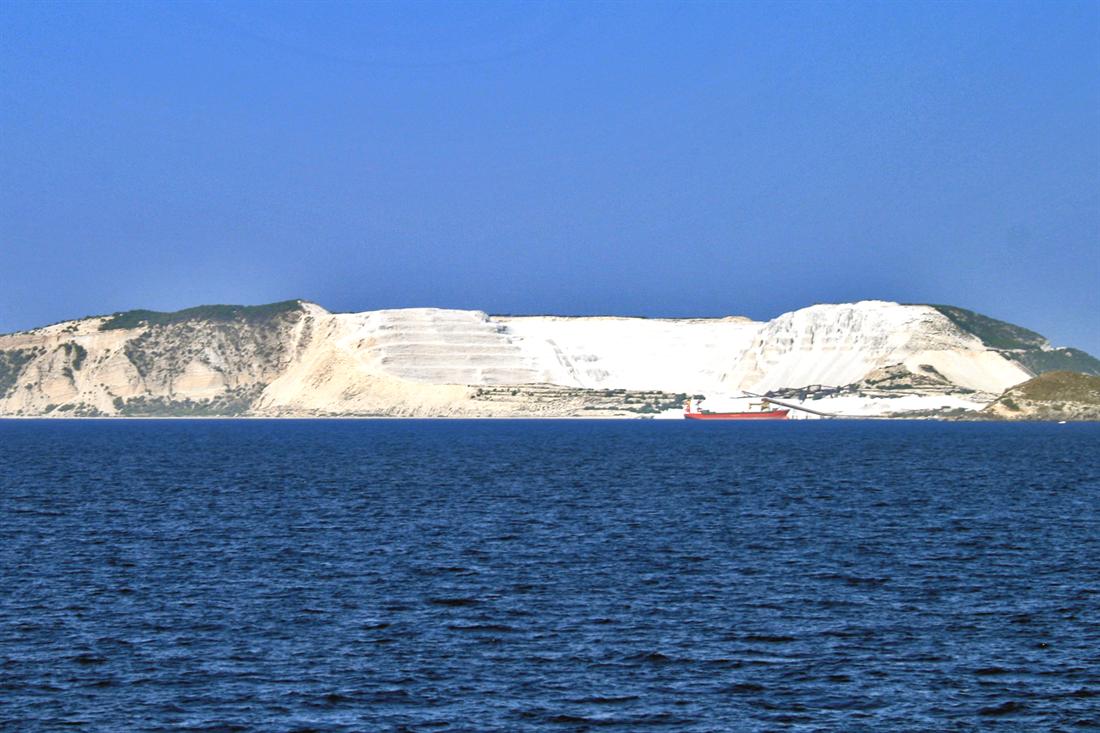
Yali island Nisyros is a small volcanic island between Kos and Nisyros, with a white pumice quarry, black obsidian and a swim stop on the Kardamena cruises. Find more trip ideas on Greece Tours.
Below we cover the rock of the island, its Neolithic past, the quarry, the beaches, the cruises that stop there and how to book.
Where does Yali island Nisyros sit in the Dodecanese?
Yali island Nisyros is a volcanic island of the Dodecanese. It lies halfway between the south coast of Kos, at Kardamena, and the island of Nisyros. Wikipedia places it in the municipality of Nisyros, in the South Aegean.
The Smithsonian Global Volcanism Program calls Yali a small crescent-shaped island. It lies between the north coast of Nisyros and the south-west coast of Kos. Its long axis runs from north-north-east to south-south-west.
Wikipedia gives the island an area of 4.558 square kilometres and a top height of 180 metres. MedGulets says Nisyros lies about two nautical miles away.
Our hub page on Nisyros tours covers the larger island next door, while this page stays on Yali itself.
Why is Yali island Nisyros called the glass island?
Gyali is the Greek word for glass, and the island is named after its volcanic glass. Wikipedia lists the spellings Gyali, Giali and Yali, and adds that the island was known as Istros in ancient times.
Travel Zone Greece links the name to the rocks. It says the island holds obsidian and perlite as well as pumice. These natural sources of glass gave the land its name.
Other sources use other spellings. The Foundation of the Hellenic World writes Yiali, and Exploring Greece writes Giali. Cruise listings spell the swim stop Yali, Giali or Gyali, and all three mean the Yali island Nisyros stop.
What is the Kos-Nisyros-Yali volcanic field?
The Kos-Nisyros-Yali volcanic field is the volcanic area that holds Yali, Nisyros and part of Kos. Its rocks span the last 3 million years. Silicic magma dominates by volume, according to a paper in the journal Elements.
Its biggest event was the Kos Plateau Tuff, a rhyolitic eruption 161,000 years ago. The paper ranks it among the largest known explosive eruptions of the Aegean arc. It released more than 60 cubic kilometres of rock, measured as dense-rock equivalent.
The Smithsonian programme says Yali lies inside the inferred submarine caldera of that eruption. The programme calls its size uncertain. It names Kefalos Bay on south-west Kos and Nisyros as the two ends of its possible span.
The paper adds that the field sits in an area of active crustal extension. That stretching shaped the magma and the land of the Yali island Nisyros region.
Is Yali island Nisyros an active volcano?
No eruption is on record at Yali island Nisyros. VolcanoDiscovery marks the island as extinct, with no eruption in the past 10,000 years, but flags both calls as uncertain. The Elements paper still calls the wider system active around Nisyros and Yali.
Experts disagree on how to class it. VolcanoDiscovery says it is debated whether Yali is an independent volcano or part of the Nisyros-Kos caldera complex.
The Elements authors cite seismic unrest, surface deformation and intense geothermal activity. They add that the latest eruptions became more silicic, and they argue that detailed monitoring is justified.
Wikipedia and VolcanoDiscovery both state that no historical eruptions are known on Yali.
What are the two halves of Yali island Nisyros made of?
The south-west half is a layered pumice deposit about 200 metres thick. The north-east half is rhyolitic obsidian lava of similar thickness. A narrow isthmus of modern reef sediment joins the two halves, says the Smithsonian programme.
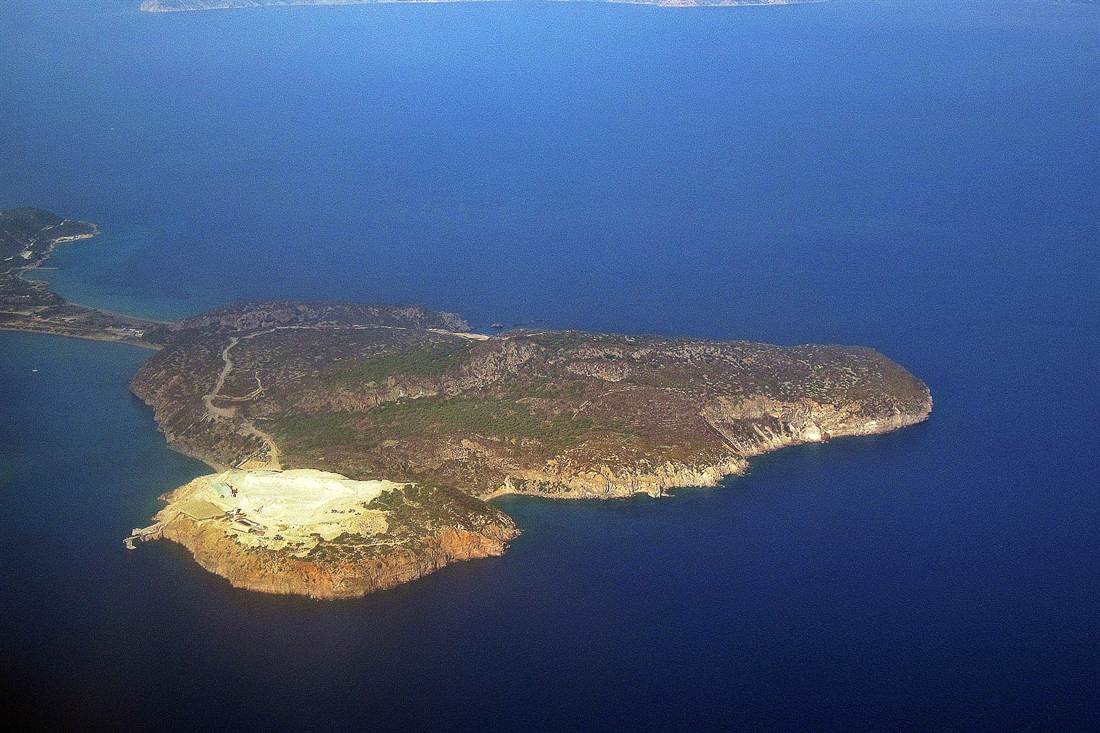
Wikipedia describes the same split on Yali island Nisyros. It lists obsidian lava domes in the north-east and pumice deposits in the south-west. It adds that miners strip the pumice out in huge quantities.
The age of the pumice is not settled in these sources. Nostalgia Travel ties it to an eruption on Nisyros about 200,000 years ago. The Smithsonian summary says the radiometric dates for the tephra are all older than 30,000 years.
The same summary notes that the pumice lies over soil that holds pottery and Neolithic obsidian artifacts. Wikipedia says the latest pumice eruptions overlie those soils.
How do pumice, obsidian and perlite differ on Yali island Nisyros?
Pumice is glass full of bubbles, obsidian is dark solid glass, and perlite is glass that has taken up water. Yali island Nisyros holds all three, and Travel Zone Greece names obsidian and perlite beside the pumice.
Wikipedia puts the pore space of pumice at 64 to 85 percent of its volume, and it floats on water. Nostalgia Travel says Yali pumice grains are about 85 percent air.
Obsidian forms when lava rich in silica cools fast. It breaks with a curved edge, and Stone Age people struck it into sharp blades.
Perlite forms when obsidian takes up groundwater. Heated to 850 to 900 degrees Celsius, it swells to between 7 and 16 times its volume. That makes it a useful industrial mineral.
Who lived on Yali island Nisyros in the Neolithic?
Small groups of farmers and herders seem to have lived on Yali in the Final Neolithic, season by season. The Foundation of the Hellenic World names three Laimos sites on the strip of land between the two halves. It calls Laimos 2 the main one.
Wikipedia dates the first seasonal stays on Yali island Nisyros to the early 4th millennium BC. One settlement stood on the coast at Laimos. Later in that millennium, people settled the north-west of the island, and cattle grazed the higher ground in winter.
Laimos 2 holds an oval stone building with two roofed rooms and an open court. Millstones show that islanders ground grain, and Wikipedia adds cheese pots for milk, plus pottery and obsidian work. The natural setting kept farming and herding small.
In the southern part of Laimos 2, diggers found a cemetery with 70 rectangular graves that share one orientation. Only seven skeletons were found. Natural forces had destroyed part of the cemetery.
What did early metalworkers and stone carvers take from Yali island Nisyros?
Two clay crucibles with copper stuck to them show metalworking on Yali in the mid-4th millennium BC. Wikipedia calls this rare evidence for the earliest phase of Aegean metallurgy, in the Final Neolithic.
A lead rivet turned up as well. Wikipedia says the Yali island Nisyros settlement was left empty by the end of the 4th millennium BC.
Obsidian from Yali island Nisyros was more brittle than the Melian kind. The Foundation of the Hellenic World says that made it poor for fine flaking. So craftspeople used it in the Late Bronze Age to carve stone vases.
Melian obsidian made the hard tools and arrowheads of the Stone and Bronze Ages. Wikipedia names Milos and Gyali as the two ancient obsidian sources of the Aegean.
Who lives on Yali island Nisyros today?
Fewer than 25 people live on Yali, and MedGulets calls the population essentially the quarry’s. Wikipedia gives 10 residents for a census in the early 2000s and 21 for one in the early 2010s. MedGulets reports 7 in the early 2020s.
MedGulets describes a small settlement called Chora on the isthmus. It holds housing and a port for quarry workers, served by a daily commuter boat from Mandraki on Nisyros.
People came back to Yali island Nisyros after the Greek revolution of the 1820s, says Wikipedia. Andreas Miaoulis used the island as a hideaway then. Surface surveys also found Hellenistic and Roman sites, says MedGulets.


Who runs the pumice quarry on Yali island Nisyros?
LAVA Mining & Quarrying runs the quarry. Nostalgia Travel and the Evia Shipping Agencies site both call the company a member of the Lafarge Group. Evia says it runs one of the biggest pumice quarries worldwide.
Nostalgia Travel says the company has mined and processed industrial minerals since the early 1950s. Pumice is the focus of its work. A Facaros guidebook dates the quarrying on Yali island Nisyros to the mid-1950s.
MedGulets places the company in the Heracles group and sizes the deposit at around 100 million tons. Nostalgia Travel gives over 120 million tons, the largest pumice reserve in Greece.
Output is about 1 million tons a year, says Nostalgia Travel. About 75 percent is exported to Europe, the USA, the Middle East and Asia.
How does the Yali island Nisyros quarry dig and ship pumice?
Bulldozers dig the pumice in an open pit, says Nostalgia Travel. Conveyor belts carry it to sifters that sort it into grain sizes, and a conveyor loads it straight onto ships.
The company makes six grain sizes and can mix one into another, says the same page. Storage holds over 200,000 tons, which lets it fill large orders fast.
Evia Shipping Agencies describes the berth. Ships moor alongside a cement pillar and tie to floating buoys. One shiploader with a rotating boom conveyor does the loading.
Portcode lists the port of Yali island Nisyros as Perlites Aegean S.A, Port of Nisyros. Its facility code starts with GRYLI.
What is Yali island Nisyros pumice used for?
Yali pumice goes into light building elements, road building, roof planting, plaster and other pouring work, says Nostalgia Travel. The page calls it a pure white material of low weight and high strength.
Fine pumice sand makes white insulating blocks with a smooth surface, the page adds, as well as plaster and coatings. It lists low weight, strength, sound absorption, insulation and fire resistance as the selling points.
Nostalgia Travel says Yali island Nisyros pumice carries the CE Mark under two European standards. It adds that Greeks and Romans used pumice long before the Christian era.
What is the swim stop at Yali island Nisyros like?
The swim stop sits at the narrow strip between Yali’s two hills. Exploring Greece says two beaches face north-west and south-east there. Sail Away Kos says its boat drops anchor off the coast so guests can swim.
The north beach has sand and light blue water, which Exploring Greece puts down to the pumice. Visitors who land at the pier walk to it along a path of 5 to 10 minutes.
The south-east beach of Yali island Nisyros is almost deserted, says Exploring Greece, with light yellow sand and fine gravel.
Travel Zone Greece writes that strawberry trees and pines shade the beach. Wikipedia says the strip-mined parts of the island have no plants.
Can visitors walk on Yali island Nisyros?
Only part of the island is open to the public. Exploring Greece says visitors learn which part on arrival. MedGulets adds that the island has no public harbour facilities. As a rule, landing needs permission from the mining company.
MedGulets lists no shop and no provisioning on Yali island Nisyros. A yacht charter guide says boats must stock up at Kos or Nisyros before they arrive.
The same guide asks visitors to stay aware of the industrial quarry operations. It lists an anchorage on the southern coast that is sheltered from the northern meltemi wind.
That anchorage lies over white volcanic sand and pumice dust, says the guide. A sailing blogger stopped in the cove of Giali for a swim. The blogger then passed a giant quarry on the island of Yali.
Which cruises stop at Yali island Nisyros?
Two GetYourGuide cruises from Kardamena stop at Yali island Nisyros: an 8-hour sailboat cruise and a 6.5-hour barbecue cruise. Both also visit Nisyros and St. Antonios, and both include a swim around Yali.
A Sail Away Kos listing of the Yali island Nisyros route gives the order of stops: St. Antonios, then Nisyros, then Yali for a last swim before the sail back to Kos. The listing gives the Yali stop a variable length.
S Tours runs a 7-hour two-island hop that swims at Giali first and visits Nisyros after. Its boat leaves Kardamena at noon, and the listing says the swim stop depends on the weather.
Our Nisyros boat trip page compares the Kos and Kardamena formats. The Kos pirate cruise page lists a 4 hour 30 minute boat out of Kardamena that includes St. Antonios and Yali.
What do you bring to the Yali island Nisyros swim stop?
Bring swimwear, a towel, sunscreen, sunglasses, a hat, and cash or a card. Sail Away Kos lists these items for its cruise. The bar on board sells drinks, and MedGulets says the island has no shop.
TUI Hellas lists bathing gear, a hat and sunblock for its cruise to St. Antonios and Giali. It also lists a jump off the boat at Gyali as a highlight.
Access rules for a Yali island Nisyros cruise differ by operator. Sail Away Kos lists its cruise as accessible to wheelchair users and toddlers. TUI Hellas calls its cruise unsuitable for guests with reduced mobility. S Tours asks guests to board and leave the boat without help.
The Nisyros leg of the day has its own plan. The crater walk is covered in our Nisyros day trip from Kos guide.
What do travellers ask about Yali island Nisyros?
When do the cruises to Yali island Nisyros run?
VolcanoDiscovery lists August as the warmest month near the volcano, at about 25.8 degrees Celsius on average. It lists February as the coldest, at 14.2.
What lunch comes with the cruise?
Sail Away Kos lists a barbecue of pork souvlaki, a Greek salad and bread. A vegetarian meal is available on request. S Tours serves a light lunch box on board and asks for vegetarian requests in advance.
How do refunds work?
The 8-hour GetYourGuide listing shows free cancellation and asks for booking at least 30 minutes ahead. Sail Away Kos refunds in full for cancellations made 24 hours or more ahead. TUI Hellas allows the same up to 1 day ahead.
How large are the groups, and are pets welcome?
S Tours sets a maximum of 60 people and sails on the Princess Maria. Sail Away Kos lists pets as welcome on board.
Where is Yali island Nisyros on a map?
Wikipedia gives the coordinates as 36.662 degrees north and 27.115 degrees east. The island sits between the south coast of Kos and the north coast of Nisyros.
Does the Kos 3 island cruise stop at Yali?
No. The Kos 3 island cruise visits Pserimos, Kalymnos and Plati instead.