
Thessaloniki Olive Oil Tasting
A Thessaloniki olive oil tasting is a guided session in the city where a host pours Greek extra virgin oils into small tasting glasses, shows guests how to smell, slurp and judge them, and pairs them with bread and local bites. Greece Tours gathers every Thessaloniki olive oil tasting on sale, from sit-down sessions to bottling visits.
Greece ranks among the world’s largest olive oil producers, behind Spain and Italy, and most Greek oil is extra virgin. A Thessaloniki olive oil tasting turns that fact into a skill: guests leave able to read a label, spot a defect and pick a fresh bottle to take home.
What is a Thessaloniki olive oil tasting?
A Thessaloniki olive oil tasting is a hosted session in the city where guests sample a flight of Greek olive oils side by side, learn the method that professional tasters use, and eat the oils with bread and local foods.
The session takes place indoors at a venue in the city, so it runs in any weather and in any season. A host explains where each oil comes from, which olive variety it uses and when it was harvested. Guests then taste every oil in turn and compare notes. The format suits first-time visitors to Thessaloniki who want a hands-on introduction to Greek food through its most-used ingredient.
Crete, the Peloponnese and Lesvos press the largest share of Greek oil, and Halkidiki is the olive region nearest the city. A Thessaloniki olive oil tasting brings oils from different regions to one table, so guests compare a green, peppery Cretan oil with a softer mainland oil in a single sitting. The aim is practical: after the session, guests judge oil by taste and smell rather than by colour, bottle design or brand.
How does a guided Thessaloniki olive oil tasting run?
A guided Thessaloniki olive oil tasting follows the method of professional panels: the oil goes into a small blue glass, guests warm it in the hand, smell it, slurp it with air, and score it for fruitiness, bitterness and pungency.
The blue or dark glass hides the colour of the oil, so that the eye does not bias the nose. The glass is small and rounded, wider at the base than at the rim, which traps the aroma inside. Each guest covers the glass with one hand and cups it with the other, warming the oil gently. Warmth releases the aroma compounds, and they gather under the covering hand until the guest lifts it for the first smell.
Next comes the nose. On a Thessaloniki olive oil tasting, guests take short sniffs, looking for green notes such as cut grass, tomato leaf and green almond, or ripe notes such as apple and banana. Then comes the slurp: a small sip stays on the tongue while the taster draws air in through the teeth with a sharp sucking sound. The air sprays the oil across the mouth and carries aroma to the back of the nose, where most flavour is detected.
The last step is the finish. Bitterness registers on the tongue, and pungency registers in the throat as a peppery catch that builds a second or two after swallowing. That catch comes from polyphenols, above all a compound called oleocanthal, and it marks a fresh, well-made oil. Between oils, tasters clear the palate with water or a slice of green apple. Each oil on a Thessaloniki olive oil tasting is then judged on three positive attributes.
- Fruity – the smell and taste of fresh olives, green or ripe.
- Bitter – a sharp taste on the tongue from green, early olives.
- Pungent – a peppery sting in the throat after swallowing.
Which Thessaloniki olive oil tasting formats are on sale?
Six Thessaloniki olive oil tasting formats are on sale: a plain sit-down tasting, a food pairing session, a tasting with traditional bites, a honey and olive oil tasting, a bottling tour with tasting and a Cretan olive oil tasting.
The sit-down Thessaloniki olive oil tasting is the core format, a flight of oils tasted step by step with a host, and one of these city sessions takes place at Olicatessen. The food pairing session matches dishes to each oil, and the traditional bites format serves small Greek snacks between samples. The honey format sets Greek honey and other traditional products beside the oils, so guests compare two old Greek staples at one table.
The bottling tour centres on the last stage of production, when the oil is filled into bottles or tins and sealed, and it ends with a tasting. The Cretan format focuses on oils from Crete, one of the three big producing regions of Greece with the Peloponnese and Lesvos. The menu, the number of oils and the venue of each Thessaloniki olive oil tasting sit on its listing, so guests compare formats there before booking.
What separates extra virgin, virgin and refined olive oil?
Under EU rules, extra virgin olive oil has free acidity of 0.8% or less and no taste defects, virgin oil allows up to 2% acidity and slight defects, and refined oil is processed until defects and most flavour are gone.
Extra virgin and virgin oils come from olives crushed by mechanical means only, with no chemicals. The words “cold extraction” on a label mean the olive paste stayed below 27°C while it was processed, which protects the aroma and the polyphenols. Refined oil starts as virgin oil with defects too strong to sell as it is, and refining makes it neutral. Oil sold simply as “olive oil” blends refined oil with virgin oil.
A Thessaloniki olive oil tasting centres on extra virgin oil, since only that grade shows the full range of fruit, bitterness and pepper. Early-harvest oil, called agourelaio in Greek, is pressed from green, unripe olives at the start of the season. The trees give less oil at that stage, but the oil carries more polyphenols, a deeper green taste and a stronger peppery finish than oil pressed from ripe, dark fruit.
Which Greek olive varieties appear at the tastings?
The Greek varieties guests meet at a Thessaloniki olive oil tasting include Koroneiki from Crete and the Peloponnese, the large green Chalkidiki olive, the Kalamata olive, and Manaki and Athinolia, two Peloponnese varieties with milder oils.
Koroneiki is a small olive and the leading oil variety in Greece. Its oil tastes green and grassy, with strong bitterness and a sharp peppery finish, because the fruit carries high polyphenol levels, which is why Cretan oils taste sharp. The Chalkidiki olive is the opposite in size, a large green fruit from Halkidiki, the olive region nearest Thessaloniki. Most of that crop is cured as table olives, yet it also gives a fruity, bitter oil.
The Kalamata olive, dark purple and almond-shaped, comes from Messinia in the southern Peloponnese and appears at the table more than in the bottle. Manaki grows in the north-eastern Peloponnese and Athinolia in Laconia, and both give softer oils with less bite. A Thessaloniki olive oil tasting that sets one of these soft oils beside a Koroneiki oil shows guests how variety, ripeness and harvest date shape the taste of the final bottle.
- Koroneiki – small fruit, green and peppery oil.
- Chalkidiki – large green fruit, mostly cured for the table.
- Kalamata – dark almond-shaped fruit, mostly for the table.
- Manaki – mild, round oil from the Peloponnese.
- Athinolia – soft, sweet oil from Laconia.
Which olive oil defects do tasters learn to spot?
Tasters learn to spot four common defects: rancid, fusty, musty and winey. Any one of them drops an oil below extra virgin grade, and a Thessaloniki olive oil tasting trains guests to name each smell and taste.
Defects come from damaged fruit, slow milling or poor storage, and each one strips the oil of its fresh character. Tasting schools teach them by setting a flawed sample beside a clean extra virgin oil, so the contrast is clear. The skill learned at a Thessaloniki olive oil tasting pays off at home, since supermarket oils labelled extra virgin sometimes fail a panel test, and a trained nose catches the fault before the oil reaches a salad.
Fusty and musty both trace back to the olives before milling: fusty oil comes from fruit left in heaps that ferment without air, and musty oil comes from fruit kept in damp storage where mould grows. Winey oil also comes from fermentation. Rancid oil is different, since it forms after bottling, when oxygen, light and heat break the oil down. A Thessaloniki olive oil tasting names all four so guests recognise them by smell.
- Rancid – smells of old nuts, crayons or putty.
- Fusty – smells of fermented olives and muddy sediment.
- Musty – smells of mould and damp cellars.
- Winey – tastes sour, close to vinegar.
What foods are paired with the oil at a tasting?
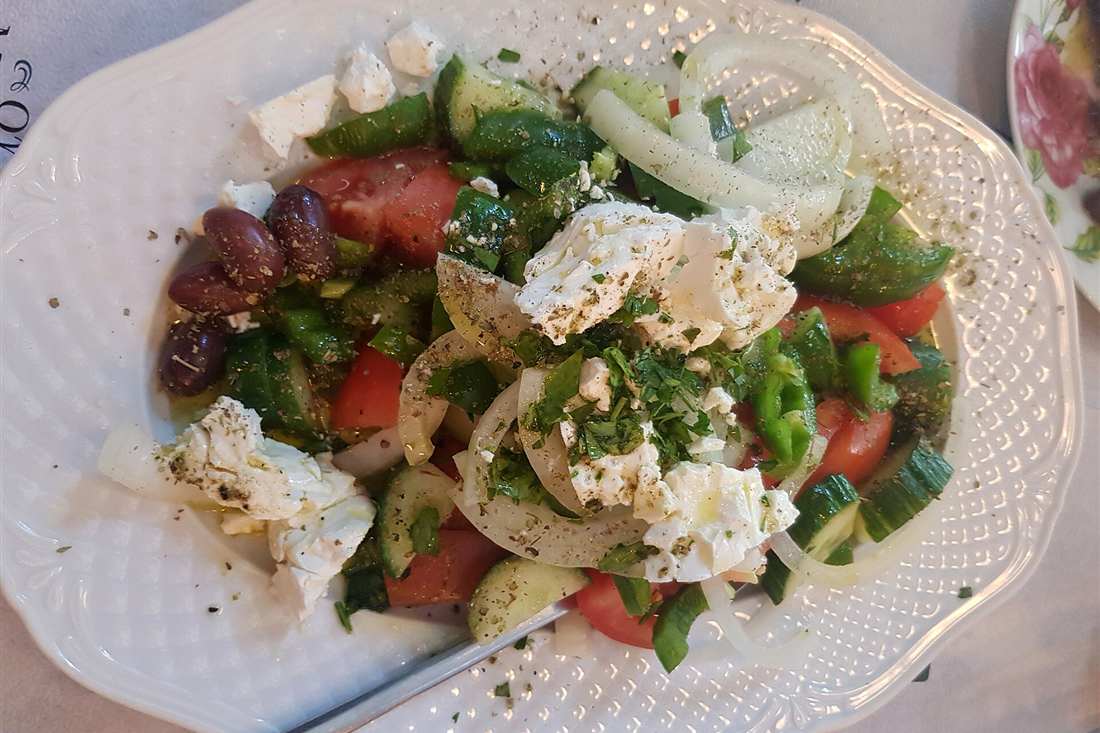
Bread, ripe tomato, feta, olives, barley rusks and Greek honey are the classic partners at a Thessaloniki olive oil tasting, and each one shows a different side of the oil, from its fruit to its pepper.
The food pairing and traditional bites formats build the session around these foods, and the exact menu differs by listing. Plain bread is the base, because it carries the oil without adding a flavour of its own. Tomato and feta test the oil against acid and salt: a green, peppery oil cuts through the richness of feta, while a mild oil lets a ripe tomato lead. Olives on the side show the same fruit in cured form.
Barley rusks soaked with oil and topped with tomato recall the Cretan dish dakos, which suits the theme of the Cretan tasting. Honey on bread beside the oil shows how sweet and bitter balance each other, the idea behind the honey and olive oil format. At a Thessaloniki olive oil tasting, the pairings turn a technical exercise into a small meal and show guests how to use each oil at home.
Where do Thessaloniki olive oil tastings take place?
Thessaloniki olive oil tastings take place at venues in the city, with the meeting point on each listing, and the oil trade of the centre runs through Ladadika by the port and the Kapani and Modiano food markets.
Ladadika is the old quarter of oil and olive merchants beside the port, and its name comes from “ladi”, the Greek word for olive oil. Its warehouses once stored the oil, olives and other goods that arrived and left through the port. Today the restored lanes hold tavernas, meze bars and cafes, and a walk through them before or after a Thessaloniki olive oil tasting sets the session in its trading context.
The Kapani market, also called Vlali, is an open market of stalls selling olives, cheese, spices, fish and meat, a short walk from Aristotelous Square. The covered Modiano market sits nearby, with olive stalls and delis under one roof. Both markets sell olives by weight from open tubs and oil by the bottle, so guests put the skills from a Thessaloniki olive oil tasting to use straight after the session ends.
How do you buy olive oil in Thessaloniki and carry it home?
After a Thessaloniki olive oil tasting, buy oil with a recent harvest date, a PDO or PGI mark and dark glass or a tin, then pack it in checked baggage, since cabin bags limit liquids to 100 ml per container at most airports.
The harvest date matters more than the best-before date, since extra virgin oil keeps its best flavour for about 12 to 18 months after harvest. PDO, Protected Designation of Origin, ties an oil to one named area; PGI, Protected Geographical Indication, gives a looser link to a region. At home, the bottle belongs in a cool, dark cupboard away from the stove and the window, with the cap closed, because light and heat turn oil rancid.
For the flight home, tins are the safest choice, since they block light and do not break. A glass bottle travels well inside a sealed plastic bag, wrapped in clothes in the centre of a checked suitcase. Oil counts toward the weight allowance, and the airline’s own rules set the limits. A 100 ml bottle fits the cabin liquids bag, which makes it an easy souvenir to carry after a Thessaloniki olive oil tasting.
- Harvest date – the latest season on the shelf.
- Origin mark – PDO or PGI for a named area.
- Acidity – 0.8% or lower for extra virgin grade.
- Container – dark glass or tin, never clear glass.
When is the best time to book a Thessaloniki olive oil tasting?
A Thessaloniki olive oil tasting runs all year, and the olive harvest from October to January brings the freshest new oil to the glass, including early-harvest agourelaio pressed from green olives at the start of the season.
Outside the harvest months, hosts pour oil from the latest season, which holds its flavour for months when it is stored in the dark. The tasting runs indoors, so rain, heat and wind do not affect it, and it makes a useful plan for a wet winter day or a hot summer afternoon. Booking ahead secures a slot in the summer months, when the city receives the most visitors, and around public holidays.
Group size, schedule and menu differ from one session to another, and the listing states each of them along with the cancellation terms. Guests with food allergies or a special diet read the menu there before booking a Thessaloniki olive oil tasting, since the bites and pairings change by format. A message to the host through the booking page settles any question about ingredients before the day of the session.
- Meeting point – the exact address in the city.
- Group size – the maximum number of guests per session.
- Language – the language the host uses in the session.
- Food served – the pairings and the allergens in them.
How does an olive oil tasting fit with other food experiences in the city?
A Thessaloniki olive oil tasting pairs well with a food tour, a wine tasting or a cooking class, since each one adds a layer to the same subject: how Greek cooks buy, taste and use their core ingredients.
A Thessaloniki food tour walks through the markets and bakeries of the centre, with bites such as bougatsa and meze, and a tasting beforehand gives guests the words to judge the oil in each dish. A Thessaloniki wine tasting follows the same nose-first method, with one difference: wine tasters judge colour, while oil tasters hide it in a blue glass. The two sessions share a vocabulary of fruit, balance and finish.
A Thessaloniki cooking class puts the oil to work in real Greek dishes cooked by the guests themselves. The order that works best is tasting first, then cooking, since guests arrive at the class knowing which oil suits raw use and which suits the pan. Booking a Thessaloniki olive oil tasting early in a stay spreads that knowledge across every meal that follows, from a market lunch to a dinner in Ladadika.
Do sunset olive trips to Halkidiki leave from Thessaloniki?
Yes, two sunset olive trips leave from Thessaloniki for Halkidiki, the olive region nearest the city: a Sithonia swim, sunset and olive tour, and a sunset olive experience. Both are out-of-town trips, separate from a Thessaloniki olive oil tasting in the centre.
Halkidiki is known for its large green table olives, and its groves spread across the three-fingered peninsula south-east of Thessaloniki. The sunset trips combine the groves with the coast, and the Sithonia tour adds a swim stop on the middle finger of the peninsula. The full detail of each trip, from the grove visit to the tasting, sits on the Halkidiki olive oil tasting page, which covers that region on its own.
The choice between the two is simple. A city tasting fits between sights in the centre and needs no transport, while a Halkidiki trip involves road travel out of the city and adds the landscape of the groves, the beaches and the sea. Guests with time for both book the Thessaloniki olive oil tasting first, then carry the method out to the groves and taste the oil where the olives grow.
Is a Thessaloniki olive oil tasting worth it?
Yes, a Thessaloniki olive oil tasting is worth it for food travellers, since it teaches a skill that lasts beyond the trip: judging oil by smell and taste, reading a label and picking a fresh bottle over a stale one.
A Thessaloniki olive oil tasting needs no prior knowledge and suits first-time visitors and home cooks alike. It runs indoors in any weather, fits between sights in the centre, and sits close to Ladadika and the markets. Guests who cook with oil every day gain the most, because they leave able to reject a rancid bottle and to match a peppery oil or a mild oil to the right dish.
Olive oil sits at the centre of Greek cooking, from salads and bread to slow-cooked vegetables, so a tasting explains the food of the whole country, not one dish. A Thessaloniki olive oil tasting also connects the city to its past as a port for the oil trade, which still shows in the name of Ladadika. For a visitor with an interest in food, it is one of the most useful experiences in the city.
Frequently Asked Questions
Do you need olive oil knowledge before a Thessaloniki olive oil tasting?
No, a Thessaloniki olive oil tasting needs no prior knowledge. The host explains each step, from warming the glass to slurping the oil, and guests learn the three positive attributes and the common defects during the session itself.
Why is the glass at a Thessaloniki olive oil tasting blue?
Colour carries no information about quality: a golden oil and a deep green oil both reach extra virgin grade. The dark glass, the standard tool of professional panels, stops the eye from influencing the nose and the palate during the test.
Why does fresh Greek olive oil make tasters cough?
The cough is a reaction to oleocanthal, a polyphenol that irritates receptors found mainly in the throat rather than on the tongue. Early-harvest Greek oils carry the most, so they draw the loudest coughs at a Thessaloniki olive oil tasting, a sign of fresh oil rather than a fault.
Can guests with dietary needs join a Thessaloniki olive oil tasting?
Yes, most guests can join, but the pairings include wheat bread, feta and honey. Guests with coeliac disease, a dairy allergy or a vegan diet check the listing and message the host before booking, since menus differ from one tasting to the next.
What does agourelaio mean on a Greek olive oil label?
Agourelaio means early-harvest oil pressed from unripe, green olives, and the word comes from agouros, Greek for unripe. Producers press it at the start of the harvest in October and November, so it reaches shops as the first new oil of the season.