
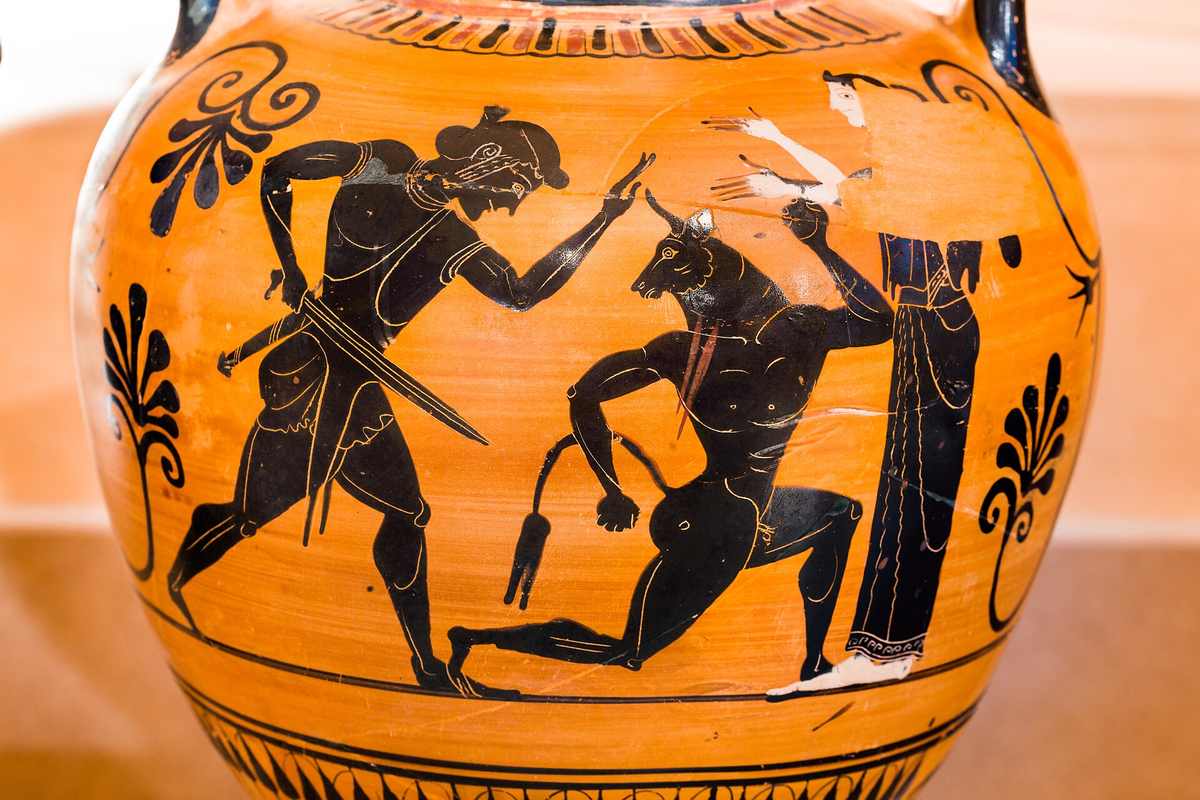
Theseus and the Minotaur is one of the most famous legends of ancient Greece, the story of an Athenian prince who sailed to Crete, entered the winding Labyrinth beneath Knossos, and killed the bull-headed Minotaur to end his city’s grim tribute of human victims. The tale weaves together courage, cunning, and tragic forgetting, and it has echoed through Western art and literature for millennia. Plan tickets and tours through My Greece Tours.
The legend is rooted in the great Bronze Age site explored in our hub guide to the Palace of Knossos, where the Labyrinth and the bull loom large in Minoan imagination. The sections below cover who Theseus was, the core myth of the Minotaur, where the story unfolds, and its main characters. They also trace how Ariadne helped him escape, what the tale symbolises, how the Minotaur was born, what happened after the beast was slain, how the myth appears in art, and whether the legend connects to the real archaeological Knossos.
Who was Theseus?
Theseus was the legendary hero and prince of Athens, named as the son of King Aegeus, though some versions call him a son of Poseidon. He grew up away from Athens, recovered his father’s tokens, and travelled to claim his birthright.
Theseus stands among the great heroes of Athenian legend, a figure the city later honoured as a founder-king and a model of civic courage. The tradition names him the son of King Aegeus of Athens. An older strand of the myth makes him a son of Poseidon, giving the hero a divine father who ruled the sea he would one day cross. Both threads run through the story at once, and ancient poets rarely troubled to reconcile them, treating Theseus as at once a mortal prince and a favourite of the gods whose destiny was marked from birth.
Theseus was raised in Troezen by his mother, Aethra, far from the Athenian court and from the father he had never met. Aegeus, before leaving Troezen, hid a sword and a pair of sandals beneath a heavy rock. He told Aethra that their son, once strong enough to move the stone, should carry the tokens to Athens and claim his inheritance. The young hero grew up under this quiet promise, knowing that a trial of strength awaited him and that his true home lay across the water in a city he had never seen.
The day came when Theseus lifted the great rock, recovered the sword and sandals, and set out to claim his birthright. Rather than sail the safe sea route to Athens, the young hero chose the dangerous overland road. He cleared it of the bandits and monsters that plagued travellers, earning a reputation as a champion before he ever reached the city gates. By the time he arrived, Theseus was already a celebrated figure, and his coming set the stage for the central ordeal of his youth, the tribute owed to King Minos of Crete. Our guide to King Minos covers the powerful Cretan ruler who imposed that tribute.
What is the myth of Theseus and the Minotaur?
The myth tells how Athens sent youths and maidens to Crete as tribute for the Minotaur, a bull-headed man kept in the Labyrinth at Knossos. Theseus volunteered among the victims, entered the maze, and killed the monster to free his city.
The heart of the legend is a cruel debt owed by Athens to Crete. The death of Androgeus, a son of King Minos, brought plague and misfortune on Athens. The city was bound to send a group of young men and women to Crete at fixed intervals as payment for the wrong. Tradition sets the number at seven youths and seven maidens, chosen from among the city’s families and shipped across the sea to a fate that offered no escape. The tribute hung over Athens like a shadow, returning again and again to steal away its children.
These victims were shut inside the Labyrinth, an inescapable maze of corridors, where the Minotaur devoured them. The creature had the body of a man and the head of a bull, the monstrous offspring of Minos’s wife Pasiphae and a sacred bull sent from the sea by Poseidon. Minos hid the shameful beast away rather than destroying it. He ordered the craftsman Daedalus to build a maze so tangled that neither the Minotaur nor its victims could ever find the way out, and the tribute kept its hunger fed while keeping Athens in fear.
Theseus, unwilling to let his fellow citizens be sacrificed, volunteered to join the tribute group and vowed to slay the Minotaur. He sailed to Crete among the doomed youths, determined to enter the maze and confront the monster at its heart, and so turn the annual sorrow of his city into a single decisive reckoning. Our guide to the Minotaur and the Labyrinth at Knossos covers the maze and the beast in detail, and the next sections cover the setting, the cast, and how Ariadne helped Theseus survive.
Where does the myth of Theseus and the Minotaur take place?
The myth unfolds across three settings: Athens, where the tribute is owed; the sea voyage across the Aegean; and Crete, where Minos rules from Knossos and the Minotaur waits in the Labyrinth. The homecoming ends at the Athenian coast.
The story opens in Athens, the great city of the Greek mainland, bound by its debt to Crete and mourning the children it must surrender. From here Theseus and the tribute victims board the ship that will carry them south. The geography of the myth becomes a geography of dread, each league of sea drawing the young Athenians closer to the maze. The voyage across the Aegean marks the passage from the familiar world of home into the alien kingdom of Minos, and the same waters will later claim Aegeus and take his name.
Crete itself forms the dark centre of the tale, and within Crete the palace of Knossos rises as the seat of Minos’s power. The Labyrinth lies beneath or within this palace, a maze of corridors so intricate that its builder Daedalus could barely find his own way out. The geography narrows step by step, from the wide sea to the island, from the island to the palace, from the palace to the maze, and from the maze to the single dark chamber where the Minotaur waits. This tightening of the setting mirrors the tightening of the hero’s ordeal.
The final scenes return north to the Athenian shore, where Aegeus watches the horizon for his son’s returning sail. The tragedy plays out at the boundary of land and sea, on the headland where the old king keeps his anxious watch. Naxos, the island where Ariadne is abandoned, adds a fourth stage to the journey, a place suspended between Crete and home. The real Bronze Age Knossos anchors all of this in a genuine landscape that visitors can still walk today through our Palace of Knossos guide.
Who are the main characters in Theseus and the Minotaur?
The central figures are Theseus, the Athenian hero; the Minotaur, the bull-headed beast; King Minos of Crete; Ariadne, his daughter and Theseus’s ally; Aegeus, the Athenian king; Daedalus, the maze-builder; Pasiphae, the Minotaur’s mother; and Poseidon.
Each figure in the legend carries a clear role and a defined relationship to the others, and the drama turns on how those relationships collide. The hero and the monster stand at the two poles of the story, while Minos, Ariadne, and the craftsman Daedalus link them across the divide between Athens and Crete. The list below sets out the principal characters, the part each one plays, and how each connects to the wider tale of tribute, love, and betrayal.
- Theseus is the Athenian prince and hero, son of Aegeus, who volunteers among the tribute victims and kills the Minotaur.
- Minotaur is the bull-headed beast of the Labyrinth, offspring of Pasiphae and the sacred bull, who devours the young Athenians.
- Minos is the king of Crete, master of Knossos, who imposes the tribute and imprisons the monster in the maze.
- Ariadne is the daughter of Minos, who loves Theseus and gives him the thread that saves his life.
- Aegeus is the king of Athens, father of Theseus, who watches for the returning sail and dies in despair.
- Daedalus is the master craftsman, servant of Minos, who designs and builds the inescapable Labyrinth.
- Pasiphae is the wife of Minos and mother of the Minotaur, joined to the sacred bull by a curse.
- Poseidon is the sea god who sends the sacred bull and, in some versions, fathers Theseus himself.
These figures form two families bound in tragedy, the house of Aegeus in Athens and the house of Minos in Crete, with the Minotaur as the monstrous secret at the Cretan heart. Ariadne crosses between them, choosing the foreign hero over her own father, while Daedalus, whose skill built the maze, will later help her scheme succeed. Our guide to Ariadne at Knossos covers the princess and her pivotal choice in the legend.
How did Ariadne help Theseus?
Ariadne, the daughter of King Minos, loved Theseus and gave him a ball of thread, the famous “clue,” to retrace his path through the Labyrinth. By tying one end at the entrance and unwinding it, Theseus found his way out after killing the Minotaur.
Ariadne, moved by Theseus when he arrived in Crete among the doomed tribute victims, resolved to help him escape the fate that Minos had planned. In the traditional account she gives him a ball of thread, sometimes called the “clue.” Her instruction was simple: fix one end at the entrance of the Labyrinth and let it unspool behind him as he advanced into the dark. The maze was designed so that no one who entered could find the way back, so this slender thread became the difference between victory and being lost forever among the endless corridors.
In many versions Ariadne also gives Theseus a sword with which to kill the beast, arming the hero as well as guiding him. Her help is an act of open defiance against her own father, for she chooses a foreign prince and the ruin of the tribute over loyalty to the house of Minos. Daedalus, the maze’s own architect, is sometimes said to have whispered the secret of the thread to her, so that the craftsman’s knowledge quietly turns against the king who commanded the Labyrinth built.
Theseus follows her plan exactly. He ties the thread at the doorway, makes his way to the centre, kills the Minotaur, and then retraces the unwound line back to the entrance, leading the other young Athenians to freedom. In return he promises to take Ariadne away from Crete with him. Her gift transforms the hero’s raw courage into a workable escape, and it makes cunning and knowledge, not brute force alone, the true weapon that defeats the monster and its maze.
How was the Minotaur born and imprisoned?
The Minotaur was born to Pasiphae, wife of King Minos, and a sacred bull sent by Poseidon. Minos, ashamed of the bull-headed child, ordered Daedalus to build the Labyrinth, a maze so tangled the creature could never escape.
The origin of the Minotaur lies in a broken bargain between Minos and Poseidon. The sea god sent a magnificent bull to Crete as a sign that Minos should rule and then sacrifice the animal in his honour. Minos, dazzled by the bull’s beauty, kept it for himself and offered a lesser beast instead, and the god’s anger fell not on the king directly but on his household. Poseidon caused Pasiphae, the wife of Minos, to be seized with an unnatural passion for the sacred bull, and from that cursed union the Minotaur was conceived.
The child that Pasiphae bore had the body of a man and the head of a bull, a creature neither fully human nor fully animal and impossible to keep at court. Minos could not bring himself to kill the monstrous offspring outright, yet he could not let it roam free among his people, and so he sought a way to hide the shame of his house forever. He turned to Daedalus, the most ingenious craftsman of the age, and commanded him to devise a prison from which the beast could never emerge.
Daedalus answered with the Labyrinth, a vast maze of winding, branching corridors so confusing that its own maker could scarcely find the exit. Within this stone tangle the Minotaur was shut away, fed on the youths and maidens sent as tribute from Athens, growing more terrible in the darkness at the maze’s heart. The imprisonment thus bound together three strands of the legend, the pride of Minos, the skill of Daedalus, and the doom of the Athenian victims. Our guide to Daedalus and Icarus covers the master craftsman who built that maze.
What happened after Theseus killed the Minotaur?
Theseus escaped Crete with Ariadne after slaying the Minotaur, but abandoned her on Naxos. Sailing home, he forgot to raise white sails as a signal of success, so his father Aegeus, seeing black sails and believing him dead, threw himself into the sea.
Theseus, having killed the Minotaur and led the survivors out of the Labyrinth by Ariadne’s thread, boarded his ship and sailed away from Crete with the freed Athenians and the princess who had saved him. The voyage home, however, turned to tragedy. In the most familiar version of the myth, Theseus stops at the island of Naxos and there abandons Ariadne, leaving the woman who had rescued him behind on the shore as he sails on. The reasons given vary in the tradition, but the outcome remains the same, a triumph shadowed by betrayal.
Ariadne’s story does not end on the empty beach, for tradition holds that the god Dionysus later found her on Naxos and took her as his own. The abandoned princess, wife of a betraying hero, becomes the bride of a god, and her fate turns from desertion to a strange exaltation. This turn softens the cruelty of Theseus’s act in the telling, yet it never fully absolves him, and the memory of the thread he repaid with abandonment hangs over the rest of his legend.
A second sorrow follows Theseus to Athens. Aegeus, before the ship set out, had asked his son to change the black mourning sails for white ones if he returned victorious. In his grief or distraction Theseus forgot the signal. Aegeus, watching from the headland and seeing black sails approach, believed his son was dead and threw himself into the water, which thereafter bore his name as the Aegean Sea. The hero’s greatest victory thus arrives hand in hand with the loss of his father, and a single forgotten promise costs a king his life.
What does the myth of Theseus and the Minotaur symbolise?
The myth symbolises courage confronting monstrosity, cunning and knowledge as the thread through chaos, and order triumphing over the beast. It also reads as a coming-of-age ordeal and a warning about the heavy cost of a forgotten promise.
At its simplest the legend stages a contest between the human and the monstrous, with Theseus embodying reason, civilisation, and civic duty against the Minotaur’s blind, bull-headed savagery. The hero’s victory reads as the triumph of order over chaos, of the ordered city over the devouring wild. Generations of readers have seen in it the founding of a more civilised Athens freed from a barbaric debt. The maze that swallows its victims becomes the disorder that heroism must master and set right.
The thread deepens this meaning, for Theseus does not conquer the Labyrinth by strength alone but by the guidance Ariadne’s clue provides. Cunning, foresight, and shared knowledge become the true path through confusion, and the ball of thread has long served as an image of the idea or method that leads a mind out of a tangle. Many later thinkers have treated the Labyrinth as the human predicament and the thread as the reason or love that guides a person safely through it.
The story also works as a rite of passage and a moral warning. Theseus crosses the sea, faces death in the dark, and returns transformed into the hero and future king Athens needs, a classic pattern of the youth who proves himself through ordeal. Yet the tragic ending, the abandoned princess and the dead father, insists that triumph carries a price, and that a promise forgotten in the flush of victory can undo everything the hero fought to win.
How is Theseus and the Minotaur depicted in art?
Theseus and the Minotaur appears across ancient Greek vase painting, Roman mosaics, and later European art. Artists most often show the climactic combat, the hero gripping the bull-headed beast, while Roman mosaics render the Labyrinth as a geometric maze.
Greek vase painters returned to the subject again and again, treating the duel between hero and monster as one of their favourite scenes. Painted pottery typically shows Theseus seizing the Minotaur by the horn or the head and driving home his weapon, freezing the myth at its decisive instant. Ariadne, Athena, or watching youths sometimes flank the pair, framing the combat as a public triumph. The scene’s popularity made the image of the man wrestling the bull-headed beast one of the most recognisable in ancient Greek art.
Roman art carried the legend forward in a different medium and mood. Floor mosaics across the Roman world laid out the Labyrinth as an elaborate geometric pattern, often with the combat set at its centre. They turned the myth into a design that a visitor could trace with the eye as Theseus once traced the thread. These maze mosaics spread the story across villas and public buildings, and they fixed the visual idea of the labyrinth as an ordered, spiralling plan rather than a formless tangle of corridors.
Later European art revived the myth during the Renaissance and beyond, as painters and sculptors drew on the classical sources to picture the hero, the maze, and the abandoned Ariadne. The subject offered artists a chance to combine heroic anatomy, dramatic struggle, and the poignant aftermath on Naxos, and it remained a steady theme in painting and sculpture. Across every era the core image endures, the hero and the bull-headed beast locked together at the heart of the maze.
Is the myth connected to the real Knossos?
The myth is legend, not documented history, but it grew from a real place and culture. Bronze Age Knossos on Crete was the centre of Minoan civilisation, whose art is filled with bulls, sacred horns, and the double axe, the symbols woven through the story.
The story of the Minotaur should be read as myth rather than recorded event, yet it is anchored to a genuine archaeological reality. Knossos was the largest Bronze Age palatial complex on Crete and the heart of the Minoan civilisation, a sprawling, many-roomed structure whose intricate plan may itself have fed the ancient idea of a labyrinth. The word “labyrinth” has long been linked to the labrys, the double-headed axe that appears repeatedly in Minoan religious imagery, suggesting the maze of legend and the palace of stone are bound together in memory.
The bull at the centre of the myth reflects something deeply real about Minoan culture. Frescoes and figurines from Crete show bull-leaping, in which athletes vaulted over charging bulls, and sacred vessels shaped as bulls’ heads, known as rhyta, served in ritual, so the animal clearly carried great religious weight. The legend of a bull-headed monster may be a mythic memory of that bull-centred world, transformed by later Greek storytellers into a tale of tribute and heroism.
Ancient writers themselves puzzled over the story’s roots and tried to rationalise it. Later authors such as Plutarch retold the legend as though it preserved a distorted memory of real events. They imagined a harsh Cretan tribute or a cruel general named Taurus, the Greek word for bull, behind the tale of a bull-headed monster. Whether or not these explanations hold, they show that the myth was long felt to reach back toward a genuine Bronze Age past. Plan your visit and tours through our Palace of Knossos guide.
How did Theseus prepare for the voyage to Crete?
Theseus volunteered for the tribute, choosing to sail among the doomed youths rather than let Athens surrender its children again. He agreed with his father Aegeus on a signal of sails, black for death and white for a safe, victorious return.
Theseus refused to stand aside while the tribute took another group of young Athenians to Crete. The prince stepped forward and offered himself as one of the victims, turning a passive dread into a deliberate mission. This choice marks the hero’s character in the legend: he does not wait to be chosen by lot but volunteers, carrying the hopes of the city into the very ship that had long meant only sorrow. The act reframes the tribute as a chance for deliverance rather than a certain death.
The agreement over the sails sits at the centre of these preparations. Aegeus, fearing the worst yet hoping for triumph, gave his son a plain instruction before the ship departed. The vessel would sail under black sails, the colour of mourning, and Theseus would raise white sails on the return only if he had survived and killed the beast. This single arrangement, simple in the telling, becomes the hinge of the tragedy that closes the myth, since the hero’s memory fails him at the fatal moment.
The voyage itself carried the tribute victims from the safety of Athens into the kingdom of Minos. The young men and women boarded together, bound for a palace they knew only by its terrible reputation, and the sea between the mainland and Crete became the threshold of the ordeal. Theseus travelled among them as an equal in danger, hiding his resolve behind the appearance of another doomed passenger, ready to act once the ship reached the shore beneath the walls of Knossos.
What weapons and tools did Theseus use against the Minotaur?
Theseus relied on a sword and Ariadne’s ball of thread. The sword, given by Ariadne in the common version, let him kill the bull-headed beast, while the thread marked his route so he could retrace his steps out of the winding Labyrinth.
The sword stands as the hero’s instrument of combat in the legend. In the widely told version Ariadne hands Theseus a blade along with the thread, arming him for the fight at the maze’s heart. The weapon lets him meet the Minotaur in close single combat rather than fall unarmed like the victims before him. The image of the hero gripping the beast and driving the sword home became the scene that ancient vase painters chose above all others, fixing the sword as the emblem of the killing.
The thread, called the “clue” in older English, serves as the tool that solves the maze. Theseus ties one end at the entrance and lets the ball unwind behind him as he moves inward, laying a line he can follow back through the branching corridors. The Labyrinth was built to defeat memory and sense of direction, so a physical trail became the one reliable means of return. The thread converts an inescapable prison into a passage the hero can walk twice, in and out.
Together the two objects split the challenge into its parts. The sword answers the monster, the thread answers the maze, and the hero needs both to survive the ordeal whole. Neither strength nor cunning alone would carry him through, since a warrior lost in the corridors would starve as surely as an unarmed victim would be devoured. The pairing of blade and thread makes the victory a union of courage and method, the very balance the myth holds up as its lesson.
How does the myth of Theseus and the Minotaur end for the hero?
Theseus ends the tale as a triumphant but grieving king. He freed Athens from the tribute and later became its ruler and unifier, yet his victory cost him Ariadne, abandoned on Naxos, and his father Aegeus, who died believing his son was lost.
The killing of the Minotaur made Theseus the deliverer of Athens, the prince who ended the cruel debt to Crete. His fame rested on that single deed, and the tradition later crowned him king of the city and credited him with uniting the scattered communities of Attica under one government. The hero of the maze grew into a founder-figure, a ruler whom Athenians remembered as a shaper of their state as much as a slayer of monsters. His youthful ordeal became the making of the man.
The losses that shadow this triumph give the legend its tragic weight. Ariadne, whose thread saved him, ended on the shore of Naxos, left behind by the hero she had rescued. Aegeus, watching for the white sails that never rose, threw himself into the sea that took his name. The victory arrived stained by desertion and death, and the myth refuses to let the hero enjoy an unclouded homecoming. The forgotten signal turns a day of deliverance into a day of mourning.
Theseus’s later legend carried both the glory and the shadow forward. Ancient storytellers gave him further adventures, campaigns, and troubles that echoed the pattern of his youth, courage repeatedly tangled with error and loss. The tale of the Minotaur remained the defining episode, the deed by which the wider Greek world knew him. It fixed his double image as the brave civiliser and the flawed man whose forgetfulness cost a king his life on the Athenian headland.
How does the myth compare to other Greek hero legends?
The myth follows the classic Greek hero pattern seen in Heracles, Perseus, and Jason. A young hero crosses into a hostile realm, defeats a monster with clever aid, and returns changed. The tragic aftermath sets Theseus apart from the cleaner victories of others.
The structure of the Theseus legend echoes the great quest myths of Greece. Heracles faced monstrous beasts through his labours, Perseus slew the Gorgon Medusa with gifts from the gods, and Jason sought the Golden Fleece with the aid of the sorceress Medea. Theseus joins this company as the youth who ventures into danger, kills the creature at its heart, and returns to claim his place. The shared pattern shows how the Greek imagination framed heroism as a journey out, a confrontation, and a homecoming.
The role of a helper woman ties Theseus especially close to Jason. Ariadne guides Theseus through the maze much as Medea guides Jason through the trials set by her father, and both princesses betray their own royal houses for a foreign hero, only to be cast aside afterward. This recurring figure, the foreign king’s daughter who saves the stranger and loses everything, marks a deep pattern in the myths. It lends the Theseus story a moral shadow that the tale of Perseus, who keeps his rescued bride, does not carry.
The tragic ending is what most sharply distinguishes Theseus. Where Perseus wins Andromeda and Heracles earns immortality, Theseus returns to a dead father and a betrayed ally, his triumph laced with grief and guilt. The myth withholds the clean reward that crowns other hero legends, insisting instead that the greatest victory can arrive alongside the greatest loss. That refusal of a simple happy ending gives the story of Theseus and the Minotaur its lasting moral and emotional force.
What are the ancient sources for Theseus and the Minotaur?
The myth survives through many ancient authors rather than one text. Plutarch’s Life of Theseus gives the fullest narrative, while poets, playwrights, and mythographers such as Apollodorus, Ovid, and Catullus preserve the tribute, the thread, and Ariadne’s abandonment across Greek and Roman literature.
Plutarch, writing in the Roman era, gave the story its most complete surviving account in his Life of Theseus. He gathered earlier traditions, weighed their contradictions, and tried to rationalise the legend as a distorted memory of real Cretan power, treating Theseus as a historical founder-king wrapped in myth. His biography remains the single richest source for the tribute, the voyage, the killing of the Minotaur, and the tangled aftermath, and it shaped how later ages understood the whole cycle of the hero’s deeds.
The Greek mythographers and poets fill in the frame around Plutarch. The handbook attributed to Apollodorus sets out the genealogy of Minos, Pasiphae, and the Minotaur and records the thread and the escape in compact form, while earlier vase inscriptions and lost epic traditions show the tale circulating long before. Athenian tragedy and the visual arts kept the legend alive on stage and on pottery, so the story reached the ancient public through performance and image as much as through written narrative.
Roman poets carried the myth into Latin literature with a strong focus on Ariadne. Ovid retells episodes of the legend in his verse. Catullus devotes a famous long poem to the abandoned princess lamenting on the shore of Naxos, giving her grief a voice that the older sources leave silent. Through these layered retellings the story of Theseus and the Minotaur reaches us not as a fixed scripture but as a living tradition, reshaped by each author who took it up.
Why does the myth of Theseus and the Minotaur still matter today?
The myth endures because its images speak to lasting human concerns. The maze stands for confusion, the thread for the idea that guides a mind through it, and the monster for the fears heroism must face, so the story keeps meaning far beyond Crete.
The Labyrinth has become one of the most durable symbols to descend from Greek myth. Writers, philosophers, and artists across the centuries have used the maze to picture the human predicament, the tangle of choices, doubts, and dangers that a person must navigate. The word “labyrinthine” carries this sense in everyday speech. The image recurs in literature and design wherever a work wants to evoke complexity, entrapment, or a search for a hidden centre, all drawn from the corridors that once held the Minotaur.
Ariadne’s thread has proved just as lasting as the maze it solves. The phrase names a method that leads reason step by step through a difficult problem, and it appears in mathematics, philosophy, and computing as a term for a systematic path to a solution. The story thus gave language a lasting metaphor for guidance and clear thinking. A listener who has never read the myth still reaches for its central image when describing the way out of a tangle.
The hero and his flaws keep the tale emotionally alive. Theseus embodies courage and civic duty, yet his forgotten sails and his abandonment of Ariadne make him a figure of human failing as well as triumph. That mixture feels truer than a spotless hero would. Modern retellings in novels, film, and art return to the story precisely because it holds victory and loss together, and it lets each generation read its own struggles into the ancient contest of hero, maze, and beast.
Frequently Asked Questions
What is the Labyrinth in the myth of Theseus and the Minotaur?
The Labyrinth is the vast, winding maze in which the Minotaur was imprisoned beneath the palace of Knossos on Crete. In the traditional myth the master craftsman Daedalus built it on the orders of King Minos. The king wanted to hide the monstrous bull-headed creature away from sight. The maze held so many branching corridors that anyone who entered could never find the way out, which is why the Athenian tribute victims sent inside were doomed.
This inescapability is exactly what makes Ariadne’s gift so important. The ball of thread, or “clue,” allowed Theseus to mark his route and retrace his steps after killing the beast. Over time the Labyrinth has become a powerful symbol of confusion, hidden danger, and the search for a way through. Many scholars connect its origins to the genuinely complex floor plan of the real Bronze Age palace at Knossos.
Why is the Aegean Sea named after Aegeus?
The Aegean Sea is named after Aegeus, the King of Athens and the father of Theseus in the traditional legend. Before Theseus sailed to Crete, his father asked him to change the ship’s sails from black to white on the return journey if he survived and triumphed. Black sails would mean the hero was dead. Theseus killed the Minotaur and sailed home, but forgot, in his grief, to swap the mourning black sails for the white ones.
Aegeus watched anxiously from a high vantage point as the ship approached. He saw the black sails and concluded that his son had perished in the Labyrinth. Overcome with despair, he threw himself into the sea below, and from that moment the waters carried his name. The story explains the sea’s name while underlining the tragic cost of a single forgotten promise.
Was the Minotaur real?
No, the Minotaur was not a real creature, and it belongs entirely to Greek mythology. In the myth it is a being with the body of a man and the head of a bull. It was born to Pasiphae, the wife of King Minos, and a sacred bull, and kept hidden in the Labyrinth at Knossos. The monster itself is imaginary, yet the story clearly grew out of a real cultural world.
The Minoan civilisation centred on Knossos placed enormous symbolic importance on the bull. Surviving frescoes depict the daring sport of bull-leaping, and ritual vessels were crafted in the shape of bulls’ heads. These genuine bull-centred customs and the maze-like architecture of the palace likely inspired later Greek storytellers. The Minotaur is best seen as a mythic reflection of a real Bronze Age society, not as a historical animal.
Who killed the Minotaur in the myth?
Theseus, the prince and hero of Athens, killed the Minotaur in the traditional legend. He volunteered to join the young Athenians sent to Crete as tribute, intending from the start to destroy the beast that devoured them. Ariadne gave him a guiding thread and often a sword as well. Theseus made his way to the centre of the maze and slew the Minotaur in single combat.
He then followed the unwound thread back to the entrance, leading the surviving youths and maidens to freedom. The killing of the Minotaur stands as the central heroic deed of Theseus’s youth. The act freed Athens from its grim tribute and secured his fame. Even so, the voyage home carried its own tragic losses in the abandonment of Ariadne and the death of Aegeus.
What role does Daedalus play in the story?
Daedalus is the master craftsman whose skill shapes much of the myth from behind the scenes. On the orders of King Minos, he designed and built the Labyrinth. The maze was so intricate that neither the Minotaur nor its victims could ever find the way out, and even its own maker could scarcely escape it. In several versions Daedalus also aids Ariadne, revealing the secret of the thread that lets Theseus survive.
The builder’s own knowledge thus turns quietly against the king he served. His cleverness stands on both sides of the story, first creating the prison and then helping to defeat its purpose. Daedalus later flees Crete with his son Icarus on wings of his own making. That further tale of ingenuity and tragedy grows directly out of his service to Minos, and our guide to Daedalus and Icarus covers it in full.
Why did Theseus abandon Ariadne on Naxos?
Theseus abandoned Ariadne on the island of Naxos during the voyage home from Crete, leaving behind the princess whose thread had saved his life. The ancient sources give differing reasons for this desertion and rarely agree on a single motive, treating the act as a fixed part of the myth rather than a moment they fully explain. Some tellings present it as callous forgetting, others as a fate ordained by the gods so that Ariadne might meet a higher destiny.
That higher destiny is the reason many versions offer. The god Dionysus is said to have found Ariadne on Naxos and taken her as his bride, turning her abandonment into an unexpected exaltation. In this reading Theseus leaves her not out of cruelty alone but because the gods claim her for themselves. The tradition thus softens the betrayal while keeping it, and the abandoned princess who becomes a god’s wife stands as one of the most poignant turns in the whole legend.
How is Theseus and the Minotaur connected to the Palace of Knossos?
Theseus and the Minotaur is set at the Palace of Knossos, the seat of King Minos and the site of the Labyrinth in the legend. The real Bronze Age palace on Crete was the largest Minoan complex, and its intricate, many-roomed plan may have inspired the ancient idea of an inescapable maze. Bulls held deep religious meaning in Minoan Crete, appearing in bull-leaping frescoes and in ritual vessels shaped as bulls’ heads.
These genuine features anchor the myth to a place visitors can still explore today. Walking the reconstructed halls, the throne room, and the storerooms of Knossos brings the setting of the legend to life, even though the Minotaur belongs to imagination rather than history. Our Palace of Knossos guide covers the site where the tale of Theseus, the Labyrinth, and the bull-headed beast is rooted.
What is the meaning of Ariadne’s thread?
Ariadne’s thread is the ball of string she gives Theseus so he can find his way out of the Labyrinth after killing the Minotaur. He ties one end at the entrance and unwinds it as he advances, laying a trail he can follow back through the branching corridors. The maze was built to defeat direction and memory, so the thread becomes the one reliable means of return, turning an inescapable prison into a passage the hero can walk twice.
Beyond the story the phrase has taken on a lasting figurative sense. An “Ariadne’s thread” now names a method or guiding idea that leads reason step by step through a complex problem, and the term appears in mathematics, philosophy, and computing for a systematic path to a solution. The image endures because it captures a universal experience, the search for a clear line of thought that leads a mind safely out of confusion, drawn directly from the princess whose gift saved the Athenian hero.