
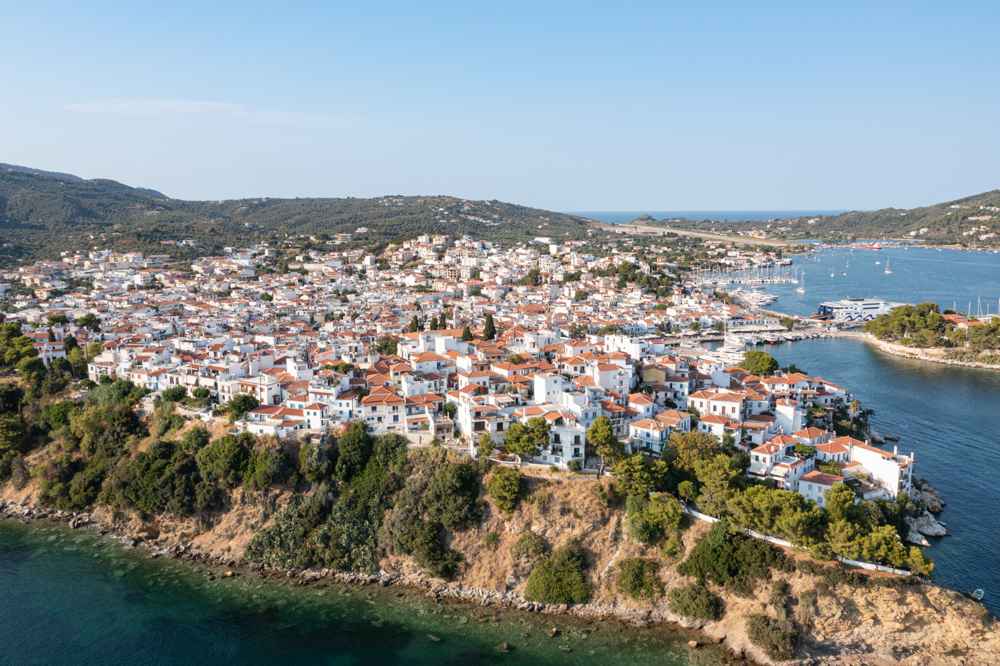
A Skiathos honeymoon pairs the Sporades’ best beaches with the one thing quiet islands cannot offer: real evenings. Days run through more than 60 beaches, from the pine-backed sand of Koukounaries to boat-only Lalaria under the north cliffs. Nights run through Skiathos Town, where terraces above the old port hand the sunset to waterside dinner tables and, later, to the clock-tower steps. The island measures about 12 by 6 kilometres, so both halves of that promise sit within a 30-minute drive of each other. Plan the whole trip with Greece Tours.
This guide sets out the honeymoon in five moves: why the island works for couples, the beaches worth a romantic detour. The boat day to Lalaria and the sea caves that anchors the week, evenings and dining in the town. Where to base by couple style. June and September deliver the honeymoon conditions — warm sea around 22 to 24°C, softer light and thinner crowds than August — and the advice below assumes that shoulder-season frame.
Why Does Skiathos Suit a Honeymoon?
Skiathos suits a honeymoon because it pairs more than 60 beaches with genuine evening life: sunset drinks above the old port, waterside dinners in stone lanes, and a nightcap on the clock-tower steps overlooking the harbour.
Honeymooners choose Skiathos because the island compresses two holidays into one small frame. The island measures about 12 kilometres long and 6 kilometres wide, so no beach sits more than a 30-minute drive from town. Days belong to the south-coast sand: Koukounaries, Banana, Vromolimnos and Agia Eleni line a single 13-kilometre road served by a bus with about 26 numbered stops. Evenings belong to Skiathos Town, where the harbour splits into a working new port and an old port ringed by tavernas. Couples swim until late in the afternoon, shower at the hotel, and reach a waterside dinner table within 20 minutes.
That daily rhythm — beach by day, a real working town by night — separates Skiathos from its quieter Sporades neighbours, Skopelos and Alonissos.
The evening circuit runs on foot and asks nothing of a hire car. Couples start with a drink on a terrace above the old port, watch the light drop behind the moored caiques. Then walk the flagstone lanes off Papadiamantis Street to a courtyard table. The clock tower of Agios Nikolaos stands above the rooftops, and its steps hold a small crowd every night after dinner, glasses in hand, harbour lights below. The Bourtzi, a pine-covered peninsula splitting the two ports, hosts open-air cultural events on summer evenings and serves morning coffee with water on three sides.
Each of these set-pieces sits within a 10-minute walk of the ferry quay, so a town-based couple repeats the full loop every night without ever repeating the same view.
Practicality strengthens the romance rather than working against it. Alexandros Papadiamantis Airport receives direct seasonal flights from British and other European cities, and the runway sits about 2 kilometres from the town centre, a transfer of under 10 minutes. Ferries and hydrofoils connect the island with Volos, Agios Konstantinos and Thessaloniki on the mainland, plus Skopelos and Alonissos next door. Honeymooners land in the morning and swim before lunch. The island’s compact size also removes the logistics that eat honeymoon time on larger islands: one main road, one bus line, and taxi rides that rarely exceed 20 minutes.
Couples spend their energy on beaches and long dinners instead of on transfers, and that difference matters most in the first exhausted week after the wedding itself.
Greenery gives Skiathos a softer register than the bare Cycladic postcard. Pine forest covers over half the island and runs down to the waterline at Koukounaries, where the protected Strofilia wetland sits directly behind the sand. Walking trails cross the interior to monasteries such as Evangelistria, about 4 kilometres north of town, where a couple escapes the coast for an hour among cypresses and stone courtyards. The Aegean here holds clear, calm water along the sheltered south coast through the whole season, with sea temperatures around 22°C in June and around 24°C in September. Shade, short walks and warm, flat water make the island easy on couples who want romance without expedition-level effort.
The resin scent of pine after sunset comes as part of the deal.
Which Skiathos Beaches Are the Most Romantic for Couples?
Agia Eleni, Banana, Mandraki and Lalaria carry the strongest romantic weight on Skiathos. Agia Eleni faces west for sunsets, Mandraki offers empty dunes behind a pine walk, and Lalaria delivers white pebbles reachable only by boat.
Agia Eleni anchors the sunset end of the itinerary. The beach sits at the island’s southwestern corner, about 13 kilometres from town and a 5-minute drive past Koukounaries. It is the one organised south-coast beach that faces due west. Late in the afternoon the sun drops straight into open sea rather than behind a headland, and the view carries across the strait to the Pelion peninsula on the mainland. Loungers and a beach bar operate through the season, and the pebble-and-sand mix keeps the water clear at the edge. Couples time a swim for the last hour of light, then stay on for the drop itself.
Every other organised beach on the south coast loses direct sun earlier, which makes this cove the island’s default sunset date.
Banana beach pairs fine golden sand with a livelier register for couples who want music with their swim. The bay hides behind the headland west of Koukounaries, reached by a short downhill path from the road-end parking, and splits into two coves. Big Banana runs beach bars, loungers and watersports through the season. Little Banana, over a low rock spine to the south, stays quieter and serves as the island’s recognised naturist cove, so couples seeking near-privacy walk the extra 3 minutes. The bay faces southwest and holds sun late into the afternoon. Water entry is sandy and gradual, and the shallows stay calm on north-wind days that stir the far side of the island.
A couple splits the day: loud cove first, quiet cove after five.
Mandraki rewards couples willing to walk 25 minutes for sand they largely keep to themselves. The path leaves the Koukounaries road near the Strofilia lagoon, crosses about 1.5 kilometres of pine forest and low dunes. Arrives at a wide northwest-facing bay with no road access. Development stops at one seasonal canteen behind the beach, so the dune line stays open and the crowd thins to a fraction of the south coast’s. The sea runs slightly cooler and livelier here than at Koukounaries, and afternoon light rakes across the cliffs toward Kastro in the northeast. Neighbouring Elias, one cove east along the same trail network, offers a second empty option.
Couples carry water and an umbrella, because shade on the sand itself is limited to dune scrub.
Lalaria beach stands apart from every other cove on the island because no path reaches it. The beach lines the northeastern tip below pale marble cliffs, a strip of sun-bleached white pebbles closed by a natural rock arch, Tripia Petra, at its southern end. Access is by boat only, on excursion caiques and private hires out of the old port, which turns the visit into an event rather than a beach day. The white stone floor reflects light up through the water and produces a pale turquoise that photographs read as edited. Swimming is the whole activity here; the beach has no loungers, no bar and no shade of any kind.
Couples treat Lalaria as the crown of the boat day covered below, not as a beach base.
How Does the Skiathos Boat Day to Lalaria and the Sea Caves Work?
The boat day departs from the old port of Skiathos Town, rounds the north coast to Lalaria’s white pebbles, and enters or approaches three sea caves: Skotini, Galazia and Chalkini. Full circuits run around five to six hours.
Couples choose between three formats at the old-port quay. Large excursion caiques run a scheduled round-island circuit with an onboard crowd and fixed stops. Small-group boats and RIBs cap numbers at around 8 to 12 passengers and add flexibility at each anchorage. Private charters. Skippered, or licence-free self-drive hires for confident hands. Set their own pace and suit honeymooners best, since this day is the trip’s centrepiece and privacy is the point. Booking happens at kiosks along the old-port waterfront or online the day before, and morning departures around 10:00 catch the calmest sea.
A small-group boat still delivers the full route for couples watching the budget, while a private hire adds the extra swim stop and the empty deck that no fixed schedule allows.
The classic circuit leaves the harbour eastward and turns up the east coast, where the shoreline steepens into cliffs with no road behind them. First landmark is Kastro, the medieval town on a sheer promontory at the island’s northern tip, where the entire population once lived behind a drawbridge for defence against pirate raids. Boats pause below the rock, and the whitewashed chapels on the summit read clearly from the water. The three sea caves follow on the northeast shore: Skotini, the dark cave, with an entrance high enough for small boats to nose inside. Galazia. The blue cave, lit turquoise by reflected sun. And Chalkini, the copper cave, stained ochre by mineral walls.
Skippers enter when the swell allows and hold position inside for photographs.
Lalaria is the anchorage every circuit builds toward, and boats hold it for about an hour. Passengers land by tender or swim in from the anchorage, because the pebble shelf drops fast and hulls stay off the shore. The routine on the beach stays simple: walk the white stones. Swim through or beside the Tripia Petra arch when the sea lies flat. Photograph the cliff line from the waterline. Removing pebbles is prohibited by local regulation, and signs on the beach state the ban plainly. The stop feels like the shortest of the day because the beach sells nothing and seats nobody, which concentrates the hour on the water itself.
Couples who want the arch photograph without heads in the frame swim out early, minutes after landing.
Weather decides the day, so honeymooners plan the boat trip early in the week and keep a spare day in reserve. The north coast takes the meltemi wind directly. On strong north-wind days operators shorten the route, skip the caves or cancel outright. The old-port kiosks announce the call by mid-morning. Calm days cluster in June and September, months that also suit couples for light and crowd reasons. Essentials for the deck: reef shoes for the pebbles, a dry bag for phones, sun cover for the open water, and drinking water, since Lalaria has no facilities at all.
Full circuits run about five to six hours with a lunch stop in a west-coast bay, and boats return to the harbour in time for a shower before dinner.
What Are Evenings Like in Skiathos Town for Couples?
Evenings in Skiathos Town follow a walkable circuit: sunset drinks on terraces above the old port, dinner at waterside or courtyard tables in the lanes, and a late drink on the clock-tower steps of Agios Nikolaos.
Skiathos Town concentrates its romance at the old port, the western half of the harbour where fishing caiques moor stern-to against a taverna-lined quay. Terraces climb the slope directly behind, and tables on the upper lanes look down over masts to the Bourtzi pines. The light sequence repeats reliably: the sun drops behind the hill at the town’s back. The harbour holds a long blue dusk while the quay lamps come on one by one. Couples take the first drink up on the slope for the view, then descend for dinner at water level. Where the gap between table edge and boat hull measures a single stride.
The whole old-port pocket covers about 200 metres end to end, so no table requires a taxi.
Dinner in the lanes offers the quieter alternative to the quay. The grid behind the waterfront stacks whitewashed houses along flagstone alleys, with bougainvillaea over the doorways and tables wedged into courtyards that hold six to ten covers. Papadiamantis Street, the pedestrian spine running inland from the new port. Carries the shops and the evening promenade. The romance lives one or two turns off it, where lane noise drops to cutlery and conversation. The house of Alexandros Papadiamantis, the island-born writer, stands just off this street as a small museum, and its quiet square suits a pre-dinner drink.
Couples wander without a fixed route, because every uphill lane eventually meets the ridge line and a harbour view, and every downhill lane returns them to the water.
The clock-tower steps close the evening. Agios Nikolaos church stands on the rock above the old port. Its clock tower lit after dark. The broad steps below it fill nightly with a mixed crowd holding drinks from the bars at their base. The platform gives the town’s best free view: the harbour arc, the ferry lights, and the black line of the Bourtzi splitting the two ports. The Bourtzi itself, reached by a short causeway from the quay. Stages open-air performances at its small theatre on summer nights. Its perimeter path stays open for a slow lap above the water.
A couple’s late loop — the steps, then the causeway, then the quay — takes 30 unhurried minutes and costs nothing beyond the price of the drinks.
Food on the island leans on the Aegean and on the Pelion market gardens across the strait. Waterside menus centre on grilled fish sold by the kilo, octopus dried on lines through the afternoon. Sporades plates such as lobster with pasta and cheese pie in coiled pastry. Courtyard kitchens inland cook the slow oven dishes: rooster braised in wine, stuffed vegetables, goat baked with lemon. Couples who want the honeymoon dinner book a water-edge table at the old port a day ahead in July and August, when quayside covers fill by 21:00. Dinner runs late by northern-European standards; locals sit down after 21:30, and kitchens serve past midnight in high season.
A carafe of local white and a shared fish plate set the standard evening.
Where Do Honeymooners Stay in Skiathos?
Honeymooners base in four zones: Skiathos Town for evenings on foot, Megali Ammos for beach-plus-town balance, Achladies and Kanapitsa for adult-calm coves with pool hotels, and Koukounaries for full resort ease beside the famous sand.
Town suits couples who rank evenings above beach proximity. Boutique guesthouses occupy restored captains’ houses in the upper lanes, with terraces over the rooftops and the harbour ten minutes downhill. The trade-off is honest: the nearest organised sand, Megali Ammos, sits a 15-minute walk south. Lane-side rooms carry bar noise until late in July and August, so light sleepers book the upper town or the Punta ridge east of the port. In exchange, the couple never watches a bus timetable, walks home from every dinner, and steps out for breakfast among locals rather than tour groups.
Honeymooners who plan boat days, evening loops and one or two beach afternoons get the most from a town base, because the port quay is the departure point for everything.
Megali Ammos runs the best balance on the island. The long sandy beach begins about 1 kilometre south of the town centre. A 15-minute walk along the coast road. Lines its back with small hotels, studios and beach bars facing the afternoon sun. Couples swim until seven, walk into town for dinner without a car, and walk back under the road lights. The beach itself operates organised loungers along most of its length and carries a lively, young profile in peak weeks, quieter at the far southern end. Rooms here cost less than equivalent town-lane addresses while keeping the same evening access.
The strip suits honeymooners who want sand at the door and the old port on the same night, every night, with zero logistics.
Achladies and Kanapitsa hold the island’s adult-calm middle ground, 4 to 7 kilometres from town along the south road. Achladies fronts a long, sheltered beach with a shallow entry and a scatter of mid-size hotels stepping down the slope to the water. Kanapitsa occupies the next peninsula, where pine-backed coves such as Vromolimnos and Kanapitsa beach itself sit below villa and hotel terraces with private pools. Nightlife stays absent by design; evenings mean the hotel terrace, or a bus and taxi run into town with the last buses returning around midnight in high season. Couples who want pool mornings, quiet coves and the option of town rather than the obligation of it choose this zone.
Its hotels book out earliest of all for late-summer honeymoon dates.
Koukounaries closes the south road, 12 kilometres from town at the final bus stop, and delivers the full-resort version of the honeymoon. The beach ranks among the most photographed in Greece: about 1,200 metres of fine pale sand backed by a protected umbrella-pine forest and the Strofilia lagoon. Large resort hotels and self-catering complexes cluster behind the pines, with pools, spas and half-board packages aimed squarely at couples. Agia Eleni’s sunset, the Banana coves and the Mandraki dune walk all sit within 30 minutes on foot, which makes this corner the strongest beach-cluster base on the island.
The cost is distance: town evenings need the bus or a 20-minute taxi, so resort-based honeymooners trade the nightly old-port loop for two or three planned town nights.
Where does a Skiathos honeymoon deliver the best sunsets?
West-facing beaches on Skiathos — Agia Eleni and Banana among them — look toward the Pelion peninsula, so the sun drops over open water rather than behind hills.
Agia Eleni beach anchors the sunset ritual on a Skiathos honeymoon. The beach sits on the island’s west coast, about 800 metres beyond the final bus stop at Koukounaries, and it faces the Pelion peninsula across open water. The sun drops directly in front of the sand, and the mountains of Pelion turn violet as the light fades. Two beach bars operate behind the sand in season, so couples claim loungers in the late afternoon and stay through the last light. The walk back to the bus stop takes about ten minutes on a flat road.
Evening buses run back to Skiathos Town in season, which turns the sunset session into an easy round trip rather than a driving commitment. Bring a light layer, because the breeze strengthens once the sun goes down.
Banana beach, also signposted as Krassa, occupies the island’s southwest tip one cove north of Koukounaries. The beach faces almost due west, so the sun sets over the sea for the whole season rather than behind a headland. A dirt track from bus stop 26 reaches the sand in about ten minutes. Small Banana, the next cove along. Holds a thinner lounger line and a quieter crowd. The rocks between the two coves give couples a private perch for the final half hour of light. Neither cove has street lighting, so a phone torch helps on the walk back.
Couples who want a longer evening pair the sunset here with a taverna dinner near Koukounaries before the last bus returns to town. Water shoes are unnecessary; the sand stays soft to the shoreline.
The clock-tower hill in Skiathos Town gives honeymooners the classic in-town sunset without leaving the lanes. The whitewashed church of Agios Nikolaos stands at the top, reached by a five-minute climb of stone steps from the old port. The terrace beside the clock faces west over the harbour, the Bourtzi peninsula and the ferry lane toward the mainland. Couples arrive about twenty minutes before the sun drops, sit on the low wall, and watch the fishing boats come in below. Cafés on the steps beneath the church serve drinks that carry to the viewpoint.
The lanes down to the old port fill with diners, so the descent leads straight into the evening rather than back to a car park. Sunset colours linger over Pelion for another half hour after the drop.
Sunset timing shapes the honeymoon evening on Skiathos. The sun sets at about a quarter to nine in midsummer and about half past seven in late September, so dinner reservations shift with the season. Buses on the Koukounaries line run into the night in high season, roughly every 20 to 30 minutes. Which lets couples watch the sun go down in the west and still eat in town. Taxis wait at the ranks by the new port for the nights the bus feels slow. The west-coast beaches empty quickly after the light goes, while the clock-tower hill stays lively. Couples alternate: beach sunsets on slow days. The town viewpoint on nights that end late in the old-port lanes.
Golden light also favours the hour before sunset for photographs on the sand.
Which quiet walks on Skiathos suit honeymooners?
Three walks carry the romance on Skiathos: the pine path from the Koukounaries road to the Mandraki dunes, the loop around the Bourtzi peninsula between the two harbours, and the old-port waterfront before the day boats leave.
The Mandraki path starts at a signposted trailhead near bus stop 23 on the Koukounaries road and runs north through pine forest for about 25 to 30 minutes. Sand replaces the soil underfoot as the trees thin, and the trail opens onto dunes above Mandraki beach, also called Xerxes’ harbour after the Persian fleet that anchored offshore. The bay holds no road, no music and no lounger rows beyond one seasonal canteen, so couples walking in the early morning have the dunes to themselves. Elia beach sits one headland east along a marked spur for a second empty swim.
Shade covers most of the route, which keeps the walk comfortable even at midday, and the return downhill takes about 20 minutes. Carry water and swimwear; the canteen closes outside the peak weeks.
The Bourtzi peninsula splits the waterfront of Skiathos Town into the old port and the new. A short causeway leads from the middle of the harbour onto the pine-covered islet, where the Ghisi brothers raised a fortress in the thirteenth century. A paved loop circles the point in about ten minutes, past the open-air theatre and the cannon platforms, with the sea on three sides. A café operates on the seaward tip in season, and a morning coffee there. Ferries sliding past, the town stacked behind. Makes the gentlest start to a honeymoon day. Couples return at night when the pines are lit and the harbour noise softens.
The loop is flat, shaded and free to enter at all hours. Benches face both harbours, so the islet doubles as a quiet reading spot.
The old-port waterfront rewards couples who rise early on Skiathos. Fishing boats land their catch at the quay from about seven, and the excursion fleet loads ropes and ice before the day visitors surface. The walk curves from the Bourtzi causeway around the old harbour to the windmill side of town in about 15 minutes, flat the whole way. Behind the quay, the lanes of the old quarter climb toward the clock tower under bougainvillea, empty at that hour except for shopkeepers washing their steps. Bakeries in the back lanes open before eight, so the loop ends with warm pastries eaten on the harbour wall.
Light on the water stays soft until mid-morning, which makes this hour the best for photographs as well as the quietest of the day.
Evangelistria Monastery gives honeymooners an inland walk away from the beach circuit. The monastery stands about four kilometres north of Skiathos Town, reached on foot in roughly an hour along a partly shaded lane or by a ten-minute taxi ride. The eighteenth-century complex remains active, with a courtyard plane tree, a small museum and a shop selling wine and olive oil produced on the estate. The flag of the Greek revolution was first raised here, which gives the visit weight beyond the view. Terraces below the walls look back over the town and the sea toward Skopelos.
Couples time the walk for late afternoon, when the heat drops and the road falls quiet, and ride a taxi back down for dinner. Modest dress applies inside; shoulders and knees stay covered in the church.
When is the best time for a Skiathos honeymoon?
June and September serve honeymooners best on Skiathos. Both months pair warm sea with open restaurants and thinner beach crowds, while August delivers the fullest nightlife at the cost of packed sand, peak rates and scarce dinner tables.
June opens the honeymoon window with sea at about 22 to 23 degrees Celsius and the longest days of the season. Daylight stretches past nine in the evening, so a beach afternoon still leaves time for a sunset walk and a slow dinner. Beach bars, boat excursions and the full bus timetable are running by early June, yet the sand at Koukounaries and Banana keeps space between loungers. Hotel availability is broader than in the peak weeks, which suits couples booking a specific sea-view room rather than any room. Wildflowers still colour the pine fringes early in the month.
Evenings ask for one light layer after dark, and the water in the first week feels brisker than the air suggests. Late June already delivers full summer heat without the August density.
September holds the warmest sea of the honeymoon calendar, at about 24 degrees Celsius after a full summer of heating. Crowds thin sharply once the first week ends, flights and rooms cost less than in August, and the light turns golden earlier in the evening. Tavernas, beach bars and the boat excursions keep operating through the month, so the island functions at full width with half the audience. The meltemi wind eases, which smooths the sea for swims and crossings alike. Couples marrying in early autumn land in the sweet spot: warm water at Agia Eleni in the afternoon, a jumper for the harbour wall at night.
By the final week the season winds down and departures grow visible along the waterfront. Sea swims stay comfortable into early October.
August delivers the loudest version of the island, and the best time to visit Skiathos depends on how much of that energy a couple wants. The month brings the busiest beaches, the fullest bar terraces and the highest room rates of the season. With Greek holidaymakers joining the international crowd around the mid-month feast of the Virgin. Honeymooners who love a party island at full volume get exactly that: open-air bars along the old port run past two in the morning. Couples chasing quiet mornings pay for it in lounger races and booked-out dinner tables. A workable compromise books an out-of-town base in Achladies or Kanapitsa and rides into the noise by choice rather than by default.
Advance booking of rooms and hire cars becomes essential from mid-July onward.
Late May and early October frame the season for couples who value silence over sea temperature. The water sits near 20 degrees Celsius at both edges — swimmable for the determined, cool for the rest — while the beaches, paths and lanes run at their emptiest. A share of beach bars and excursion boats stands down outside June to September, so the honeymoon leans on walks, tavernas and the town rather than on full beach service. Flight schedules into Skiathos airport thin at the edges too, and routings via Athens or Thessaloniki replace direct arrivals. Room rates reach their season lows.
Couples who picture private coves, empty dunes at Mandraki and a table at any taverna without a wait find those weeks closest to that picture. At the cost of shorter evenings.
What does a sample romantic day on a Skiathos honeymoon look like?
A model honeymoon day on Skiathos runs from a quiet morning swim and a Bourtzi coffee, through a long west-coast beach afternoon, to sunset drinks above the old port and dinner in the lanes, ending with a clock-tower nightcap.
Morning starts at Megali Ammos, the town beach a ten-minute walk from the harbour, with a swim before the loungers fill. Back in town, coffee on the Bourtzi follows: the causeway, the pine shade, the first hydrofoil of the day cutting toward Skopelos below the café terrace. A slow browse through the lanes comes next. The Papadiamantis House museum. Home of the island’s best-known writer, sits one block off the main street and takes about half an hour. Bakeries supply the beach bag with spanakopita and peaches for later. By late morning the couple is at the bus stand or in a taxi.
Heading west along the south-coast road while the day visitors are still queueing for the excursion boats. The whole morning costs little more than the coffee and the pastries.
Midday belongs to the west coast. The bus reaches Koukounaries in about 30 minutes from town. A footpath continues over the low headland to Agia Eleni. Where the loungers face Pelion and a beach bar handles lunch and shade. Swimming, reading and doing nothing fill the early afternoon; the water off the west coast stays calm on the sheltered days and clears to sand at depth. A long taverna lunch works as the alternative rhythm — grilled fish, a shared carafe, feet in the shade — stretched until the heat breaks. Couples who prefer full seclusion walk on to the rocks between Banana and Small Banana instead.
Nothing on this stretch requires a booking, a ticket or a schedule before the evening. Sun cream and water top-ups matter more here than any plan.
Late afternoon splits into two workable endings. The beach version stays west: loungers kept until the sun drops toward Pelion, a drink from the bar, the sky doing the work. The town version rides the bus back by six, allows a shower and a rest at the hotel. Then climbs the steps to the clock tower for the sunset over the harbour. Both endings converge on the old port by nine. Golden light lasts about an hour before the drop in high summer, which leaves time for photographs on the sand or on the Bourtzi walls.
The rest hour matters on a honeymoon more than an extra sight; the couples who nap at five are the ones still dancing at one. Taxis shortcut the bus queue on the nights it matters.
Dinner in the old-port lanes closes the day. Tables spill onto the cobbles behind the harbour, candles on cloth, grilled octopus and island wine within a two-minute walk of the water. Reservations help in July and August; walk-ins work in June and September. After the plates clear, the nightcap options ladder upward by energy: a quiet cocktail on the harbour wall, a bar terrace over the old port with music at conversation volume, or the club strip toward the airport road for couples not done dancing. The clock-tower steps stay open all night for the final drink under the lit church.
The walk home through the lanes takes ten minutes at most, which is the whole argument for basing a honeymoon in town. Repeat the pattern with different beaches and the week fills itself.
How do couples plan the practical side of a Skiathos honeymoon?
Practical planning for a Skiathos honeymoon covers three decisions: flying into the island airport or ferrying from Volos, relying on the single bus line instead of hiring a car, and pacing seven days between big outings and empty ones.
Arrival works two ways. Skiathos airport receives direct seasonal flights from across Europe plus year-round domestic links via Athens. The runway sits about two kilometres from Skiathos Town. A ten-minute taxi ride or a walkable distance with light luggage. Ferries and hydrofoils run from Volos and Agios Konstantinos on the mainland. With crossings between about one and a half and three hours depending on the vessel. From Mantoudi on Evia. Couples arriving from a mainland wedding usually pair a morning drive to Volos with an early-afternoon fast ferry and check in before sunset. Luggage porters and hotel transfers meet the boats at the new port. Booking arrival and departure legs before the accommodation locks the honeymoon dates cleanly.
Plane-spotters line the runway fence for the famous low landings.
A hire car is optional on a Skiathos honeymoon, and skipping it removes parking stress from the week. One bus line covers the whole south coast, running the 12 kilometres from Skiathos Town to Koukounaries through 26 numbered stops in about half an hour. With departures in high season at intervals of 15 to 30 minutes. The stops read like a beach menu: Megali Ammos, Achladies, Kanapitsa, Vromolimnos, Troulos, Koukounaries. Taxis fill the late-night gaps from the rank at the new port. Water taxis connect the harbour with beaches along the south coast in season, turning a transfer into a boat ride.
Couples wanting the north-coast dirt roads for a single day hire a small jeep for that day alone. Bus tickets are bought on board with small cash.
Pacing decides whether a honeymoon week ends rested or ragged. A rhythm that works on Skiathos alternates one planned day with one empty one: boat day, beach day. Skopelos crossing, beach day, monastery walk and town, beach day, final evening kept free. Empty days carry the romance — a late breakfast, a single beach, one long dinner — while the planned days supply the stories told for the next decade. Mornings run cooler and emptier than afternoons, so anything active starts before ten. The heaviest heat between one and four in the afternoon belongs to shade, siestas and long lunches.
Couples who front-load the big outings in the first half of the week keep the second half flexible for the weather and for repeating whatever they loved most on the island.
Booking order keeps the planning simple: flights or ferries first, accommodation second, the boat day and any couples’ extras once the dates are fixed. Packing for a honeymoon here means swimwear, one smarter outfit for dinner, walking sandals for cobbles and paths. Reef shoes for pebble coves. A light layer for the harbour breeze after dark. Cash covers bus tickets, sunbed pairs and the smaller tavernas; cards work everywhere larger. Pharmacies, ATMs, a health centre and a port authority office all operate in Skiathos Town, so nothing essential requires forward shipping. Phone signal reaches every south-coast beach.
The honeymoon paperwork amounts to passports and booking confirmations — Greece asks nothing extra of married arrivals — which leaves the planning energy for the days themselves. Sun cream sells at island prices, so bring it packed.
Frequently Asked Questions
How do couples pace a honeymoon budget on Skiathos?
Splitting the week into anchor spends and free days keeps a Skiathos honeymoon budget balanced. The anchor spends are the accommodation, the boat day and two or three signature dinners; everything else on the island costs little. Beach days built around the bus, a bakery lunch and free swimming run on small change, and the sunsets, the Bourtzi loop and the Mandraki walk cost nothing at all. A workable pattern alternates one spending day with one near-free day, which lets the total settle around the accommodation rather than climb past it. June and September prices sit below August across rooms, flights and hire cars, so shifting the dates moves the budget more than trimming the days does.
Cash suits bus fares, sunbeds and small tavernas; cards cover the rest. Couples who book the flights and room early, then leave the daily spending loose, land the honeymoon they pictured without an accounting exercise attached to it. The island rewards time spent, not money spent, on four days out of seven.
Which Skiathos beaches give honeymooners real privacy?
Mandraki, Elia, Small Banana and the rock platforms between the named coves give couples the most privacy on Skiathos. Mandraki and Elia sit behind the pine forest on the northwest coast, reachable only on foot or by boat, and hold one seasonal canteen each rather than lounger rows. Small Banana runs quieter and clothing-optional, with a crowd that keeps to itself. Privacy on the organised south-coast beaches follows the clock instead of the map: Koukounaries before ten in the morning and after six in the evening belongs to walkers and swimmers, not the lounger crowd. Timing beats distance in August, when even the footpath coves collect visitors by noon.
Early June and late September restore the empty-cove picture across the whole west end. Couples wanting a guaranteed private swim take a water taxi to a north-coast bay in the morning and arrange the pickup hour before stepping off the boat. Shade is scarce on the unorganised coves, so an umbrella travels with the towels.
What do couples wear for dinner on Skiathos?
Smart-casual covers every dinner table on Skiathos. Men wear linen shirts or polos with shorts or light trousers; women wear summer dresses or separates; sandals pass everywhere, and no restaurant on the island asks for a jacket. Tavernas by the water accept beachwear with a cover-up at lunch, while the evening tables in the old-port lanes lean one notch dressier without ever reaching formal. The practical constraints outrank the style ones: cobbled lanes and the clock-tower steps punish thin heels, so flat sandals or low wedges carry the night better. Evenings on the harbour cool under the breeze even in July, and a light shawl or overshirt earns its place at every outdoor table after ten.
Monastery visits are the one true dress code on the island — covered shoulders and knees inside Evangelistria. Packing one smarter outfit per person handles the honeymoon dinners; the rest of the case stays beach-weighted. Laundry services in Skiathos Town turn a small case around within a day in season.
Is a Skopelos day trip worth it on a Skiathos honeymoon?
A Skopelos day trip fits a Skiathos honeymoon cleanly and fills one full day. Ferries and hydrofoils cross from the new port to Skopelos Town in about 45 minutes to one hour. With the shorter hop to Glossa at the island’s north end taking around 30 minutes. Skopelos Town climbs an amphitheatre of slate roofs and churches around its bay, greener and quieter than Skiathos, and rewards a slow morning of lanes, bakeries and harbour cafés. The chapel of Agios Ioannis at Kastri, perched on a sea rock up a stairway of about a hundred steps and known from a famous film wedding. Sits near Glossa and draws couples for the climb and the view.
Organised excursions from Skiathos combine the town, a swim stop and the chapel in one loop. Independent couples ride the scheduled ferry, rent nothing, and walk. Morning departures with early-evening returns leave the Skiathos dinner ritual untouched. Seats on the afternoon return sell out in August, so tickets are bought on arrival.
Where are the best honeymoon photo spots on Skiathos?
Five locations produce the honeymoon album on Skiathos: the clock-tower terrace at sunset, the Bourtzi walls with the harbour behind. The bougainvillea lanes of the old quarter, the dunes at Mandraki. The white pebbles of Lalaria from the boat. The clock tower works best in the final hour of light, when the harbour glows and the crowds thin to a handful. The old-quarter lanes photograph best before nine in the morning, empty and freshly swept, with flowers at full colour. Mandraki’s dunes give the empty-beach frame without a drone, and the pine path itself makes a green corridor shot on the way. Lalaria’s arch and white pebbles demand the boat day and a mid-morning sun angle.
Phone cameras handle all five; a couple wanting framed prints books a local photographer for one golden hour rather than carrying kit all week. Salt spray and sand argue for a sealed bag between shots. West-coast sand at Agia Eleni adds a sixth frame in the hour before sunset.
What do honeymooners do on Skiathos when the weather turns?
Rainy or windy days on Skiathos redirect the honeymoon rather than cancel it. The Papadiamantis House museum, the shops and cafés of the main street, and the covered tavernas around the old port fill a wet morning inside a ten-minute radius. Evangelistria Monastery works under cloud, and its museum and shop add indoor time to the walk. Wind days matter more than rain days: the meltemi from the north closes the Lalaria boat runs while leaving the sheltered south-coast beaches swimmable. The couple swaps the itinerary order instead of losing a day. Summer rain arrives in short bursts and clears within hours, and July and August record only one or two wet days in a typical month.
A spa treatment, a long lunch and an afternoon film in the room absorb the rest. Flexible couples keep the boat day unbooked until the forecast firms, then commit two days ahead. September storms pass overnight more often than they settle in for the week.
Can couples arrange a proposal or vow renewal on Skiathos?
Proposals and vow renewals both work on Skiathos with light planning and no bureaucracy for the symbolic versions. A sunset proposal needs only a location choice: the clock-tower terrace for the town backdrop. The rocks at Banana for the open-sea horizon, or the empty dunes at Mandraki for full privacy. Hotels on the island arrange terrace dinners, flowers and photographers on request, and the concierge desk handles those details in one conversation. Symbolic vow renewals run anywhere a couple stands — beach, boat deck or monastery courtyard viewpoint — since no ceremony of that kind requires a licence.
Legally binding ceremonies for foreign couples involve municipal paperwork arranged weeks ahead through the town hall, so honeymooners wanting the legal version start the process from home. Local photographers cover golden-hour sessions across the island. The quietest execution pairs a Mandraki morning walk with a ring and no audience beyond the pines. June and September evenings give the softest light and the widest choice of empty settings.