
A Rhodes itinerary is a day-by-day plan that groups the island’s sights by area, so you spend more time seeing the medieval Old Town, Lindos and the beaches and less time driving between them. Because Rhodes is large, a well-ordered route is the difference between a relaxed trip and a rushed one. The plan below works for three days and stretches comfortably to a week. Plan tickets and tours through My Greece Tours.
For the full picture of the island, see our Rhodes travel guide. The sections below cover how many days you need, a classic three-day plan, how to extend it to five to seven days, how to plan day trips, and practical tips for building your route.
How many days do you need in Rhodes?
Three days is the minimum for a satisfying Rhodes itinerary, covering Rhodes town, Lindos and one west-coast or boat day. Five to seven days lets you add more beaches, mountain villages, the south and extra island day trips without rushing between distant areas.
Rhodes is one of the largest Greek islands, and its main sights are spread along both coasts and through the interior, so the length of your stay should match how much driving you are willing to do. A short three-day visit concentrates on the headline experiences: the walled Old Town, the acropolis at Lindos, and a single excursion west or by boat. This keeps each day anchored to one area rather than crisscrossing the island. The distances are real: the drive from Rhodes town to the far south can take well over an hour each way, so trying to see opposite ends of the island in one day wastes much of it behind the wheel rather than at the sights themselves.
With more time, the island rewards a slower pace. A week lets you fold in quiet beaches, the Seven Springs, the wine country around Embonas, and the far south at Prasonisi, each of which sits some distance from Rhodes town. The guiding principle is the same at any length: cluster what you see by region. Our guide to things to do in Rhodes covers the full range of attractions, and the next section covers a classic three-day plan.
What is a good 3-day Rhodes itinerary?
A classic three-day plan dedicates Day 1 to Rhodes town, Day 2 to the east coast around Lindos with a beach, and Day 3 to the west coast and interior or a boat trip to Symi. Each day stays within one area to keep driving to a minimum.
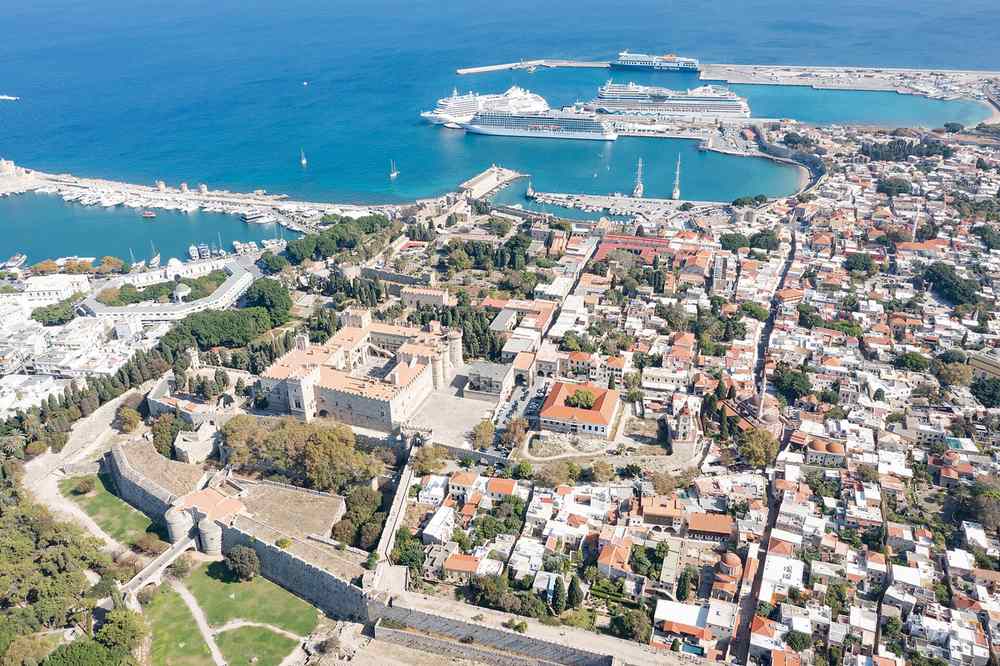
Day 1 belongs to Rhodes town. Spend the morning inside the medieval Old Town, walking the Street of the Knights to the Palace of the Grand Master, then wander the lanes and ramparts at your own pace. In the late afternoon, head to the Acropolis of Rhodes on Monte Smith, where the temple terraces and the restored stadium catch the light beautifully at sunset, a quiet contrast to the busy walled town. If you have an evening to spare, the lanes of the Old Town are at their most atmospheric after the day-trippers leave, when the floodlit walls and quiet squares feel a world away from the daytime bustle.
Day 2 follows the east coast to Lindos, whose whitewashed village climbs to a dramatic clifftop acropolis above the bay. Pair the climb with a swim at a nearby beach such as Tsambika or Anthony Quinn Bay. Day 3 turns west to Ancient Kamiros and the Valley of the Butterflies, or instead takes a boat to the island of Symi. Our guide to Rhodes Old Town covers the medieval quarter in depth, and the next section covers extending the trip to five to seven days.
How do you extend to a 5 to 7 day Rhodes itinerary?
To extend beyond three days, add more beaches, the Seven Springs at Epta Piges, the wine village of Embonas below Mount Attavyros, the southern coast around Prasonisi, and one or two extra island day trips. Spread these across the week so each new area gets its own unhurried day.
Once the three core days are done, the additions naturally radiate outward from Rhodes town. A relaxed beach day lets you explore stretches of coast you skipped earlier, while the Seven Springs offers a shaded inland walk through pools and a stream, a refreshing change from the open shoreline. These gentler days balance the busier sightseeing of the first three. A week also leaves room for the simple pleasures that make an island holiday, such as a long lunch in a hill village, an unplanned stop at a quiet cove, or an afternoon spent doing very little by the sea.
Higher up, the wine village of Embonas sits on the slopes of Mount Attavyros, the island’s tallest peak, and makes a natural base for exploring the interior. Further south, the long quiet beaches and the wind-swept spit at Prasonisi, where two seas meet, feel a world away from the resorts. Our guide to Lindos covers the east coast’s standout village, and the next section covers planning day trips within your itinerary.
How do you plan day trips within a Rhodes itinerary?
Plan day trips by treating each as a self-contained day built around one destination, whether an inland site, a far-coast beach, or a neighbouring island by boat. Book boat trips ahead in peak season and keep the rest of that day light so travel time does not crowd out the visit.
The most popular boat excursion is to Symi, a short sail north of Rhodes, where a horseshoe harbour lined with neoclassical houses rises steeply from the water. A day there typically allows a few hours ashore plus a swim stop, so it works best as a standalone day rather than tacked onto other plans. Confirm departure times the day before, as schedules shift with the weather. Building one flexible, unbooked day into a longer itinerary is wise too, giving you a buffer to move a boat trip if strong summer winds disrupt the crossings.
On land, day trips to Ancient Kamiros, the Valley of the Butterflies or the southern beaches each deserve their own day because they sit well away from Rhodes town. Group nearby stops together rather than driving back and forth, and start early to beat both the heat and the crowds. Our guide to the Symi day trip from Rhodes covers the boat excursion, and the next section covers practical planning tips.
What tips help you plan a Rhodes itinerary?
The most useful tip is to group sights by area and tackle one region per day, hiring a car for flexibility while using buses between the main resorts. Start early to avoid heat and crowds, and reserve boat trips in advance during the busy summer months.
A hire car gives the most freedom on Rhodes, opening up the interior villages, remote beaches and the southern tip that are awkward to reach otherwise. If you prefer not to drive, frequent buses link Rhodes town with the major east-coast resorts and Lindos, which is enough for a beach-and-town focused trip. Match the transport to the kind of itinerary you want before you book anything, since adding a car later in peak season can be difficult when the best vehicles are already taken.
Beyond transport, the timing of each day matters as much as the route. Sites such as the acropolis at Lindos and the Old Town are far more pleasant early or late, when the light is soft and the lanes are quiet. Carry water, plan a midday swim or rest, and leave some unscheduled time for the chance discoveries that make an island trip memorable. Even a loose plan works far better when each day has a single clear focus and a simple fallback in case the weather or the ferries change your plans. Plan your visit and tours through our Rhodes travel guide.
Frequently Asked Questions
Is three days enough for Rhodes?
Three days is enough to see the highlights of Rhodes if you plan by area and accept that you will leave plenty for a return visit. A sensible three-day route gives the first day to Rhodes town, including the medieval Old Town and the Acropolis of Rhodes on Monte Smith, the second to the east coast around Lindos with a beach stop, and the third to the west coast and interior or a boat trip to Symi. This covers the island’s most famous sights without long backtracking. What three days cannot do is reach the quieter corners, such as the Seven Springs, the wine villages around Embonas and Mount Attavyros, or the far south at Prasonisi. If those appeal to you, or you simply want a slower pace with more beach time, five to seven days is the more comfortable length for a Rhodes itinerary.
Do you need a car for a Rhodes itinerary?
You do not strictly need a car, but one gives by far the most flexibility on an island as large as Rhodes. A hire car lets you reach the interior villages, the Seven Springs, the mountain wine country and the southern beaches around Prasonisi, all of which are difficult or slow to visit by public transport. It also lets you start early and time your visits to avoid the heat and crowds. If you would rather not drive, frequent buses connect Rhodes town with the main east-coast resorts and with Lindos, which is enough for an itinerary centred on the town, the Old Town and a few well-served beaches. Boat day trips, such as the sailing to Symi, run regardless of whether you have a car. The right choice depends on how far off the main coastal strip you want to roam during your stay.
What is the best order to see Rhodes?
The best order is to group sights by area and dedicate each day to one region, which keeps driving to a minimum on this spread-out island. A natural sequence starts in Rhodes town, where the walled Old Town, the Palace of the Grand Master, the Street of the Knights and the Acropolis of Rhodes on Monte Smith sit close together. From there, work down the east coast to Lindos and its clifftop acropolis, pairing it with a beach such as Tsambika or Anthony Quinn Bay. Save the west coast and interior, including Ancient Kamiros and the Valley of the Butterflies, for a separate day, and treat a boat trip to Symi as its own self-contained outing. If you have a longer stay, slot the Seven Springs, Embonas and the southern beaches into the middle of the trip, so each distant area gets an unhurried day rather than being rushed.