
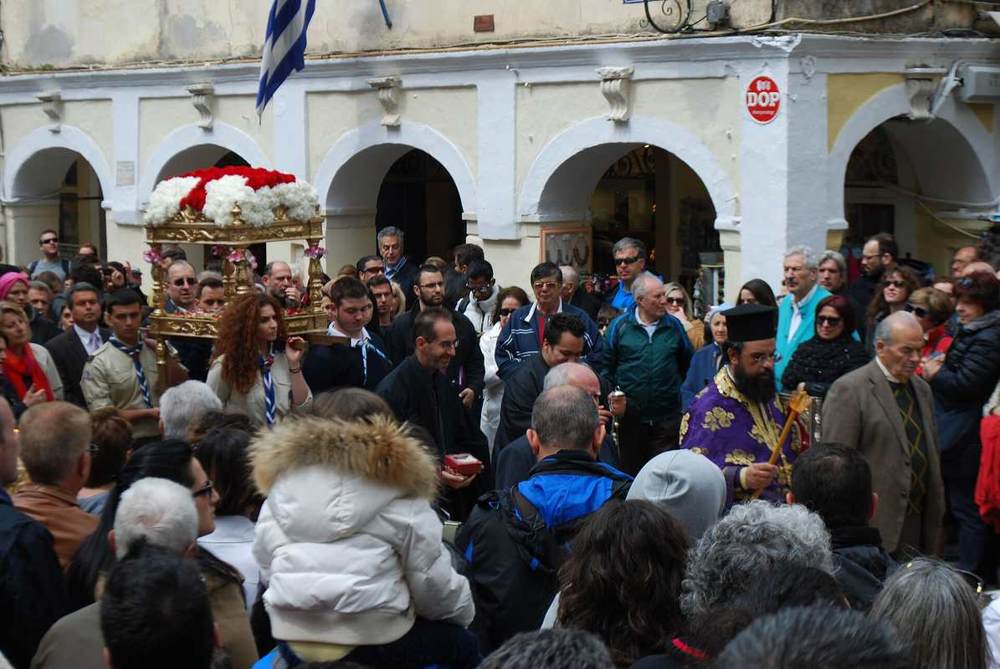
Greek Orthodox Easter, known as Pascha, is the biggest and most deeply felt festival of the entire Greek year, and on Rhodes it transforms the island into something quieter, older and far more moving than the summer holiday version most visitors know. Across Holy Week the medieval Old Town, the traditional inland villages and every parish church fill with candlelight, incense and slow processions, building towards a midnight moment of pure release. This is culture experienced rather than watched, with families opening their tables and their traditions to anyone present. If you want to see the island at its most authentic, spring is the season, and this guide from My Greece Tours explains exactly what to expect.
Easter on Rhodes rewards travellers who understand its rhythm, from the mournful Good Friday Epitaphios to the joyful Resurrection at midnight and the feasting that follows. For wider context on getting around, where to stay and what else to see, read our full Rhodes travel guide. The sections below cover Holy Week traditions, the midnight service, the Easter Sunday feast, the atmosphere in the Old Town and villages, and the honest pros and cons of visiting at this time.
What happens during Holy Week on Rhodes?
Holy Week, the days leading to Pascha, builds steadily through mourning and anticipation. Churches hold daily services, homes are cleaned and prepared, and by Good Friday the whole island turns solemn as Epitaphios processions carry the flower-decked bier of Christ through the streets after dark.
Holy Week, called Megali Evdomada, is the spiritual heart of the Greek year, and on Rhodes it unfolds with a seriousness that surprises visitors expecting a beach island. Each evening brings its own service, and the mood deepens as the week progresses. Homes are scrubbed and whitewashed, tsoureki bread is baked, and eggs are dyed deep red to symbolise the blood of Christ. By Holy Thursday the churches are draped in mourning, and the faithful queue quietly to venerate the cross. The rhythm is unhurried and communal, drawing families back from the mainland and abroad. Even non-religious travellers feel the gravity of these days, when the island seems to hold its breath before the great release of Easter night.
On Good Friday the island reaches its most sombre point. In the afternoon the Epitaphios, a wooden bier smothered in fresh flowers arranged by parishioners overnight, is prepared in every church to represent the tomb of Christ. After dark, each parish carries its Epitaphios in a slow candlelit procession, chanting hymns as it winds through the streets and squares, sometimes meeting other parishes along the way. In the Old Town the effect against medieval stone is unforgettable, and in the villages entire communities follow behind. Our guide to Rhodes Old Town covers the medieval quarter where these processions are most atmospheric, and the next section covers the midnight Resurrection service.
What is the midnight Resurrection service like?
On Holy Saturday, worshippers gather before midnight with unlit candles. At exactly midnight the priest brings out the Holy Light, the church darkens, and the flame passes hand to hand as everyone sings Christos Anesti, Christ is Risen, while fireworks and firecrackers erupt across the island.
The Anastasi, or Resurrection service, is the emotional summit of the whole year. On Holy Saturday evening the faithful fill the churches and gather in the squares outside, each holding a white candle called a lambada. Shortly before midnight the lights are extinguished and the church falls into darkness and silence, symbolising the tomb. Then the priest emerges with a single lit candle carrying the Holy Light and proclaims Come, receive the light. The flame is shared from candle to candle until the whole crowd glows, and at the stroke of midnight everyone bursts into the ancient greeting Christos Anesti, met with the reply Alithos Anesti, Truly He is Risen.
The moment the greeting rings out, the restraint of Holy Week breaks completely. Bells peal, fireworks light the sky over the town and villages, and firecrackers snap in the streets as strangers exchange the Easter greeting and kiss on both cheeks. People then carry their lit candles carefully home, trying to keep the flame alive through the door to bless the household for the year, often marking a small cross of soot above the entrance. Many break their long Lenten fast that same night with magiritsa soup. Our guide to best time to visit Rhodes covers how the seasons shape your trip, and the next section covers the Easter Sunday feast.
What do people eat for Easter Sunday on Rhodes?
Easter Sunday is a day of open-air feasting. Whole lamb or goat is spit-roasted slowly over charcoal from morning, served alongside red-dyed eggs cracked in the tsougrisma game, tsoureki sweet bread, salads, wine and endless mezedes shared among family and neighbours.
After the long fast of Lent, Easter Sunday is the great feast, and on Rhodes it happens outdoors wherever there is space, in courtyards, gardens and village squares. From early morning the spit is turned over glowing charcoal, and the smell of roasting lamb or kid drifts through every neighbourhood. The cooking is a social event in itself, with men tending the fire, women preparing salads and sweets, and children playing nearby while the meat browns for hours. Wine flows freely, and tables groan under mezedes, cheese, fresh bread and spring greens. The atmosphere is generous and unhurried, and visitors who have made even a small connection with a local family are often warmly invited to join.
No Easter table is complete without the red eggs, dyed on Holy Thursday and central to the game of tsougrisma, where two people tap their eggs point to point and the one whose egg stays uncracked is said to enjoy good luck for the year. Magiritsa, a soup made from lamb offal, herbs and lemon, traditionally breaks the fast after the midnight service, while tsoureki, a soft braided bread flavoured with mahleb and mastic and often studded with a red egg, is eaten throughout the day. Our guide to Rhodes food covers the island’s wider cuisine and specialities, and the next section covers the atmosphere in the Old Town and villages.
What is the Easter atmosphere like in the Old Town and villages?
The medieval Old Town and the traditional inland villages offer the most atmospheric Easter on Rhodes. Candlelit processions along cobbled lanes, Byzantine chapels, whitewashed village squares and close-knit communities create a spiritual intensity that the modern resorts simply cannot match.
The walled Old Town of Rhodes, one of the best-preserved medieval towns in Europe, becomes extraordinary at Easter. Its narrow cobbled lanes, stone archways and small Byzantine churches provide a setting that feels almost unchanged for centuries, and the Good Friday processions moving through this backdrop by candlelight are genuinely spine-tingling. The usual tourist bustle is absent, replaced by residents, incense and quiet reverence. Because many visitors have not yet arrived for the season, you experience the quarter as a living community rather than a showpiece, with local families walking to their parish church and neighbours greeting one another softly in the lamplit streets before returning home to break their fast together.
Inland, the traditional villages such as those on the slopes of the interior show Easter at its most intimate and unchanged. In places like Lindos, with its whitewashed houses and hilltop chapel, and in smaller mountain settlements, the entire community takes part, and customs are followed exactly as they have been for generations. Village churches are the focus of daily life through Holy Week, and the Easter Sunday feasts spill into squares and courtyards where everyone knows everyone. Our guide to Lindos covers this iconic village and its dramatic setting, and the next section covers the pros and cons of visiting at Easter.
What are the pros and cons of visiting Rhodes at Easter?
Visiting at Easter offers authentic culture, mild spring weather and far fewer crowds than summer, making it deeply rewarding. The trade-off is that some resorts, tours and tourist services are not yet fully open, and shops and sites may close on the holy days themselves.
The advantages of an Easter visit are considerable for the right traveller. You witness the most important festival in Greek life at close quarters, share in genuine traditions rather than staged shows, and enjoy the island in gentle spring weather when wildflowers cover the hills and the days are mild and clear. Crowds are a fraction of the summer peak, so the Old Town, the archaeological sites and the coastline feel spacious and calm. Prices for flights and rooms are usually lower outside the main season, and locals have more time to talk. For anyone interested in culture, food and photography, this is arguably the finest and most meaningful time of year to experience the real Rhodes.
The drawbacks are practical rather than serious. Because Orthodox Easter often falls on a different Sunday to Western Easter, usually somewhere in April or May, it can land before the tourist season is fully underway, so some beach resorts, hotels and organised tours may not have opened yet, and the sea is still cool for swimming. On the holiest days, especially Good Friday and Easter Sunday, many shops, restaurants and even some attractions close so that people can observe the festival with their families, which needs a little planning around. Our guide to things to do in Rhodes covers what to see across the island in any season. Plan your visit and tours through our Rhodes travel guide.
Frequently Asked Questions
When is Orthodox Easter on Rhodes?
Greek Orthodox Easter, or Pascha, does not fall on a fixed calendar date and frequently lands on a different Sunday to Western Easter, usually somewhere in the spring, most often in April or May. The Orthodox Church calculates the date using the Julian calendar and the rules of the ancient councils, which is why it can differ from the Catholic and Protestant Easter by anything from a week to several weeks, though occasionally the two coincide. Because the exact Sunday shifts from one spring to the next, it is always worth checking the specific date well before you book, since the whole Holy Week schedule of processions and services builds towards it. Practically, an Easter visit means travelling in spring, when Rhodes enjoys mild, flower-filled weather but before the full summer season has begun, so you should plan for a shoulder-season trip rather than a peak-summer one.
Can tourists attend the Easter church services on Rhodes?
Yes, visitors are genuinely welcome to attend the Easter services, and doing so is one of the most memorable experiences the island offers. The Good Friday Epitaphios processions and the midnight Resurrection service on Holy Saturday are public events that spill out of the churches into the streets and squares, so you do not need to be Orthodox or to understand Greek to take part respectfully. It helps to dress modestly, to stay quiet and observant inside the church, and to follow the lead of those around you. For the midnight service, arrive in good time and buy a white candle, as sharing the Holy Light with the crowd is the heart of the moment. Standing among local families as the darkened church suddenly fills with candlelight and the whole town erupts into Christos Anesti is profoundly moving, and most Rhodians are happy to see respectful visitors sharing in their most important celebration of the year.
Is Easter a good time to visit Rhodes for a holiday?
Easter can be an excellent time to visit if you value culture and calm over guaranteed beach weather. You experience the island’s most important festival, enjoy mild spring temperatures and wildflowers, and share the Old Town and ancient sites with far fewer people than in high summer, often at lower prices. The trade-offs are that the sea is still cool, some beach resorts, hotels and organised excursions may not have fully opened for the season, and on the holiest days many shops, restaurants and attractions close so families can celebrate. If your priority is guaranteed hot swimming weather and a full resort programme, later in the season suits you better. If you want authentic Greek life, atmospheric processions, spring landscapes and a genuine sense of place, an Easter trip to Rhodes is hard to beat, provided you plan a little around the holy-day closures and treat the visit as a cultural spring break.