
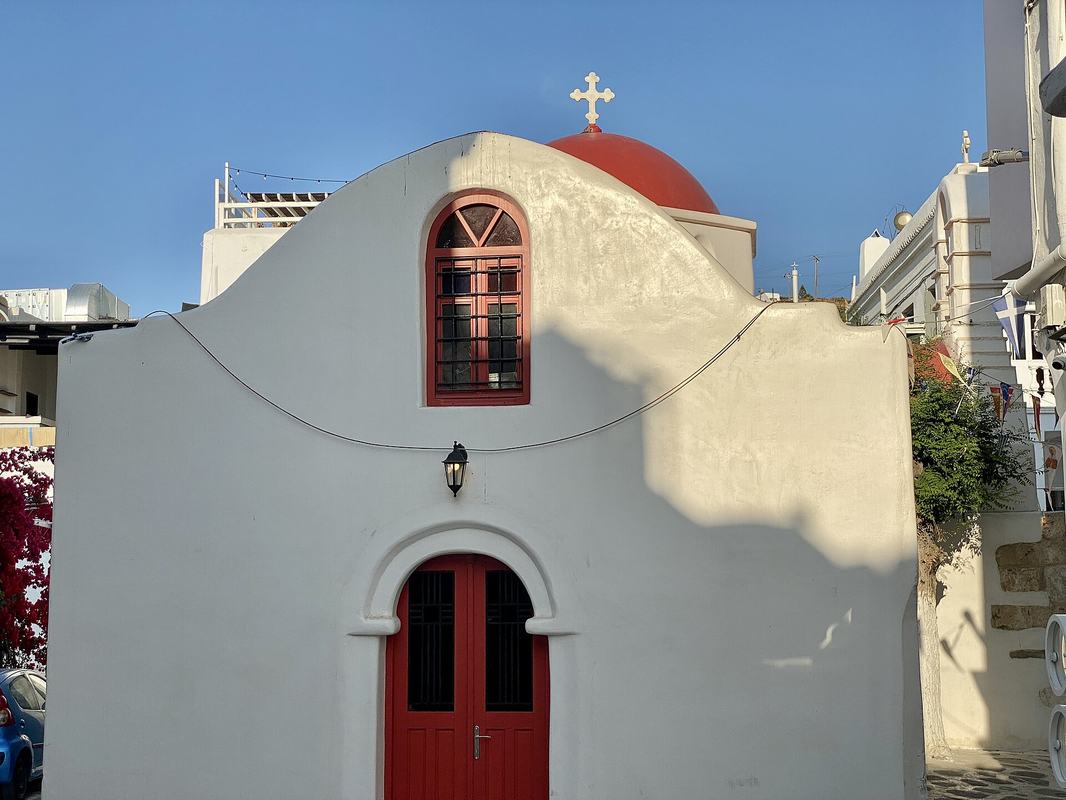
Panagia Protothronos stands on the central square of Halki, in the green heart of the Tragaea valley on Naxos. The whitewashed church ranks among the oldest continuously used places of worship on the island, its walls carrying frescoes painted across the Byzantine centuries. The name means “Our Lady enthroned first”, a title tied to an early bishopric seat here. Travellers reach the square through olive groves and old marble towers, then step from bright sunlight into a cool, painted interior. This guide explains the building, its art and its story, and shows how to reach and enter it respectfully. Explore Naxos with My Greece Tours.
The church sits at the core of the Tragaea, the fertile inland region that anchors any serious Naxos travel guide. Its layered wall paintings record the changing hands and tastes of the island across long stretches of Byzantine rule. The sections below cover what the monument is, its history and frescoes, its cruciform architecture, its place within Halki, and the practical details you need for a respectful, well-timed visit. Each part links to nearby villages, churches and routes so you can build a full day around the square rather than a single quick stop.
What is the Panagia Protothronos church in Naxos?
Panagia Protothronos is a whitewashed Byzantine church on the main square of Halki, dedicated to the Virgin Mary. It ranks among the oldest continuously used churches on Naxos, holding frescoes from across the Byzantine era.
The name translates as “Our Lady enthroned first”, a phrase pointing to an early episcopal seat established at this spot. The church grew from an early-Christian building and kept its role as a place of worship without a long break, which is rare for a monument of this age. Its plain outer walls hide a richly painted interior, so the contrast between the bright square and the dim, frescoed nave defines the visit. The church anchors the village of Halki both spiritually and geographically, standing where the roads of the Tragaea meet. Local families still gather here for feast days, keeping the building a living parish rather than a sealed museum piece open only to ticket holders.
The monument belongs to a dense network of painted chapels across the Tragaea valley, a landscape studied by anyone tracing the history of Naxos. Byzantine Naxos held a bishop, and Protothronos marked that authority in stone and paint. Its walls were not decorated in one campaign; instead, successive generations added and covered images as styles and needs shifted. The church therefore reads like a stacked archive of island faith, each layer set down by a different century. Visitors who slow down can pick out this depth in the plaster. The building rewards a careful look far more than a passing glance, and it sets the tone for the wider village square around it.
What is the history behind Panagia Protothronos in Naxos?
The church traces its origin to the 6th century, growing from an early-Christian basilica into a Byzantine cross-plan building. It served as an episcopal seat and remained in continuous use through the island’s long Byzantine and later history.
The earliest phase reaches back to the 6th century, when an early-Christian basilica occupied the site at the centre of the Tragaea. Naxos held a bishop during Byzantine rule, and Protothronos carried that seat, a status echoed in its “enthroned first” name. The building was reworked over the Byzantine centuries into a cross-shaped church, absorbing new walls, arches and painted programmes as it went. This long, unbroken use sets it apart from ruined chapels that dot the countryside. It stands close to other landmark churches that shaped island faith, including the celebrated Panagia Drosiani a short drive away in the same valley. Together these monuments trace the arc of Christian Naxos across a wide span of centuries.
Successive rulers, clergy and painters left their mark without erasing the core of the church. The frescoes accumulated in distinct phases, so historians read the walls as a timeline rather than a single moment. The Tragaea itself, ringed by Byzantine towers and monasteries, formed the island’s inland power base, and Protothronos sat at its religious centre. The nearby Christos Fotodotis monastery guarded the eastern approaches while the square church held the heart. This layered past explains why scholars return to Halki again and again. The building is less a fixed relic than a record of how island worship changed hands, tastes and rulers while never once falling silent as a functioning church.
What frescoes and architecture define the church?
Protothronos is a cruciform, cross-in-square Byzantine church with a central dome, built over an early basilica. Its interior carries layered frescoes from a handful of centuries, revealing successive painting styles beneath and beside one another on the plaster.
The plan is cruciform, a cross-in-square shape crowned by a central dome, the classic Byzantine form for a church of this rank. Thick stone walls, whitewashed outside, support rounded arches and a modest cupola that gathers light onto the paintings below. The early-Christian basilica beneath the present church still shapes the eastern end and the sanctuary. The result is a compact, solid building suited to the exposed valley square rather than a soaring cathedral. This restraint is typical of island churches, which favour strength and shade over height. The architecture frames the art, drawing every eye toward the apse and the painted saints who watch over the nave from their ranks along the curving Byzantine walls.
The frescoes are the church’s true treasure, layered across the plaster in phases spanning the Byzantine centuries. Cleaning and study have revealed images set one over another, so early figures appear beside later ones on the same wall. Saints, feast scenes and the enthroned Virgin fill the apse and vaults in the rich palette of Byzantine art. This stacked decoration lets visitors read the building’s whole life in paint, a rare survival among the a wealth of painted villages of Naxos. The dim interior protects the pigments, so the colours hold their depth.
Slow, quiet looking rewards the visitor here, as each layer tells a different chapter of island devotion, style and skill across the long reach of the Byzantine world.
How does the church fit into the village of Halki?
Protothronos anchors Halki’s central square, the social and historic core of the Tragaea. Marble towers, kafeneia and the old Vallindras distillery ring the plaza, making the church the natural first stop on any village walk.
Halki was once the commercial and administrative capital of the Tragaea, and its square still carries that weight. The church sits at the centre, ringed by neoclassical houses, fortified towers and shaded cafes where visitors pause between sights. Stepping out of the painted interior, travellers find the Vallindras distillery, craft shops and marble lanes within a couple of steps. This tight cluster makes Halki one of the most rewarding stops among the villages of Naxos, and the church is its historic anchor. The plaza works as a natural base for exploring the wider valley on foot, with paths leading off toward chapels and olive groves.
A handful of island squares pack so considerable history into so small a space around a single church.
The church also connects Halki to the broader web of things to do in Naxos, since the Tragaea sits on the main cross-island road toward the mountain villages and Mount Zas. Day-trippers often pair Protothronos with the surrounding towers and nearby painted chapels in one loop. The square offers shade, food and parking, so it suits a relaxed midday halt rather than a rushed photo stop. Its central position means most Tragaea itineraries pass through here anyway. The church, the distillery and the marble lanes together give travellers a full sense of inland Naxos, far from the coastal resorts, in a compact and walkable village setting that repays an unhurried visit.
How do you visit Panagia Protothronos?
Reach Halki by car or bus from Naxos Town, roughly a twenty-minute drive inland. Entry is usually free, hours are limited and mainly morning, and modest dress covering shoulders and knees is expected.
Halki lies about twenty minutes inland from Naxos Town along the main cross-island road, and buses serve the village through the day. The church stands right on the central square, so no long walk is needed once you arrive. Opening hours are limited and lean toward the morning, and the building may close during the midday break, so an early visit is the safest plan. Entry is generally free, though a small donation for upkeep is welcome. It asks for modest dress that covers shoulders and knees, and quiet, respectful behaviour inside as an active church. Photography rules vary, so check for signs and avoid flash near the fragile frescoes on the ancient walls.
Pair the visit with the surrounding Tragaea sights to make the trip worthwhile, since the valley holds towers, chapels and walking paths within a short radius. Nearby stops such as Panagia Drosiani and the mountain villages sit an easy drive away, so a single loop can take in a series of monuments. Bring water, comfortable shoes and cash for the cafes and the distillery on the square. A morning at Halki leaves the afternoon free for beaches or Naxos Town. The Tragaea rewards slow travel, and this church is its quiet centrepiece. Plan your visit and tours through our Naxos travel guide.
Frequently Asked Questions
What does the name Panagia Protothronos mean?
Panagia Protothronos translates as “Our Lady enthroned first”, a title given to the Virgin Mary at this church. The phrase points to the building’s early rank as an episcopal seat, since Naxos held a bishop during Byzantine rule and this church marked that authority. The word Panagia means “All-Holy”, the common Greek title for the Mother of God, while Protothronos combines the roots for “first” and “throne”. The name therefore signals both devotion to the Virgin and the church’s standing as a primary seat of island faith. It fits the building’s long, continuous use and its central place in the Tragaea valley.
The title has stuck through the centuries and still marks the church on maps, road signs and feast-day notices today. Travellers who understand the name grasp at once why this modest whitewashed building carries such weight in the religious history of Naxos and its inland heart.
Is Panagia Protothronos still an active church?
Panagia Protothronos remains an active parish church, not a sealed museum. Local families gather here for services and feast days, keeping the building a living part of Halki rather than a fenced-off ruin. This continuous use is central to the church’s identity and helps explain why it ranks among the oldest churches in unbroken worship on Naxos. It asks visitors to respect its role: dress modestly with shoulders and knees covered, keep voices low, and avoid disturbing any service in progress as a working church. Photography may be restricted, and flash is discouraged near the fragile frescoes.
The feast of the Virgin draws the community to the square, so timing a visit around a festival offers a vivid glimpse of living island tradition. Treating the church as an active place of prayer, rather than only a monument, gives travellers a fuller and more respectful experience of Halki and the wider Tragaea valley.
How old are the frescoes inside the church?
The frescoes span a handful of centuries of the Byzantine era, layered one over another across the church’s interior walls. The building itself traces its origin to the 6th century, and painted programmes accumulated in distinct phases over the long stretch of Byzantine rule that followed. Cleaning and study have uncovered images set beneath or beside later ones, so a single wall can show more than one period of art at once. This stacked decoration turns the interior into a visual timeline of island faith and painting style. Saints, feast scenes and the enthroned Virgin fill the apse, vaults and dome in the rich colours typical of Byzantine work.
The dim, cool interior has helped protect the pigments over the centuries. Visitors who look closely can trace how the church was decorated, covered and redecorated as tastes and needs changed, making the frescoes one of the richest surviving records of Byzantine painting anywhere in the villages of Naxos.