
Naxos and Syros sit in the same Cyclades, yet they answer very different questions. Naxos is the largest island in the group, a broad landscape of long sandy beaches, mountain villages and ancient marble. Syros is the administrative and cultural capital of the Cyclades, built around the grand neoclassical port of Ermoupoli. One leans toward beach days and open space; the other toward architecture, theatre and year-round island life. This guide compares them fairly across the things that shape a holiday, so the choice fits your trip rather than a headline. Plan the details and book excursions on either island with My Greece Tours.
Naxos rewards travellers who want beaches, hiking and a slower rhythm, and our Naxos travel guide maps the whole island in depth. Syros rewards travellers drawn to elegant towns, culture and an authentic working port that never fully empties in winter. The sections below cover the core difference between the two, their beaches, their towns and architecture, the atmosphere and who each island suits, and how to combine both across one Cyclades itinerary without wasted days.
What is the core difference between Naxos and Syros?
Naxos is a large beach-and-mountain island built for relaxed, active holidays across long coastlines and inland villages. Syros is a compact cultural capital centred on the neoclassical port of Ermoupoli, elegant and year-round.
Naxos measures its scale in kilometres of sand and metres of altitude. Zas, the highest peak in the Cyclades, rises above valleys of olive groves and stone villages. The coastline runs for long uninterrupted stretches on the west, so beach space rarely feels scarce. Distances are real, and a rental car turns the island from a resort into a region to explore. The Naxos travel guide lays out how the coast, the mountains and the old town connect. Travellers who want variety across one island gain the most here. The pace stays unhurried even in high summer, and the interior offers cool, green counterpoints to the shore that few other Cyclades islands can match at the same size.
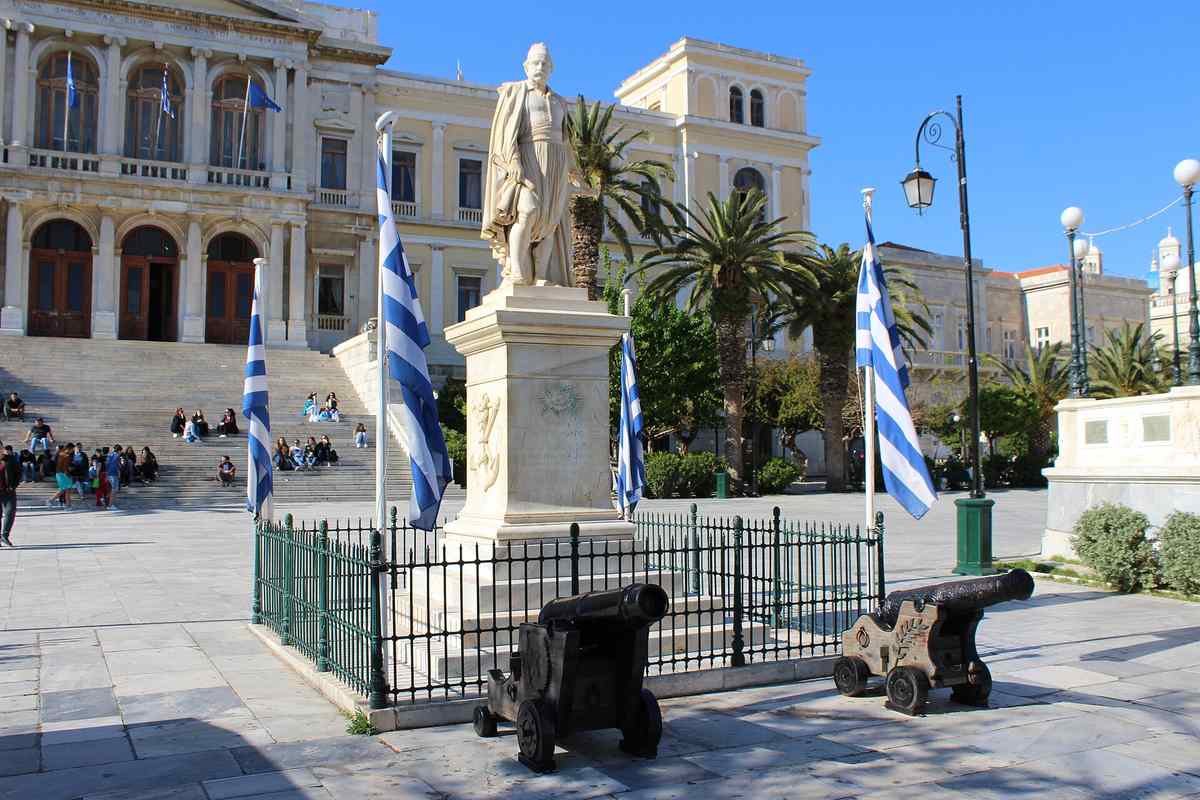
Syros concentrates its character in one remarkable town rather than across a wide territory. Ermoupoli grew wealthy as a nineteenth-century shipping and trade capital, and the marble squares, mansions and the Apollon theatre still carry that ambition. The island keeps a full population through winter, so shops, tavernas and civic life run on a local calendar rather than a tourist one. Beaches are smaller and more sheltered, gathered mainly on the south and west. Syros suits travellers who treat the town itself as the destination and the coast as an accompaniment.
The contrast is clear: Naxos spreads outward into landscape, while Syros draws inward toward architecture and daily urban rhythm that stays authentic across every season of the year.
How do the beaches on Naxos and Syros compare?
Naxos owns some of the longest sandy beaches in the Cyclades, wide and shallow along its west coast. Syros offers smaller, calmer coves, more sheltered and closer to town but less expansive.
Naxos beaches form an almost continuous ribbon south of the main town. Agios Prokopios, Agia Anna and the vast Plaka run into one another across pale sand and shallow turquoise water that suits families and swimmers. Further south, Mikri Vigla draws windsurfers and kitesurfers to reliable afternoon breezes, while remote Alyko hides cedar dunes above quiet bays. The full range appears in our guide to the beaches of Naxos. Space is the defining quality here. Even in peak weeks the sheer length of coastline absorbs the crowds, and walkers can move from an organised beach with sunbeds to an empty stretch within minutes. The west-facing orientation also delivers long golden sunsets over the sea most evenings.
Syros trades scale for shelter and proximity. Galissas, Kini and Vari sit in protected bays with calm, clear water, and Kini in particular frames a memorable sunset behind fishing boats. Delfini and Armeos reward walkers with quieter swimming, and several coves lie a short drive from Ermoupoli, so a morning in town and an afternoon by the sea fit comfortably into one day. The beaches are more intimate than sweeping, better for a relaxed swim than a full beach-resort day. Sand gives way to fine pebble in places, and the sheltered geography keeps the water flat on breezy days that whip up the open western beaches elsewhere.
Syros rewards travellers who want the sea near a lived-in town rather than a dedicated coastal holiday.
Which island has the more striking towns and architecture?
Both impress differently. Naxos Town crowns a Venetian Kastro above a working harbour, while Syros presents Ermoupoli, a grand neoclassical port with marble squares and a UNESCO-listed medieval Catholic quarter at Ano Syros.
Naxos Town, or Chora, stacks whitewashed lanes beneath a Venetian castle, the Kastro, where Catholic noble families once lived behind carved coats of arms. Below, the harbour front leads to the Portara, the enormous marble doorway of an unfinished temple of Apollo that frames every sunset. The mountain villages extend the story inland, from marble-paved Apeiranthos to the fortified towers of Halki, all covered in our guide to the villages of Naxos. The Naxos Town experience mixes medieval layers with a lively modern quayside. Architecture here is Cycladic and Venetian, weathered and organic, growing out of the rock rather than planned, which gives the old town a maze-like charm that rewards slow wandering after dark.
Ermoupoli was designed as a capital, and it shows. Miaouli Square opens in marble beneath the neoclassical town hall, and the restored Apollon theatre echoes La Scala in miniature. Grand mansions climb the twin hills of Vrodado, crowned by the Orthodox church, and Ano Syros, the medieval Catholic settlement whose stepped lanes and Capuchin heritage carry protected status. The blend of Orthodox and Catholic, Greek and Italianate, is unlike anywhere else in the Cyclades. This is planned nineteenth-century grandeur rather than village vernacular. Ermoupoli reads as a small European city that happens to sit on an Aegean island, with painted ceilings, ironwork balconies and a genuine cultural programme.
Travellers who love architecture and history without a museum queue find Syros deeply rewarding on foot, morning to night.
Which island suits which kind of traveller?
Naxos suits beach lovers, families, hikers and travellers wanting variety and space. Syros suits culture seekers, architecture and theatre lovers, and travellers who prefer an authentic year-round town over a resort atmosphere.
Naxos fits a broad range of holidays under one roof. Families gravitate to the shallow west-coast sand, walkers head for Zas and the Tragaea valley, and food travellers chase the island’s cheeses, citron liqueur and potatoes across village tavernas. The atmosphere stays relaxed and unpretentious, busier than remote islands but never frantic. Ferry links are strong, and our guide on how to get to Naxos covers the routes and flight options. Travellers weighing nearby islands can also read Naxos vs Paros to see how the neighbours differ. Naxos rewards a week that mixes beach mornings, mountain afternoons and long dinners, with enough ground to explore that boredom never sets in across a longer, slower stay.
Syros appeals to travellers who value culture and authenticity over a classic beach break. The theatre and music scene, the film festival, the marble streets and the mix of Orthodox and Catholic heritage give it depth few small islands offer. It stays lively in winter because locals live and work there, so the tavernas serve residents, not just visitors, and prices reflect a real town. Couples, solo travellers and anyone drawn to elegant surroundings and a genuine sense of place feel at home. Those comparing quieter, traditional alternatives may find Naxos vs Tinos useful too. Syros rewards curiosity about how a Greek island actually functions across the whole year rather than only in the summer season.
Can you combine Naxos and Syros in one trip?
Yes. Both sit within the Cyclades and connect by ferry, so pairing them balances Naxos beaches and landscape with Syros culture and architecture across a single well-planned week in Greece.
The two islands complement each other rather than repeat. A common rhythm gives Naxos the larger share, four or five nights for beaches, villages and hiking, then two or three nights on Syros for Ermoupoli and its cultural life. Ferry connections across the central Cyclades make the hop practical, though schedules vary by season, so booking crossings ahead protects the itinerary. Starting on Naxos suits travellers who want to unwind first and finish with town evenings; reversing the order works equally well. The distinct characters mean neither island feels like a duplicate of the other, and the contrast becomes the highlight of the trip rather than a compromise between two similar destinations competing for the same days.
Order and timing shape the experience most. Peak summer favours Naxos for its beach range and Syros for warm evenings of open-air theatre and dining, while shoulder months reward Syros travellers with a town that never shuts down and Naxos walkers with cooler trails. Keep a buffer day around ferry connections so a cancelled crossing never collapses the plan. A pairing like this delivers the full spread of the Cyclades in one holiday: long sand and green mountains on one island, marble squares and living culture on the other. Plan your visit and tours through our Naxos travel guide.
Frequently Asked Questions
Is Naxos or Syros better for a first visit to the Cyclades?
Naxos is the more natural first-visit choice for travellers who picture classic Greek-island beaches, whitewashed old towns and easy variety. Its long west-coast sand, the Portara sunset and the mountain villages deliver the postcard Cyclades in one place, and strong ferry links make it simple to reach and to pair with neighbours. Syros makes a rewarding first visit for a different traveller, one drawn to elegant architecture, theatre and an authentic year-round town rather than a beach-first holiday. The grand port of Ermoupoli and the medieval quarter of Ano Syros feel unlike the standard island image, which surprises many arrivals. Neither choice is wrong. Beach seekers and families lean Naxos; culture lovers and architecture enthusiasts lean Syros.
Travellers wanting both can start on Naxos for the scenery and add a short Syros stay to close the trip with the cultural capital of the Cyclades.
How do you get from Naxos to Syros?
Naxos and Syros connect by ferry across the central Cyclades, and the crossing is short and frequent enough to make a two-island trip realistic. Both conventional and high-speed services run the route in the warmer months, with high-speed vessels covering the hop quickly and standard ferries taking a little longer for a lower fare. Frequency thins outside peak season, so travellers pairing the islands should check timetables and book crossings ahead rather than assuming a daily direct sailing. Syros also serves as the ferry hub of the Cyclades, which means connections through its port are among the most reliable in the island group, and a small airport adds another option for reaching it.
Building a spare buffer day around the crossing protects the itinerary against weather cancellations, which affect all Aegean routes. Ports on both islands sit beside their main towns, so transfers are quick and walkable on arrival.
Which island is livelier at night, Naxos or Syros?
The two islands offer different kinds of evening rather than a simple more-or-less. Naxos concentrates its nightlife along the Chora harbour front, where bars, tavernas and a relaxed after-dark crowd gather beside the water, busy in summer yet rarely rowdy. The mood stays social and unpretentious, geared toward long dinners and sunset drinks rather than clubbing. Syros trades volume for culture. Ermoupoli fills its marble squares with cafes and diners late into the evening, and the town’s theatre, live music and festival calendar give nights a cultural texture that runs across the whole year, not only in high summer. Because locals live there year-round, the evening atmosphere feels genuine rather than staged for visitors.
Travellers wanting beach-town buzz lean toward Naxos; those wanting elegant squares, music and theatre lean toward Syros. Both stay comfortable and safe, and neither is a party island in the mould of Mykonos or Ios.