
A published destination table counts 44 airports behind Mykonos flights: 4 in Greece and 40 in 22 other countries, and only the Athens link carries no seasonal tag. The hop from Athens takes 25 minutes by one count and 45 minutes by another, while London sits 3 hours 50 minutes away.
Anyone still weighing islands can open the Greece Tours homepage first, then return here for the schedule, the runway, the wind and the Athens connection on Mykonos.
Which cities send Mykonos flights, and which countries do they cover?
Mykonos flights reach the island from 44 different airports in the Wikipedia destination table: 4 in Greece and 40 abroad. The foreign airports sit in 22 countries. Athens is the only airport the table does not mark seasonal.
The table has 58 entries but only 44 different airports. Carriers overlap on the same city, so Tel Aviv, Naples and Rome each appear 3 times. Athens, Thessaloniki, Vienna, Munich, Geneva, Milan Malpensa, Riyadh and Bologna appear twice. Count airports, not lines, when you compare Mykonos flights with any other route list.
The 4 Greek airports are Athens, Heraklion, Rhodes and Thessaloniki. The table marks Heraklion, Rhodes and Thessaloniki as seasonal. Of all Mykonos flights in the table, the Athens link is the only one without a seasonal tag. The Mykonos island guide covers what the island offers once you land.
Abroad, the table counts the airports behind Mykonos flights by country like this:
- Italy: 6 airports (Salerno, Milan Malpensa, Naples, Rome Fiumicino, Bologna, Verona)
- United Kingdom: 4 (London Heathrow, London Gatwick, London Luton, Manchester)
- Germany: 4 (Frankfurt, Munich, Düsseldorf, Stuttgart)
- France: 4 (Paris Charles de Gaulle, Paris Orly, Nice, Lyon)
- Switzerland, the United Arab Emirates, Spain and Israel: 2 airports each
- 14 other countries with 1 airport each: Turkey, Serbia, Austria, Saudi Arabia, Bahrain, Kuwait, Luxembourg, Lebanon, Qatar, Hungary, Cyprus, the Netherlands, Belgium and Romania
Wikipedia’s template for these tables has a line titled Seasonal and a line titled Charter. In the table of Mykonos flights, 43 of the 44 airports sit on a Seasonal line. None sits on a Charter line, although the table intro says the listed carriers operate regular scheduled and charter flights.
Air charter means renting an entire aircraft instead of individual seats, says Wikipedia. The article calls it a non-scheduled service. It says charter flights need certification from the civil aviation authority of the country. Charter is the term to know when you read a list of Mykonos flights.
Mykonos flights carry the IATA code JMK and the ICAO code LGMK. IATA codes have three letters and are mainly used for timetables, reservations and baggage tags. ICAO codes have four letters, and the first one or two letters name the country. LG stands for Greece. London Heathrow shows the pairing: LHR in IATA and EGLL in ICAO.
How long do Mykonos flights take from Athens, London, Paris and other departure cities?
From Athens, Mykonos flights take 25 minutes by the Wikipedia island entry and about 45 minutes by a route-data page. Direct flights take 3 hours 50 minutes from London and 3 hours 25 minutes from Paris.
Wikipedia places the island 150 kilometres east of Athens, and Mykonos flights from there take 25 minutes by its count. A route-data page gives 136 kilometres between the two airports and about 45 minutes for the non-stop trip. Plan the day around the longer figure. Landing is covered in what the terminal offers on arrival.
Route-data pages give direct times for these cities. London is the farthest in the list at 2,519 kilometres, and Zürich is the nearest at 1,766 kilometres.
- London: 2,519 kilometres, 3 hours 50 minutes
- Paris: 2,237 kilometres, 3 hours 25 minutes
- Frankfurt: 1,935 kilometres, 2 hours 50 minutes
- Geneva: 1,863 kilometres, 2 hours 50 minutes
- Zürich: 1,766 kilometres, 2 hours 45 minutes
- Amsterdam: 3 hours 20 minutes
Each page gives one figure per city, not per airport. The Wikipedia table lists three London airports and two Paris airports. Check the airport on your ticket before you compare times for Mykonos flights. The pages give the same 2 hours 50 minutes for Frankfurt and Geneva, though Frankfurt lies 72 kilometres farther.
Mykonos flights land in Greece, which runs on Eastern European Time, UTC+2, and moves to UTC+3 in summer. The United Kingdom runs on UTC+0 in winter and UTC+1 in summer. Germany, France, Italy, Switzerland, Austria, Spain, Belgium, Hungary, Sweden and the Netherlands use Central European Time. It is UTC+1, and UTC+2 in summer.
Summer time starts on the last Sunday in March and ends on the last Sunday in October. Each region changes at 01:00 UTC. Greece therefore stays 2 hours ahead of the United Kingdom and 1 hour ahead of Central Europe all year. The gap holds for every one of the Mykonos flights in the list.
On the ticket for Mykonos flights from London, a 10:00 departure lands at 15:50 local time. That shows 5 hours 50 minutes between the two clocks, but the flight lasts 3 hours 50 minutes. A 10:00 departure from Paris lands at 14:25, and a 09:00 departure from Zürich lands at 12:45.
In which months do Mykonos flights run, and how big is the swing between the busiest and the quietest month?
Mykonos flights run in every month, and August is the busiest for passengers. The quietest month holds 4,370 passengers in one year and 7,742 in the other. August carries about 91 times that in one year and about 51 times in the other.
The airport site publishes a monthly traffic table for Mykonos flights. It sets one year beside the year before and splits passengers and flights into domestic and international. The airport labels the figures provisional. Wikipedia’s yearly table gives the same totals. Both years put the peak in summer and the low point in winter.
August leads for passengers in both years, at 396,427 and 395,610. July leads for Mykonos flights, with 4,027 and 4,162, or 130 to 134 a day. The low point is February in one year and December in the other. Those months count 100 and 173 flights. July counts about 40 times and about 24 times that.
- June to September carry between 80 and 81 percent of all passengers in both years.
- The six months from late spring to October carry about 94 percent.
- November to March carry about 3 percent.
- Flights follow the same shape, with June to September holding about 78 percent of them.
- International passengers make up between 66 and 69 percent of the yearly total.
The swing comes from foreign flights. From November to March, five months, the table counts 46 foreign flights in one year and 57 in the other. July alone counts 2,914 and 2,932. April to October carry more than 99 percent of the foreign passengers. Mykonos flights from abroad are a summer service.
Domestic Mykonos flights never stop. January counts 164 and 180 domestic flights, between 5 and 6 a day. July counts 1,113 and 1,230, between 36 and 40 a day. Wikipedia says the airport has limited flight connections and operating hours in the off-peak tourist season. A traveller without a winter flight can compare all the ways to reach the island.
Timetables run in two seasons: summer, from the last Sunday of March to the last Saturday of October. Winter takes the other 5 months. Foreign Mykonos flights jump from 16 and 22 in March to 176 and 163 in April. They fall from 404 and 402 in October to 20 and 19 in November.
How big an aircraft can land on Mykonos flights, and what does the runway allow?
Mykonos flights land on one asphalt runway, 16/34, that is 1,903 metres long and 30 metres wide. By Wikipedia’s rules of thumb, narrow-body jets fit that length and wide-body aircraft need more. The airport stands 123 metres above sea level.
Divide the table’s passengers by its flights. August comes to about 99 a flight in both years. The quietest months come to about 44 and about 45. That is an average load across Mykonos flights, not a seat count.
Wikipedia’s runway article sets two lines. A runway of at least 1,800 metres is adequate for aircraft below 100,000 kilograms. Wide-body aircraft need at least 2,400 metres at sea level. Both are general rules, not limits written for one airport. Mykonos flights sit between the two lines.
Wikipedia adds that any aircraft, Mykonos flights included, takes off lighter in hotter or more humid conditions. A narrow-body airliner has a single aisle, up to six seats abreast and a cabin under 4 metres wide. A wide-body fuselage is more than 5 metres across. A plane-spotting guide records narrow-body jets as the largest types it saw at the airport.
- The guide says the single runway, the lack of taxiways and the small apron limit the movements.
- It lists one apron for all flights, with open parking positions and no boarding bridges.
- A data page lists a VOR-DME named MKN and a non-directional beacon named MKO beside the runway.
- A project report states that the replaced runway surface is expected to withstand the projected traffic for 20 years.
Wikipedia defines a VOR as a short-range VHF radio navigation system for aircraft. A VOR paired only with distance measuring equipment is a VOR-DME. A non-directional beacon is a radio beacon with no inherent directional information. Runway lights serve darkness and low visibility, and from the air they outline the runway.
A slot is a permission from a slot coordinator to take off or land at a set time and date. Wikipedia calls an airport that allocates slots a Level 3, or coordinated, airport. A notice from the Hellenic Aviation Service Provider on missing slots uses LGMK as its sample destination. LGMK is the ICAO code of Mykonos Airport.
How does wind change landings and take-offs on Mykonos flights?
A wind that blows across the runway pushes the aircraft sideways, so landings and take-offs get harder. A wind along the runway helps. Mykonos flights meet a northerly summer wind, and the runway heading decides how much of it blows across.
Mykonos flights share the Aegean with the Etesian wind, also called the meltemi. Wikipedia calls it a strong, dry north wind that blows periodically from late spring to mid-September. Its direction falls anywhere between north-east and north-west, depending on local topography.
Wikipedia lists the runway used by Mykonos flights as 16/34. A runway number is the magnetic heading in tens of degrees, so end 34 points to about 340 degrees. A due north wind lies 20 degrees off that line. A north-west wind lies 25 degrees off and a north-east wind 65 degrees.
The crosswind is the part of the wind that blows across the runway. Wikipedia gives one rule for Mykonos flights: wind speed times the sine of the angle between wind and runway. A 10-knot wind at 45 degrees gives 7.07 knots across. A strong enough crosswind can damage the undercarriage of an aircraft on landing.
The Beaufort table on Wikipedia gives four steps from force 5 to force 8. The Etesian wind can blow at force 7 to 8, so Mykonos flights face the upper steps. Force 7 covers 28 to 33 knots. Force 8 covers 34 to 40 knots. Both ranges come from the Beaufort table on Wikipedia.
Every landing, Mykonos flights included, can end in a go-around. Wikipedia defines it as an aborted landing on final approach or after touchdown. The pilot or air traffic control starts it, and a sudden wind change is one listed reason.
After a go-around, the pilot can divert to an alternate airport. The pilot can also circle and wait, especially in bad weather, says Wikipedia. A flight plan names alternate airports for weather at the destination. When it calls for a hold, the extra fuel and the hold time appear on it. That is how wind delays Mykonos flights.
How does a connection through Athens work for Mykonos flights booked from outside Europe?
The traveller lands at Athens International Airport (ATH), clears Schengen entry checks and boards a domestic flight to JMK. On one carrier the bags can go through to the last stop. For Mykonos flights on separate tickets, the traveller collects and re-checks them.
Athens International Airport, code ATH, serves Athens and Attica as well as connecting traffic, says Wikipedia. The Mykonos Airport table on Wikipedia lists it as a domestic destination. Wikipedia puts the island 150 km from Athens, across the Aegean Sea, the gap that Mykonos flights from ATH cover.
Travellers who prefer the sea route can read the Mykonos to Athens options.
The airport has two terminals: a main terminal and a satellite terminal reached by an underground link. Check-in for Mykonos flights from ATH sits in the main terminal, which holds all 153 desks. Wikipedia assigns Hall A to flights to non-Schengen and non-European countries, and Hall B to intra-Schengen flights and domestic services.
Greece sits inside the Schengen Area. A traveller who starts outside the area goes through Schengen entry border checks on arrival, says Wikipedia. The reason it gives: officials at a later stop cannot tell who boarded at the origin and who joined midway.
Wikipedia describes through check-in as a booking where the passenger holds boarding passes for every flight. The bags go to the final destination. It adds that a passenger can use it when the whole trip runs with one airline. Wikipedia sorts the other cases like this:
- Interline ticket: carriers with an agreement handle one ticket across more than one flight.
- Separate tickets: for Mykonos flights, the passenger collects the bags and checks in again with the next carrier.
- Self-connecting trip, also called virtual interlining: a third party combines the flights, and through check-in can be missing.
Wikipedia calls itineraries on separate tickets riskier. The second carrier can be unaware of a delay on the first flight. It grants a cost-free rebooking after a lost connection less readily. Mykonos flights bought on a second ticket carry that risk.
The International Air Transport Association (IATA) publishes the Station Standard Minimum Connecting Time. It sets the official shortest time to move a passenger and luggage between two flights at one airport. Its list holds over 400 airports with the greatest connection traffic, and together they represent 90% of international connections.
Which private, charter and island-hopper flights share the Mykonos flights runway with scheduled traffic?
Charter flights and general aviation, such as business jets, share the runway with scheduled traffic on Mykonos flights. The Wikipedia table for Mykonos Airport names no other Cyclades island. Ferry transport remains the prominent way to hop between the islands.
General aviation is the ICAO term for all civil flying except commercial air transport and aerial work. Scheduled Mykonos flights count as commercial air transport, so they sit outside it. Wikipedia lists business aviation, meaning self-flown travel for business purposes, as a general aviation category. A business jet is a jet designed for transporting small groups of people.
Wikipedia says one peak season made it necessary to severely limit general aviation activity at Mykonos Airport. Private Mykonos flights were allowed only a technical stop of 2 hours. Wikipedia describes a technical stop as a stopover for refuelling. A later summer notice cut the stop to one hour.
Ground arrivals are covered in ground transfers after landing.
An airport slot is a set date and time to take off or land, granted by a slot coordinator. A business aviation association note says traffic spikes at Mykonos and other Greek tourist islands caused delays. The delays led to slot rules for general aviation flights under instrument rules. Only ad hoc slots are accepted, never a series.
Level 3 airports are the coordinated ones, where slots are required. Requests go to the Hellenic Slot Coordination Authority. The note adds that an operator needs a parking authorization number from the airport first. Heraklion and Thessaloniki are the two exceptions. On a multi-stop route, an operator can need to reposition to other Greek airports for parking.
Air charter is the business of renting an entire aircraft, not single seats, says Wikipedia. It is a non-scheduled service, and charter Mykonos flights need an operator with certification from the civil aviation authority. The airline table of Mykonos Airport says its carriers fly regular scheduled and charter flights.
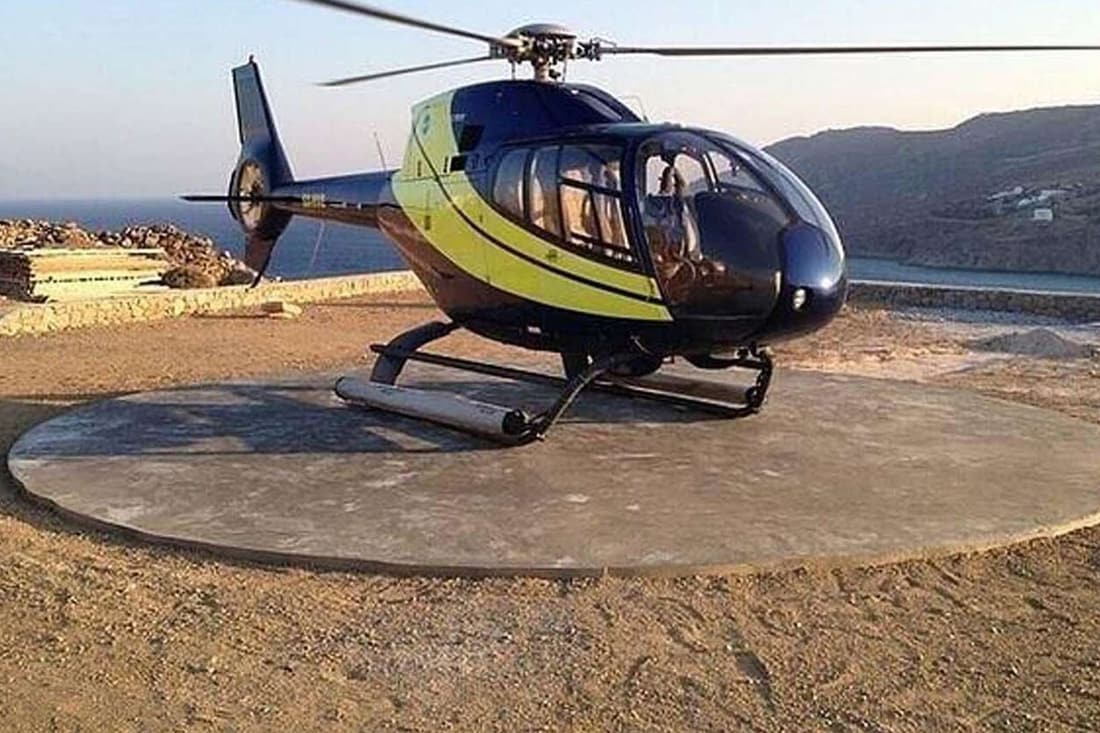
Rotor flights have a page of their own: helicopter flights over the island.
The Wikipedia tables for the Naxos, Paros, Syros and Milos airports name no route to Mykonos. Each of them lists Athens. Island hops by air do not appear among Mykonos flights in those tables. The runways of the neighbours show how small their airports are:
- Santorini: the main asphalt runway is 2,197 metres long, and Wikipedia calls the island one of the Cyclades with a major airport.
- Paros: runway 17/35 measures 1,400 metres, and the table lists seasonal charter flights to Klagenfurt and Graz.
- Syros: runway 18/36 measures 1,080 by 30 metres, and the island lies 144 km southeast of Athens.
- Milos: runway 08/26 measures 1,075 metres, and only a Dash 8, an ATR 42 or a smaller aircraft can use it because of the apron and the short runway.
- Naxos: runway 18/36 measures 901 metres, and the airport lies 3 km from Naxos City.
What else do travellers ask before booking Mykonos flights?
What do the codes JMK and LGMK mean on Mykonos flights?
JMK is the three-letter IATA code that timetables, reservations and baggage tags use for Mykonos flights. LGMK is the four-letter ICAO code that air traffic control and flight planning use. The first letters show the country, and the ICAO prefix table lists LG for Greece.
Which liquids can go in hand luggage on Mykonos flights?
Each liquid container holds no more than 100 ml. All containers go in one transparent re-sealable bag of up to one litre. The rule covers gels, aerosols, pastes and lotions. Essential medicines, baby food and milk can exceed 100 ml for use during the trip.
Where does a power bank travel on Mykonos flights?
EASA says spare batteries and power banks go in carry-on baggage on Mykonos flights, never in checked baggage. Each one needs its own protection against short circuits. A passenger can carry a maximum of two. EASA says not to recharge them on board.
How does a boarding pass write the time on Mykonos flights?
A boarding pass shows the passenger, the flight number, the date and the scheduled time for departure, says Wikipedia. The 24-hour clock sees common use in aviation. It writes times as hh:mm, for example 01:23, and the day begins at 00:00.
Which second name does Mykonos Airport carry on the list of Greek airports?
Wikipedia lists the airport as Mykonos Island National Airport and shows the name Dilos in quotation marks beside it. Wikipedia also spells the island Delos as Dilos. Delos is a small Greek island near Mykonos, close to the centre of the Cyclades.
Which Greek body regulates Mykonos flights?
Wikipedia describes the Hellenic Civil Aviation Authority as the government department for the regulation of civil aviation in Greece. It handles air traffic control and airport operations. Its tasks also include aircraft registration and the licensing of civil air operators.