
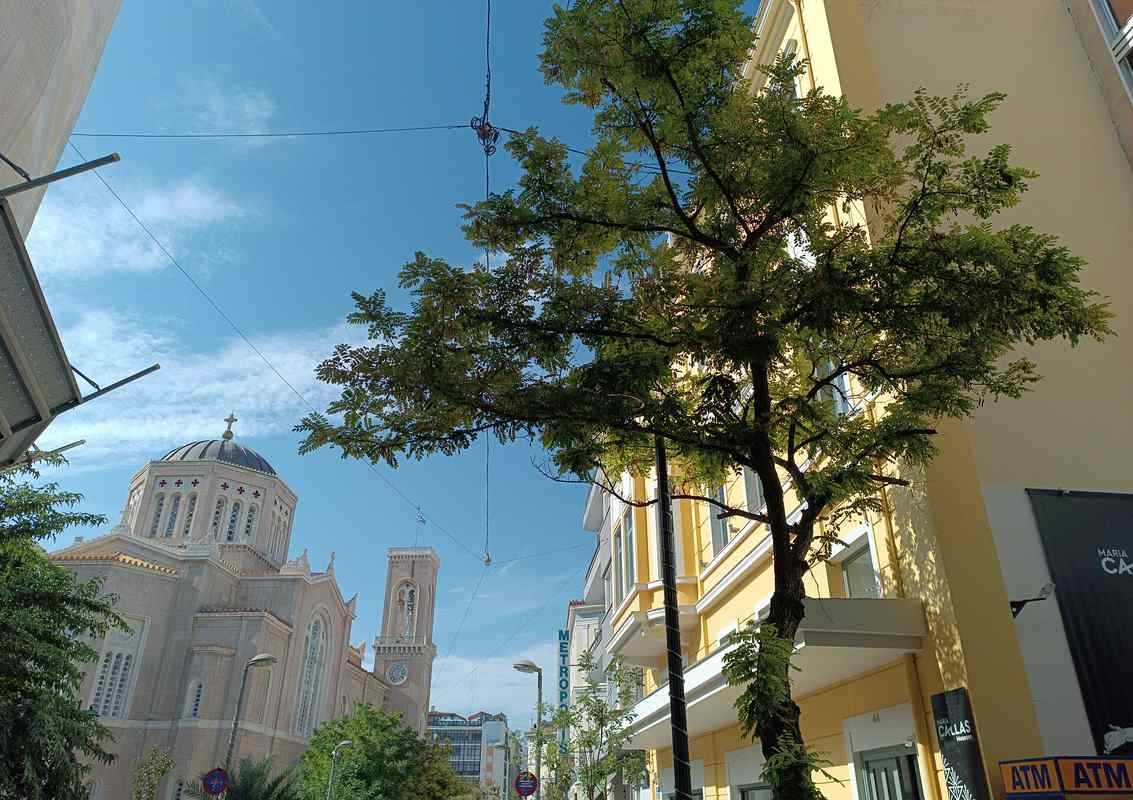
The Metropolitan Cathedral of Athens, the Mitropoli, is the great cathedral church of Greece, standing beside the tiny, jewel-like Byzantine Little Metropolis on its own square in the old centre. See it on a walk through historic Athens with skip-the-line sightseeing tickets and tours from My Greece Tours.
This important church and its ancient neighbour are a moving stop in the Athens travel guide. The sections below cover what it is, its history, the architecture, the Little Metropolis, the relics, practical details and how to get there.
What is the Metropolitan Cathedral of Athens?
The Metropolitan Cathedral of the Annunciation, popularly known as the Mitropoli, is the cathedral church of the Archbishop of Athens and of all Greece, and the most important Greek Orthodox church in the country. Standing on Mitropoleos Square in the old centre near Plaka and Syntagma, this grand 19th-century cathedral hosts major state and religious ceremonies and is free to visit.
At the spiritual heart of the city stands the Metropolitan Cathedral of Athens, a grand and important church that every visitor passes on a walk through the old centre. Formally dedicated to the Annunciation of the Theotokos, it is universally known by Athenians simply as the Mitropoli, or Metropolis, and it holds the highest religious status in the country as the cathedral church, or seat, of the Archbishop of Athens and of All Greece, the head of the Greek Orthodox Church. As such, it is the most important Orthodox church in Greece, the setting for the most significant religious services and major national and state ceremonies, including royal weddings and funerals and the funerals of prominent public figures.
The cathedral rises on its own open square, Mitropoleos Square, in the historic centre close to Plaka and a short walk from Syntagma, its imposing presence marking it out among the surrounding streets. Free to enter and richly atmospheric, it offers visitors a glimpse into the living faith and traditions of Greek Orthodoxy. Beside it stands a far older and tinier treasure. The surrounding old quarter is detailed in the Plaka guide. Its construction was a remarkable undertaking.
What is the history of the cathedral?
Work on the Metropolitan Cathedral started on Christmas Day in 1842, when the foundation stone was laid by King Otto and Queen Amalia. Built over 20 years by three successive architects, including Theophil Hansen, it famously used marble from 72 demolished old churches. It was completed and dedicated to the Annunciation by the King and Queen in 1862, becoming the cathedral of the new Greek state.
The story of the cathedral’s creation is closely tied to the birth of modern Greece and is unusually colourful. Construction began with great ceremony on Christmas Day in 1842, as the cornerstone was set in place by King Otto and Queen Amalia, the first monarchs of the newly independent Greek kingdom, who wished to give their young capital a cathedral worthy of the nation. The building took two full decades to complete, passing through the hands of three successive architects, beginning with the renowned Theophil Hansen and carried on by Dimitris Zezos, Panagis Kalkos and Boulanger, which partly explains its blend of styles. One of the most remarkable facts about its construction is that the workers built the cathedral’s immense walls using marble salvaged from seventy-two old and ruined churches that were demolished around the city, so the great church is quite literally constructed from the stones of its predecessors.
After twenty years of work, the completed cathedral was solemnly dedicated to the Annunciation of the Theotokos by the King and Queen on 21 May 1862. This rich history makes the building a monument to the faith and aspirations of the young Greek state. The era of King Otto shaped the city, as seen in the National Garden guide. Its architecture reflects that ambition.
What is the cathedral’s architecture like?
The Metropolitan Cathedral is a large three-aisled domed basilica, around 40 metres long and 20 metres wide, with a dome about 24 metres high. Its architecture blends neoclassical and Greek-Byzantine styles, reflecting its long construction by several architects. The interior holds notable frescoes, icons, the archbishop’s throne and the tombs of saints, creating a rich and atmospheric sacred space.
The Metropolitan Cathedral is an imposing and richly decorated building whose architecture rewards a closer look, even for those who only step inside briefly. In form it is a large three-aisled basilica crowned by a central dome, substantial in scale at roughly forty metres long and twenty metres wide, with the dome rising about twenty-four metres above the floor, making it a commanding presence on its square. Because it was built over twenty years by several different architects, its style is a distinctive blend of the neoclassical taste fashionable in nineteenth-century Athens and the Greek-Byzantine tradition of Orthodox church architecture, a combination visible in its facade and proportions.
Inside, the cathedral is decorated in the rich Orthodox manner, with notable wall frescoes and painted icons, a grand iconostasis screen, the ornate throne of the Archbishop of Athens, and elaborate fittings of marble and gilt that create a solemn, atmospheric sacred space. The interior also shelters important religious relics and tombs, lending it deep spiritual significance for the faithful. Whether admired for its architecture or its devotional atmosphere, the cathedral interior is well worth a visit. Its scale contrasts beautifully with its tiny neighbour. The Little Metropolis beside it is a gem.
What is the Little Metropolis?
The Little Metropolis, or Mikri Mitropoli, is a tiny 12th-century Byzantine church standing right beside the great cathedral, dedicated to Agios Eleftherios and the Virgin. Built partly from ancient and early Christian marbles, it is famous for the around 90 carved relief scenes covering its exterior walls. Far older and more charming than its giant neighbour, it is a jewel of Byzantine Athens.
Standing in the shadow of the great cathedral, and for many visitors even more captivating, is the exquisite little church known as the Little Metropolis, or Mikri Mitropoli, a true jewel of medieval Athens. Officially dedicated to Agios Eleftherios and the Panagia Gorgoepikoos, this tiny Byzantine church dates from around the twelfth century, making it many centuries older than the nineteenth-century cathedral beside which it sits. What makes it so remarkable is its construction and decoration: the church was built using a fascinating patchwork of ancient and early Christian marble pieces, spolia salvaged from older classical and Byzantine monuments, and its exterior walls are covered with around ninety carved relief scenes and panels, including ancient friezes, figures, animals and symbols.
Look closely and you will see that Christian crosses were carved over some of the older pagan images to “neutralise” them. Cruciform in plan and built almost entirely of marble, the Little Metropolis is a treasure of Byzantine art and one of the most charming small churches in Greece. Its intimate scale and intricate carvings make it a delight to examine after the grandeur of the cathedral. It is an unmissable detail of the square. The two churches together tell the story of Christian Athens. The cathedral also holds sacred relics.
What relics and features are in the cathedral?
The Metropolitan Cathedral holds the relics of two revered Orthodox martyrs: Saint Filothei, an Athenian noblewoman who rescued enslaved Greek women under Ottoman rule, and Patriarch Gregory V, hanged in Constantinople in 1821 and brought to Athens. Their relics rest in a marble chest carved by the famous sculptor Yannoulis Halepas. A small museum in the crypt holds further religious treasures.
Beyond its architecture, the Metropolitan Cathedral is a place of deep religious significance, above all because it shelters the sacred relics of two greatly revered Orthodox saints and martyrs whose stories are bound up with Greek history. The first is Saint Filothei, an Athenian noblewoman of the sixteenth century who devoted herself to charity and was made a saint for rescuing Greek women who had been taken captive into Ottoman harems, ultimately suffering martyrdom for her work; she is a patron of the city. The second is Patriarch Gregory V, the Ecumenical Patriarch of Constantinople who was hanged by the Ottoman authorities in 1821 in reprisal at the outbreak of the Greek War of Independence, his body cast into the Bosphorus before being recovered and eventually brought to Athens.
The relics of both martyrs lie within the cathedral inside a marble chest carved by the renowned Greek sculptor Yannoulis Halepas, the same artist behind the famous Sleeping Girl, drawing pilgrims and the faithful. The cathedral also houses a small museum in its crypt displaying further religious treasures and artefacts. These sacred elements make the church profoundly meaningful to Greek Orthodox believers. The martyrs link directly to the 1821 struggle, as told in the National Historical Museum guide. Visiting is easy and free.
How do you visit the cathedral?
The Metropolitan Cathedral stands on Mitropoleos Square in the old centre, a short walk from Syntagma and Monastiraki metro stations and within easy reach of Plaka and the Acropolis. Entry is free and no booking is needed, with the cathedral open daily, roughly 5.30am to 7.30pm, and Sunday mass in the morning. Dress modestly, covering shoulders and knees, and view the Little Metropolis beside it.
Visiting the Metropolitan Cathedral is simple, free and easily combined with sightseeing in the historic centre. The cathedral stands on its own open square, Mitropoleos Square, in the heart of the old city, only a short walk from both Syntagma and Monastiraki metro stations and within fifteen minutes on foot of the Acropolis, the Ancient Agora and the Temple of Olympian Zeus, so it slots naturally into any walking route through central Athens. Entry to the cathedral is completely free and there is no need to book in advance; it is generally open to visitors daily across a long span, roughly from 5.30am until 7.30pm, with Sunday mass held in the morning, usually between about 8.30 and 10.30am, when services rather than sightseeing take precedence.
As this is an active and important place of worship, visitors should dress respectfully, covering their shoulders and knees, and behave quietly and reverently inside, especially during services. Be sure to allow time to admire the tiny Little Metropolis church standing right beside the cathedral, with its remarkable carved walls. Together the two churches and their square make a moving and atmospheric stop. The wider old-town routes are explained in the getting around Athens guide. The questions below cover the points visitors ask most.
Frequently Asked Questions
What is the Metropolitan Cathedral of Athens?
The Metropolitan Cathedral of Athens, the Mitropoli, is the cathedral church of the Archbishop of Athens and of All Greece and the most important Greek Orthodox church in the country. Built between 1842 and 1862 using marble from 72 demolished churches, it hosts major religious and state ceremonies and stands on Mitropoleos Square.
What is the Little Metropolis next to the cathedral?
The Little Metropolis (Mikri Mitropoli) is a tiny 12th-century Byzantine church beside the great cathedral, dedicated to Agios Eleftherios. Built partly from ancient and early Christian marbles, it is famous for around 90 carved relief scenes covering its walls. Far older than the cathedral, it is a jewel of Byzantine Athens.
Is the Metropolitan Cathedral of Athens free to visit?
Yes, the Metropolitan Cathedral of Athens is free to enter, with no booking required, and is generally open daily from around 5.30am to 7.30pm, with Sunday mass in the morning. As an active church, visitors should dress modestly, covering shoulders and knees, and be respectful, especially during services.