
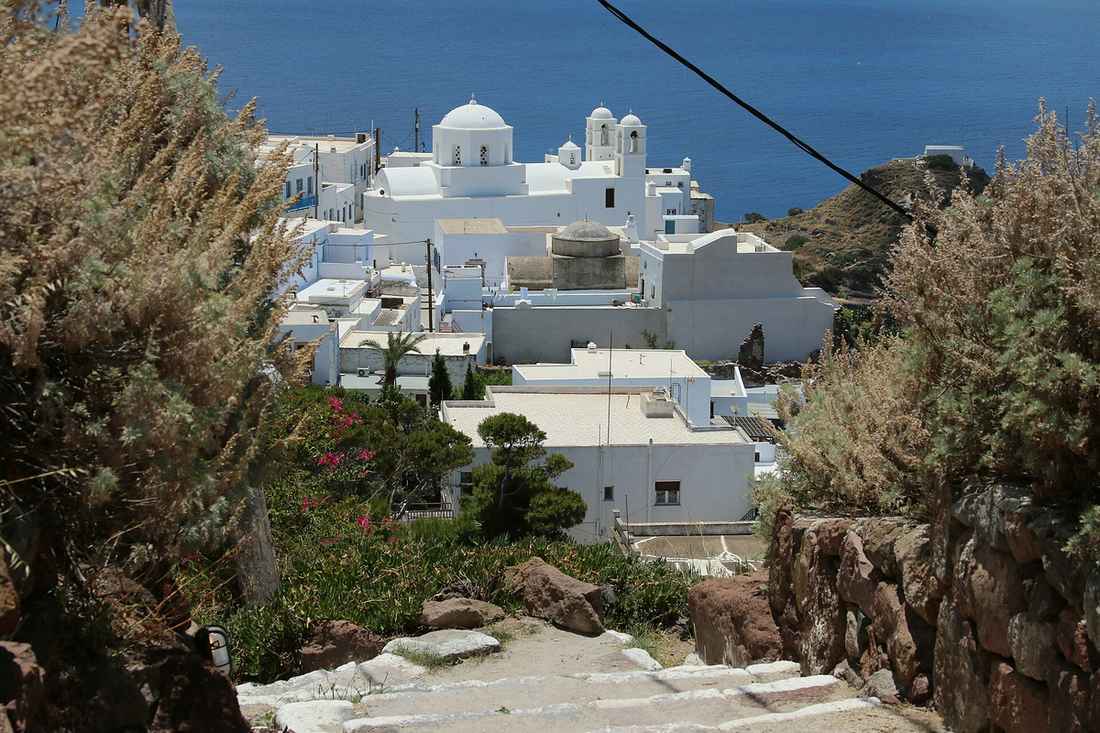
Milos churches number over 140, from the metropolitan Panagia Korfiatissa in Plaka to the ancient Panagia tou Kipou and the monastery of Agios Ioannis in Triades. Plan church visits and tours through My Greece Tours.
The churches are a quieter side of the Milos travel guide. The sections below cover how many churches there are, the main churches, the monasteries, the sacred island and how to visit them.
How many churches does Milos have?
Milos has over 140 churches and chapels, a remarkable number for a small island. They range from grand metropolitan churches to tiny family chapels dotted across the villages and countryside, reflecting the island’s deep religious tradition and its status as a sacred island.
Milos counts over 140 churches. The number astonishes on a small island. Chapels dot every village. The faith runs deep.
The churches vary widely. Grand metropolitan churches anchor the towns. Tiny family chapels speckle the land. Each carries its own story.
The countryside holds many. Whitewashed chapels crown the hills. Lonely shrines mark the coast. The blue domes catch the eye.
The churches define the island’s faith. They earn it a sacred name. Our guide to the things to do in Milos sets the scene. The next section covers the main churches.
For a small island, Milos holds an extraordinary number of churches, with more than 140 churches and chapels scattered across its villages, hills and coast. This density reflects a deep, long-standing religious tradition, in which families and communities built their own chapels for centuries. The result is a landscape dotted with whitewashed, blue-domed churches, from grand village churches to tiny shrines on remote headlands, each a small landmark in the scenery.
The churches tell the island’s story as much as its faith. Many date back centuries, with frescoes, icons and architecture spanning the Byzantine, Venetian and later eras. They sit at the heart of village life, hosting festivals and feast days through the year. For visitors, the churches offer a quieter, more cultural side of the island, rewarding a wander through the villages and a climb to the hilltop chapels with their sweeping views over the gulf and the sea.
What are the most important churches on Milos?
The most important Milos churches are Panagia Korfiatissa, the metropolitan church in Plaka, Panagia Thalassitra near the Kastro, the ancient Panagia tou Kipou, the oldest on the island, Panagia Tourliani above Klima, and Panagia Portiani in Zefyria.
Panagia Korfiatissa leads them. The metropolitan church crowns Plaka. Byzantine frescoes fill it. The terrace draws a sunset crowd.
Panagia Thalassitra guards the heights. It stands near the Kastro ruins. The protector of sailors watches the sea. The views sweep the gulf.
Panagia tou Kipou runs ancient. The Byzantine church is the oldest. It dates to the fifth century AD. The history humbles a visitor.
Two more reward a visit. Panagia Tourliani crowns a hill above Klima. Panagia Portiani anchors Zefyria. Our guide to Plaka covers the capital. The next section covers the monasteries.
Panagia Korfiatissa is the island’s most prominent church, the metropolitan church of Milos, founded in the nineteenth century and set on a hilltop in Plaka. Known for its Byzantine frescoes and fine architecture, it stands beside a famous sunset terrace with sweeping sea views. Nearby, close to the Kastro ruins, sits Panagia Thalassitra, the protector of sailors, alongside the small chapel of Panagia Eleousa, both offering gorgeous views over the gulf from the heights of the old town.
Several other Panagia churches reward a visit across the island. Panagia tou Kipou, built in Byzantine times and dating to around the fifth century AD, is the oldest church on Milos, a humble and deeply historic site. Panagia Tourliani sits on a small hill above the painted fishing village of Klima, prized for its old icons and the lovely view from its courtyard. Panagia Portiani, in the centre of the old capital of Zefyria, dates from the seventeenth century and survives as a preserved monument.
The most important churches reward an easy half-day. Panagia Korfiatissa, the metropolitan church, crowns the hilltop of Plaka with Byzantine frescoes and a famous sunset terrace. Nearby, Panagia Thalassitra, the protector of sailors, sits by the Kastro ruins with gorgeous gulf views. Across the island, Panagia tou Kipou, the oldest church, dates to Byzantine times, while Panagia Tourliani crowns a hill above Klima and Panagia Portiani anchors the old capital of Zefyria. Together they show the depth of the island’s faith and its long architectural history.
What are the main monasteries on Milos?
The main monastery on Milos is Agios Ioannis Siderianos, near Triades, set on a hill above a beautiful bay. One of the best-preserved on the island, it has served as a monastery since the sixteenth century.
Agios Ioannis Siderianos leads. The monastery sits near Triades. The northwest hill holds it. The bay spreads below.
The site runs old. It has served since the sixteenth century. The documents confirm the date. The history endures.
The setting rewards a visit. The hill opens over a bay. The remote spot feels timeless. The peace draws the pilgrim.
The monastery crowns the northwest. The remote bay frames it. The beach at Triades sits nearby. The next section covers the sacred island.
The most notable monastery on Milos is Agios Ioannis Siderianos, set on a hill above a beautiful bay near Triades in the remote northwest of the island. One of the best-preserved monasteries on Milos, it has functioned as a monastery since the sixteenth century, according to documents that have been identified, giving it a long and well-recorded history. Its isolated setting, far from the main towns, adds to its atmosphere of peace and devotion.
The monastery is tied to local tradition and pilgrimage, with its feast day drawing visitors to the remote bay. Reaching it involves a drive to the northwest of the island, often on rougher roads, which keeps it quiet and unspoiled. The journey rewards visitors with both the historic monastery and one of the island’s wilder, more secluded corners. For travellers interested in the island’s religious heritage, it makes a worthwhile contrast to the village churches around Plaka and Adamas.
Why is Milos a sacred island?
Milos is named a sacred island by the Holy Synod mainly because of its early-Christian catacombs, among the most ancient Christian monuments in Greece. Together with its 140-plus churches, the catacombs give the island a profound religious significance in the Orthodox world.
The catacombs earn the title. They rank among the oldest Christian monuments. Greece holds few so ancient. The Holy Synod marked it sacred.
The early Christians worshipped here. They carved the tombs in the rock. The faith took root early. The history runs deep.
The churches reinforce the status. Over 140 dot the island. The faith fills the landscape. The sacred name fits.
The island carries a holy weight. Faith and history meet here. Our guide to the Milos catacombs tells the story. The next section covers how to visit.
Milos holds a special place in the Orthodox world, named a sacred island by the Holy Synod largely because of its early-Christian catacombs. Carved into the soft volcanic rock near Trypiti, the catacombs are among the most ancient Christian monuments in Greece, where the early Christians worshipped and buried their dead. Their age and significance give the island a religious weight far beyond its size, drawing pilgrims and history lovers alike.
The catacombs are only the foundation of the island’s sacred character. The remarkable density of churches, more than 140 across a small island, speaks to centuries of deep devotion among the local communities. Feast days and religious festivals fill the calendar, especially in summer, animating the village churches and remote chapels. Together, the ancient catacombs and the countless churches make Milos one of the more spiritually significant islands in the Cyclades, a side that complements its beaches and geology.
The sacred status of the island runs deeper than any single church. The early-Christian catacombs near Trypiti, carved into the volcanic rock, are among the most ancient Christian monuments in Greece, where the first believers worshipped and buried their dead. The Holy Synod declared the island sacred largely on their account. The remarkable density of churches, more than 140 across a small island, and a calendar full of feast days reinforce that standing. Together, the catacombs and the countless churches make Milos one of the more spiritually significant islands in the Cyclades.
How do you visit the churches of Milos?
You visit the churches of Milos easily by car, quad or on foot, as the main ones cluster around Plaka, Adamas and the villages. Dress modestly, respect service times, and combine the hilltop churches with sunsets and the catacombs for a rich cultural day.
The main churches cluster close. Plaka holds Korfiatissa and Thalassitra. Adamas keeps its own churches. A short drive links them.
Getting there is simple. A car, quad or the bus reaches the villages. The hilltop churches need a short walk. The lanes guide the way.
Respect eases a visit. Modest dress suits the churches. Quiet honours the services. The custom matters at the door.
A church day rewards the visitor. It pairs sunsets with history. Combine them with the Folklore Museum in Plaka for a cultural day.
Frequently Asked Questions
How many churches are there on Milos?
Milos has over 140 churches and chapels, a remarkable number for such a small island. They range from grand metropolitan churches in the towns to tiny family chapels and remote shrines dotted across the villages, hills and coast. This density reflects a deep, centuries-old religious tradition, in which families and communities built their own chapels. The result is a landscape scattered with whitewashed, blue-domed churches, each a small landmark in the scenery. Together with the early-Christian catacombs, this abundance of churches earned Milos its status as a sacred island.
What are the most important churches on Milos?
The most important churches on Milos include Panagia Korfiatissa, the metropolitan church set on a hilltop in Plaka, known for its Byzantine frescoes and famous sunset terrace, and Panagia Thalassitra, the protector of sailors, near the Kastro ruins. Panagia tou Kipou, dating to around the fifth century AD, is the oldest church on the island. Panagia Tourliani sits above the fishing village of Klima with a fine courtyard view, and Panagia Portiani, in the old capital of Zefyria, is a preserved monument from the seventeenth century. The monastery of Agios Ioannis Siderianos near Triades is also notable.
Why is Milos a sacred island?
Milos is named a sacred island by the Holy Synod mainly because of its early-Christian catacombs, carved into the volcanic rock near Trypiti and among the most ancient Christian monuments in Greece. Here the early Christians worshipped and buried their dead, giving the island a profound religious significance. This is reinforced by its extraordinary density of churches, more than 140 across a small island, and a calendar full of religious feast days and festivals. Together, the ancient catacombs and the countless churches make Milos one of the most spiritually significant islands in the Cyclades.