
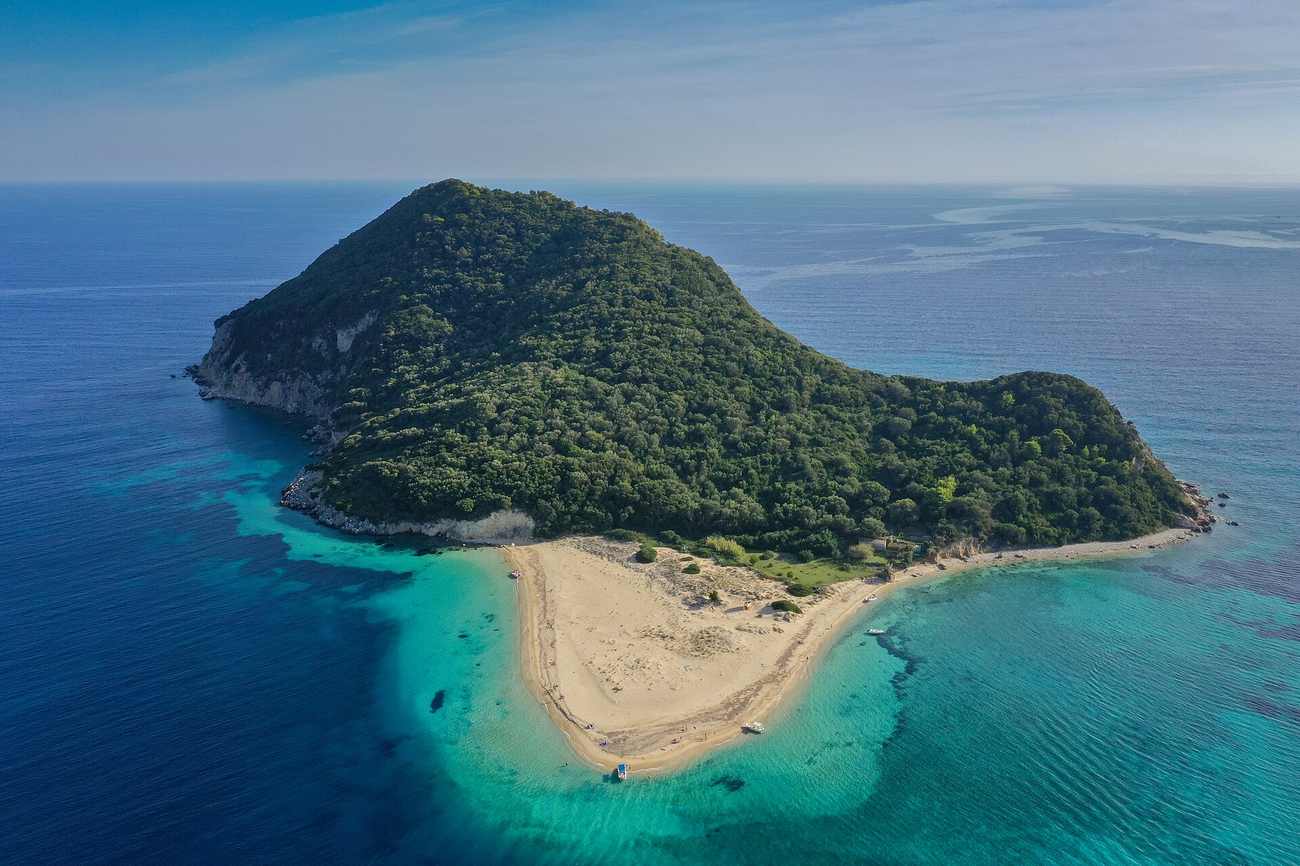
Marathonisi is a small uninhabited islet in Laganas Bay on the south coast of Zakynthos, and its low green profile and pale headland make it look exactly like a swimming turtle. The resemblance is so striking that the whole islet is called Turtle Island. Visitors reach it by boat from Keri, Agios Sostis or Laganas, and its untouched shoreline leaves a lasting impression. The islet lies inside the National Marine Park of Zakynthos and joins striking natural beauty to the conservation story of the loggerhead turtles. Plan your whole adventure with My Greece Tours.
Marathonisi joins striking natural beauty to the conservation story of the Zakynthos turtles in a way that feels immediate and vivid. The islet has no buildings or facilities, yet it draws visitors who appreciate its unspoiled character and its role as a genuine nesting site for the loggerhead sea turtle. The sections below cover how to reach the islet by boat, what to expect on its shore, and why the National Marine Park of Zakynthos matters for every traveller. For broader planning, our Zakynthos travel guide lays out everything the island offers.
Where is Marathonisi located in Zakynthos?
Marathonisi lies inside Laganas Bay on the south coast of Zakynthos, inside the National Marine Park. The uninhabited islet sits in the warm, shallow waters of the bay, close to the resorts of Keri, Agios Sostis and Laganas.
The south coast of Zakynthos curves into Laganas Bay, a wide and sheltered stretch of water that holds Marathonisi at its very heart. The bay is the reason the islet exists as a destination at all, since its calm, shallow warmth draws the loggerhead turtles to nest along the sandy shoreline year after year. Resorts line the bay on the mainland side, and the closest of them is Laganas Beach, a long strip of sand that runs directly north of the islet.
From there, small boats leave across flat water to reach the turtle-shaped headland in minutes, passing over the same seagrass meadows that feed the very animals that give the bay its distinct character and its fully protected status in Greek and European law.
Keri, on the western side of Laganas Bay, is the second main departure point for boats heading to Marathonisi. The small harbour sits beneath tall cliffs, and the boat ride to the islet traces a coastline of white rock and remarkably clear water. Most trips combine the crossing with a stop at the Keri Caves, a series of sea arches and grottoes carved into the cliffs west of the harbour. Swimmers leap from the boats into the deep blue inside the caves, and the water stays cold even at the height of the summer season.
The route then turns east across the open bay, bringing passengers to the pale headland of Marathonisi for a landing on the sandy beach or a drift into the sea cave on the far side.
Marathonisi lies about three kilometres off the coast of Laganas, a small islet of roughly 1.5 kilometres set within the sheltered waters of Laganas Bay. The island sits at the heart of the National Marine Park of Zakynthos, which protects the loggerhead turtles that nest along this southern shore. Its curved northern beach faces the mainland of the island, giving calm, shallow water over pale sand. The southern side rises into low cliffs and pine-covered slopes, uninhabited and left to nature. Boats reach the islet from Laganas and Keri harbours, and its outline, seen from the water, resembles a turtle at rest.
This position within the marine park makes Marathonisi both a scenic swimming stop and a protected haven for one of the Mediterranean’s key turtle populations.
Why is Marathonisi called Turtle Island?
Marathonisi is called Turtle Island because its low green profile and pale headland resemble a swimming turtle. The shape is unmistakable from a distance, and the name has stuck among locals and visitors alike across Laganas Bay.
The name Turtle Island is far more than a visual joke. Marathonisi is a genuine nesting site for the loggerhead sea turtle, the species that returns to Laganas Bay each nesting season to lay its eggs in the warm sand above the tide line. The islet lies inside the National Marine Park of Zakynthos, the first marine park established in Greece for the protection of the loggerhead turtles and their breeding habitat. Park wardens monitor the beach and mark the nests with metal cages, and visitors are asked to respect the cordoned areas and avoid disturbing the sand at night.
The rules are strict on purpose, and they keep the turtles coming back to the same stretch of shore generation after generation, season after season.
The turtle shape is best seen from the water, approaching the islet on a slow boat. The low green back rises from the sea in a gentle dome, and the pale headland stretches forward like a head reaching toward Laganas. From the right angle the twin bays on either side look like flippers, and the whole silhouette reads as a giant turtle mid-stroke. Local boatmen have pointed out the resemblance for as long as trips have run, and the nickname has overtaken the official name in everyday speech. Tourists ask for Turtle Island at every harbour in the bay, and captains know exactly where to turn.
The shape changes with the light, and the outline is sharpest in the calm, flat water of an early morning crossing.
Marathonisi earns the name Turtle Island on two counts, its shape and its role as a nesting ground. Seen from the water or the air, the low green islet with its rounded back and pointed head recalls a loggerhead turtle floating in the bay. The deeper reason lies beneath the surface, where loggerhead turtles feed in the surrounding water year-round and haul out to nest on the island’s beaches in summer. The islet sits within the marine park set up to protect these turtles, and its sands rank among the most important nesting sites in the Mediterranean. Snorkellers in the bay often spot turtles feeding close to the surface.
The name captures both the look of the island and the living creatures that give it its purpose within the protected waters of the south.
How do visitors reach Marathonisi from Zakynthos?
Small boats and cruises run out to Marathonisi from Keri, Agios Sostis and Laganas, often as part of a turtle-spotting trip. The crossing is short, and the two landing spots are a sandy beach and a sea cave.
Boats of every size leave from three harbours for the crossing to Marathonisi. From Keri, from Agios Sostis and from Laganas, small wooden launches and glass-bottomed cruisers set out across the bay, often bundling the islet into a half-day turtle-spotting circuit. The trip is one of the most popular Zakynthos boat tours on offer, and the competition keeps prices reasonable and departure times frequent throughout the peak months. Boats slow down near the turtles, and passengers crowd the rails for a clear view of the animals surfacing beside the hull.
The crews know the bay by heart and steer toward the spots where the turtles feed on the seagrass beds, then drop anchor at Marathonisi for a swim in the shallows beside the turtle-shaped headland.
Agios Sostis is the quietest of the three departure points, a small port at the narrow end of Laganas Bay connected to the mainland by a wooden bridge. The boats here are smaller and run on a relaxed timetable, carrying families and couples rather than large tour groups. The ride to Marathonisi takes under twenty minutes, crossing the calmest section of the bay. Passengers disembark straight onto the sandy beach, where the water is clear and shallow enough for children to stand. The cave side of the islet is a short swim away, and the boats drift close enough for a look inside the rock arch.
There are no jetties and no moorings, so every visitor steps off the boat into the sea and wades ashore through the warm water.
Boats to Marathonisi depart from Laganas harbour and from the smaller port at Keri, crossing the sheltered bay in about 20 to 25 minutes. Operators run morning and afternoon trips through the season, and tickets are sold at kiosks along the waterfront. Standard excursions include the crossing, time on the island’s beach, and a snorkelling stop in the bay where turtles feed. Prices sit in a modest range per person, and comparing operators at the harbour helps match a trip to your plans. Glass-bottom boats add a view of the seabed and any turtles below. The calm water of Laganas Bay keeps the crossing smooth on most days.
The islet has no dock, so boats anchor offshore and passengers wade or take a tender to the beach, a routine that keeps the visit low-impact and in step with park rules.
What can visitors find on the shore of Marathonisi?
Marathonisi has two landing spots, a sandy beach on one side and a sea cave on the other, both reached by boat. There are no buildings or facilities on the island, so visitors come prepared for a bare, natural shore.
Marathonisi has two distinct landing spots, and the boatmen choose between them based on wind and crowd levels. The sandy beach faces north toward Laganas, a crescent of soft pale sand shelving gently into turquoise water. It is one of the most photographed Zakynthos beaches, framed by green slopes and open sea. The water is warm and waist-deep for a long way out, and the sand is fine and clean underfoot. The sea cave sits on the opposite side of the islet, a dark arch cut into the white rock where the water glows blue from the reflected light.
Boats nose inside the cave mouth and passengers swim through the opening into a chamber of clear, still water that echoes with the slap of small waves against the stone.
There are no buildings on Marathonisi, no sunbeds, no tavernas and no shade. Visitors bring water and sunscreen and take everything back on the boat at the end of the stop. The islet is bare by design, kept wild so the turtles find the same conditions they have known for centuries. The beach is roped off in places where nests lie beneath the sand, and the cordons shift through the season as new clutches appear. Park wardens patrol the shoreline on foot, and their presence is a reminder that this is a protected nesting ground first and a tourist stop second.
The lack of facilities is the point, and it keeps the island as close to its natural state as any beach in the Ionian.
The northern shore of Marathonisi holds a curved strip of white-gold sand with no sunbeds, umbrellas, or buildings of any kind. The sand is fine and clean, and the water shelves gently into pale aquamarine that deepens to cobalt further out. A second, smaller beach hides behind two sea caves on another side of the islet, framed by cliffs and reached by a short walk or a swim. The lack of facilities keeps the island wild, a deliberate condition of its protected status. Pine and scrub cover the higher ground, home to birds and insects rather than people. Visitors find no shops or tavernas, so the island offers nature rather than comfort.
This unspoiled state is the whole point of Marathonisi, a rare patch of Ionian coast left much as it has always been.
Why is the beach on Marathonisi protected for turtles?
The sandy beach is protected as a genuine nesting site for the loggerhead sea turtle. Visitors are asked to keep to rules that guard the nests, and the islet lies inside the National Marine Park of Zakynthos for full protection.
The National Marine Park of Zakynthos was created to protect the loggerhead nesting beaches on the south coast, and Marathonisi sits at its centre. The rules on the islet mirror the rules at every protected beach in the bay, including Gerakas Beach on the eastern headland. Visitors must stay behind the marked nest zones, must not dig in the sand and must leave the beach before sunset. Sun loungers and umbrellas are banned, and artificial lights that could disorient hatchlings are prohibited entirely. The park authorities enforce these measures across the whole breeding season, and the result is a stable and slowly growing population of turtles returning to Laganas Bay.
Marathonisi is the cleanest and most remote of the nesting sites, and its wild condition is the model the park works toward everywhere.
Visitors play a direct part in keeping Marathonisi wild. The park asks everyone who lands on the beach to respect the nest zones, to keep noise low and to carry every piece of rubbish back to the boat. Sunscreen washes off in the water and can harm the turtles, so reef-safe products are strongly recommended. The wardens who patrol the beach are happy to answer questions about the nesting cycle, and their guidance helps visitors understand why the rules exist. The islet is small and the visit is short, but the impact of every boatload adds up across a long summer.
Travellers who follow the rules leave the beach exactly as they found it, and the turtles that return under cover of darkness find the sand open and ready for the next clutch of eggs.
The beaches of Marathonisi serve as nesting grounds for loggerhead turtles, which return each summer to lay their eggs in the warm sand. Female turtles come ashore at night between late spring and midsummer, digging nests above the tide line before returning to the sea. The marine park enforces strict rules to protect this cycle, closing parts of the island and limiting how close visitors may come to the water’s edge. Hatchlings emerge in late summer and early autumn, scrambling toward the sea under cover of darkness. Umbrellas, staying after sunset, and disturbing the sand are all forbidden during the nesting months. These measures give the turtles the undisturbed space they need to breed.
The protection of Marathonisi’s sands underpins the survival of one of the Mediterranean’s most significant loggerhead populations along this stretch of the southern coast.
Frequently Asked Questions
How long is the boat ride to Marathonisi?
The boat ride to Marathonisi depends on the departure point, and the crossing is short from every harbour in Laganas Bay. From Laganas itself the trip takes about fifteen minutes, the shortest of the three options by a clear margin. From Agios Sostis the ride is under twenty minutes across the calmest stretch of the bay, a gentle run over flat water. From Keri the journey is longer, roughly thirty minutes, but the route passes the cliffs and sea caves on the western shore and is the most scenic of the three departure options.
Most captains slow the boat near the seagrass beds to look for turtles on the way, which extends the trip but adds the most memorable part of the whole outing. The return leg is equally relaxed, and the full circuit including a swim stop and cave visit runs about two to three hours from departure to docking back at the harbour.
Can you see turtles at Marathonisi?
Turtles are visible in the waters around Marathonisi throughout the nesting and hatching season, which runs from late spring to early autumn. The loggerhead sea turtles swim in the seagrass meadows of Laganas Bay to feed, and boats crossing to the islet slow down when a head or shell breaks the surface. The animals are wild and follow their own rhythm, so sightings are never guaranteed on every trip, yet the bay holds one of the densest populations in the Mediterranean and the odds are good on most days.
The turtles also come ashore on the islet’s beach at night to dig nests and lay eggs, though this happens in darkness and visitors are not permitted on the beach after sunset. Hatchlings emerge from the nests later in the season and make their way to the water, again under the cover of full darkness. The park monitors every nest and records the numbers each year.
What should visitors bring to Marathonisi?
Marathonisi has no facilities of any kind, so visitors need to bring everything for a short stay on a bare beach. Drinking water is the most important item, as there is no shade and no source of fresh water on the islet. Sunscreen is essential, and reef-safe formulations are recommended to protect the turtles and the marine ecosystem of the bay. A towel, a hat and a dry bag for phones and valuables complete the basic kit. Snorkelling gear is worth packing, as the water around the sea cave and the rocky edges of the islet is clear and full of fish. Sturdy water shoes help on the rough stone near the cave entrance.
Visitors should take all rubbish back to the boat, since there are no bins and no cleaning service on the island. The stop is usually brief, often under an hour, so a light pack is enough for the whole visit to the islet.
What rules must visitors follow at Marathonisi?
Marathonisi lies within Zone B of the National Marine Park, so visitors follow strict rules that protect the nesting turtles. During the nesting months from late spring through October, umbrellas may not be pushed into the sand, and staying on the island after sunset is forbidden. Visitors keep to the edge of the beach, usually within three to five metres of the water, and avoid disturbing the sand where eggs may lie. Leaving rubbish behind is prohibited, so all litter travels back on the boat. Exploring the island alone is not allowed, as parts stay closed to guard the nesting zones. Motorised water sports and loud noise are banned to keep the bay calm for the feeding turtles.
These measures let the loggerheads breed undisturbed and keep the islet in its natural state. Visitors who respect the rules help protect one of the Mediterranean’s key turtle sites, and guides on organised trips explain the limits before landing on the beach.