
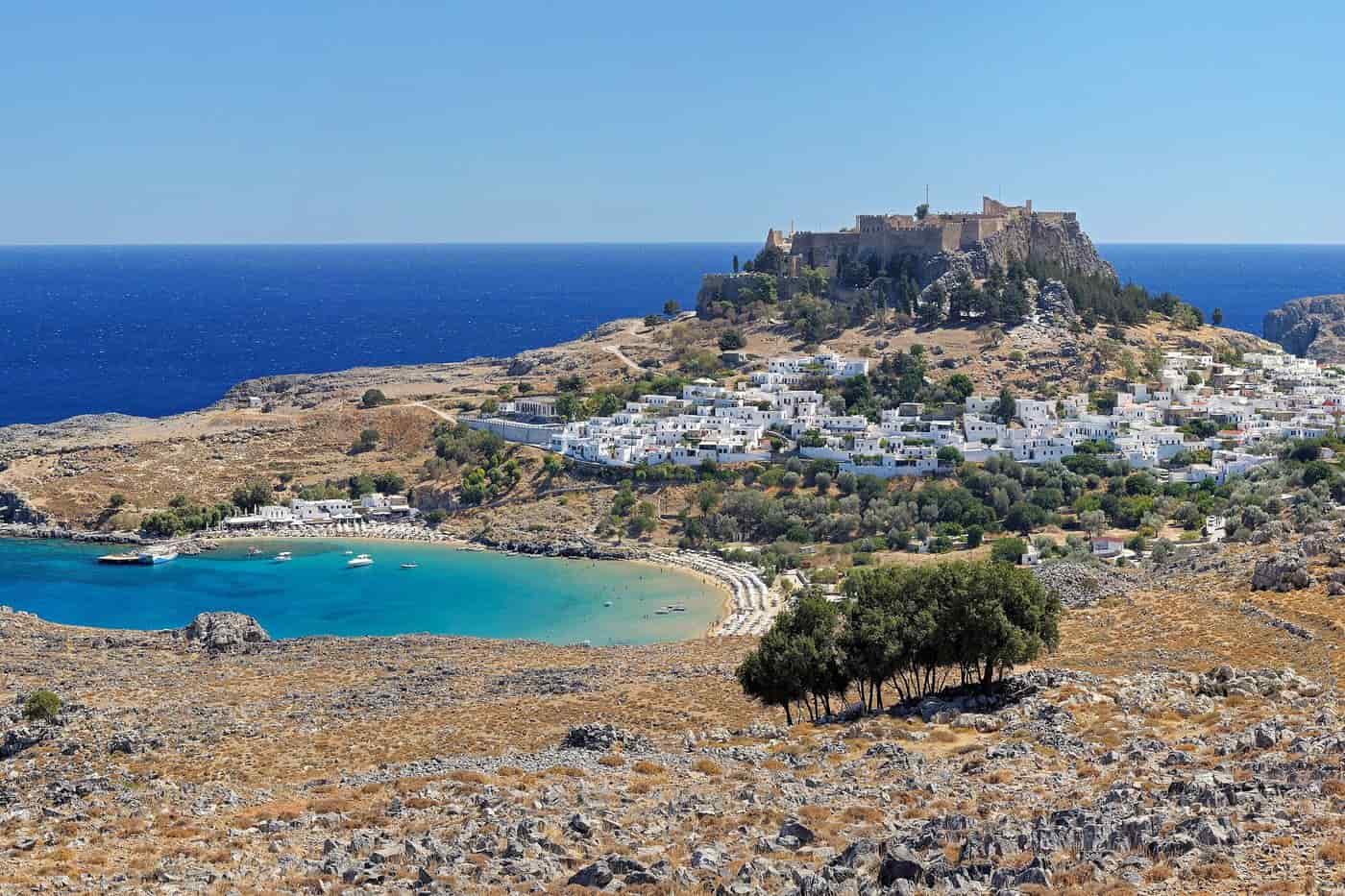
Lindos acropolis tickets open the walled archaeological site on the steep rock above Lindos, on the east coast of Rhodes, where the rock rises 116 metres. The site holds the Temple of Athena Lindia, a Hellenistic stoa, a ship relief cut into the rock and the castle of the Knights of St John. Greece Tours lists the entry tickets and guided visits checked for this page.
This page covers what Lindos acropolis tickets cover and let visitors see, the history of the rock, the ticket and tour types, the climb, the best time to visit, the nearby beaches and sights, how visitors reach Lindos and the admission rules. The tickets and tours below are checked on GetYourGuide.
What do Lindos acropolis tickets cover?
Lindos acropolis tickets cover the walled archaeological site on the steep rock above Lindos, on the east coast of Rhodes in the Dodecanese. The rock rises 116 metres, and the site holds Greek, Roman, Byzantine and Knights-era monuments under the Greek Ministry of Culture.
Lindos is an archaeological site and a fishing village on Cape Krana. The acropolis rises above it as a natural citadel. The Greeks, the Romans, the Byzantines, the Knights of St John and the Ottomans fortified the rock in turn, so Lindos acropolis tickets open a summit shaped by each of these powers.
The Greek Archaeological Service took over the restoration of the site in 1948, after the official incorporation of the Dodecanese into the Kingdom of Greece. Today Greek and international archaeologists restore and protect the ancient buildings under the supervision of the Greek Ministry of Culture, whose Odysseus portal gives the site a chronology from the 9th century BC to the 17th century AD.
- Hellenistic wall: a circuit of the same date as the Propylaea, repaired in the 2nd century AD at the expense of P. Aelius Hagetor, a priest of Athena.
- Castle walls: the walls and towers of the Knights follow the natural line of the cliff.
- Time span: finds from the Archaic period onward and building work up to the rule of the Knights in the 14th to 16th centuries.
- Supervision: the Greek Ministry of Culture and its Archaeological Service.
The main page on the Lindos Acropolis in Rhodes profiles the whole site, and Lindos acropolis tickets give entry to the monuments inside its walls.
What do Lindos acropolis tickets let visitors see?
Lindos acropolis tickets let visitors see the Doric Temple of Athena Lindia, the Propylaea, a Hellenistic stoa of 42 columns, a ship relief cut into the rock, a Roman temple, the castle of the Knights of St John and the Church of St John.
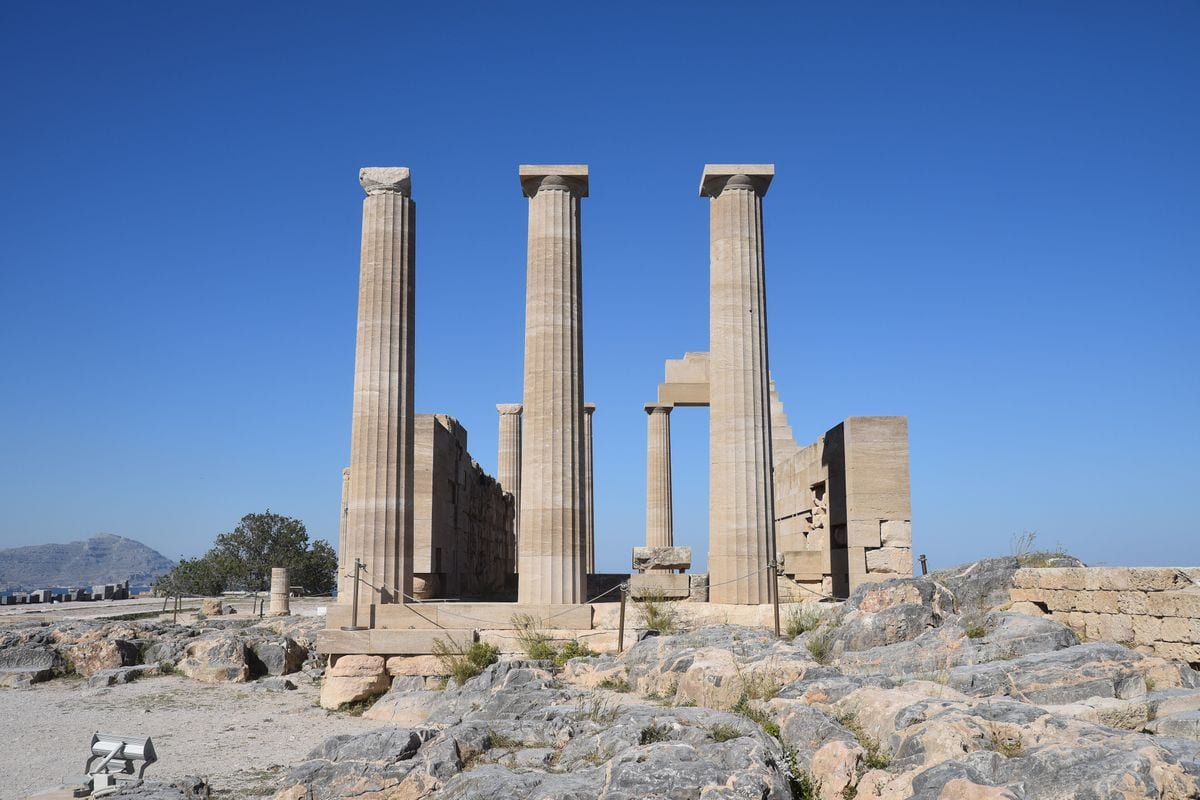
The Temple of Athena Lindia dates from about 300 BC and stands on the site of an earlier temple, above a natural cave in the cliff. The Doric building measured 7.75 by 21.65 metres, and the table of offerings and the base of the cult statue of Athena survive inside it. The sanctuary was a Pan-Hellenic shrine of Athena, and holders of Lindos acropolis tickets find it at the top of the acropolis.
Lindos acropolis tickets also take visitors through the Propylaea of the sanctuary, which date from the 4th century BC. A monumental staircase leads to a D-shaped stoa and a wall with five door openings. The Hellenistic stoa with projecting side wings dates from about 200 BC, ran 87 metres and stood on 42 columns.
The relief of a Rhodian warship is cut into the rock at the foot of the steps that lead to the acropolis, and it dates from about 180 BC. A statue of General Hagesander, the work of the sculptor Pythokritos, stood on its bow. Specialists treat the Lindos relief and the Nike of Samothrace as images of a trihemiolia. The relief also carries a list of the crews of two such ships: 144 men each, 120 of them rowers.
- Roman temple: the remains of a temple from about 300 AD.
- Castle of the Knights: built before 1317 on Byzantine foundations; a pentagonal tower on its south side commanded the harbour and the settlement.
- Church of St John: a Greek Orthodox church of the 13th or 14th century, built on the ruins of an older church.
Lindos acropolis tickets bring these layers together inside one walled circuit.
What history do Lindos acropolis tickets open up?
Lindos acropolis tickets open up a history that runs from a Dorian city founded, in myth, around the 10th century BC, through the rule of Cleobulus and the Knights of St John, to the Danish excavations of 1900 to 1914 that reached bedrock.
Lindos was one of the three ancient cities of Rhodes and a member of the Dorian Hexapolis. By the 8th century BC it had become a major trading centre, and its importance declined after the founding of the city of Rhodes in the late 5th century BC. In classical times the temple of Athena Lindia dominated the acropolis, and Lindos acropolis tickets lead into that same precinct.
In the 6th century BC Cleobulus, a poet and one of the Seven Sages of Greece, ruled Lindos, and the saying “Moderation is the best thing” is attributed to him. Historical accounts state that he restored the sanctuary of Athena. Later, Alexander the Great, Ptolemy Soter, Pyrrhus and Philip V dedicated offerings to Athena Lindia, so Lindos acropolis tickets open a shrine that kings honoured.
The Lindian Chronicle, an inscription dated to 99 BC, records dedications made in the temple of Athena. A Danish expedition found the marble slab reused as a paving block in the Byzantine church of Saint Stephen, and Christian Blinkenberg first published it in 1912. It lists about 45 dedications, 37 of them still legible, with four miracle stories about Athena. According to the Chronicle, the Persians besieged Lindos in 490 BC, and Athena saved the city.
- Knights of St John: the order ruled Rhodes from 1310 to 1522, and its castle at Lindos was the strongest after the castle of the city of Rhodes.
- Danish excavations: the Carlsberg Institute of Denmark led the dig under Karl Frederik Kinch and Christian Blinkenberg.
- Italian restoration: during the Italian occupation of 1912 to 1945, restorers rebuilt the staircase to the Propylaea and covered large surfaces with concrete.
The finds of the Danish dig went on display in Copenhagen, while Lindos acropolis tickets show the buildings themselves in place on the rock.
Which Lindos acropolis tickets and tours exist?
Lindos acropolis tickets come in four forms: the standard entry ticket listed by the Greek Ministry of Culture, a ticket paired with an audio guide, a guided tour of the summit, and a day trip from Rhodes town by coach or boat that includes the visit.
The Ministry of Culture and Sports lists the entry types for the site on its Odysseus portal: a full ticket and a special ticket package. Standard Lindos acropolis tickets give entry to the walled site and the monuments inside it. The acropolis of Lindos ranks third among the archaeological sites of Greece by visitor numbers.
An audio guide gives a recorded spoken commentary on a handheld device, or as a download from the Internet, and serves a self-guided walk. A guided tour puts a professional guide at the head of the group, pointing out the sights and explaining their history and meaning.
Cruise boats from Rhodes run daily trips down the south-east coast as far as Lindos, and coach day trips make the same journey by road from Rhodes town. Lindos acropolis tickets on such a trip cover the same site as a ticket bought alone.
- Standard ticket: entry to the walled site, listed by the Ministry as a full ticket.
- Audio guide ticket: site entry plus a recorded commentary for a self-guided walk.
- Guided tour: a professional guide who explains the temple, the stoa, the ship relief and the castle.
- Coach day trip: a trip by road from Rhodes town with time for the acropolis and the village.
- Boat trip: a cruise from Rhodes down the south-east coast to Lindos, with the climb on shore.
Every visit on Lindos acropolis tickets starts in the village below the rock, and the page on Lindos village on Rhodes covers the settlement itself.
How do holders of Lindos acropolis tickets climb the rock?
Lindos acropolis tickets lead to a site on a steep rock 116 metres high. Visitors reach it from Lindos village on foot or on a donkey or mule, and the Greek Ministry of Culture states that the acropolis has no access for disabled people.
The Odysseus portal of the Ministry gives two ways up from the village of Lindos: on foot or on mules. The donkeys of Lindos are an emblem of the village. They offer rides to visitors inside the settlement and can carry them all the way up to the acropolis, so holders of Lindos acropolis tickets choose between the walk and the ride.
At the foot of the steps that lead to the acropolis, the ship relief is cut into the rock. From there, a Hellenistic staircase of the 2nd century BC leads to the main archaeological area. The monumental staircase to the Propylaea, rebuilt during the Italian occupation, carries the climb to the temple of Athena at the top.
- Height: the rock of the acropolis stands 116 metres high.
- On foot: the walk starts in the village of Lindos, the access point named by the Ministry.
- Donkey or mule: animals from the village carry visitors up to the acropolis.
- Steps: a Hellenistic staircase and a rebuilt monumental staircase lead to the summit.
- Accessibility: the Ministry lists no access to the acropolis for disabled people.
From the summit, holders of Lindos acropolis tickets look out over the surrounding harbours and coastline.
When is the best time to use Lindos acropolis tickets?
Lindos acropolis tickets are best used outside the summer months, when heat and cruise traffic peak on Rhodes. Lindos is the warmest area in Greece, with a mean annual temperature of around 22 °C, so the cooler seasons suit a visit to the hilltop site.
Lindos has a Mediterranean climate with mild winters and hot, dry summers, and the rain falls mainly in winter. The south-east of Rhodes is warmer than the rest of the island, and the highest temperature ever recorded on Rhodes, 43.6 °C, was measured in Lindos. On average, Lindos also logs 6.1 days a year when the temperature never drops below 30 °C.
Summer holds the records. One August, the station of the National Observatory of Athens in Lindos registered the highest mean monthly temperature ever recorded in Europe. In another summer, Lindos posted the highest average summer temperature in Europe, 32.0 °C. Visitors who use Lindos acropolis tickets in the summer months meet this heat on the rock of the acropolis.
Crowds follow the same calendar. The acropolis of Lindos ranks third in visitor numbers among the archaeological sites of Greece. Cruise itineraries call at Rhodes, especially in the summer months, when the number of vehicles on the island also more than doubles and traffic jams are common.
- Summer: hot, dry days, the heat records of the island and the heaviest cruise and road traffic.
- Winter: mild temperatures and the main rainy season of the year.
- Sunshine: over 3,100 hours a year in south-east Rhodes, the highest mean annual total in Greece.
- Annual mean: around 22 °C in Lindos, against 20.9 °C in the city of Rhodes.
Spring and autumn fall between these two extremes, so Lindos acropolis tickets used in those seasons avoid both the summer peak and the winter rain.
Which beaches and sights combine with Lindos acropolis tickets?
Lindos acropolis tickets combine with St Paul’s Bay, the beaches of the Lindos bay and the Chapel of Saint George Pachymachiotis in the village. Further along the east coast lie the resorts of Pefkos and Charaki, with Feraklos Castle on the hill above Charaki.
St Paul’s Bay carries the name of the Apostle Paul. According to tradition, Paul landed at this spot in Lindos during his third missionary journey, when he preached Christianity on Rhodes. The small beach in the bay has been named one of the ten best beaches in Europe.
Lindos itself sits in a large bay on Cape Krana, on the east coast of the island, and faces the fishing village of Charaki. Its beaches make the fishing village a holiday destination. In the village, the Chapel of Saint George Pachymachiotis dates from the late 14th century and lies in the historical centre of the ancient town.
Holders of Lindos acropolis tickets can add Feraklos Castle, a ruined fortress on an 85 m hill above Charaki. The Knights Hospitaller captured it on 20 September 1306 as their first possession on Rhodes, and the castle gives views of Charaki bay, Agia Agathi beach and the acropolis of Lindos in the distance.
- Pefkos: a beach resort 4 km south-west of Lindos, with the pure sand of Lee beach and no motorised water sports.
- Lardos: a village on the Lardos stream, about 8 km west of Lindos, with a history of olive groves and vineyards.
- Charaki: a fishing village and small resort with a half-moon bay, tavernas and waterfront holiday apartments.
- Agia Agathi: a beach near Charaki that draws summer visitors.
Pefkos lies on the coastal road that links Lindos with Lardos, so a morning with Lindos acropolis tickets leads straight on to both places.
How do holders of Lindos acropolis tickets reach Lindos?
Lindos acropolis tickets are used on the east coast of Rhodes, about 40 km south of the city. Visitors reach Lindos by car on Greek National Road 95, on orange KTEL buses from the city centre, or on daily boats from Mandraki harbour.
The road network of Rhodes radiates from the city along the east and west coasts. Greek National Road 95, the Rhodes–Lindos National Avenue, runs mainly inland from north to south. It has four lanes from Rhodes town to Kolympia and two lanes for the rest of the way to Lindos.
Diagoras International Airport lies at Paradisi, on the west side of the island, about 14 km south-west of the city. Greek National Road 100 runs inland from east to west and links the airport with the east coast, so drivers with Lindos acropolis tickets cross the island before they head south.
Two bus operators serve Rhodes. RODA, the municipal company, runs the city routes and links the city with the airport and the west coast. KTEL runs the orange buses that leave the city centre for the villages and resorts of the east coast, and its services connect Rhodes town with Charaki, Lardos and Lindos.
- By sea: cruise boats leave Mandraki, the oldest port of the island, in the centre of Rhodes city, for daily trips down the south-east coast to Lindos.
- By taxi: a fleet of 450 taxis serves the island.
- From the airport: Charaki lies about 35 km south of the airport and 10 km north of Lindos on the main east coast road.
- Beyond Lindos: a provincial road starts just before Lindos and runs through villages and resorts to Katavia, the southernmost village of the island, with a branch on to Prasonisi.
A Lindos boat trip from Mandraki swaps the inland road for the coast and pairs the sea journey with Lindos acropolis tickets on the same day.
Which admission rules apply to Lindos acropolis tickets?
Lindos acropolis tickets follow the national rules of the Greek Ministry of Culture and Sports. Entry is free on set days, free for EU children and young people up to 25 and non-EU children up to 18, and reduced for EU seniors over 65.
Free admission also covers other groups. Persons with disabilities enter free regardless of their country of origin, and one escort also enters free when the disability reaches 67% or more. Tourist guides in Greece, journalists, refugees, and members of ICOM and ICOMOS, the international councils of museums and of monuments and sites, enter free as well.
The reduced ticket applies to senior citizens over 65 from Greece and other EU member states, to parents who accompany primary-school visits from EU and European Economic Area states, and to teachers who escort school visits from countries outside the European Union. Holders of free or reduced Lindos acropolis tickets prove their status with the documents the Ministry names.
The Ministry publishes the free-admission days for Lindos on its Odysseus portal, and the same national rules apply at other state sites in the Dodecanese, such as the Acropolis of Rhodes.
- 6 March: free entry in memory of Melina Mercouri.
- 18 April: free entry for International Monuments Day.
- Museums Day: free entry on International Museums Day, one month after Monuments Day.
- Last weekend of September: free entry during the European Heritage Days.
- National holidays: free entry on the national holidays in the Ministry’s list.
On these days, Lindos acropolis tickets are free for every visitor, whatever the age or country of origin.
Frequently Asked Questions
Do seniors get reduced Lindos acropolis tickets in summer?
No. Reduced Lindos acropolis tickets for senior citizens over 65 from Greece and other EU member states apply from 1 October through the winter and spring months. From 1 June to 30 September, seniors pay the full ticket. On entry, they show an ID card or passport to prove age and country of origin.
Why is Lindos so hot for visitors with Lindos acropolis tickets?
Visitors with Lindos acropolis tickets enter the warmest place in geographical Europe. Warm katabatic winds blow over Lindos for a large part of the year and push the mean annual temperature to 22.0 °C. That average beats the annual means of weather stations in Tel Aviv, Cairo and the Canary Islands, which lie much further south.
Which documents support free or reduced Lindos acropolis tickets?
Each group needs proof for free or reduced Lindos acropolis tickets. Visitors with disabilities show a Disability Card, or an ID card or passport with a disability certificate. Journalists show a valid journalist ID card, tourist guides a professional ID card, and ICOM or ICOMOS members a valid membership card with an ID card or passport.
Which pass replaces Lindos acropolis tickets for teachers and archaeology graduates?
A three-year Free Entry Pass replaces Lindos acropolis tickets for teachers in Greece, active or retired, and for graduates of history and archaeology departments. The Ministry’s services and the municipal Citizen Service Centres issue the pass after a simple application with two photographs and the required documents, and the pass can be renewed.