
Explore Limnos Island, Greece, with our travel guide featuring top beaches, ancient sites, local cuisine, and a 3-day itinerary for the perfect getaway.
Limnos Travel Guide: Explore Greece’s Undiscovered Island — Beaches, History, Food & 3-Day Itinerary
Limnos (sometimes written Lemnos) remains one of Greece’s best-kept island secrets, with wide sandy beaches, windswept plains, Bronze Age ruins, and a food scene built on local cheese, seafood, and indigenous wine. Today, we’re seeing more travelers add Limnos to island-hopping routes precisely because it feels untouched: fewer crowds than the Cyclades, easy access from northern Greece, and landscapes that shift from lunar volcanic plateaus to green orchards and salt marshes.
In this guide, we’ll explain why Limnos deserves a spot on your Greece tours list, how to get there and get around, the top sights and beaches to prioritize, what and where to eat, and a practical 3-day itinerary that balances culture, swimming, and tasting local life. Whether you’re planning a private guided tour, a small-group island hop, or a relaxed week based in Myrina, our tips will help you make the most of Limnos.
No tour operator lists guided tours on Limnos itself, so the tours below cover Kavala and ancient Philippi on the mainland, the port of the Limnos ferry line.
Why Visit Limnos: Key Highlights, Landscape, And Best Time To Go
Limnos stands out for its contrasts. From the airy harbor town of Myrina with its Venetian castle to the dusty, windswept highlands around Kaminia, the island offers a palette of scenery that doesn’t look like the postcard-stacked Cyclades. Key highlights we return to when recommending Limnos:
- Quiet, wide beaches: Many of Limnos’s beaches are expansive and shallow, perfect for long swims, wind sports, and families. Keros, Gomati, and Plati are among those that draw repeat visitors.
- Rich archaeology: Poliochni is one of Europe’s earliest urban settlements. Hephaistia and ancient Myrina reveal Bronze Age and Classical layers: the island’s history feels immediate and walkable.
- Unique culinary identity: Limnio, the island’s indigenous red grape, plus Kalathaki Limnou cheese and seafood straight off a small family boat,s give the food scene a memorable profile.
- Birdlife & wetlands: Moudros Bay and surrounding salt flats attract migratory birds: birdwatchers and nature lovers will appreciate the quieter seasons.
- Winds and outdoor sports: The island’s breezes are excellent for windsurfing and kitesurfing; you’ll also find great hiking and cycling routes across largely traffic-free roads.
Best time to go
- Late spring (May–June): Warm sea temperatures start to arrive, wildflowers are in bloom, and the island is pleasantly quiet.
- Early autumn (September–early October): The sea is still warm, tourist numbers drop, and harvest-related food events pop up in villages.
- Peak summer (July–August): Expect hotter days and some local crowds, ideal if you’re combining Limnos with busy islands and want guaranteed beach weather. The winds can be stronger, which is excellent for sailors and wind-sports enthusiasts.
Why add Limnos to a Greece tour itinerary
We recommend Limnos for travelers who want authenticity, outdoor activity, and history without sacrificing creature comforts. If you’re building a custom Greece travel package or an island-hopping tour from Athens or northern ports, Limnos gives a balanced counterpoint to Santorini‘s views and Mykonos‘s party scene: slower-paced, more local, and surprisingly diverse.
Getting There And Getting Around: Flights, Ferries, Car Hire, And Local Transport
Getting to Limnos is straightforward, and how you arrive shapes your experience.
Flights
- Direct flights: Limnos International Airport (LXS), near Myrina, receives seasonal flights from Athens and some European cities. Flight time from Athens is about 45–55 minutes. There are more frequent regional connections than a few years ago, so check schedules early when booking private or small-group tours.
- From northern Greece: Kavala and Alexandroupoli are regional airports with ferry or drive options if you’re exploring Thrace and eastern Macedonia before island hopping.
Ferries
- From Piraeus (Athens): Regular ferries and high-speed vessels run to Limnos, though schedules vary by season. Overnight ferries allow you to sleep while covering the distance.
- From northern ports, Kavala and Thessaloniki have direct summer services: ferries from Kavala are popular for those combining Limnos with Thassos and Samothrace.
Choosing between a plane and a ferry
- Time vs. experience: Flights are faster and let you maximize beach time; ferries are better for relaxed island-hopping and transporting a rental car.
- Weather considerations: High winds can delay smaller ferries in winter/shoulder seasons. Keep a buffer day when planning connections.
Getting around Limnos
- Rental car: We strongly recommend hiring a car for flexibility. Roads are generally good: distances are manageable (you can cross the island in about 1–1.5 hours). Small, fuel-efficient cars are ideal for narrow lanes.
- Motorbike/scooter: Popular for couples or solo travelers during summer, but consider luggage and wind, Limnos can be gusty.
- Local buses: There’s a public bus network connecting Myrina with Moudros, Platy, and select beaches, but frequency is limited outside summer. Use it if you prefer not to drive, but plan schedules carefully.
- Taxis and transfers: Taxis are available in Myrina and near the airport; pre-booked transfers are convenient for small groups and guided tours.
Car hire tips
- Book early in summer, fleet sizes are smaller than on busier islands.
- Opt for insurance that covers wind-related incidents: also get a GPS or offline map for rural routes.
- If you plan to visit remote beaches or do light off-road exploring, choose a car with slightly higher clearance.
Practical travel tip
If you’re booking a multi-island tour, coordinate ferry timetables with inland activities. For private guided tours and tailor-made packages, we recommend landing in Limnos by plane and using ferries for onward island hopping, so you reduce transit time and get more daylight for exploring.
Top Sights, Beaches, And Outdoor Highlights
Limnos’s attractions spread across archaeology, beaches, birdwatching, and active pursuits. We break these down so you can plan by interest.
Must-See Archaeological, Cultural, And Natural Attractions
Poliochni
- Why go: Often called ‘Europe’s oldest town,’ Poliochni is a Bronze Age settlement with multi-layered ruins and a small on-site museum. It’s compact but evocative, and a must for history-focused tours.
- Practical: Guided visits add context; consider a local archaeologist or guide from Myrina for richer interpretation.
Hephaistia (Hisarlik & Ancient Hephaistia)
- Why go: Hephaistia was the island’s classical center with Roman and Byzantine phases. Ruins sit near the modern village, offering easy access and views across the Aegean.
- Practical: Stop in the nearby village cafes afterward for a slow lunch.
Moudros Bay and WWI history
- Why go: Moudros was a strategic harbor during WWI: monuments and memorials mark Allied landings and naval activity. The wide bay is also scenically beautiful and good for sunset walks.
Keros & Wetlands
- Why go: Keros (not to be confused with other islands) features sandy beaches that are popular with windsurfers and kitesurfers. Nearby salt pans and wetlands attract birdlife, great for sunrise photography.
Myrina Castle and Old Harbor
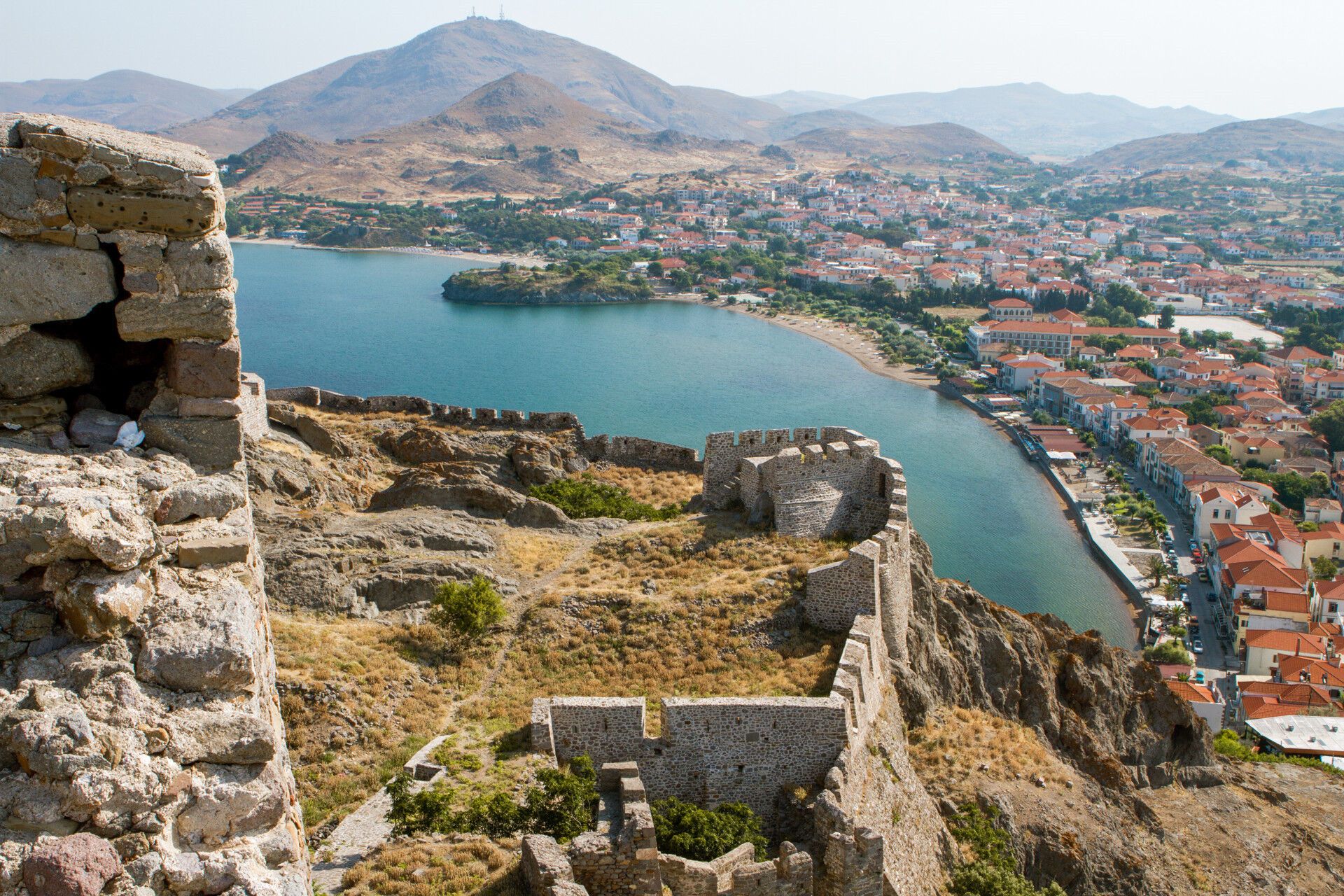
- Why go: The Venetian-built castle overlooking Myrina’s harbor is picturesque. From its walls, you get panoramic views of the town and the islands. The harbor below is lined with seafood tavernas and cafes.
Gomati and Plati Beaches
- Why go: Both offer long sandy stretches and shallow seas. Plati is often quieter, while Gomati has easier access and facilities during the summer. Families and snorkelers appreciate the gentle entry and clear water.
Kaminia and the Volcanic Plateau
- Why go: The island’s north and west feature volcanic geology and scrubby plateaus. The wind-sculpted landscape is compelling for photographers and hikers: villages like Kaminia feel like a step back in time.
Kastrosimo & Chapel Trails
- Why go: Limnos is dotted with small Byzantine chapels and hilltop watch towers. Short coastal trails connect a series of these structures and offer easy half-day hikes.
Outdoor sports and activities
- Windsports: Keros Bay and parts of the northern coastline get reliable breezes in summer. There are local schools and temporary rental stands in peak season.
- Hiking & cycling: Quiet backroads, low traffic, and varied terrain make Limnos good for self-guided hikes and bike routes. Map a loop from Myrina to Hephaistia and back through inland villages to experience both coast and countryside.
- Birdwatching: The island is on migratory routes; spring and autumn are best for species variety. Pack binoculars and a guidebook, or join a local naturalist excursion.
Top-sight day plan (sample)
- Morning: Explore Poliochni with a guide, then coffee in a nearby village.
- Afternoon: Swim at Keros or Plati: relax on a sandy beach.
- Evening: Return to Myrina for castle views and seafood tavernas along the harbor.
Limnos’s charm lies in its variety. You can spend one day on archaeology and quiet beaches, and the next day windsurfing or walking salt flats with hardly any line between activities.
Food, Where To Stay, Activities, And A Practical 3-Day Itinerary
Food and drink
Limnos’s cuisine is regional, seasonal, and proudly local. A few specialties to look for:
- Kalathaki Limnou: A soft sheep’s cheese made on the island, often grilled or served in pies.
- Limnio wine: An ancient indigenous grape variety producing spicy, medium-bodied reds with a long history tied to Limnos. Many small producers bottle limited runs; tastings are a highlight.
- Seafood & sardines: Fresh catches are central to tavern menus, from grilled fish to small fried sardines.
- Honey & citrus: Local honey and fruit feature in desserts and breakfasts.
Where to stay
- Myrina (best for first-timers): Charming harborfront, a wide choice of rooms, easy access to eateries and tours. Great if you want to be in the middle of town life.
- Moudros: Calmer, historically rich, and closer to eastern beaches and wetlands.
- Inland village stays: Farms and guesthouses in villages like Kontias give authentic rural experiences, think breakfasts of home-made cheese and local bread.
- Self-catering villas and small boutique hotels: Increasingly available for travelers seeking privacy or for small-group tours.
Activities we recommend booking
- A guided archaeological tour of Poliochni and Hephaistia.
- A half-day windsurf or kitesurf lesson at Keros (seasonal).
- A wine tasting with a local producer focused on Limnio and other regional varieties.
- A birdwatching trip around the Moudros wetlands in migration seasons.
Practical 3-Day Itinerary (balanced for first-time visitors)
Day 1, Myrina & Nearby Beaches (easy arrival day)
- Morning: Arrive via flight or ferry, and settle into accommodation in Myrina. Walk the harbor and climb to Myrina Castle for an orientation view.
- Lunch: Harbor taverna with grilled fish and a glass of local white.
- Afternoon: Short drive to Gomati or Plati beach for a long swim and light snorkeling. These beaches are shallow and family-friendly.
- Evening: Stroll the old town, try a starter of fried Kalathaki Limnou, and join a seaside taverna for dinner.
Day 2, Archaeology, Villages & Wine
- Morning: Visit Poliochni with a local guide to learn the Bronze Age context. Continue to the Hephaistia ruins nearby.
- Lunch: Village taverna in Kontias or a winery picnic if available.
- Afternoon: Wine tasting focused on Limnio and a tour of a vineyard. If time allows, a short hike along nearby trails to see inland landscapes and chapels.
- Evening: Return to Myrina or stay in a quiet village: dinner focused on regional dishes and local wine.
Day 3, Moudros, Keros & Outdoor Fun
- Morning: Drive east to Moudros Bay for birdwatching or a historical walk covering WWI sites. Coffee by the water.
- Midday: Head to Keros for wind-sports tryout, or a lazy beach day if you prefer calmer waters.
- Afternoon: If we have time and energy, cycle a short coastal stretch or explore the salt flats and wetlands near Moudros.
- Evening: Final dinner in Myrina. Seek out a family-run taverna for seafood meze and a chance to try Limnos desserts and local honey.
A few extra tips for our itinerary
- Pace: We’ve built in relaxed afternoons because Limnos rewards unhurried exploration. Don’t overpack days; part of the island’s charm is idle time by the sea.
- Booking: In summer, reserve cars, accommodations, and activities several weeks in advance. For private tours, coordinate pick-up times with your flight or ferry arrival.
- Flexibility: If you’re combining Limnos with other islands on an island-hopping tour, adapt Day 3 for travel time; ferries and flights can dictate the order of visits.
Sample budgets and considerations
- Mid-range travelers: Comfortable hotels, car hire, a couple of guided tours, and several dinners out, budget accordingly for peak season ferry/flight prices.
- Small-group and private tours: Adding a local guide for archaeology or food tours raises costs but vastly improves context and access to producers. We recommend at least one organized excursion for a deeper insight into Limnos’s culture.
Where is Limnos, and what shapes its landscape?
Limnos lies in the north Aegean, between Mount Athos and the Dardanelles. It covers 477.6 square kilometres and counted 16,411 residents in the 2021 census. Volcanic rock, low hills and the bays of Moudros and Pournias shape the Limnos landscape.
Limnos is the eighth-largest island of Greece and sits in the Thracian Sea between Mount Athos, Samothrace, Imbros and Lesbos. With Agios Efstratios, it forms the regional unit of Limnos in the North Aegean region. Pliny the Elder recorded that the shadow of Mount Athos, to the west, fell on the forum of ancient Myrina at the summer solstice. To the east, the island faces the mouth of the Dardanelles, and in 1912 the Greek fleet used Moudros Bay as its forward anchorage to watch the straits.
Limnos is a volcanic island. Volcanic and schist formations dominate its rock, limestone is absent, and the ancient names Aethaleia and Pyroessa refer to the smoke and fire of its volcanic past. Volcanic activity on Limnos is extinct today. The west and northwest are rocky and hilly, with Mount Skopia as the highest point at 430 metres, while the rest of the island opens into flat wheat fields and vineyards that run down to the sea.
- Moudros Bay: a southern inlet that cuts 14.2 kilometres inland, opens 5.2 kilometres wide and reaches 40 metres at its deepest point, ranked among the safest natural harbours of the eastern Mediterranean.
- Pournias Bay: a north-east inlet whose shores hold the Palaiopolis peninsula of ancient Hephaestia and the cape of Chloi with the Kabeirion.
- Wetlands: the Alyki and Chortarolimni lakes and the Diapori marsh, all Natura 2000 sites, plus salt marshes on Moudros Bay where flamingos, ducks, wild geese and swans gather.
- Pachies Ammoudies: a sand desert that covers 7 hectares of Limnos.
Myrina, the capital of Limnos, sits on the west coast and counted 6,190 residents in the 2021 census; the town was named Kastro until 1955. A rocky promontory about 120 metres high splits its bay into Romeikos Gialos to the north and Tourkikos Gialos to the south, and the ruins of a Venetian castle crown the rock.
What is Poliochni on Limnos, and why is it called one of the oldest towns in Europe?
Poliochni is a prehistoric settlement on the east coast of Limnos, near Kaminia, founded in the 4th or 5th millennium BC. Its earliest layers predate Troy I, and it grew into a walled Early Bronze Age town with streets, wells and an assembly hall.
The site on Limnos looks across the sea to Troy and the mouth of the Hellespont. Its houses share party walls along paved streets and squares, drains collected rainwater, and masonry-lined wells reach more than 9 metres deep. Inside the main gate on the west side stands a long hall with stone benches down its length. The excavators named it the bouleuterion after the council houses of classical Greece, which it predates by almost 2,000 years.
The Italian School of Archaeology at Athens began digging here in 1930 under Alessandro Della Seta and ran regular campaigns from 1931 to 1936. Luigi Bernabò Brea resumed the work in 1951–1953, 1956 and 1960. The dig exposed 7 successive towns in 7 layers, which earned Poliochni the name heptapolis, and Bernabò Brea gave each town a colour:
- Black (I), 3500–3200 BC: round and oval huts on stone bases, rebuilt over 7 levels.
- Blue (II), 3200–2700 BC: a larger town with a defensive wall, the first metal pins, awls and a dagger, and stamp seals.
- Green (III), 2700–2600 BC: the shortest phase, with 3 building stages.
- Red (IV), 2600–2400 BC: a hoard of bronze tools and weapons, including a shaft-hole axe and daggers.
- Yellow (V), 2400–2100 BC: a large fortified town of multi-room blocks around megaron halls, rich in gold jewellery.
- Brown (VI), 2100–1700 BC: resettlement after a gap in occupation.
- Violet (VII), 1700–1400 BC: the final phase, also called the Mycenaean phase.
The Poliochni treasure, a hoard of gold jewellery from the site, closely matches Priam’s Treasure, which Heinrich Schliemann found at Troy, and it sits in the National Archaeological Museum in Athens. A later Bronze Age settlement on Limnos, developed around 2000–1650 BC, lies on the islet of Koukonisi in Moudros Bay; Greek archaeologists found it in 1994–1997.
What were Hephaestia and the Kabeirion of ancient Limnos?
Hephaestia was the ancient capital of Limnos from the 8th to the 6th century BC, named after Hephaestus, the smith god who fell on the island. The Kabeirion, across Pournias Bay at Chloi, was the sanctuary of the Kabeiroi, his sons, and their mystery rites.
In the Iliad, Zeus hurls Hephaestus from Olympus; the god falls for a whole day and lands on Limnos, where the Sintians care for him. Greek tradition adds that he set up his forge on the volcano Mosychlos and taught the Sintians metalwork, and that the sea nymph Kabeiro bore him the Kabeiroi, gods of metalworking. The whole island was sacred to Hephaestus.
Hephaestia covered the Palaiopolis peninsula on the north-east coast of Limnos, which gave the city two natural harbours, used according to the weather. Its coins show a burning torch, evidence of the Hephaisteia festival held for the god. Alessandro Della Seta excavated the city from 1926 to 1936 and found a necropolis of the 9th–8th centuries BC with more than 130 ossuaries: male urns held knives and axes, female urns held gold diadems, earrings and bracelets. In 325 AD, Bishop Strategios of Hephaestia attended the First Council of Nicaea.
- Theatre of Hephaestia: a stone theatre of the late 5th or early 4th century BC with a circular orchestra 12.40 metres across. Restored from 2000 to 2004, it staged Sophocles’ Oedipus Rex in 2010, its first play in 2,500 years, and the Municipality of Limnos holds a festival there each summer.
- Kabeirion: the sanctuary on the cape of Chloi, founded between the 8th and 7th centuries BC and excavated by the Italian School in 1937–1939, with work resumed from 1982. Its Hellenistic initiation hall measures 33 by 46.10 metres behind a 12-column stoa.
- Cave of Philoctetes: a sea cave at the north end of Tigani cove, beside the Kabeirion and reached from the water. Tradition places here the archer whom the Greeks left on Limnos for 10 years with a festering snake bite on the way to Troy.
- Lemnian women: a myth in which the women of Limnos killed every man on the island after the men took Thracian wives. Only King Thoas survived, hidden by his daughter Hypsipyle, and the Argonauts later landed on an island ruled by her.
What does the Archaeological Museum of Limnos in Myrina hold?
The Archaeological Museum of Limnos fills a 19th-century Ottoman administration building on Romeikos Gialos in Myrina. Its rooms run from the stone tools of Ouriakos through Poliochni, Hephaestia and the Kabeirion to Byzantine Limnos, including the Siren figures from Hephaestia.
The municipality of Kastro, today’s Myrina, bought the building in 1939 and began converting it into a museum in 1956. In 1961, the finds that had spent the Second World War in the museum of Mytilene or in the National Archaeological Museum in Athens returned to Limnos. The museum closed after earthquake damage in 2014 and reopened with a redesigned permanent exhibition that covers prehistory to the Byzantine era.
- Prehistory: stone tools from Ouriakos, the oldest settlement yet found on the Aegean islands, and Bronze Age finds from Poliochni, prehistoric Myrina and Koukonisi.
- Hephaestia: grave goods from the necropolis and votive offerings from the sanctuary of the Great Goddess, led by the figures of Sirens and sphinxes.
- Kabeirion: Archaic vases from the sanctuary of the Kabeiroi at Chloi.
- Artemis of Myrina: Archaic statuettes of musicians and of a bull sacrifice from the sanctuary of Artemis.
- Sculpture: Classical and Roman statues, grave stelae and inscriptions from Limnos and Imbros, among them a Roman copy of the Eros of Thespiae by Lysippos from Hephaestia.
- Small finds: coins, jewellery, tools and objects of bone and metal from the Hellenistic period to the Middle Ages.
The Kaminia stele, also called the Lemnos stele, stays in the National Archaeological Museum in Athens, as does the Poliochni treasure. This 6th-century BC funerary stone, found at Kaminia on Limnos in 1885, carries the oldest known text in the Lemnian language.
The museum stands on the Romeikos Gialos seafront near the castle, beside the prehistoric site of Myrina, and the museum and the site form one archaeological area. A morning in the galleries pairs with the walk up to the castle and a swim at Romeikos Gialos or the adjoining Riha Nera beach.
What is the history of Limnos from Byzantium to union with Greece?
Limnos passed from Byzantium to the Venetian Navigajoso family in 1207, returned to Byzantine rule in 1278, went to the Genoese Gattilusi in 1453 and to the Ottomans in 1456, and joined Greece after the Greek fleet landed in October 1912.
Under Byzantium, Limnos belonged to the theme of the Aegean Sea and suffered Saracen raids in the 10th century and Seljuk raids in the 11th. After the Fourth Crusade of 1204, Westerners called the island Stalimene, and the Latin Empire granted it to the megadux Filocalo Navigajoso. His son Leonardo held half of Limnos with the capital, Kastro, and his sisters held the fortresses of Moudros and Kotsinos. The Byzantine admiral Licario besieged the island in 1277, and the Navigajosi surrendered it in 1278. After the empire lost its Anatolian lands in the 1320s, Limnos served as the granary of Constantinople.
Sultan Mehmed II confirmed Dorino I Gattilusio as lord of Limnos and Thasos for an annual tribute of 2,325 gold coins, but in 1456 the islanders rose against Niccolò Gattilusio and submitted to the Sultan. Ottoman rule on Limnos then broke 3 times:
- Venice, 1464 to 1479: Venetian forces held Limnos until the Treaty of Constantinople returned it to the Ottomans.
- Venice, 1656 to 1657: the Ottomans retook Kastro on 15 November 1657 after a 63-day siege.
- Russia, 1770: Count Alexei Orlov besieged Kastro for 3 months, and the Ottoman fleet of Cezayirli Gazi Hasan Pasha drove the Russian ships out of Moudros Bay on 9 and 10 October 1770.
On 21 October 1912, 8 October in the Old Style calendar, troops from the fleet of Rear Admiral Pavlos Kountouriotis landed unopposed in Moudros Bay and marched on Kastro. The small Ottoman garrison and 280 armed men from Lera, today’s Agios Dimitrios, scattered after a brief firefight, and the Greek flag rose over Kastro on 22 October with no Greek casualties. From Moudros Bay the Greek fleet defeated the Ottoman navy at Elli on 16 December 1912 and off Limnos on 18 January 1913. The Great Powers ceded Limnos to Greece in February 1914, and the Treaty of Lausanne confirmed the annexation in 1923.
What role did Moudros Bay on Limnos play in the First World War?
Moudros Bay on Limnos served as the forward Allied base and hospital base of the Gallipoli campaign in 1915, then as the anchorage where the Allies and the Ottoman Empire signed the Armistice of Mudros aboard HMS Agamemnon on 30 October 1918.
Moudros Bay ranks among the safest natural harbours of the eastern Mediterranean. In February 1915 the Royal Navy sent Admiral Rosslyn Wemyss to Limnos as Governor of Moudros, with orders to prepare the largely unused harbour for operations against the Dardanelles, 50 kilometres from the island. General Ian Hamilton and his staff arrived on 10 April, and the ANZAC Corps assembled on Limnos on 12 April 1915 for practice landings before the assault of 25 April. The Allies built French and Australian piers, troops camped on the hills toward Koukonisi, and the south shore, still called Aerolimenas, served as a seaplane landing ground.
Limnos served as the hospital base of the Entente forces. The No. 3 Australian General Hospital treated the wounded there from 1915, and the hospital ship HMHS Britannic, fitted with 3,309 beds, left Liverpool for Mudros on 23 December 1915 to bring sick and wounded soldiers home. After the Allies called off the campaign at the close of 1915, Moudros remained the Allied base for the blockade of the Dardanelles.
On 27 October 1918, Ottoman Minister of Marine Rauf Bey opened talks aboard HMS Agamemnon with Admiral Somerset Gough-Calthorpe, commander of the British Mediterranean Fleet. The armistice signed on 30 October took effect at noon on 31 October, and its signing table now rests aboard HMS Belfast in London. The Commonwealth War Graves Commission keeps 3 sites on Limnos:
- East Mudros Military Cemetery: 885 Commonwealth burials, including 148 Australians and 76 New Zealanders.
- Portianos Military Cemetery: 352 graves of British, French, Australian, New Zealand, Egyptian and Indian soldiers at Portianou.
- West Mudros Muslim Cemetery: a memorial marking the graves of 170 men of the Egyptian Labour Corps.
The town of Lemnos in Victoria, Australia, founded in 1927 as a settlement for returning First World War soldiers, carries the name of the island.
What is Myrina, the capital of Limnos, like?
Myrina, the capital of Limnos with 6,190 residents in the 2021 census, curves around 2 bays split by a 120-metre rocky headland and its castle, with the Romeikos Gialos waterfront to the north and the Tourkikos Gialos harbour to the south.
The castle, the strongest fortress of Limnos in every era, covers 144 stremmata, or 14.4 hectares, of the headland. Its triple wall, up to 8 metres high and 1.5 metres thick, carries 14 towers, and fallow deer roam free on the castle hill. The town below carried the name Kastro until 1955. The walls record 5 builders:
- Andronikos I Komnenos, 1185: the emperor strengthened a fort first raised in the early 12th century from the stones of the classical acropolis.
- Filocalo and Leonardo Navigajoso, 1207 to 1260: the Venetian lords gave the castle its present form.
- John V Palaiologos, 1361: the Byzantine emperor repaired the fortifications.
- Francesco Pasqualigo, 1477: the Venetian commander repaired and extended the walls.
- Cezayirli Gazi Hasan Pasha, 1780: after his repairs the fortress mounted 150 cannons.
North of the headland, Romeikos Gialos, the “Roman Shore” named after the Romioi of Byzantium, formed the Greek quarter under Ottoman rule. Its neoclassical stone mansions, built between the mid-19th and early 20th centuries by Limnos families enriched in Egypt, face a quay of cafés that continues to the sandy beach of Richa Nera. South of the headland, Tourkikos Gialos housed the Turkish community; today fish taverns ring its old harbour, where caiques moor below the castle, lit on summer evenings.
The market street runs north to south and links the 2 shores, with OTE square, the hub of the bank branches of Limnos, halfway along it. The interwar town counted more than 200 shops. The provincial hospital of Limnos stands in the Tchas quarter behind the harbour, and buses to the villages leave from Perivola square behind Romeikos Gialos. On clear evenings the 2,033-metre peak of Mount Athos stands on the western horizon at sunset, and Pliny the Elder wrote that its shadow reached the forum of Myrina at the summer solstice.
Which villages of Limnos are worth a visit?
The villages of Limnos worth a visit are Kontias, Kornos, Kaspakas, Sardes, Katalakko, Atsiki, Agios Dimitrios, Kalliopi, Plaka and Moudros, 10 settlements that span all 4 municipal units of Limnos, from the windmills of Kontias to the lighthouse of Plaka.
- Kontias: 8 kilometres east of Myrina, this former home of sea captains keeps stone mansions and restored windmills; with 1,500 residents in 1940, Kontias ranked second only to Myrina.
- Kornos: built as an amphitheatre on the southern slopes of Skourka hill, its mansions of Greeks enriched in Egypt earned the 19th-century nickname “petit Paris”.
- Kaspakas: stone houses climb the western slopes above a valley of fig and almond trees, and the village figs won a gold medal at the Zappeion in 1930.
- Sardes: houses step up the hillsides of a plateau at the northern edge of Skourka, in a village of beekeepers, livestock farmers and lyra players.
- Katalakko: hidden at the bottom of a ravine in the northwestern hills, the village appears only from the rim of the ridge above; 116 residents lived there in 2001.
- Atsiki: set on a hill in the middle of the central plain, one of the richest farming villages of the 19th century and the home village of Byzantinist Peter Charanis.
- Agios Dimitrios: 556 refugees from Reis Dere near Çeşme settled the former Ottoman village of Lera after 1922, and the village took its new name in 1947.
- Kalliopi: the east-coast village near Keros bay runs horse races on the feast of Agios Georgios along a 3-kilometre course from the chapel near Keros beach.
- Plaka: the northeasternmost village lies by Cape Plaka and its 30-metre lighthouse of 1912, and former residents of Imbros gather each year at its chapel of Agia Anna.
- Moudros: the second town of Limnos faces the islet of Koukonisi, linked to the shore by a raised stone causeway with 2 bridges.
Stone and tile shape the villages of Limnos: in 2001, 65% of the 12,116 dwellings on the island were stone-built and 90.2% had pitched roofs of red tiles. Emigrant money built schools across Limnos: Pantelis Familiadis, an Egyptian Greek, funded the Sardes school of 1912, and Kontias emigrants in the United States helped rebuild their school after the 1968 earthquake.
Which wines does Limnos produce?
Limnos holds two PDO appellations built on Muscat of Alexandria: PDO Muscat of Limnos for sweet dessert wines, delimited in 1971, and PDO Limnos for dry, medium-dry and medium-sweet whites, delimited in 1982 and extended to dry red Limnio in 2011.
Limnio is the red grape native to Limnos, and wine historians identify it with the Lemnia vine that Aristotle described as a specialty of the island; Jancis Robinson calls the match almost certain. Growers on Limnos call it Kalampaki. The vine survives harsh drought, ripens late and reaches high must weights, so a Limnio red carries a full body, noticeable alcohol, moderate tannins, a mineral aroma and a herbal note that Oz Clarke compares to bay leaves. Serve it with aged cheese, game and roasted meat. Limnio also anchors the Plagies Melitona appellation in Halkidiki and grows around Mount Athos.
Muscat of Alexandria rules the vineyards of Limnos. Growers delivered 2,449 tonnes of Muscat grapes to the island’s Union of Agricultural Cooperatives, against 86 tonnes of Limnio. The volcanic soil of Limnos draws out aromas of apricot, fresh grapes, roses and mint, and the dry white tastes dry while it keeps the full perfume of the grape.
- Dry and off-dry whites: 100% Muscat of Alexandria under PDO Limnos, in dry, medium-dry and medium-sweet styles.
- Dry red: Limnio, admitted to PDO Limnos in 2011.
- Sweet red: 90% Limnio and 10% Muscat of Alexandria, from sun-dried grapes or fortified, aged at least 24 months in oak barrels.
- Muscat of Limnos: 100% Muscat of Alexandria, made as vin naturellement doux from sun-dried grapes or as fortified vin doux naturel.
The vines of Limnos grow mainly in the central and southern parts of the island, around Atsiki, Moudros and Nea Koutali, where the land shelters them from the northerly winds, and a large share of the island’s vineyards follows organic methods. Vintners who press grapes from their own lower-yield vineyards have the right to add “grand cru” to a Muscat of Limnos label. Myth ties wine to the island from the start: Thoas, son of Dionysus and Ariadne, taught the islanders to plant vines, and Homer has Euneus, son of Jason and Hypsipyle, trading Lemnian wine to the Achaeans at Troy for bronze.
Which cheeses and local foods come from Limnos?
Limnos produces Kalathaki Limnou, a PDO brine cheese of sheep’s milk with up to 30% goat’s milk, and melipasto, a semi-hard sheep-goat cheese, alongside flomaria egg pasta, thyme honey, fava pulses, wheat rusks and, historically, the medicinal Lemnian earth.
Kalathaki Limnou joined the EU register of protected cheeses in 1996 and takes its name from the kalathakia, the small cylindrical baskets that drain the curd and print a relief pattern on its surface. Dairies on Limnos curdle the milk at 33-34°C with rennet, move the curd into the baskets 45-60 minutes after adding the rennet, rub it with coarse salt and sink it in tins of 6-8% brine. The cheese ripens for 3 weeks at 14-18°C and then for at least 2 months at 6°C. Each head measures 10-15 cm across and 10 cm high, with small fat-filled holes and a taste close to feta but less sour.
Melipasto, also sold as melichloro, is a semi-hard sheep-goat cheese of Limnos, drained in baskets and dried in a windy, north-facing, shaded space until it hardens. Greece added the craft of melipasto to its National Inventory of Intangible Cultural Heritage in 2020. Cooks on Limnos pair it with pasta, serve it plain and fry it as saganaki.
- Flomaria: egg pasta of flour, eggs, milk and salt, cut longer than hilopites and cooked with rooster.
- Honey: thyme honey from island hives, in quantities that barely exceed local demand.
- Pulses: fava purée made from the seeds of Lathyrus clymenum.
- Wheat: the grain that fed classical Athens and Byzantine Constantinople, milled today into flour and baked into paximadia rusks.
- Sweets: honeyed katimeria from Agios Dimitrios, venizelika named after Eleftherios Venizelos, and samsades, sesame pastries soaked in syrup.
The oldest export of Limnos is Lemnian earth, a medicinal clay dug near Kotsinos beside a spring called Phthelidia. Workers pressed it into tablets stamped with a seal, which gave western Europe the name terra sigillata, “sealed earth”. Dioscorides prescribed it in the first century AD against poison, open wounds and venomous bites, and Galen travelled to Limnos to see the yearly digging, when a priestess performed the rites and a wagon-load of earth came out of the hill. In the Middle Ages the digging fell on 6 August. Laboratory analysis finds montmorillonite, kaolin, alum and hematite in the clay.
Is Limnos good for windsurfing and kitesurfing?
Yes. Limnos, nicknamed Anemoessa, “the wind-ridden one”, catches the north to north-east meltemi from late spring to mid-September, and Keros, a 3 km sandy beach on the east coast beside Kalliopi, gives kiters and windsurfers waist-deep flat water, chop and small waves.
The meltemi, the etesian wind of the Aegean, blows over the northern Aegean from north to north-east, peaks in the afternoon and on its strongest days reaches force 7-8 on the Beaufort scale. Limnos is the flattest island in the Aegean, topping out at 430 m on Mount Skopia, so the north wind crosses its low plains unbroken. The island also has a winter wind season: Limnos logs its highest mean wind speed, 20.7 km/h, in February, and strong winds mark August as well. Summer air on Limnos runs 2-5°C cooler than in Athens.
Keros takes its name from the Greek word for “horn”, after the curve of its gulf, which served as a port until the late Middle Ages. The sandy bottom stays waist-deep far out from the beach. Riders find flat water at the northern end, small chop in the middle and small waves at the southern end, and the curve of the bay returns a drifting rider to the sand. Kalliopi, the village behind Keros, sits 1.5 km north of the Chortarolimni lagoon.
The centres on Keros run lessons and rent boards, sails and kites, and the season there runs from Easter to the end of November. Book a lesson before a first session on Limnos, because the meltemi rises fast in clear weather.
- Forecast: check the wind forecast each morning and plan for stronger gusts after midday.
- Kite size: rig a smaller kite or sail as the afternoon wind builds.
- Spot choice: learn on the flat northern water and leave the southern waves to experienced riders.
- Company: ride within sight of a staffed centre or a partner, never alone.
- Swimmers: keep a wide berth from bathers and launch away from them.
Which wetlands and wildlife does Limnos protect?
Limnos protects the Alyki salt lagoon, Chortarolimni and Asprolimni in the east under Natura 2000 sites GR4110001 and GR4110006, which also cover Moudros Bay, Diapori marsh and the Fakos peninsula; greater flamingos, ruddy shelducks, avocets and lesser kestrels use these wetlands.
Chortarolimni, “weed lake”, is a seasonal brackish marsh of 2.3 km² between Kalliopi to the north, Roussopouli to the south-west and Romanou to the west. The water dries out completely in summer, and sand dunes close to 1,000 m wide and 5 m thick ring the basin. The traveller Pococke recorded it as Mylou Lake in 1738, and the archaeologist Conze as Komi Lake in 1858.
Alyki, the salt lagoon east of Agios Alexandros near Kontopouli, fills in winter and shrinks in summer to salt marsh. Flocks of greater flamingos gather there in winter and spring, and the lagoons along Moudros Bay shelter ducks, wild geese and swans. Black-winged stilts, avocets and collared pratincoles nest on the shores, lesser kestrels breed nearby, and marsh harriers and hen harriers patrol the reedbeds. Offshore, the islet of Sergitsi and the rocks around it hold breeding colonies of Eleonora’s falcon and Audouin’s gull.
- Distance: watch from roads and tracks at the edge with binoculars or a spotting scope, and never walk onto the lagoon bed.
- Nesting season: keep off bare mud and shingle in spring, where stilts, avocets and pratincoles lay eggs on the ground.
- Disturbance: keep dogs on a lead, fly no drones and turn back when a flock lifts its heads or starts to walk away.
- Timing: arrive at dawn or late afternoon, when the light sits low and the birds feed.
- Litter: carry out every bottle, bag and fishing line.
Beyond the wetlands, Limnos carries 681 plant taxa, and one of them, Erysimum rechingeri, grows nowhere else on Earth. Marram grass, sea daffodils and cottonweed hold the dunes at Agios Ioannis, Agios Sozon and Evraiokastro, and a relict stand of Tabor oak survives on the island.
What are the Pachies Ammoudies sand dunes of Limnos?
The Pachies Ammoudies, also called the Ammothines or the Limnos Desert, are 7 hectares (70 stremmata) of fine-sand dunes in northern Limnos, 3 km north of Katalakkos village near Gomati beach, a landscape that records the sea which covered the area in the Palaeolithic era.
Katalakkos hides at the bottom of a ravine in the hilly north-west of Limnos, and the sand hills rise between the village and the north coast. These are inland dunes, set back from the shoreline, and the wind keeps redrawing their ripples and crests. White sea daffodils (Pancratium maritimum), a protected flower that Limnos villagers call the lily of the Virgin, push straight out of the sand in August. Olive trees line the edge of the sand, and rabbits, chukar partridges, hoopoes and common quails live in the scrub.
Dune habitats are fragile on Limnos: farming, unplanned building and tourist infrastructure have shrunk the island’s sand ecosystems, which also survive at Agios Ioannis, Agios Sozon and Evraiokastro. Offshore, the uninhabited islet of Sergitsi, part of the Katalakkos community, belongs to the Natura 2000 network of Limnos, together with the Alyki and Chortarolimni lakes and the Bay of Moudros. Stay on bare sand, step around the lilies and carry every piece of litter back out.
- Start point: Katalakkos, where road signs at the village entrance point to Gomati beach.
- Final stretch: a dirt track runs north through wild olives to the edge of the dunes, where cars stop.
- Best light: early morning or late afternoon, when a low sun sharpens every ripple.
- What to carry: water, a hat and sandals, because the open sand has no shade.
Gomati bay, near the dunes on the north coast of Limnos, is a long sandy beach with medieval remains. The ruined Sfoungaras fort, known today as Mikro Kasteli, appears in 1284 in the records of the Great Lavra monastery of Mount Athos, whose Gomati estate ranked that year as its richest dependency. The name Gomati comes from the Byzantine general Gormatos, who gave his land in the area to the monastery. Two monks still lived on the estate until 1928, when its 4,000 stremmata were divided among families from Sardes and Katalakkos.
Which churches and chapels of Limnos stand out?
Four Limnos churches stand out: Panagia Kakaviotissa, a roofless chapel built into a rock cave on the summit of Mount Kakavos near Thanos; Zoodochos Pigi at Kotsinas, above a holy well reached by 64 steps; the towered Evangelistria basilica in Moudros; and Agia Triada in Myrina.
Panagia Kakaviotissa, dedicated to the Dormition of the Virgin, has no roof: the overhanging rock serves as its ceiling and forms its east side, while the other three walls stand free. The two-room chapel covers 18.36 square metres, its walls of grey local stone and poros rise 1.01 to 1.97 metres, and a stone cross-wall acts as the templon. A document of 1305 records the small monastery of Theotokos Kakkaviotissa passing to the Great Lavra on Mount Athos, and Limnos tradition says Lavra monks sheltered in the cave from raids during Ottoman rule.
The chapel holds one liturgy a year, on the Tuesday after Orthodox Easter, when descendants of the Moumtzis family from Kontias carry the icon of the Virgin back up the mountain; tradition says the last monk entrusted it to a shepherd of that family before he left for Mount Athos. A dirt road climbs toward the peak, and a 20–30 minute walk over bare rock ends at a view across the Aegean. The chapel is protected as a historic monument.
- Zoodochos Pigi, Kotsinas: the church stands inside the ruined castle of Kotsinas on the north coast of Limnos, over a holy well whose 64 steps descend almost to sea level; the site is recorded in 1415, the present building dates from 1954, and its Bright Friday festival draws pilgrims from across Limnos.
- Evangelistria, Moudros: a three-aisled basilica with a towered belfry, built in 1903–04 with major help from an association of Moudros emigrants in the United States; Admiral Kountouriotis donated its epitaphios, and the church was consecrated in 1919.
- Agia Triada, Myrina: the cathedral of the Holy Metropolis of Lemnos and Agios Efstratios, a see whose record reaches back to 325, when Bishop Strategios of Hephaestia attended the First Ecumenical Council at Nicaea; the patron saint of Limnos is Agios Sozon.
Where are the hot springs of Limnos?
The hot springs of Limnos rise at Therma, 1 km from Kornos on the old road out of Myrina, where two springs deliver 42–44 °C water from 1,200 metres underground to baths recorded since 1548 and rebuilt by Ottoman admiral Hasan Pasha in 1781.
Travellers wrote the history of Therma. In 1548 Belon described a small changing room and a vaulted chamber with a stone bathtub, and both still stand beside the newer buildings. A map of 1588 marks the road from Kastro, the name Myrina carried until 1955, to the baths; that road continued across to eastern Limnos and stayed in use until the first post-war years. Pococke listed the baths as Thermai in 1739. Hasan Pasha Jezairli added a guesthouse and new bath halls with an inscription praising the healing water of Limnos, and a second inscription, dated 1255 in the Islamic calendar (1839–40), records a renovation.
Travellers also used the Turkish name Lidja. Hunt found bathers there in 1801, and women bathed on separate days from men; in 1898 De Launay described them arriving on donkeys in long, flowing robes. Between the two world wars, Myrina families came out every Saturday for the weekly bath, and the baths worked until the first post-war years. A development scheme begun in 1928–30 by Athanasios Vafeas and continued by his sons planted trees and raised a hotel, then stalled unfinished.
The restored bathhouse now runs as a modern hydrotherapy centre and spa, with bath treatments, rejuvenation therapies and products made from Limnos raw materials. Locals still fill bottles at the fountains paid for in 1908 by Dimitrios Chamos, a Greek of Egypt, and on the hill above the springs stands the Profitis Ilias chapel of 1872, renovated in 2001, where Limnos families walk up on the eve of its feast and stay the night.
- Chemistry: odourless, low in hardness, weakly radioactive and slightly alkaline, with a pH of 8.55.
- Taste: clear, low in salts and pleasant to drink.
- Bath therapy: recommended for arthritis, osteoporosis and rheumatic complaints.
- Drinking therapy: recommended for kidney stones and gallstones.
How do you island-hop from Limnos to Agios Efstratios, Lesvos and the mainland?
From Myrina port, Limnos ferries sail to Agios Efstratios, 18 nautical miles south-west, to Lavrio in Attica, to Kavala in eastern Macedonia and to Mytilene on Lesvos, while Hephaestus airport, 18 km east of Myrina, handles flights to Athens and Thessaloniki.
- Agios Efstratios: year-round ferries cross to Agios Efstratios, the remotest island of the Aegean, home to 257 residents on 43.3 square kilometres, with a 2 km beach at Alonitsi that looks back to Limnos.
- Lavrio: the year-round line from Limnos to Attica lands below Cape Sounion, and Agios Efstratios keeps its own link to Lavrio, so the smaller island fits as a stop on the way.
- Kavala: ferries run north-west to Kavala, the mainland port for ancient Philippi.
- Lesvos: ferries reach Mytilene, capital of Lesbos, the third-largest Greek island at 1,630 square kilometres, and Sky Express flies the same hop; the Petrified Forest lies near Sigri in the west of Lesvos.
Limnos International Airport “Hephaestus” (LXS) opened in 1959 and shares its grounds with a Hellenic Air Force base. Aegean Airlines and Sky Express fly to Athens, Olympic Air flies to Thessaloniki and Ikaria, and summer flights arrive direct from Vienna and Helsinki. The drive from the terminal takes 10 minutes to Moudros, 25 minutes to Myrina or Plati and 30 minutes to Thanos beach; our page on Limnos airport transfers compares the pre-booked private car, the taxi rank and the KTEL bus, which runs from Myrina rather than the terminal.
Travellers weighing the north Aegean against the Cyclades find two different islands. Limnos covers 477.6 square kilometres, the eighth-largest island in Greece and nearly three times the 160.1 square kilometres of the Milos municipality, and trades Cycladic drama for farmland, vineyards, the Pachies Ammoudies dunes and long sandy beaches such as Plati and Thanos. Milos answers with the white volcanic rock of Sarakiniko, the sea caves of Kleftiko reached by boat and frequent ferries from Piraeus, and the Milos vs Limnos comparison sets beaches, food and value side by side.
Conclusion
Limnos is for travelers who want the feel of discovering something real rather than ticking a famous photo spot. Today, the island is easier to reach than before, making it a smart addition to Greece tour itineraries that value history, wide beaches, good food, and outdoor activity. We’ve shared island logistics, the must-see ruins and beaches, essential flavors, and a tight 3-day plan to help you experience the island without rushing.
Whether you’re booking a private guided tour, including Limnos on an island-hopping route, or planning a short escape from Athens, allocate at least three days here: you’ll leave with full stomachs, sandy feet, and a curiosity to return.
Limnos Travel Guide: Frequently Asked Questions
What are the must-see sights and beaches on Limnos Island?
Key sights include the ancient archaeological sites of Poliochni and Hephaistia, the Venetian Myrina Castle, Moudros Bay with WWI monuments, and tranquil beaches like Keros, Gomati, and Plati, which are perfect for swimming and wind sports.
How can I get to Limnos, and what are the best transport options on the island?
You can reach Limnos by direct flights from Athens and some European cities or by ferry from Piraeus, Kavala, and Thessaloniki. Renting a car is recommended for flexible island exploration, while local buses and taxis provide limited but usable transport.
What is the best time of year to visit Limnos Island?
Late spring (May–June) and early autumn (September–early October) offer warm seas, pleasant weather, fewer crowds, and seasonal food events. Peak summer (July–August) guarantees beach weather and strong winds ideal for sailing and wind sports.
What local foods and wines should I try on Limnos?
Try Kalathaki Limnou cheese, made from local sheep’s milk, seafood straight from family boats, and Limnio, the island’s indigenous red wine grape producing spicy, medium-bodied reds. Local honey and citrus desserts are also specialties.
Are there outdoor activities and sports available on Limnos?
Yes, Limnos is great for windsurfing and kitesurfing, especially at Keros Bay, hiking the volcanic plateaus and chapel trails, cycling on quiet roads, and birdwatching in the wetlands at Moudros Bay during migration seasons.
How should I plan a short, 3-day itinerary to make the most of Limnos Island?
Day 1: Explore Myrina and nearby beaches like Gomati. Day 2: Visit archaeological sites Poliochni and Hephaistia, plus wine tasting. Day 3: Discover Moudros Bay history, try wind sports at Keros, and enjoy birdwatching or light cycling around wetlands.
Find more experiences in My Greece Tours: