
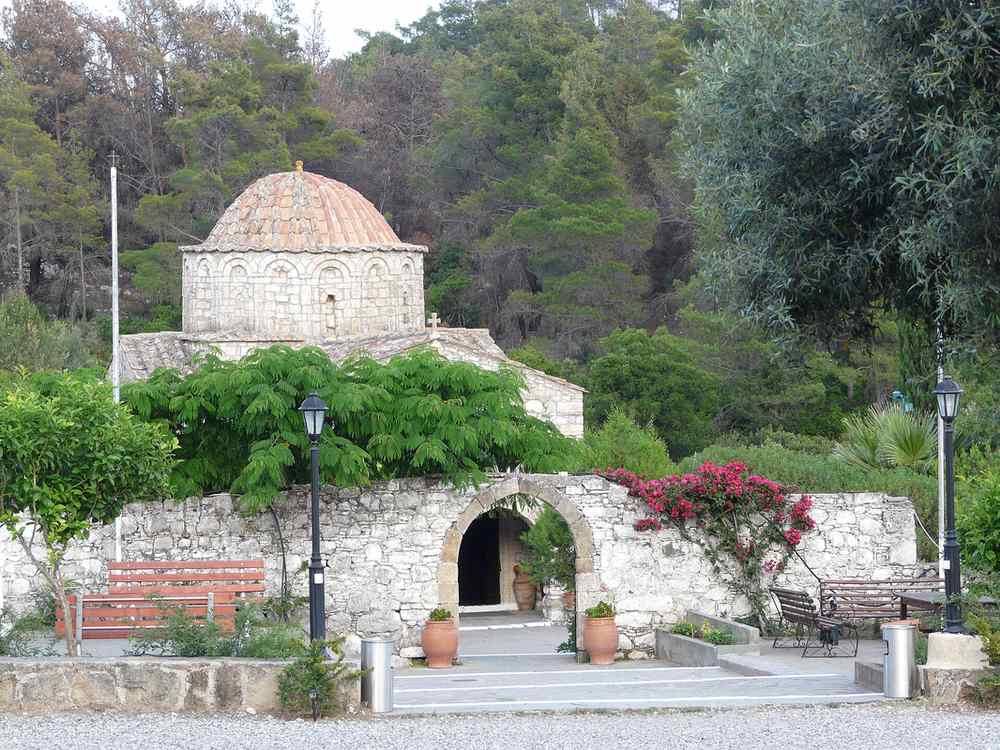
Laerma is a traditional inland village in the south-central interior of Rhodes, set among pine forest and worked farmland well away from the busy coastal resorts. It sits on the road that links the island’s east coast to its wooded heart, a quiet working settlement with a village square, old churches, and families who keep bees and farm the surrounding land. Most travellers reach Laerma not for the village alone but as the gateway to the historic Thari Monastery, the oldest monastery on Rhodes, hidden in the forest just to the south. The pace here is slow, the air smells of pine and honey, and the rhythm of rural life carries on much as it has for generations. For tours and trip planning across the island, start with My Greece Tours.
This page explains where Laerma sits, how to reach it, what to see in and around the village, and why it works as a base for exploring the forested interior. Read it alongside our wider Rhodes travel guide for regions and itineraries. The sections below cover the village setting, the road to Thari Monastery, practical access by car, the nearby villages, and how to fit Laerma into a day of inland touring.
Where is Laerma and what is the village like?
Laerma is a traditional inland village in south-central Rhodes, set among pine forest and farmland in the wooded interior. It lies on the route between the east coast and the central highlands, a quiet working community built around a square, with churches, beekeeping and farming at its heart.
The village occupies a gentle valley in the south-central interior, ringed by the pine forests that cover much of inland Rhodes. Unlike the coastal resorts, Laerma is a genuine working settlement where farming and beekeeping still shape daily life. Around the central square you will find a kafeneio or two, a handful of small churches, and houses that look out over olive groves and fields rather than the sea. The honey produced from the surrounding pine and thyme is a local source of pride, and the slow, unhurried atmosphere is one of the main reasons travellers seeking authentic rural Greece make the detour here away from the busier east coast.
The setting also makes Laerma a natural pause on any inland route. Pine-covered ridges rise on every side, and the roads out of the village wind through forest towards monasteries, springs and other interior settlements. It is the kind of place where you slow down, watch village life unfold, and use the square as a base before heading deeper into the woods. Our guide to Thari Monastery covers the forest sanctuary just south of the village, and the next section covers the road that leads there.
How do you reach Thari Monastery from Laerma?
Thari Monastery sits in the forest a short drive south of Laerma, reached by a winding paved road through the pines. It is the oldest monastery on Rhodes, and the village is its natural gateway, with the route signposted from the centre of Laerma towards the wooded interior.
From the village square, a quiet road threads south through dense pine forest to reach the monastery, which stands in a clearing surrounded by trees. The drive is short but slow, following the curves of the wooded hills, and it gives a real sense of why Thari became a place of retreat and contemplation. As the oldest monastery on the island, it holds important Byzantine wall paintings inside its church, and the forest setting has kept it peaceful and largely untouched by mass tourism. Visitors usually combine the monastery with a wander through Laerma itself, treating the village as the practical starting point for the visit.
Because the monastery is active, modest dress is expected, and the forest road is best driven in daylight when the bends and gradients are easy to read. Carry water and fuel, as services in the interior are limited and you will not find shops along the forest track. Plan a relaxed half-day so you can enjoy both the sanctuary and the surrounding woodland without rushing. Our guide to Asklipio covers a historic village within easy reach to the south, and the next section covers reaching Laerma by car.
How do you get to Laerma and do you need a car?
You really need a hire car to reach Laerma comfortably, as it lies in the interior away from the main coastal bus routes. Winding forest roads connect it to the east coast and to the central villages, and a car gives you the freedom to combine the monastery, the village and nearby settlements in one trip.
Laerma is reached by inland roads that branch off the east-coast highway and climb into the wooded hills. The most common approach is from the east coast near the Asklipio and Gennadi area, turning inland and following signs towards the interior. The roads are paved but narrow and winding in places, threading through forest and farmland, so unhurried driving is the rule. Public transport into the deep interior is sparse and infrequent, which is why almost every visitor arrives by rental car, scooter or organised tour rather than relying on island buses that mainly serve the coast.
Allow plenty of time for the drive, as the distances feel longer than the map suggests once you are on the bends. A car also lets you link Laerma with other inland highlights in a single loop, returning to the coast by a different route. Fuel up before you head inland and keep an eye on the road for the occasional farm vehicle or grazing animals. Our guide to things to do in Rhodes covers the island’s wider attractions for context, and the next section covers the villages around Laerma.
What villages and sights are near Laerma?
Laerma sits among the central and southern inland villages of Rhodes, within reach of Asklipio to the south and Apollona in the wooded interior. The whole area rewards slow exploration, with monasteries, forest, springs and traditional settlements scattered through the hills around the village.
To the south, the historic village of Asklipio is known for its castle ruins and a frescoed Byzantine church, an easy add-on to a day spent around Laerma. Deeper in the interior, Apollona offers another taste of traditional mountain-village life, with folklore traditions and a quiet square of its own. Between these settlements lie pine forests, small chapels and farmland, and the roads that connect them make for a scenic, unhurried drive. This part of Rhodes is far removed from the resort coast, and the villages share a slow, working character built around agriculture, livestock and the seasons.
Travellers who enjoy authentic rural Greece often string several of these places together, pausing for coffee in a village square or a meal of local produce along the way. The interior is also the source of much of the island’s honey, cheese and garden vegetables, so it is good country for sampling traditional flavours. Our guide to Apollona covers a neighbouring interior village, and the next section covers how to build Laerma into a touring day.
How do you fit Laerma into a day of inland touring?
Laerma works best as one stop on a relaxed inland loop, combined with Thari Monastery, Asklipio and the surrounding forest. Set off early, drive slowly, and treat the village square as a pause between sights rather than a destination in itself for the whole day.
A satisfying inland day might start on the east coast, turn inland past Asklipio, and climb to Laerma for a coffee and a wander before continuing south through the forest to Thari Monastery. From there you can loop back towards the coast or push deeper towards Apollona and the central villages, depending on your time and appetite for winding roads. Because the interior is quiet, you rarely fight crowds, and the rhythm of the day is set by the landscape rather than the clock. Bring water, snacks and a full tank, and be ready to stop wherever a view or a village square invites you.
Pair the inland scenery with the island’s traditional cooking, as the interior villages are a good place to taste honey, cheese, garden vegetables and slow-cooked dishes. Our guide to Rhodes food covers the local dishes and produce worth seeking out as you travel. Whatever route you choose, keep it relaxed: the appeal of Laerma and its surroundings is the unhurried, authentic feel of rural Rhodes far from the resorts. Plan your visit and tours through our Rhodes travel guide.
Frequently Asked Questions
Is Laerma worth visiting?
Laerma is worth visiting if you want to experience authentic rural Rhodes away from the coastal resorts. It is a traditional inland village set among pine forest and farmland, with a quiet square, old churches, and a working community that still farms and keeps bees. Most travellers come not for the village alone but because it is the natural gateway to the historic Thari Monastery, the oldest on the island, hidden in the forest just to the south. If your idea of a good day is a slow drive through wooded hills, a coffee in a village square, and a visit to a peaceful Byzantine monastery, Laerma fits perfectly. It is less suited to those looking for beaches, nightlife or big sights, which belong to other parts of the island. Treat it as one stop on an inland touring loop, combined with Asklipio, Apollona and the surrounding forest, and it rewards the detour.
Do you need a car to visit Laerma?
A car makes visiting Laerma far easier, and in practice most travellers arrive by hire car, scooter or organised tour. The village lies in the interior of Rhodes, away from the main coastal bus routes, and public transport into the deep inland is sparse and infrequent. The roads that reach Laerma branch off the east-coast highway and wind through pine forest and farmland, paved but narrow in places, so they call for unhurried, careful driving in daylight. Having your own vehicle also lets you combine Laerma with nearby highlights such as Thari Monastery, Asklipio and Apollona in a single loop, returning to the coast by a different route. Fuel up before heading inland, carry water, and allow more time than the map distances suggest, because the bends slow you down. Without a car you would struggle to reach the village reliably, so plan transport before you go rather than relying on buses.
What is Thari Monastery and how is it linked to Laerma?
Thari Monastery is the oldest monastery on Rhodes, set in a forest clearing a short drive south of Laerma, which serves as its natural gateway. The monastery is reached by a winding paved road that threads through dense pine woodland from the village, and the route is signposted from the centre of Laerma. Inside, the monastery church is known for its important Byzantine wall paintings, and the secluded forest setting has kept it peaceful and largely free of mass tourism. Because it is an active religious site, modest dress is expected of visitors, and the forest road is best driven in daylight when the curves and gradients are easy to manage. Most people combine the monastery with a stroll around Laerma itself, using the village square as the practical starting point. Allow a relaxed half-day so you can enjoy both the sanctuary and the surrounding woodland without feeling rushed along the way.