
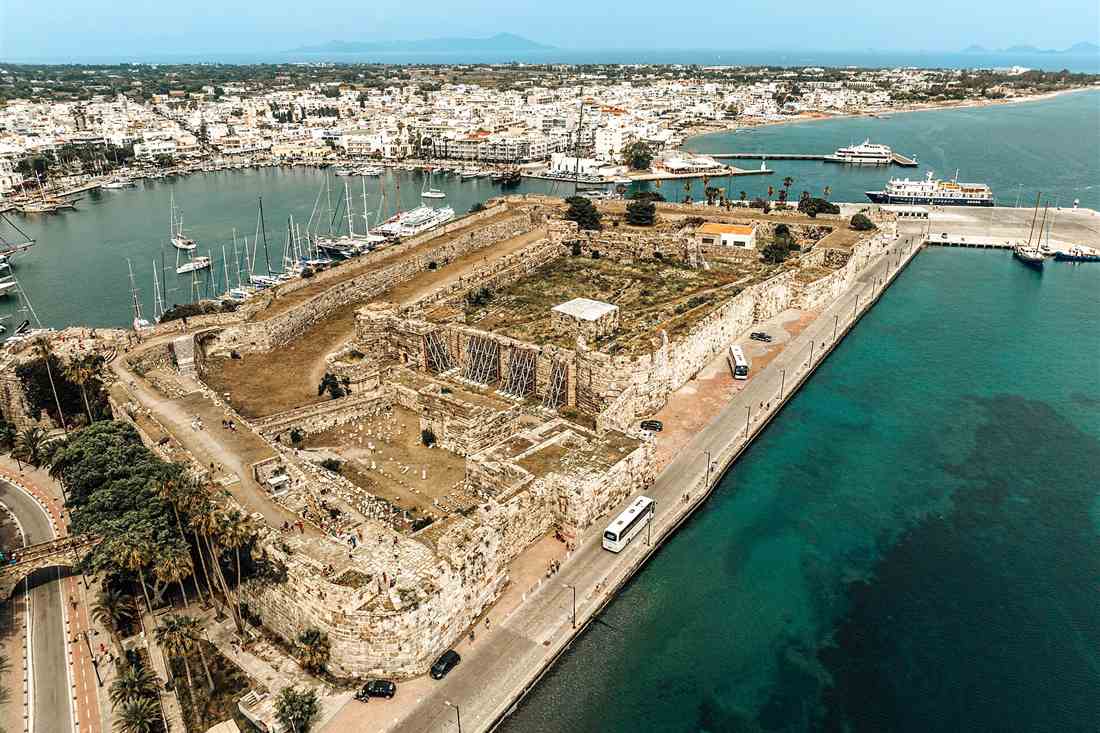
A Kos photoshoot works the castle of Neratzia and the Ancient Agora in Kos Town, the terraces of the Asklepieion above the coast, the mountain village of Zia at sunset and the beaches at Agios Stefanos and Paradise. Plan the rest of the trip with Greece Tours.
What do the three Kos photoshoot sessions cover?
The beach session works one stretch of coast, the Kos Town tour session walks the monuments of the old centre, and the island family session moves a group between a town setting and a beach in the same booking.
The beach format suits couples and solo travellers who want water, sand and an open horizon behind them. The town format suits anyone who wants the castle, the Agora and the harbour in the frame, and it covers the most ground on foot.
The family format is built around a group rather than a pair, so the pace is slower and the stops are closer together. Flat ground through the centre of Kos Town and along the northern beaches makes that format workable with small children.
All three run as private sessions. No other clients join the route, and the photographer follows the group rather than a fixed timetable.
Where do you shoot in Kos Town?
The centre of Kos Town is compact and level. The castle, the Agora, the plane tree and the harbour stand within a few hundred metres of each other, which is why the town session works as one continuous walk rather than a drive between stops.
The Defterdar mosque on Eleftherias square and the municipal market building give the square its Ottoman and inter-war layers. The palm trees of Finikon avenue throw hard shade in a line, which suits frames taken in the middle of the day.
A Kos photoshoot in the town ends at the marina or the old harbour, where the fishing boats and the castle wall close the background.
What is a Kos photoshoot at Neratzia castle like?
A Kos photoshoot at the castle walks around and inside the Knights Hospitaller fortress that guards the harbour entrance, where curtain walls, gun platforms, gateways and a stone bridge stand over the water, with the town and the moored boats behind the subject.
The castle was raised by the Knights of Rhodes and takes its name, Neratzia, from the bitter orange trees that grew inside it. Its walls carry reused ancient blocks and carved coats of arms, so the stonework itself gives detail to close frames.
The fortress sits at the end of a causeway beside the palm avenue, which means the light comes off the water on three sides. Early morning puts the sun behind the harbour and lights the seaward wall directly.
Frames from the outer road show the whole castle with the town beyond it. The boat side of the island sits at Kos 3 island cruise.
Can you shoot in the Ancient Agora?
Yes: the Agora of Kos lies open beside the castle as a field of standing columns, foundations and paved streets, and it was one of the largest market places of the ancient world, at the commercial heart of the ancient city.
The site is unfenced along part of its edge and sits directly on the route between the harbour and the town centre. Columns stand in short rows rather than in a single colonnade, which gives depth without a crowd of visitors in the shot.
The excavation runs down towards the sea, so the ground is uneven in places and flat shoes matter. Photographers keep to the paths and shoot from them, as the site rules allow no tripods on the ruins.
A Kos photoshoot that starts in the Agora carries straight on to the castle in under five minutes on foot.
Can a Kos photoshoot use the plane tree of Hippocrates?
The square sits between the castle bridge and the Defterdar mosque, so three periods of the town stand within one frame: the Hospitaller fortress, the Ottoman fountain and the tree itself.
Shade under the canopy is deep and even, which suits portraits at midday when the open sites are burnt out by the sun. The stone supports give a clean horizontal line behind a seated subject.
Why shoot at the Asklepieion?
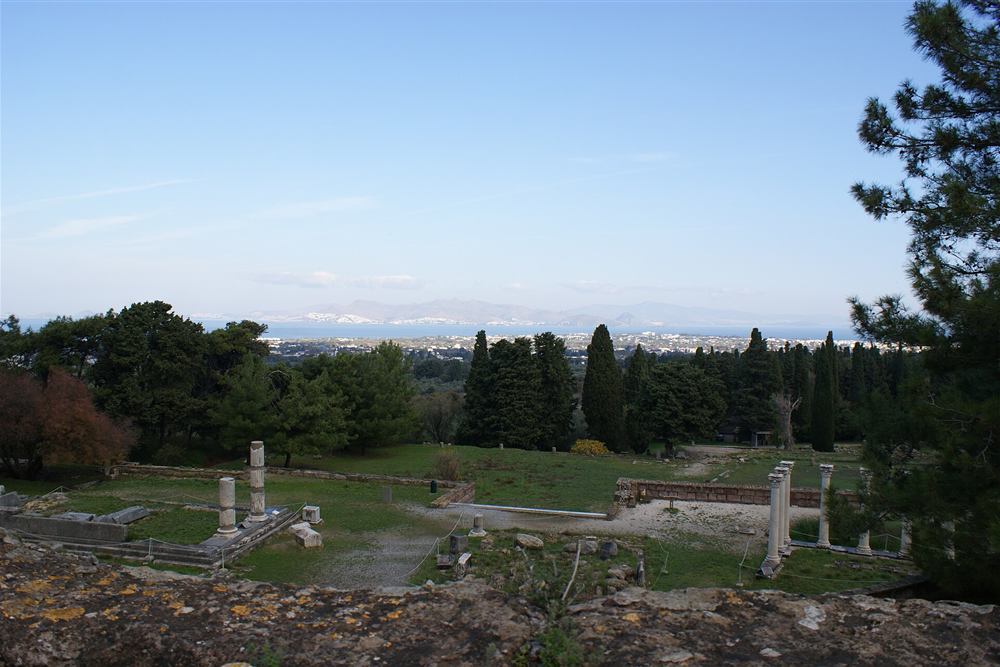
Because the healing sanctuary rises on three stepped terraces above the plain, linked by broad stone staircases, with standing columns on the upper level and the strait to the Turkish coast filling the view behind them.
The terraces were built into the hillside, so each level gives a different height without a climb of any length.
The top terrace holds the temple platform and looks north over cypress and pine to Kos Town and the sea. Morning light lands on the columns from the east and keeps the stone warm rather than white.
A Kos photoshoot here is taken handheld on the marked paths. The site opens early, and the first hour after opening is the quietest of the day.
What is the Zia sunset Kos photoshoot?
An evening Kos photoshoot in the mountain village on the slopes of Mount Dikeos, which faces west across the island and holds the sunset view, with stone lanes, terraces and the plain running down to the sea below.
Zia is one of the smaller settlements of Kos, above Zipari on the road that climbs the northern slope. The village lanes stay in shade through the afternoon and open to the light only in the last hour.
The viewpoint terraces at the top of the village look over the plain towards Kefalos, with the sun dropping into the Aegean beyond. That hour is the busiest of the day in the village, so photographers set up before it.
The evening route is covered at Zia Kos sunset tour.
Which mountain villages suit a Kos photoshoot?
The Asfendiou villages on the northern flank of Mount Dikeos, a cluster of small settlements with stone lanes, whitewashed chapels and plane trees, set above the coastal plain and reached by the road climbing from Zipari.
Lagoudi and Zipari lie on the same slope and keep the same building stock. The villages sit high enough for the strait and the Turkish coast to appear behind a subject standing on the lane.
Mount Dikeos is the highest ground on Kos, and the road up it turns steeply, so a session in the villages is planned with driving time in it rather than squeezed between two town stops.
The route is covered at Asfendiou villages.
Which beaches suit a Kos photoshoot?
Paradise beach on the southern bay for open sand and clear water, Agios Stefanos for the standing columns of its early Christian basilica beside the sea, and Mastichari on the north coast for a working harbour and a flat shoreline.
The basilica at Agios Stefanos stands within metres of the water, its columns and mosaic floors open to the sky. The islet of Kastri lies offshore with a chapel on it, closing the frame behind the ruins.
Paradise beach sits on the south-facing Kefalos bay, where the water is shallow and the sand pale. The south coast takes the afternoon sun directly, which pushes sessions there to the end of the day.
Mastichari is the ferry port for Kalymnos and keeps fishing boats along its quay. The evening at sea sits at Kos sunset cruise.
What is the Alyki salt lake shoot?
A session on the flat shore of the Alyki lagoon behind Tigaki, where a white salt crust meets shallow water, flamingos feed in spring and nothing stands between the subject and the horizon.
The lagoon lies between Tigaki beach and the inland road, a few kilometres west of Kos Town. Its surface shrinks through the summer and leaves a pale crust that reflects light back up into a portrait.
Flamingos, herons and waders use the lagoon on migration, and they hold their distance rather than scattering, so a long lens keeps them in the background of a frame.
There is no shade on the shoreline. A Kos photoshoot here runs early, before the wind picks up off the strait and ruffles the water.
When is the light best for a Kos photoshoot?
The first two hours after sunrise for the castle, the Agora and the northern beaches, the last hour before sunset for Zia, Asfendiou and the southern bays, and the middle of the day for the shaded lanes and the plane tree square.
Kos lies low and open, and the summer sun stands almost overhead at midday. Between eleven and four the white stone of the Agora and the sand at Tigaki throw back enough glare to flatten faces.
The north coast faces the strait and keeps even light through the afternoon. The south coast at Kefalos takes the sun head-on and works best as the day ends.
Sunset moves by more than three hours between midwinter and midsummer, which is why the meeting time is set against the date rather than fixed.
Which season suits a Kos photoshoot?
Late spring and early autumn: the light is softer, the heat is off a session that runs an hour or more, the flamingos are on the lagoon in spring, and the town monuments are open without the high-summer crowds.
Kos has a hot-summer Mediterranean climate, and July and August bring the strongest sun and the fullest streets. Sessions in those months run at either end of the day and skip the middle entirely.
In winter the village tavernas at Zia close and the island empties, which leaves the monuments and beaches clear but shortens the usable daylight.
Spring brings green on the slopes of Mount Dikeos and wildflowers over the archaeological sites.
What does a family Kos photoshoot include?
Level ground through Kos Town and along the northern beaches makes the format workable with prams and small children. The distance between the castle, the Agora and the harbour is short enough to walk without a break.
Cycle paths run from Kos Town out to Lambi and Psalidi, and families who hire bicycles use them to reach a beach setting without a car.
Group frames and individual portraits are taken at each stop rather than at the end.
Where do couples book a Kos photoshoot?
A couples Kos photoshoot runs on the Asklepieion terraces with the strait behind, on the castle walls above the harbour, in the lanes of Zia at sunset, and at Agios Stefanos beside the basilica columns with the islet of Kastri offshore.
For a proposal the photographer works at a distance with a long lens, then joins the couple afterwards for portraits. The route and the signal are agreed before the day.
The town tour session takes couples through the Agora, the plane tree square and the old harbour in one walk of about an hour.
Honeymoon and engagement sessions run on the same terms as the couples format.
What do you wear to a Kos photoshoot?
A Kos photoshoot asks for light fabric that moves in the wind off the strait, flat or grippy shoes for the uneven ground in the Agora and the Asklepieion stairs, a second outfit when the session covers two settings, and water in summer.
Long dresses work on the castle walls and the Zia terraces, where the wind is steady. Pale colours hold their tone against the dark volcanic sand at some of the southern beaches.
Archaeological sites allow handheld cameras and no tripods, so the photographer carries light and works around the marked paths.
Shade is scarce at the salt lake and on the Asklepieion terraces; a hat between frames keeps the session comfortable.
How do you get around for a Kos photoshoot?
On foot in Kos Town, by bicycle on the cycle paths to Lambi and Psalidi, and by car or taxi to the Asklepieion, Zia, Tigaki and the southern beaches, with the airport at Antimachia in the middle of the island.
Kos is flat along its northern coast, which is why cycling works here better than on most Greek islands. The paths are separated from the road for much of the run out of town.
The Asklepieion lies a short drive south of the town. Zia and the Asfendiou villages sit higher up and take longer on the climbing road.
Ferries reach the island at Kos Town and at Mastichari, which links to Kalymnos.
How do you book a Kos photoshoot?
Evening slots go first in July and August, when the sunset hour is the only comfortable window for an outdoor session.
Confirmation carries the meeting point and the start time, and the photographer sets the exact route once the date and the light are known.
What is the Roman side of Kos Town?
The Odeon is a small theatre with stone tiers. A subject stands in the middle of the floor and the seating curves behind.
The gymnasium keeps a long line of white columns. The line gives a strong background for a full-length frame.
Casa Romana is roofed, so its mosaics work on a hot day. A Kos photoshoot moves through all four sites in about half an hour.
What is Platani?
A small village on the road to the Asklepieion, settled by the island’s Turkish community, with a fountain square, low houses and tavernas under trees.
The village sits between Kos Town and the sanctuary. Sessions stop there on the way up or back.
Shade covers most of the square. That makes it a midday stop rather than an evening one.
The lanes are quiet, so a Kos photoshoot there works without waiting for people to pass.
Which south coast beaches suit a Kos photoshoot?
Kefalos bay, at the western end of the island, holds Camel, Paradise, Polemi and Psilos Gremos. Cape Krikelos further out holds Skinos, Theologos and Moscholiou.
These beaches face south. The sun lands on them all afternoon and sets over the sea at the end of it.
Camel beach sits in a small cove between rocks. Paradise is wider, with pale sand and shallow water.
The drive from Kos Town takes about 45 minutes, so a session there fills an evening.
What about the north coast beaches?
Tigaki, Marmari and Mastichari run along the north shore, all flat and sandy, with the salt lake behind Tigaki and a fishing harbour at Mastichari.
The north coast looks across the strait to Kalymnos and the Turkish mountains. That line of hills sits in the background of every frame.
Wind is stronger here. Mastichari and Kohilari are used for kiteboarding because of it.
A Kos photoshoot on this coast is booked early in the day, before the wind builds.
How long does a Kos photoshoot run?
A Kos photoshoot runs about an hour for the beach or town format, and longer when the route adds a second setting or leaves Kos Town for Zia, the Asklepieion or Kefalos bay.
Driving time counts. Zia is 20 minutes from the town, Kefalos bay about 45.
The photographer sets the start time by the sunset time that week.
Groups move slower than couples, so family sessions cover fewer stops in the same hour.
What rules apply to a Kos photoshoot at the archaeological sites?
A Kos photoshoot works handheld: cameras are allowed at the Asklepieion, the Agora and the Roman sites. Tripods, lighting rigs and staged shoots need a permit, and visitors keep to the marked paths.
Photographers work with natural light for this reason. Nothing is set up on the stonework.
Sites open in the morning and close in the afternoon, so an evening session uses the town or a beach instead.
Entry to each site is paid separately at the gate.
Is a Kos photoshoot worth booking for one day on the island?
Yes. A Kos photoshoot takes about an hour, covers the castle, the Agora and the harbour on foot, and leaves the rest of the day free.
Cruise passengers and day visitors land in Kos Town. Every town location sits within walking distance of the port.
The town session is the one that fits a short stop. Zia and Kefalos bay need a car and half a day.
Booking ahead matters, because the photographer holds one slot per party.
What does a Kos photoshoot include?
A private photographer for the session, a route planned in advance, and edited photographs delivered after the shoot. The number of guests is fixed when the booking is made.
No other clients join the route. The session belongs to one party.
The meeting point is named at booking, so nobody waits in the wrong square.
What can go wrong on the day?
Wind and heat. The strait between Kos and Turkey blows hardest in the afternoon, and midday sun in summer burns out the pale stone at the Agora and the sand at Tigaki.
A Kos photoshoot avoids both by running early or late. The photographer sets the hour when the date is booked.
Rain is rare in summer and normal in winter. Winter sessions move to the covered mosaics at Casa Romana or the shaded lanes.
The archaeological sites close in the afternoon, so a late session uses the town streets, the harbour or a beach.
How does a Kos photoshoot compare with shooting the island yourself?
A photographer knows which hour each location takes its light, which saves the guesswork: the castle wall in the morning, Zia at sunset, the Asklepieion before the coaches arrive.
Local photographers also know where to stand at each site to keep other visitors out of the frame.
They carry one camera and work handheld, because the sites allow no tripods.
The result is a set of edited photographs of the whole party, rather than phone shots with one person always missing.
Can a Kos photoshoot use the museums?
Yes, for the courtyards and entrances. The Archaeological Museum stands on Eleftherias square in the centre of Kos Town, and the Hippocratic Museum sits near the Asklepieion road.
The museum facade on Eleftherias square faces the market building and the mosque. All three sit around one square.
Indoor photography rules differ from the open sites, so the photographer asks at the desk before shooting inside.
The museum holds finds from the Agora and the Asklepieion, which makes it a short stop between the two.
What is on the coast east of Kos Town?
Psalidi, Agios Fokas and Therma, where hot springs run down the rocks into the sea. The road east follows the shore with the Turkish coast across the water.
Psalidi sits at the end of the cycle path from the town, so a session there needs no car.
Therma is the furthest of the three and has a pebble shore and a small hot pool at the water’s edge.
This coast faces east. A Kos photoshoot here is shot at sunrise rather than at the end of the day.
What does a Kos photoshoot find at the Casa Romana?
A rebuilt Roman villa with mosaic floors, courtyards and colonnades, roofed against the weather, in the western excavation zone of Kos Town.
The mosaics show fish, animals and geometric borders.
The courtyards are open to the sky inside the building.
It is the one site on the island that works in rain.
What does a Kos photoshoot find at Kefalos?
A hill village above the south-western bay, with a ruined windmill on the ridge, a church on the shore below and the islet of Kastri offshore.
Kefalos was the old capital of the island.
The bay below holds the longest beaches on Kos.
The drive from Kos Town takes about forty-five minutes.
What does a Kos photoshoot find at Antimachia?
A Knights’ castle on the ridge in the middle of the island, with a long curtain wall, two churches inside and views over both coasts.
The castle gate carries the arms of the Order.
The inside is open ground with wild flowers in spring.
The airport lies on the same plateau.
Frequently Asked Questions
How much is a photoshoot in Kos?
Where is the best backdrop on Kos?
The castle of Neratzia on the harbour, the Asklepieion terraces above the coast and Zia at sunset.
When is the light best?
The first two hours after sunrise and the last hour before sunset.