
A Kefalonia photoshoot is either a session with a hired local photographer or a tour with planned photo stops at the island’s beaches and villages. Find more trip ideas on Greece Tours.
The guide below explains both formats, the places to shoot, the tours, the light and what to bring for a Kefalonia photoshoot.
What is a Kefalonia photoshoot?
Two products share the name. One is a private session where a local photographer takes portraits of you at a place you choose. The other is a tour with photo stops along its route. You book and use each one differently.
A Kefalonia photoshoot in the first sense is a booked portrait session. You agree a place and a time with the photographer. The photographer then takes your pictures there and hands them over afterwards.
Couples, families and individual guests book these sessions. One island photographer offers a private photo experience for couples, families and guests. It is arranged through selected villas, hotels and private bookings. A booking-platform listing tags its session as romantic, family friendly and good for groups.
Engagement shoots form their own group. One couple booked an engagement shoot, and the fiancé planned the proposal with the photographer beforehand. The testimonial calls the planning stress free. Another island studio lists engagement sessions in its portfolio.
The second kind of Kefalonia photoshoot is a tour with photo stops. One operator sells a guided Instagram tour of the island. Its listing promises expert photo assistance at each location. The inclusions name a professional English-speaking tour escort and photo assistance at key stops. They name no photographer.
Pick a session when the people in the frame matter. Pick a tour when the places matter. Both formats suit a trip to the island of Kefalonia. A Kefalonia photoshoot of either kind ends with pictures of the places you visited.
How does a Kefalonia photoshoot session work?
You book a time and pick a spot. You meet the photographer 15 minutes before the start, and the shoot runs one to two hours. The photographer guides your poses. The files reach you by online gallery, USB stick or transfer link, depending on the studio.
Start with the place. One island studio meets clients at the location of their choice. A booking-platform listing says the meeting point follows the place where the shoot happens. A Kefalonia photoshoot is built around that spot, so choose it first.
Arrive early. The studio sets the meeting 15 minutes before the start time. Its platform listing repeats the 15 minutes. The listing says the extra time helps the photographer meet your goals and value your photo time.
Sessions run from one to two hours, and the studio adds time on request. Its platform listing shows a one-hour session. The fee changes with the length of the session and the number of people. Give the studio both numbers when you plan a Kefalonia photoshoot.
Photographers differ in style. The platform listing says the photographer shows you how and where to pose. The pose is meant to suit your character. A second island photographer asks for no strict poses. That photographer guides gently when needed and lets the day unfold.
Time is set aside at the end of the session. The platform listing says you can ask questions about editing and learn how to receive your content. A full refund applies when you cancel at least 24 hours before the start.
Delivery of a Kefalonia photoshoot differs by studio. One wedding and lifestyle studio puts images online about six to nine weeks after the shoot, says its FAQ. They sit in a password-protected gallery. The same FAQ gives you all the digital files for unlimited personal use.
Another photographer who shoots on Kefalonia offers a client gallery, a USB stick or a transfer link. Clients get all photos, in colour and in black and white.
Photo counts differ as well. The platform listing names pictures in high resolution as its inclusion and states no count. Ask the photographer for the count and the delivery date before you pay. Do this for every Kefalonia photoshoot you consider.
The same listing marks this Kefalonia photoshoot wheelchair accessible and suitable for all fitness levels. It offers an English-language guide. Infants and small children can ride in a pram or stroller. One studio confirms individual portraits in its FAQ.
Which beaches suit a Kefalonia photoshoot?
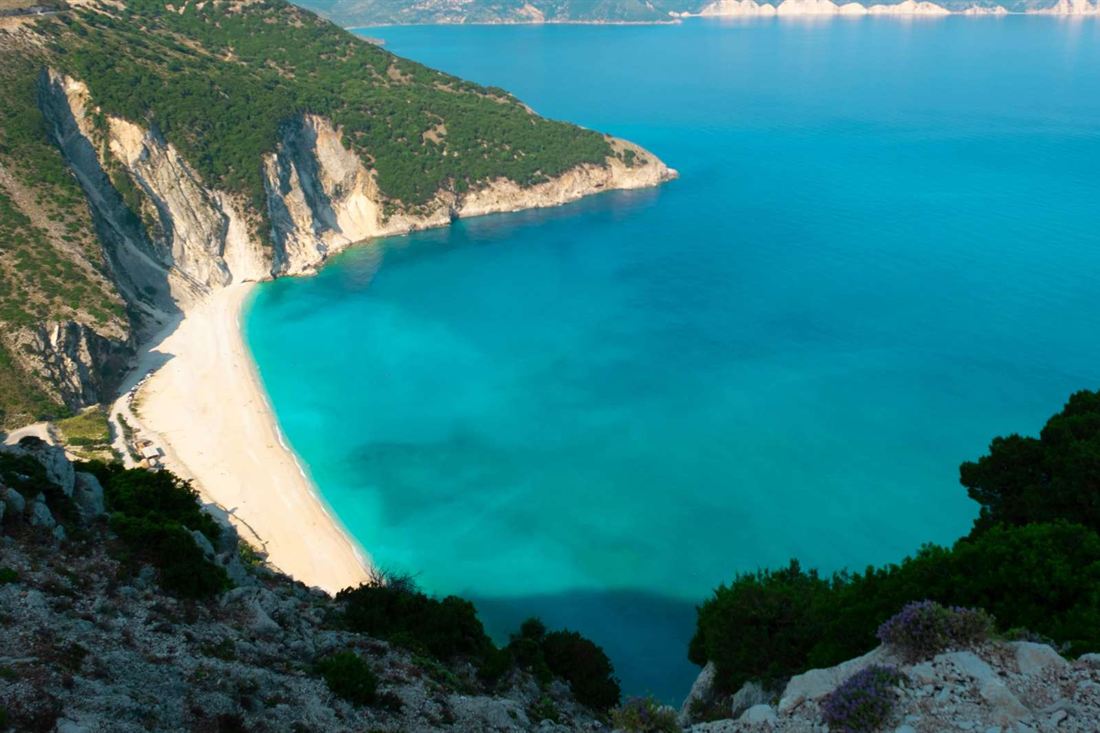
Three beaches suit a Kefalonia photoshoot. Myrtos has white pebbles and turquoise water. Antisamos has a small bay ringed by mountains. Xi has red sand under white cliffs. Each beach gives a different palette to work with.
Myrtos beach lies in the north-west of the island, in the region of Pylaros. It sits between the feet of two mountains, Agia Dynati and Kalon Oros. Kalon Oros reaches 901 m. A wide frame holds the shore and both slopes together.
The sediment around the beach is marble, a changed form of limestone. The shore itself is round white cobblestones. Waves lift the finest bits of marble and carry them along the curve of the beach. That marble dust gives the water its turquoise shade. A Kefalonia photoshoot at Myrtos puts white stone and turquoise sea in one frame.
The Telegraph wrote that the white pebbles form an arc a mile and a half long. The film Captain Corelli’s Mandolin used the beach for its mine explosion episode.
A steep, winding road about 2 km long, with hairpin turns, leads down to Myrtos from the village of Divarata. Private cars park at the base of the cliffs. Taverns stand at the top of the road in Divarata.
Antisamos is a small bay near Sami. Wikivoyage describes blue water, white stones and mountains in a circle around the bay. A Kefalonia photoshoot at Antisamos therefore has a ring of mountains behind the water.
Wikipedia says the film Captain Corelli’s Mandolin was mainly shot in Argostoli, Sami and on Antisamos Beach. Two beaches in this list, then, appear on screen in the same film.
Xi Beach lies in the south of the Paliki peninsula, near the town of Lixouri. Its sand is red, and white clay cliffs stand behind it. Rain has worn the soft clay of those cliffs.
The red colour comes from clay minerals that break down and release iron. Xi is geosite number 03 of the UNESCO Geopark Kefalonia Ithaka. For a Kefalonia photoshoot it offers red sand against white cliffs.
The sand strip is 3.3 km long and up to 50 m wide in places. Areas near hotels have loungers and sunshades. Areas away from amenities look more natural. Showers and changing cabins stand at both entrances.
Which villages suit a Kefalonia photoshoot?
Assos, Fiskardo and Agia Effimia suit a Kefalonia photoshoot because each one is a coastal village with its own scene. Assos brings a Venetian castle on a peninsula. Fiskardo brings a harbour with original architecture. Agia Effimia brings a small fishing harbour.
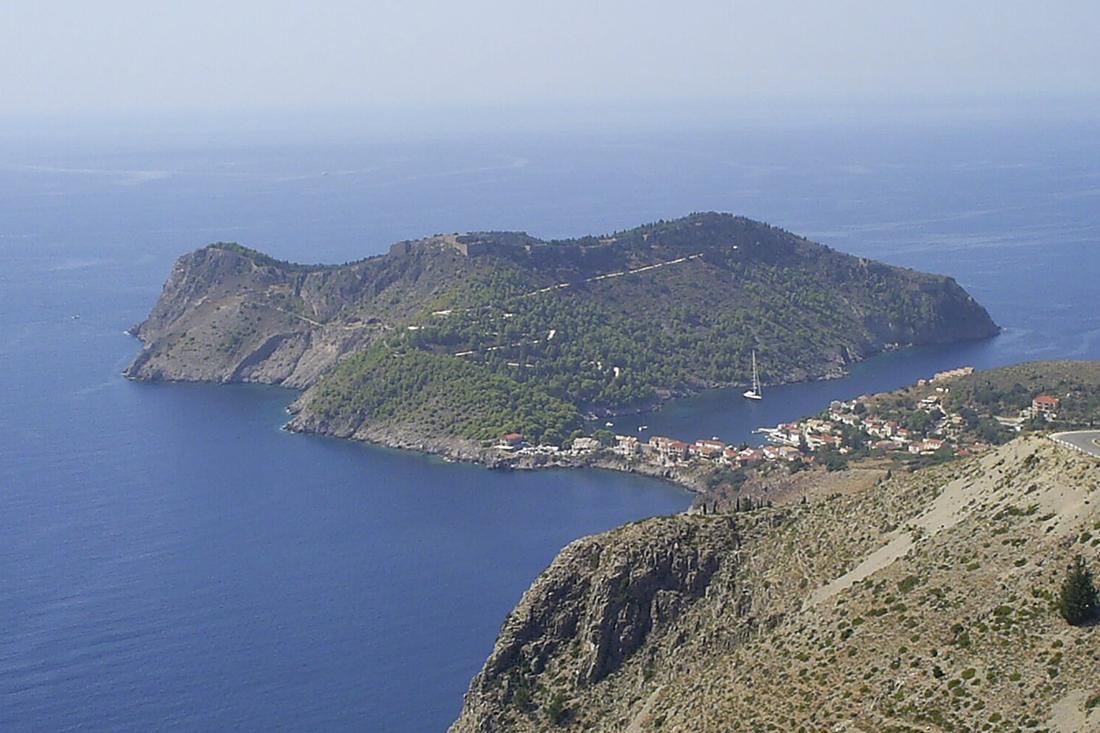
Assos is a village on the west coast, 36 km north of Argostoli. It was founded under Venetian rule. From fifteen ninety-three it served as the administrative capital of northern Kefalonia. Wikipedia lists a population of 61.
The castle of Assos stands on a rocky hill 170 m high. The hill fills the whole peninsula. A wall 2,000 m long protects the castle, and the site covers 44,000 square metres. Wikipedia’s photograph of the village is taken from this peninsula, so a Kefalonia photoshoot can look back at the houses.
The castle overlooks the bay of Agia Kyriaki. The British general Charles James Napier described it as stronger than Gibraltar. The preserved parts are sections of wall and an arched gate with the Venetian Lion of Saint Mark.
Inside the ruins stand the small church of St Mark and the house of the Venetian High Commissioner. A renovated stone path leads up to the castle.
Fiskardo is the northernmost port of Kefalonia, a short distance from Ithaca. It lies 32 km north of Argostoli. The bay that holds the port is also called Fiskardo and is 2 km long.
The great earthquake of nineteen fifty-three destroyed almost all settlements on the island and left Fiskardo in the north untouched. The village kept its original architecture. A Kefalonia photoshoot in Fiskardo can use that architecture as a backdrop.
The coast around Fiskardo is mainly rocky and has pebble-beached coves. The fishing fleet is small and getting smaller. Greek law protects the village and the dense forest around it as areas of great natural beauty.
Agia Effimia lies on the east coast and was the seat of the former Pylaros municipality. It is a traditional fishing village centred on a small harbour. Wikipedia lists a population of 638.
Sailing holidays are popular in the harbour, and flotilla sailing groups are based there. A Kefalonia photoshoot here works with boats and a small harbour. The village holds taverns, bars, shops and a traditional wood-fired bakery.
The earthquake destroyed older buildings in the village, yet original buildings survive.
Which Kefalonia tours add photo stops?
Three GetYourGuide listings build photo stops into the route. A private Jeep ride covers Argostoli. A day trip links Antisamos, Melissani and Myrtos. A 4×4 sunset drive climbs Mount Ainos. Each one suits a Kefalonia photoshoot made with your own camera.
None of the three is a studio booking. The vehicle halts at set spots, and you take the pictures yourself. The tours differ in length, group size and light.
The Argostoli Private Jeep Wrangler Tour with Photo Stops lasts 1 hour in an open cabrio Jeep. It is the private choice for a Kefalonia photoshoot, with a group of up to four people. Booking closes 2 hours before the start, and cancellation is free.
A review site splits the route into four parts:
- The lighthouse of Saint Theodoroi, with about 10 minutes for photos.
- A short off-road section of about 10 minutes.
- A viewpoint above Lassi, with about 15 minutes for photos.
- A 20-minute guided drive through the outskirts of Argostoli.
Pickup is from Lassi, Argostoli centre or the port. The route stays close to Argostoli, so this ride fits a short Kefalonia photoshoot between other plans.
Kefalonia: Antisamos Beach, Melissani Cave, Myrtos View Tour is a day trip of 5.5 hours for a small group. The driver explains throughout the tour. The listing’s web address calls it a Myrtos photo tour. Its text names the beach where a film took place.
Melissani is the stop where timing shapes the picture. Showcaves advises a visit on a sunny day at the middle of the day. The visit follows the sun, not the clock on the tour sheet.
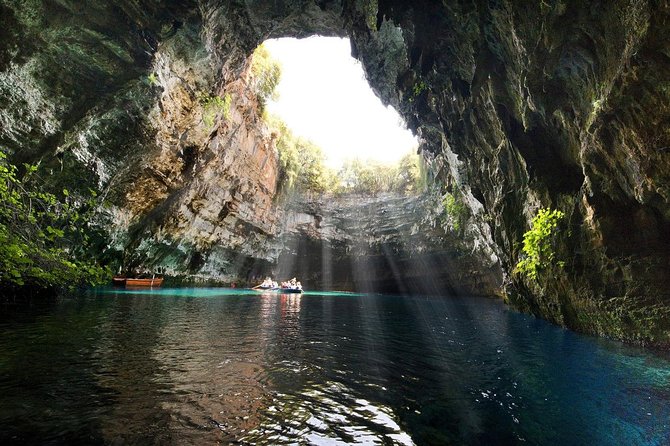
The first hall has a large oval opening in the roof. With the sun directly overhead, its rays strike the ultramarine water and light the cave blue. Early in the morning the pier stays in shadow.
A Kefalonia photoshoot in the cave happens from a small boat. A tunnel leads to a pier, and the boat circles the first hall under the open roof. The boatman then pulls it along a rope on the wall, through a narrow channel, to the second chamber.
That chamber has yellow electric lamps. Passengers stay in the boat and cannot step onto the island.
Plants grow at the cave opening, and the stone beside it runs from stucco to honey brown. Forest surrounds the cave. Those colours frame the blue water in a Kefalonia photoshoot.
Where can a Kefalonia photoshoot catch the golden hour?
Mount Ainos gives the widest frame. It is the tallest mountain on Kefalonia, at 1,628 metres. The Premium 4×4 Sunset Experience halts at a high viewpoint there for a 30-minute photo stop at sunset.
Wikipedia defines the golden hour as the time shortly after sunrise or before sunset. Daylight is redder and softer then than when the sun is higher in the sky. The low sun also draws longer shadows across a Kefalonia photoshoot.
The mountain sits inside Mount Ainos National Park. It is the smallest of the national parks in Greece and covers more than 3,000 hectares. Greek fir and black pine cover the slopes, and the pine forests grow between 700 and 1,200 metres.
On clear days the view takes in the northwest Peloponnese and Aetolia, which gives a Kefalonia photoshoot a far horizon. The islands of Zakynthos, Lefkada and Ithaca are in view as well. Television and mobile phone relay towers stand on the summit, so choose the angle with care.
The Kefalonia: Premium 4×4 Sunset Experience: Golden Hour lasts 4.5 hours and includes pickup. Groups are small, with up to eight guests per vehicle. The listing promises soft off-road routes, local tastings and panoramic sunset views. It is the sunset pick of the three for a Kefalonia photoshoot.
Discover Greece gives the timetable. The drive to the national park and the top viewpoint takes 1 hour 30 minutes. The sunset photo stop gives a Kefalonia photoshoot 30 minutes. The route passes black pine forests, mountain trails and ridge lines. The viewpoint stop depends on the sunset time.
Travellers with their own car can drive to a transmitter station and walk from there. A dirt track of about 10 minutes follows. Steps of about 10 minutes then lead up to the summit. The page on Mount Ainos covers the park in more depth.
The two lights pull in opposite directions. The Melissani blue belongs to the overhead sun, while the golden hour on the mountain belongs to the low sun. A Kefalonia photoshoot gains from planning one of each.
When is the light right for a Kefalonia photoshoot?
Soft light falls in the first and last hours of the day. On 21 June the sun rises at 6:15 am and sets at 9:04 pm in Argostoli. That gives the island 14 hours 49 minutes of daylight on its longest day.
Wikipedia says the golden hour has no clearly defined length and changes with the season and the latitude. A Kefalonia photoshoot therefore needs the sunset time for its own date. At Argostoli the sun rises at 7:25 am and sets at 7:35 pm on 22 September.
Midday is the hard case. The same Wikipedia page says a bright overhead sun creates strong highlights and dark shadows. It calls this harsh light a particular problem for portraits, and it says contrast is lower in the golden hour.
Wikipedia describes Cephalonia as an island with hot, sunny summers and mild, rainy winters. It names the climate hot-summer Mediterranean under the Köppen system. A summer Kefalonia photoshoot meets sun, while a winter one meets rain.
The Ionian Islands lie in the Ionian Sea, west of mainland Greece. Argostoli, the largest port, sits in the west of Kefalonia. The sun sets in the west, so the west coast looks out over open sea at sunset.



What do you bring to a Kefalonia photoshoot?
Pack for sun in summer and for rain from autumn on. A sun hat, shoes with grip and a polarizing filter cover the summer kit. A rain jacket covers the wet months.
Light clothes suit summer. The average high at Argostoli is 29.5°C in July and 29.9°C in August. The average low is 20.6°C and 21.6°C. Wikipedia lists winter days at 14 to 15°C and winter nights at 8 to 9°C. A winter Kefalonia photoshoot therefore needs layers.
Rain starts to matter from October. Argostoli records 94.7 mm in October, 155.9 mm in November and 150.0 mm in December. Those months bring 7, 11 and 12 rain days of 1 mm or more. A rain jacket and a spare dry outfit protect the session.
Wikipedia defines a sun hat as headgear made to shade the head, face, neck and shoulders from direct sunlight. Sunscreen helps protect against sunburn. Both belong in the bag for a summer Kefalonia photoshoot.
Wikipedia puts the plains at less than 15% of the island and calls the island rugged and mountainous. Shoes with grip suit uneven ground better than flat sandals. Wikipedia describes hiking boots as footwear that protects the feet and ankles on outdoor walks.
Three camera items from Wikipedia suit a coastal shoot. A polarizing filter darkens skies, manages reflections and suppresses glare from the sea. A lens hood blocks the sun to prevent glare and lens flare. A tripod prevents camera movement during slow exposures.
A drone adds its own rules. The Civil Aviation Authority of Greece runs the national drone portal. The portal states that every owner must know the European regulations. The European Union Aviation Safety Agency sets one limit for classes C0 to C4. Fly below 120 m above ground level.
Couples who plan a ceremony portrait can read about Kefalonia weddings for the settings that suit a ceremony.
What do travellers ask about a Kefalonia photoshoot?
Drones, daylight, rain and the blue hour draw the questions. The answers rest on the European Union Aviation Safety Agency, Wikipedia and sunrise data for Argostoli. Each Kefalonia photoshoot plan starts from a checked figure.
Does a camera drone need registration?
Yes, for classes C1 to C4 and for a C0 drone that carries a camera and is not a toy. The agency sets the remote pilot minimum age at 16, and a State can lower it to 12. A drone shot for a Kefalonia photoshoot starts with that registration.
How far must a drone stay from people?
The distance depends on the class. A C2 drone keeps 30 m from uninvolved people, or 5 m with the low-speed function on. C3 and C4 drones keep 150 m from uninvolved people and urban areas. C0 and C1 drones never fly over assemblies of people.
What is the blue hour?
Wikipedia describes the blue hour as a twilight period at dawn or dusk. The sun sits well below the horizon and no sharp shadows fall. On 21 June the twilight after sunset ends at 9:36 pm at Argostoli, about half an hour later.
How short is the winter day?
On 21 December the sun rises at 7:50 am and sets at 5:21 pm at Argostoli. That leaves 9 hours 30 minutes of daylight, so a winter Kefalonia photoshoot starts early and ends by late afternoon.
Which month has the least rain?
July, with 1.3 mm of rain on 0 rain days. August follows with 5.6 mm on 1 rain day, and June records 10.5 mm on 1 rain day. Wikipedia lists these Argostoli averages, so July is the driest month for a Kefalonia photoshoot.