
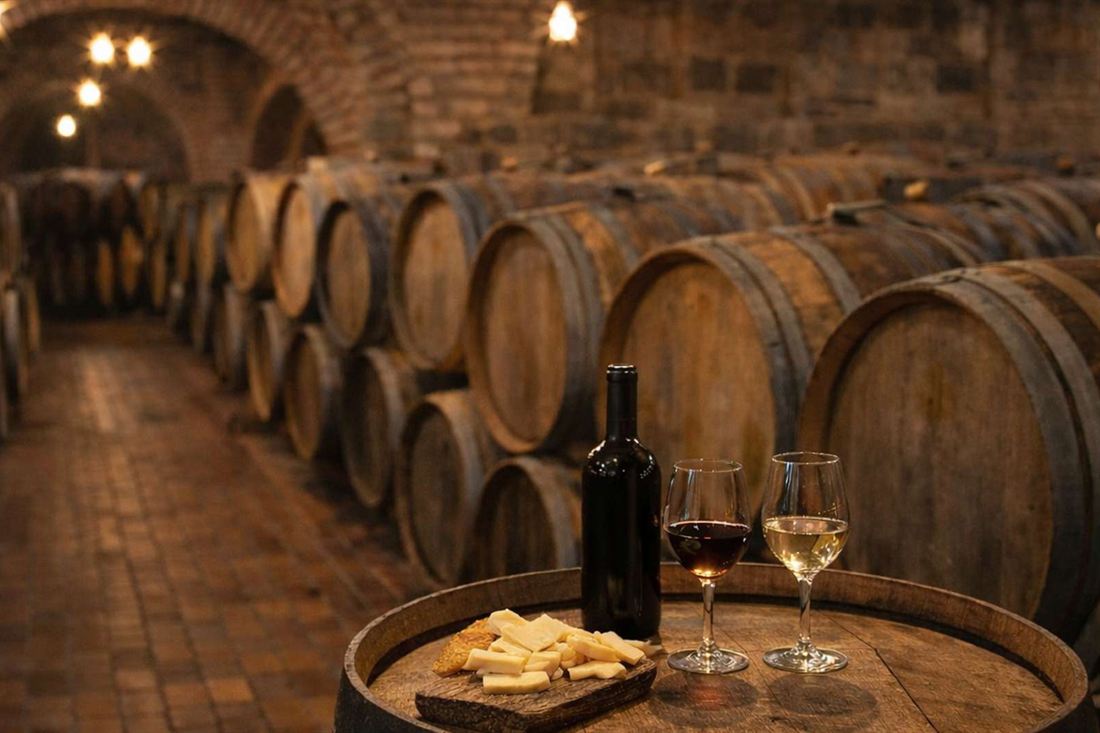
A Kastoria wine tasting pours the wines of the mountain vineyards of Western Macedonia, at a cellar near the lake town of Kastoria or on a guided day out with a winery stop. Map out the wider northern trip on Greece Tours.
The answers below run from the bookable Kastoria wine tasting tours to the local wineries and grapes, the sun-dried wine of Siatista, the nearby wine zones, the glass itself and the harvest.
What is a Kastoria wine tasting?
A Kastoria wine tasting is a sitting where you sample wines from the Kastoria area. It happens at a winery cellar door or tasting room. It also happens at a wine bar or at a restaurant table with a lake view.
Wikipedia says wine tasting is the judging of wine through the senses. It adds that informal, recreational tasting is a much less analytical process, aimed at a general, personal appreciation. That personal approach fits a holiday: you taste, notice what you like and move to the next glass.
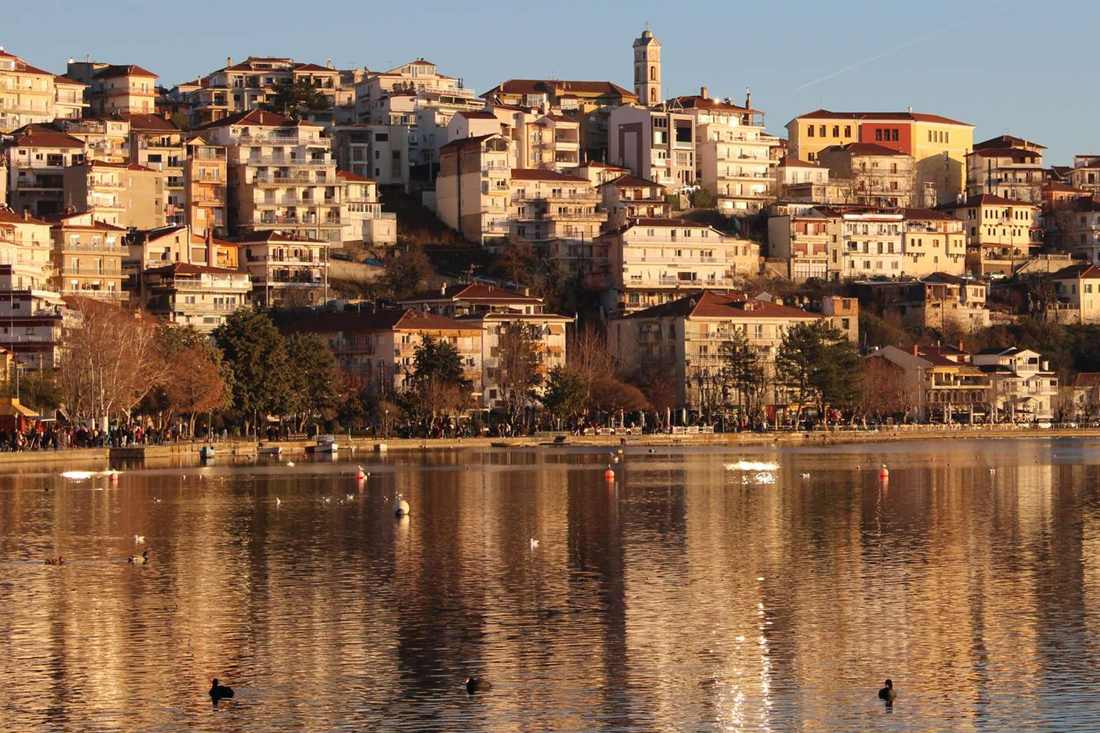
Kastoria is a city in Western Macedonia, on a promontory on the western shore of Lake Orestiada. Its economy includes the sale and distribution of locally grown produce, with wheat, apples, wine and fish named first. A Kastoria wine tasting starts from that local product.
A winery visit is the first kind of Kastoria wine tasting, and it takes place where the wine is made. Wikipedia’s wine tourism entry describes a visit in three steps. First comes the history of the winery, then how the wine is made, then the tasting.
Wikipedia adds that a winery can have a tasting room where customers taste wines before they buy. A Greek wine-tourism guide says Kastoria joined the Greek wine map relatively recently. It counts two visitable wineries, in the municipal units of Vitsi and Agia Triada, both in the municipality of Kastoria.
A wine bar sells wine rather than liquor or beer. Wikipedia names a wide selection by the glass as a typical feature of the wine bar. Where licensing rules allow it, a wine bar can also sell the wines it serves. That makes the bar the quick, glass-by-glass form of a Kastoria wine tasting.
Discover Kastoria is the website of the Kastoria municipality. It invites visitors to enjoy local wines in restaurants of the town and wider area with a lake view. A glass at those tables is a Kastoria wine tasting without a cellar visit.
The wine-tourism guide also lists Vinamorato, under Kastoria wine events and tastings. It lists the Kastoria Wine Club too, a circle of wine lovers.
Which Kastoria wine tasting tours can you book?
Two GetYourGuide listings put a wine stop on the Kastoria road. One is an 8-hour private tour that starts in Kastoria. The other is an 11-hour small-group day trip from Thessaloniki with an optional tasting. Both show free cancellation.
The first listing is titled Kastoria: Private Pozar Thermal Baths, Edessa, & Winery Tour. It starts in Kastoria and lasts 8 hours. Its summary calls it a full-day guided tour of Western and Central Macedonia. The stops are Pozar Thermal Baths, Edessa and a local winery.
The listing sets a private group, priced per group of up to 3 people. It offers pickup and free cancellation, and it asks for a booking at least 10 hours before the start. Its summary does not name the winery or describe a tasting, so ask the operator what the cellar stop includes.
Two of the three stops are not wine. Wikipedia places the Pozar thermal baths 32 km north of Edessa and 13 km west of Aridaia. It says the water is naturally heated to 37 degrees Celsius.
Edessa has twelve waterfalls, of which four are easily visible. The winery is the third stop, so the cellar visit on this tour is one part of a long day.
The second listing is titled Thessaloniki: Small Group Day Trip to Siatista & Kastoria. It starts in Thessaloniki and lasts 11 hours. Its summary says to opt for wine tasting and to meet the locals. The Kastoria wine tasting is a choice, not a fixed stop.
The listing prices the trip per group of up to 8 people. It offers pickup, free cancellation and a 10-hour booking cut-off, like the private tour. For the town, the lake and the route, read our Kastoria day trip from Thessaloniki guide, which covers them.
Choose by start point and group size. A visitor staying in Kastoria books the 8-hour private tour for up to 3 people. A visitor staying in Thessaloniki books the 11-hour trip for up to 8 people. Either way, Kastoria wine tasting tours are long days with one wine stop.
For Naoussa wine instead, the listing From Thessaloniki: Naousa Wine Escape & Tasting runs 8 hours. All three listings show free cancellation and ask for a booking at least 10 hours ahead. Read the terms on the listing page before you pay.
Which wineries make the wine behind a Kastoria wine tasting?
Two visitable wineries make wine in the municipality of Kastoria: Stergiou Winery at Metamorfosi and Maggel Winery near Koromilia. The Discover Kastoria website lists both as stops on the Wine Route of the Lakes.
Kastoria entered the Greek wine map relatively recently, says the Wine Surveyor guide to wine tourism in Kastoria. A Kastoria wine tasting therefore draws on a young wine scene. The route runs southwest through the Kastoria area, where the PGI Kastoria wines are produced.
Metamorfosi belongs to the Vitsi municipal unit, and Koromilia belongs to the Agia Triada unit. Both units sit in the municipality of Kastoria. Vitsi is also a forested mountain range, and its highest peak reaches 2,128 metres.
Stergiou Winery stands at the foot of Mount Vitsi, on the south slope across the lake from Kastoria. Its vineyard lies at 680 metres and covers 60 stremmata. One stremma equals 1,000 square metres. The winery building stands inside the vineyard.
The Discover Kastoria website calls the Stergiou family vineyard a model of organic viticulture. Stergiou is one winery stop for a Kastoria wine tasting on the route.
Maggel Winery sits one kilometre from Koromilia, a mountain settlement at 750 metres that carried the name Sliveni before. Vines surround the winery. The cellar below it holds barrels of French oak, and a modern line fills the bottles.
The estate describes a young, dry-farmed vineyard on steep slopes. Maggel is the second winery stop for a Kastoria wine tasting on the Wine Route of the Lakes.
Abraam’s Vineyards lies in Komninades, a village in the Nestorio municipality of the Kastoria regional unit. The En Primeur Club lists its appellation as Kastoria and its farming as organic. Its listing names an orange wine tasting and a vineyard tour as experiences.
The same listing says visits are by appointment only. A Kastoria wine tasting at Abraam’s Vineyards therefore needs a booking first.
Which grapes and wine labels come from the Kastoria area?
Two estates publish the grapes behind a Kastoria wine tasting. Stergiou grows five: Merlot, Cabernet-Sauvignon, Sauvignon-Blanc, Xinomavro and Riesling. Maggel grows the Greek grapes Malagousia, Agiorgitiko and Xinomavro, plus a wide set of international ones.
The PGI Kastoria label, called the Local Wine of Kastoria, has marked the area’s wine since two thousand and six. PGI stands for Protected Geographical Indication. In Greek it is Topikos Oinos, or regional wine.
At least 85% of the grapes must come from the named zone. That rule applies to every PGI Kastoria bottle on a Kastoria wine tasting table.
Stergiou states its aim as showing the historic vineyard of Kastoria through distinctive wines tied to the local microclimate. Maggel lists Pinot noir, Tannat, Cabernet Franc, Cabernet-Sauvignon, Syrah, Merlot, Viognier and Sauvignon-Blanc among its international grapes.
Both estates grow Xinomavro, which means sour black in Greek. Wikipedia names Kastoria among the places that grow it on a lesser scale. Malagousia was nearly extinct until a professor of oenology found it again in Nafpaktia. Tannat is historically grown in South West France, in the Madiran appellation.
Maggel lists seven labels on its site: two whites, three reds and two rosé wines. Each label page names the grape blend. A Kastoria wine tasting of Maggel bottles can follow these seven blends.
- Ktima Leuko: 75% Viognier and 25% Malagousia.
- Agiami Leuko: 100% Sauvignon blanc.
- Agiami Erithro: 80% Cabernet Sauvignon and 20% Syrah.
- Maggel Tannat: 100% Tannat.
- Pinot noir: 100% Pinot noir.
- Agiami Rose: 100% Tannat.
- Erozium: 50% Pinot noir and 50% Syrah.
The Agiami labels take their name from the agiami, which means a favourable wind over Lake Kastoria. The Agiami Leuko page describes a golden-yellow wine, left unfiltered, with citrus aromas and honey in the mouth.
The Maggel Tannat page describes a deep red wine with violet tints and blackberry and raspberry aromas. The Pinot noir page names cherry, blackberry and strawberry aromas.
How does a Kastoria wine tasting connect to Siatista and its liastos wine?
Siatista lies 47.2 km from Kastoria by road, about 36 minutes of driving. Its sweet liastos wine comes from grapes partly dried in the shade. A Kastoria wine tasting with a Siatista stop adds a second wine style.
Siatista is a town in the Kozani regional unit, 28 km southwest of Kozani. Its wine zone covers the municipality of the same name and dates from the early nineties. Zone vineyards must grow above 600 m.
The West Macedonia tourism office puts Kastoria and Siatista on one wine route. The two places sit in different regional units. A Kastoria wine tasting and a Siatista visit therefore cross a unit border.
Liastos is a straw wine, according to Wines of Greece. The grapes dry in the shade for a long time, in rooms built for the job. A later revision of the zone rules allowed these wines without fortification.
The Greek National Tourism Organisation spells the wine liasta or iliasta. It says the wines mature for years in barrels. It names Preknadi and Chondromavro among the grapes of the zone.
A Master of Wine writes that records praise the sweet wines of the area from the early 19th century. The writer says the grapes dry in the air, as for Tuscany’s Vin Santo, for two months or longer. A local producer says the vineyards shrank from 1,100 ha to about 350 in recent decades.
Vineyards in the Kozani region appear in Ottoman tax records from the 16th century. A Kastoria wine tasting that adds Siatista reaches a town with at least seven traditional cellars, says Wines of Greece. The Wine Roads of Northern Greece network lists three wineries to visit across Siatista and Velventos.
Wikipedia lists Siatista among the growing areas of Xinomavro, and Kastoria among the smaller ones. That grape ties a Kastoria wine tasting to a Siatista visit. The Siatista zone also lists Moschomavro, Chondromavro, Merlot, Cinsault and Cabernet Sauvignon for its red and rosé wines.
How do the Amyntaio and Naoussa wine areas sit near a Kastoria wine tasting?
Amyntaio lies 62.8 km from Kastoria by road, about one hour of driving. Naoussa lies 112 km away, about two hours and nine minutes. Both areas grow Xinomavro, the main red grape of Macedonia.
Amyntaio is a town in the Florina regional unit. It takes its name from Amyntas III, the father of Philip II. The town sits at 589 m above sea level.
The Amyndeon wine zone dates from the early seventies. It covers a plateau in the southeast of the Florina unit. Vineyards stand between 570 m and 750 m. Three mountains frame the plateau: Vermio, Vitsi and Voras.
The West Macedonia tourism office names four lakes around the vineyards, among them Vegoritida, Petron and Zazari. It says the lakes shape a microclimate that gives the Xinomavro freshness and aroma. A wine glossary calls the climate continental, with cold, snowy winters and warm, dry summers.
A wide gap between day and night temperatures helps the grapes keep their acidity. Amyndeon has the highest average height of the four Xinomavro zones, at 615 m. The other three zones are Naoussa, Goumenissa and Rapsani.
The soil is sandy, and Wines of Greece says it has kept old vines on their own roots. The PDO allows only Xinomavro. It covers dry red, dry rosé, sparkling dry rosé and sparkling semi-dry rosé. Wines of Greece says Amyndeon makes the only PDO rosé in Greece.
The West Macedonia wine route lists five visitable wineries in the Florina regional unit. They are Amyntas Winery, Alpha Estate, Dimopoulos Estate, Kir-Yianni Estate and Vegoritis Winery. Keep that visit separate from your Kastoria wine tasting, since the drive takes an hour in one direction.
Wikipedia calls Naoussa the center of Xinomavro growing, and its PDO from the early seventies requires 100% Xinomavro grapes. Our Naoussa wine day trip covers that area in full. Treat it as a separate trip, not as part of a Kastoria wine tasting.
How does a guided Kastoria wine tasting run, glass by glass?
A guided Kastoria wine tasting follows five steps with every glass: color, swirl, smell, taste and savor. The same five steps repeat for each wine in the flight, from the first pour to the last.
Color comes first. Wikipedia says a wine is judged better against a white background, with the glass held at an angle. Color can point to the grape variety. It can also show whether the wine spent time aging in wood.
Swirling is the second step. Swirling lets more oxygen reach the wine and frees more aroma. Sparkling wine is not swirled to the point of releasing its bubbles.
Smell is the third step. Wikipedia calls the nose of a wine, its aroma, the major factor in the flavor you perceive in the mouth. Pausing over the glass lets the taster anticipate the flavors.
Taste and savor close each glass at a Kastoria wine tasting. The taster notes texture, flavor and weight. Savoring means holding the wine in the mouth long enough to reach the taste buds. Pausing at each step is what separates wine tasting from simple drinking.
The order of the glasses at a Kastoria wine tasting matters. A Wine Spectator expert recommends tasting from lightest to heaviest, then from driest to sweetest. That order puts whites before reds, with sweet wines last.
The reason is sugar. Sweeter wines have a longer finish, and the sweet flavor lingers. A dry red then seems bitter or sour. The taster also reads the glass. Sweeter wines are denser, and they leave thick streaks, called legs or tears, down the inside when swirled.
A tasting flight is a selection of wines poured for sampling and comparison. Wikipedia puts a flight at three to eight glasses, and a flight can reach fifty.
When does the grape harvest change a Kastoria wine tasting?
The northern hemisphere harvest runs from early September to early November. Autumn is when a Kastoria wine tasting meets the vineyards at picking time. A vintage wine carries the year of its own harvest.
Visit Greece, the national tourism site, gives October until early November for the Naousa harvest. Naousa is another wine area of northern Greece. It says the aroma of fresh grapes fills the air then. For the wider region, see our Macedonia tours page.
Kastoria has a humid subtropical climate, says Wikipedia. It says the lake moderates temperatures, so Kastoria records less extreme temperatures than the rest of Western Macedonia. The city stands at 700 metres, in a valley surrounded by limestone mountains.
The weather table for Kastoria gives September an average high of 26.4 degrees Celsius and a low of 13.5. October falls to a high of 19.6 and a low of 8.6. November brings 13.9 and 5.8. Rain adds 46 millimetres in September and 66 millimetres in October.
Time of harvest is one factor in grape quality, next to weather, soil and pruning. Grapes do not ripen further once picked, so the picking date sets their sweetness. Wikipedia lists these points in its winemaking entry.
Ask for the vintage at a Kastoria wine tasting. A vintage wine is made from grapes that were all, or primarily, harvested in one year. A vertical tasting compares different vintages from one winery. A horizontal tasting compares one vintage across different wineries.
Wine does not reach the glass on the day of the harvest. The time from harvest to drinking runs from months for Beaujolais nouveau to over twenty years for structured wines.
Which quick questions does a Kastoria wine tasting raise?
Five quick questions follow a Kastoria wine tasting. They cover the age to buy alcohol, the drink-drive limit, spitting, wine in luggage and serving temperature. The answers come from Wikipedia and the European Union’s Your Europe site.
What age do you need to buy wine in Greece?
Greece sets the purchase age for alcohol at 18, in shops and in bars. Wikipedia lists no age limit for drinking in private and a limit of 18 for drinking in public. A Greek law bars minors from drinking in public.
What is the drink-drive limit after a Kastoria wine tasting?
Greek law sets 0.05% alcohol in the blood, equal to 0.25 milligrams per litre of breath. It drops to 0.02% for drivers who have held a licence for under two years, motorcycle riders and professional drivers. Traffic police run routine breath tests without a probable cause, especially at weekends and on major holidays.
Is it rude to spit out wine at a winery?
No. Wikipedia says spitting out wine at a winery is not considered rude, even in front of the winemaker or owner. Ask where to spit before the first pour, which Wikipedia calls the polite step.
Can you carry wine home from a Kastoria wine tasting in your luggage?
Your Europe lists 90 litres of wine as the guideline for personal use between EU countries. Each country can set its own values, but none can set them lower. Wikipedia says liquids over 100 millilitres cannot pass the security checkpoint, so a wine bottle goes in checked luggage.
At what temperature is wine served at a tasting?
The Wine & Spirit Education Trust chills sweet wines to 6 to 8 degrees Celsius. It puts light to medium whites at 7 to 10 degrees. Medium to full reds sit at room temperature, 15 to 18 degrees. A colder wine shows more acidity and tannin and fewer aromas.