
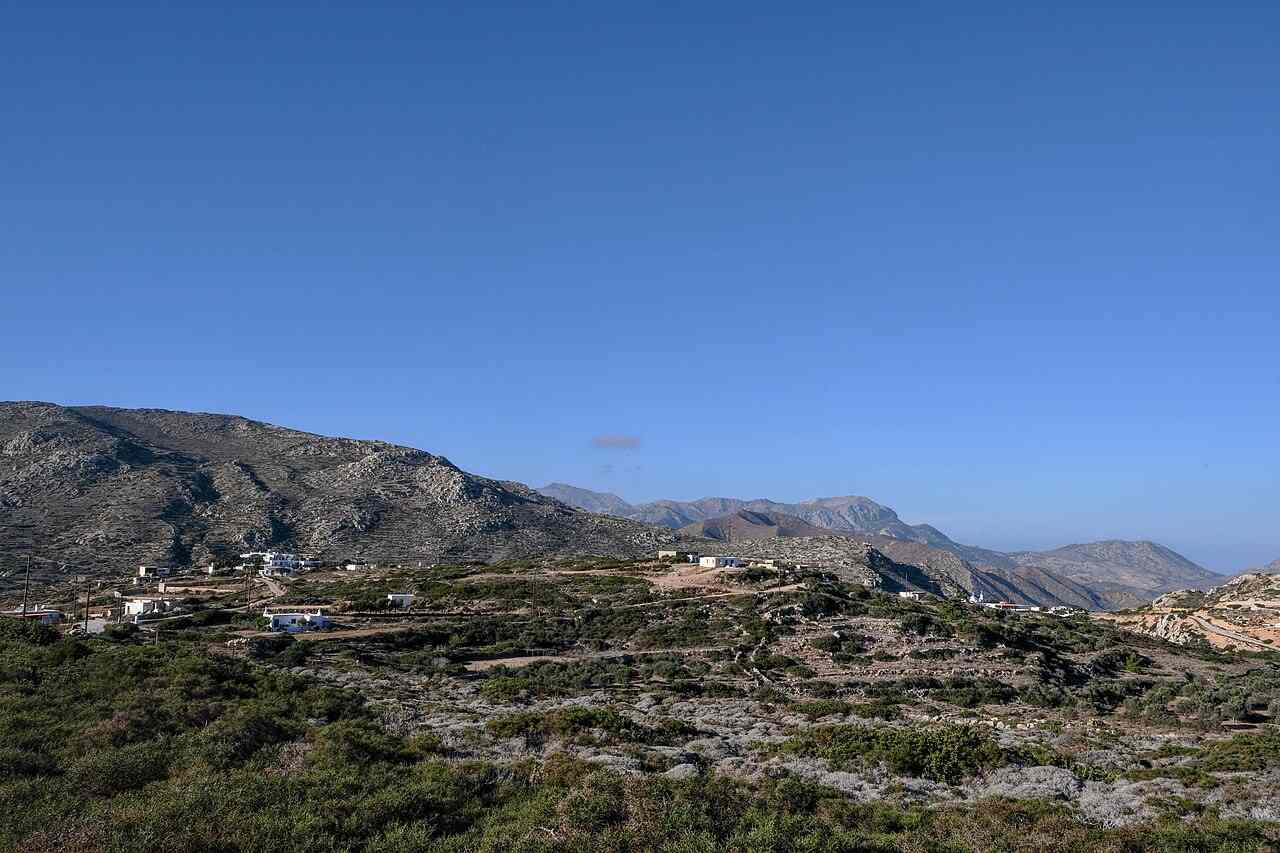
Karpathos is large, mountainous and thinly served by buses, so a hire car or scooter is close to essential for exploring it. The beaches, villages and the remote north all lie a drive apart on quiet but often narrow. Winding roads. Having your own vehicle turns the island’s size from a frustration into the freedom to see both coasts at your own pace. Plan the whole trip with Greece Tours.
This guide covers car rental in Karpathos in full: where to hire, which car to choose, what it costs. What the roads are like, where to find fuel, the driving rules. What you can reach with a car. Read it beside the guide to how to get to Karpathos for the wider picture of island transport.
Do you rent a car in Karpathos?
For most visitors, yes. Karpathos is large and mountainous, its beaches and villages spread far apart, and buses run only times a day, so a hire car or scooter is close to essential to explore the island properly.
Karpathos spreads its attractions across a big, rugged island, from the southern beaches and windsurf bays to the west-coast villages and the remote north around Olympos. Public buses do run, but only a handful of times a day between Pigadia and the main villages. Which is enough for a single outing but far too infrequent to rely on for touring, so most visitors hire a vehicle.
A car or scooter unlocks the whole island: the mountain villages, the west coast, the drive north to Olympos, and the beaches that the buses never reach conveniently. The main exception is the string of east-coast coves such as Apella and Kyra Panagia. Some of which have no road and are reached instead by the daily boat from Pigadia.
A stay focused solely on the town of Pigadia, its beach and the boat trips can manage without a car, using the buses for the odd village trip. For everyone else, a hire vehicle is best treated as part of the cost of a Karpathos holiday. Picking one up on arrival at the airport is the simplest approach.
Where can you rent a car in Karpathos?
Car hire is available at Karpathos airport and in Pigadia, with agencies also in Arkasa, Amoopi and Lefkos. Both international companies such as Avis and Europcar and local firms operate on the island.
The main places to hire a car are the airport, on the southern tip of the island, and the capital, Pigadia, where most agencies are based along the seafront. Additional rental offices can be found in the villages of Arkasa, Amoopi, also known as Lakki. Kato Lefkos, so wherever you are based there is usually an agency within reach.
Both international brands, including Avis, Europcar, Enterprise and others, and independent local firms operate on Karpathos, and the local companies often offer competitive prices and personal service. Scooters and small motorbikes are also widely available to hire for those who prefer two wheels on the island’s quiet roads.
Collecting a car at the airport on arrival is the most convenient option, since a vehicle is useful for reaching your accommodation anyway. It avoids a separate trip to a rental desk in town. Wherever you hire, booking ahead in summer is wise, as the agencies can fill up in the peak weeks.
What type of car you rent in Karpathos?
A small car is best for Karpathos, since the roads are narrow and winding and parking is easier.
The narrow, twisting mountain roads and the tight village lanes make a small car the sensible choice on Karpathos. Both for handling the bends and for parking in the villages and at the beaches. A compact car copes with everything the island’s paved roads throw at it, and its size is an advantage on the single-track sections rather than a limitation.
There is no need for a four-wheel drive: all the main roads are surfaced and fine to drive with a normal car. Only a few beach access tracks are unpaved, where a little care suffices. Paying extra for an SUV or a jeep is rarely necessary unless you simply prefer the higher ride, so a standard small hire car is enough for a typical trip.
For travellers based in the south around Amoopi and the airport, a scooter or small motorbike is a fun and economical alternative for short hops to the beaches and into Pigadia, though a car is more comfortable for the longer drives to the west coast and the north. Match the vehicle to how much of the island you plan to cover.
How much does car rental cost in Karpathos?
Car rental on Karpathos tends to cost more than on the larger nearby islands of Crete and Rhodes, reflecting its smaller, more remote market. Booking well ahead secures both a vehicle and a better rate in the busy summer weeks.
Prices are usually somewhat higher than on Crete or Rhodes for a comparable car. The cost is still reasonable by the standards of a holiday. It is worth factoring the higher rate into a budget when planning a trip that relies on a hire car.
The single most useful step is to book in advance, especially for July and August, when demand from visitors peaks and agencies are fully booked. Reserving ahead not only guarantees a vehicle but usually secures a better price than turning up and hoping for a last-minute car. Which can be scarce and expensive at the height of summer.
Comparing local firms alongside the international brands often pays off, as the independent agencies can offer good rates and flexibility. Whichever you choose, confirm what the price includes, such as insurance cover and any extras, when booking. Reserve early for the peak weeks to keep both the choice and the cost in your favour.
What are the roads like in Karpathos?
The roads in Karpathos are quiet, with no roundabouts or traffic lights, but many are narrow, single-track mountain roads with steep bends. They have pull-over spots for passing, and the route to the north is the most demanding.
Driving on Karpathos is calm compared with the mainland, with little traffic, no roundabouts and no traffic lights, but the terrain makes for demanding roads. Many routes, especially through the mountains and to the northern villages, are very narrow and often only wide enough for a single vehicle. With steep drops and blind bends that call for care and a slow, steady pace.
On the single-track stretches there are extra-wide pull-over areas where cars can wait to let oncoming traffic pass, and using them courteously keeps the mountain roads flowing safely. The paved ring road serves the middle of the island well, while the long climb to Olympos and Diafani in the north is the most challenging drive. A roughly two-hour route of switchbacks best not rushed.
None of this deter a careful driver, since the roads are perfectly manageable with attention and a small car. Drive slowly on the bends, heed the posted limits. Be ready to pull over. Take the northern route in particular at an unhurried pace to enjoy the scenery and drive it safely.
Where are the petrol stations in Karpathos?
Karpathos has around five petrol stations, all in the south: at Arkasa, two between Amoopi and Pigadia, and two on the road out of Pigadia toward Aperi. Fill up before driving north, as there is no fuel beyond the centre.
Fuel on Karpathos is concentrated in the south of the island. There are roughly five petrol stations in total: one at Arkasa on the west coast. Two on the road between Amoopi and Pigadia. Two as you leave Pigadia heading toward Aperi and the central villages. All are easy to reach when you are in the populated south of the island.
The crucial thing to know is that there are no fuel stations in the north. Beyond the central villages. Anyone driving up to Olympos and Diafani must fill the tank before setting out. Running low on the long northern route, far from any pump, is a real risk, so make topping up before a northern trip a firm habit.
For day-to-day driving around the south and the centre, fuel is never far away, and the stations are straightforward to use. Just keep an eye on the gauge before the longer drives. Treat a full tank as essential before heading for the remote north. Where the nearest fuel is a two-hour drive back.
What do you rent a car in Karpathos?
To rent a car in Karpathos you need a valid driving licence held for the minimum period set by law, and to meet the agency’s age requirements. Parking is free across the island, and drink-driving is strictly forbidden.
The main requirement is a valid driving licence issued by your country of residence and held for the minimum period set by local law. Along with meeting the rental agency’s minimum age and any young-driver conditions. Drivers from outside the EU check whether an International Driving Permit is needed alongside their home licence before travelling.
The rules of the road are the standard Greek ones: drive on the right, wear seatbelts, and observe the posted speed limits, which are modest given the winding roads. Drink-driving is strictly forbidden and enforced, so avoid alcohol entirely when you plan to drive, particularly on the demanding mountain routes.
Parking is refreshingly simple on Karpathos: it is free everywhere. With parking areas in Pigadia and rough parking at the beaches and villages, where you generally just leave the car wherever there is space. This makes touring the island by car easy, with none of the paid-parking hassle of the bigger destinations.
What can you reach with a car in Karpathos?
With a car you can reach almost the whole island: the beaches, the mountain villages, the west coast, and the remote north with Olympos. Only some east-coast coves have no road and are reached instead by boat.
A hire car opens up the length of Karpathos. From a southern base you can drive to the beaches of Amoopi and Diakoftis, the windsurf bays of Afiartis, the west-coast resorts of Arkasa and Lefkos, and the ring of central villages such as Menetes, Aperi and Othos, all covered in the guide to the villages of Karpathos.
The car also makes the north accessible, with the long but scenic drive up to the medieval village of Olympos and the port of Diafani. A trip that is far harder to manage by the infrequent buses. Along the way, the sights, viewpoints and chapels of the interior are yours to stop at freely, which is much of the pleasure of having your own transport.
The one part of the island a car cannot reach is the string of roadless east-coast coves. Some of which, like parts of the coast near Apella, are accessible only from the sea. For those, the daily boat from Pigadia is the answer; otherwise, a car reaches essentially everything, as the guide to things to do in Karpathos makes clear.
Frequently Asked Questions
Do you need a car in Karpathos?
For most visitors, yes. Karpathos is large and mountainous, with its beaches and villages spread far apart and buses running only times a day. A hire car or scooter is close to essential to explore the island. Only a stay focused on Pigadia, its town beach and the boat trips can really manage without one.
Where can you rent a car in Karpathos?
Car hire is available at Karpathos airport and in the capital, Pigadia, with additional agencies in Arkasa, Amoopi and Lefkos. Both international companies such as Avis and Europcar and local independent firms operate on the island, and scooters are also widely available. Collecting a car at the airport on arrival is the most convenient option.
What car you rent in Karpathos?
A small car is best for Karpathos, as the roads are narrow and winding and parking is easier with a compact vehicle. You do not need a four-wheel drive, since all the main roads are surfaced and fine for a normal car. For short hops around the south, a scooter is a fun and economical alternative.
Are the roads in Karpathos difficult to drive?
The roads are quiet, with no roundabouts or traffic lights, but many are narrow, single-track mountain roads with steep bends, so they demand care and a slow pace. Pull-over areas allow oncoming traffic to pass. The long route north to Olympos and Diafani is the most challenging, and there is no fuel in the north, so fill up first.