
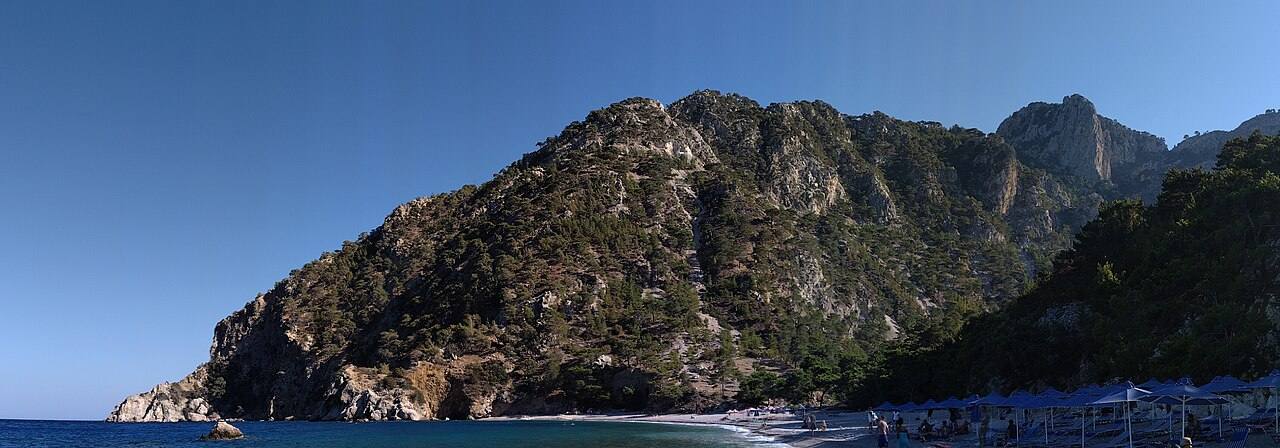
Apella is the most celebrated beach on Karpathos, a cliff-framed cove on the east coast where white pebbles drop into water so clear the seabed shows metres down. Backed by a slope of pine and cedar and reached by a short walk from a car park above. It was once ranked among the most beautiful beaches in Europe. It remains the image most visitors carry away from the island. Plan the whole trip with Greece Tours.
This guide covers everything you need for a day at Apella: how to reach it by car, bus or boat, what the beach and its water are like. The facilities on offer, the little rock chapel of Agios Loukas on the approach. When to go to enjoy it at its best. Read it beside the wider guide to Karpathos beaches to plan a fuller run of the coast.
What is Apella beach in Karpathos?
Apella is a cliff-framed cove on the east coast of Karpathos, about 18 kilometres north of Pigadia, known for its white pebbles, pine backdrop and vivid turquoise water. It is widely rated the finest beach on the island.
Apella lies on the east coast of Karpathos, roughly 18 to 19 kilometres north of the capital, Pigadia, set at the foot of a steep, pine-clad slope. The cove combines white sand and small pale pebbles with water that runs an intense. Clear turquoise. The green of the pines against the white of the beach and the deep blue of the sea gives it an almost exotic beauty rare in the Aegean.
The beach earned wide fame when it was ranked among the most beautiful in Europe, and it has drawn visitors to the island ever since. Yet because there is no road right down to the sand and no resort behind it, Apella keeps an unspoiled feel. Reached only by a short walk down from a car park above the pines, which limits the crowds and preserves the setting.
Apella sits on the stretch of east coast that holds the island’s most celebrated coves, near Kyra Panagia and Achata, and it is the highlight of them all. Its combination of clear, deep water for swimming and snorkelling. Natural shade at the back of the beach. A dramatic cliff-and-pine setting makes it the beach most people come to Karpathos to see.
How do you get to Apella beach?
Apella is about 18 kilometres north of Pigadia, a drive of some 30 to 40 minutes along the east-coast road to a car park, then a five-minute walk down a path.
By car, head north from Pigadia on the east-coast road, passing the village of Aperi and climbing above the sea, before turning off down the signed lane to Apella. The drive takes around 30 to 40 minutes and offers wide coastal views, ending at a car park set above the pines. From there a stepped path descends to the beach in about five minutes, and the walk back up is steep in the midday heat.
For those without a car, a public KTEL bus serves Apella days a week during the swimming season. Typically leaving Pigadia in the morning and returning in the late afternoon, enough for a full day at the beach. Check the current schedule locally, as it runs only on set days and times, and plan the day around the single return service.
The easiest car-free option is the boat. The daily excursion boats from Pigadia harbour call at Apella along with the other east-coast coves. Anchoring offshore and bringing swimmers in, which avoids both the cliff lane and the steep steps. For the full picture of the routes and departures, see the guide to Karpathos boat trips.
What is Apella beach like?
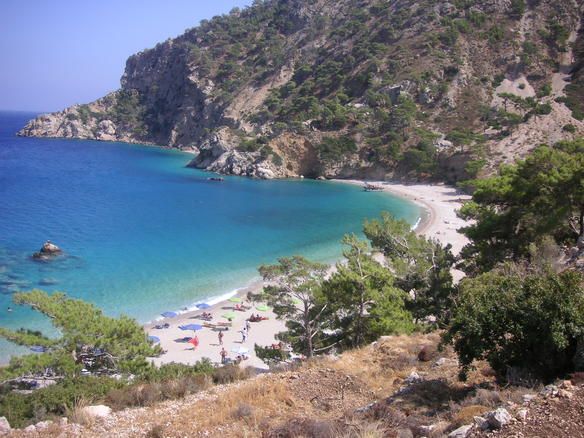
Apella is a crescent of white sand and small pebbles that shelves into deep, clear turquoise water, backed by a slope of pine and cedar that gives natural shade.
The beach itself is a curve of fine white sand and small pale pebbles at the water’s edge, giving way to a smooth, sandy seabed offshore. The water shelves gently at first and then drops into deep, clear blue. Ideal for swimming out from the shore. Its clarity is remarkable even by the standards of the island. Pine and cedar climb the slope directly behind the sand, so there is natural shade at the back of the beach even at midday.
Apella occupies a sheltered cove framed by rock, and because it faces east it is protected from the prevailing northerly meltemi that can churn the more exposed beaches. This keeps its water calm and swimmable on days when the surf bays of the south are wild, one reason it stays reliably beautiful through the summer. The setting, enclosed by cliffs and greenery, feels secluded despite the beach’s fame.
The scale of Apella is intimate rather than sprawling, a single perfect cove rather than a long strand. Which is part of its appeal and also why it fills quickly in high summer. Arriving early rewards you with the beach at its calmest and clearest, before the day’s visitors and the excursion boats arrive around the middle of the day.
What facilities are at Apella beach?
Apella has a single traditional taverna above the beach and sunbeds and umbrellas for hire, but no resort development. Bring water and sun protection, as facilities are limited and the beach is otherwise unspoiled.
At the top of the path down to the beach stands a traditional taverna, which serves Greek dishes, snacks and cold drinks and is the main facility at Apella. It gives somewhere to eat and shelter from the sun. It is the reason a day here need not be entirely self-sufficient, though it is the only such option at the cove.
Down on the sand, sunbeds and umbrellas are available to hire through the season, giving shade and comfort for those who want it, while the back of the beach offers natural shade under the pines for those who do not. Beyond this, Apella has no development at all: no resort, no rows of bars, and no road to the sand, which is exactly what keeps it beautiful.
It pays to come prepared, with water, sun cream and a hat for a full day. A mask and fins if you plan to snorkel along the rocky sides of the cove. The unspoiled character is the trade-off for the limited services. Most visitors consider it well worth carrying their own supplies to spend a day at one of the finest coves in the Aegean.
Is Apella good for swimming and snorkelling?
Yes. Apella’s deep, exceptionally clear water and sheltered east-facing cove make it excellent for swimming, while the rocky edges of the bay reward snorkellers with good visibility and marine life.
The water at Apella is among the clearest on the island, and the cove’s gentle shelving followed by a deep, calm centre makes it a fine place to swim. Because it faces east and sits enclosed by cliffs, it is sheltered from the meltemi and stays calm on days when other beaches are choppy. Swimmers can rely on it through much of the summer.
For snorkellers, the clarity is the draw. Along the rocky edges of the bay the water is clear enough to pick out fish metres down, and the boulders shelter wrasse, bream and the occasional octopus. Bring a mask and fins to explore the sides of the cove, where the underwater life is richest, and the visibility often exceeds what the open sand offers. Early morning, before the boats arrive and the wind picks up, gives the clearest water and the calmest conditions for exploring the cove with a mask.
The calm, deep water also suits confident swimmers who want to swim out from the shore, though as with any beach it pays to keep an eye on conditions. Families with young children find the shallow, sandy entry at the water’s edge safe for paddling, while the deeper centre and the rocky sides give stronger swimmers and snorkellers plenty to explore.
What is the chapel at Apella beach?
On the approach to Apella stands the small chapel of Agios Loukas, dating to the thirteenth century and built into the rock, with painted frescoes on its ceiling.
The little chapel of Agios Loukas is set into the rock beside the path, a small medieval church that dates back to the thirteenth century. Built directly into the stone, it is easy to miss but genuinely well worth the short stop. A reminder that even the island’s most beautiful beach carries a trace of its long history.
Inside, the chapel preserves painted frescoes on its ceiling, faded but atmospheric, in the tradition of the Byzantine churches found across Karpathos. Its position, tucked into the rock on the way to the beach, makes it a natural pause on the walk down. Adding a touch of the sacred and the historic to a day otherwise spent by the sea.
Small rock and cliff chapels like Agios Loukas are a recurring feature of Karpathos, often marking old paths and remote spots, and they reward a moment’s attention. Combining the chapel with the beach turns a swim at Apella into a fuller experience of the island, pairing its natural beauty with a piece of its religious heritage. Set into the rock on the descent. It also marks the point where the path leaves the car park and drops toward the sea. It is hard to miss on the way down.
When is the best time to visit Apella beach?
The best times are late May, June and September to October, when the weather is warm and the beach is quieter. In July and August, arrive early, as the small car park and the cove fill by late morning.
Apella is at its best in the shoulder months of late May, June, September and October, when the weather is warm, the sea comfortable. The beach far quieter than at the height of summer. These months let you enjoy the cove without the crowds and the parking pressure of the peak, and September in particular pairs warm water with thinning visitors.
In July and August the beach is popular and fills quickly, and the small gravel car park above the pines can be full by late morning. The excursion boats also arrive around midday, adding to the numbers on the sand. To enjoy Apella at its calmest and clearest in high summer, come early in the morning, before the crowds and the boats, and consider leaving by early afternoon.
Whatever the month, the mornings are the finest time at Apella, with the light on the water at its best and the cove at its calmest and quietest. Pairing an early start with the wider run of the east coast, or arriving by the first boat of the day. Gives the best of this celebrated beach before the day’s visitors arrive. See the guide to Karpathos for how it fits into a trip.
Frequently Asked Questions
Where is Apella beach in Karpathos?
Apella beach lies on the east coast of Karpathos, about 18 to 19 kilometres north of the capital, Pigadia. It sits in a cliff-framed cove at the foot of a pine-clad slope. Reached by a signed lane off the east-coast road to a car park, then a five-minute walk down a stepped path to the sand.
How do you get to Apella beach?
By car it is a 30 to 40 minute drive north from Pigadia along the east-coast road to a car park, then a five-minute walk down. A public bus runs days a week in the swimming season, leaving Pigadia in the morning and returning in the afternoon. The daily excursion boats from Pigadia also call at Apella, anchoring offshore and bringing swimmers in. Which avoids the steep cliff lane and the walk down the steps entirely and is the simplest way to reach the cove in high summer when the car park fills early.
Is Apella beach worth visiting?
Yes. Apella is widely rated the finest beach on Karpathos and was once ranked among the most beautiful in Europe. With white pebbles, a pine backdrop and vivid, clear turquoise water in a sheltered cove. Its natural beauty, calm water for swimming and snorkelling, and unspoiled setting make it the highlight of the island’s beaches. The short walk down from the car park. The lack of any road to the sand. Are a small price for a cove that stays this beautiful and uncrowded outside the peak weeks.
Does Apella beach have facilities?
Apella has a single traditional taverna above the beach serving food and drinks, and sunbeds and umbrellas for hire on the sand, but no resort development. The back of the beach has natural shade under the pines. Because facilities are limited, it is wise to bring water, sun protection and a mask for snorkelling.