
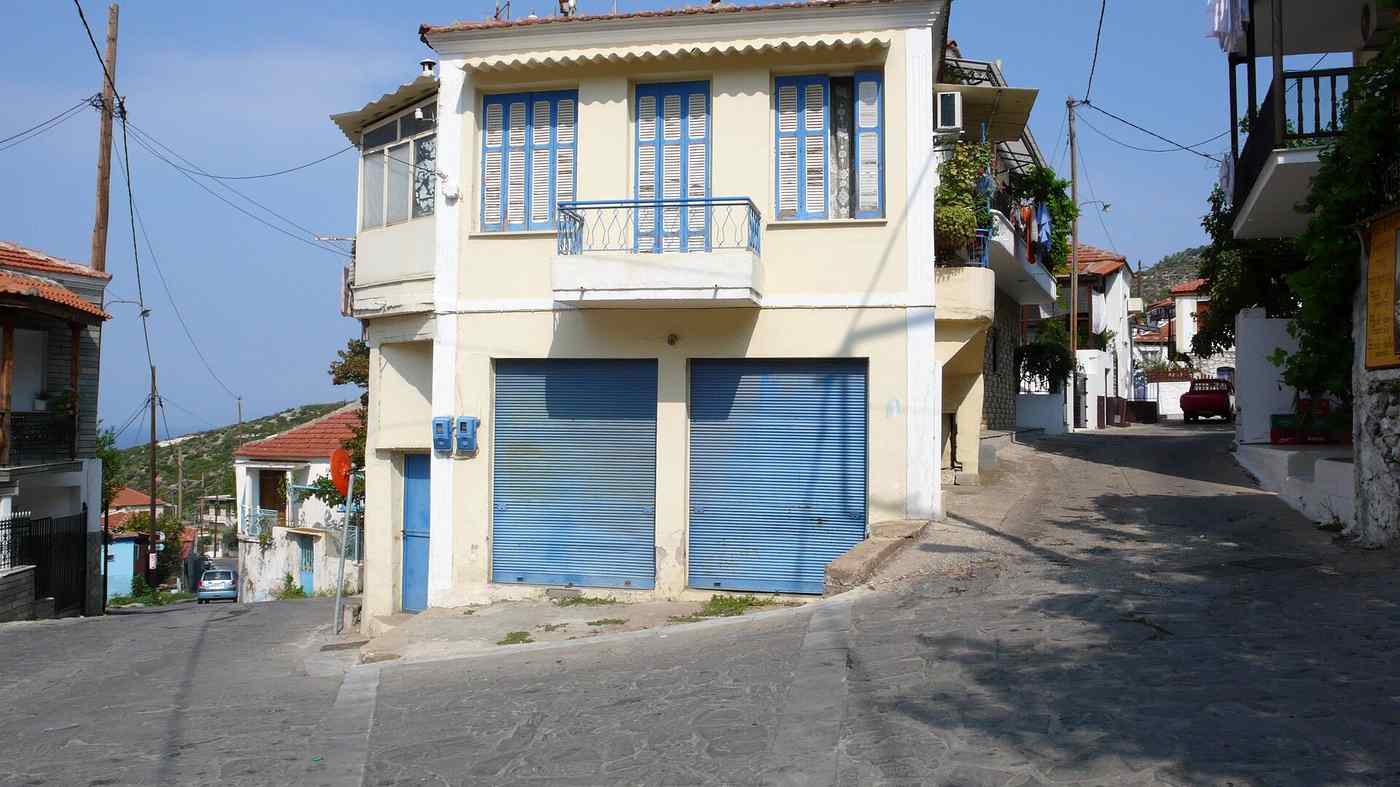
Kallirachi is a traditional inland village on the western side of Thassos, built amphitheatrically across a green hillside above its own small harbour. Stone houses with slate roofs stack up the slope in tight rows, linked by narrow lanes that climb toward a chapel on the ridge. Olive terraces and pine woods surround the settlement, and the sea glitters to the west below. The village keeps the quiet, lived-in character of old Thassos, far from the beach resorts, and rewards travellers who want authentic mountain-village life rather than a seafront promenade.
Travellers reach Kallirachi by turning inland from the west-coast road that rings Thassos, a short climb up from the fishing harbour of Skala Kallirachi on the shore below. The old village and its coastal port share a name but differ in character, since the harbour lives by its boats and tavernas while the upper village guards olive groves, family courtyards and a hushed square shaded by a plane tree. This guide covers the inland settlement, its stone architecture, its viewpoint chapel and the working olive country that has sustained the community for generations.
Where is Kallirachi village on Thassos?
Kallirachi stands on the western side of Thassos, an inland village built into a hillside above the coast. The settlement rises about three kilometres up from its harbour, Skala Kallirachi, between the areas of Prinos and Limenaria.
Kallirachi occupies a green slope on the west coast of the island, set back from the shoreline rather than built upon it. The coastal ring road that circles Thassos passes below the village, and a narrow side road branches inland and climbs the hill. Prinos and its port sit to the north along the same coast, while Limenaria lies to the south. Drivers arriving from the capital, Limenas, follow the western arc of the ring road for roughly twenty kilometres before reaching the turn. The village faces the Thracian Sea toward the mainland, and on clear days the coastline near Kavala and Nea Peramos shows on the horizon across the strait.
Distances on Thassos stay short because a single ring road, close to one hundred kilometres long, circles the whole island. Kallirachi lies on the quieter western half, away from the busier eastern beaches around Golden Beach and Skala Potamia. The drive from Limenas takes about thirty minutes, and the climb from the coast to the village adds only minutes more. Buses on the island’s western route stop at Skala Kallirachi on the shore, leaving the final uphill stretch to the old village on foot or by car. The position keeps Kallirachi within easy reach of the coast yet clearly apart from the resort strip and its summer crowds.
Skala Kallirachi and the upper village form a linked pair, a pattern repeated all around Thassos. The word ‘skala’, meaning landing or port, grew on the water as the fishing and shipping annex of the older inland settlement. Villagers built their homes uphill, safe from sea raids, and kept their boats and warehouses down at the harbour. The lower port of Skala Kallirachi now draws most visitors with its tavernas and quay, while the historic core sits quietly above. A short, winding road of about three kilometres joins the two, climbing through olive groves that separate the working waterfront from the residential heights.
Olive terraces and pine woods wrap the village on every side, marking it as farming country rather than a beach destination. The houses sit at a modest elevation on the hillside, high enough for wide sea views yet low enough to stay green and sheltered. Ridges of the island’s interior rise behind the settlement toward Ypsario, the highest peak on Thassos. Cooler air drains down these slopes in the evening, tempering the summer heat that lingers on the coast. The combination of altitude, tree cover and distance from the shore gives Kallirachi a calmer climate and a landscape shaped by cultivation rather than by tourism.
Why is Kallirachi built amphitheatrically on the hillside?
Kallirachi follows the curve of its hillside in tiers, so its houses rise one above another like seats in a theatre. This amphitheatrical layout let every home share the western view, catch the breeze and drain rainwater down the slope.
Amphitheatrical building means the houses climb the slope in stepped rows, each set slightly higher than the one in front. Builders on Thassos used this arrangement wherever a village sat on a hillside, and Kallirachi shows it clearly. Every tier of homes looks over the roofs below toward the sea, so no house blocks another’s light or view. The stepped plan also suited the terrain, since level ground was scarce and terracing turned a steep incline into buildable plots. Stone retaining walls hold each level in place, doubling as the foundations for the houses above. The result reads from a distance as a single sweep of grey-roofed homes curving across the green hillside.
Defence shaped the choice of an inland, elevated site long before views mattered to visitors. Pirates and raiders worked the northern Aegean for centuries, and coastal settlements lay exposed to sudden attack. Villagers on Thassos answered by building their permanent homes uphill, hidden from the sea and easier to defend. The height of Kallirachi gave lookouts a clear line down to the coast, so residents spotted boats approaching the harbour long before they landed. The tight cluster of stone houses, packed close along narrow lanes, formed a defensive knot that strangers found hard to penetrate. Safety, not scenery, first drew people to this slope, and the layout still reflects that older logic.
Water management reinforced the terraced design across the whole village. Rain falling on the upper slopes runs downhill, and the stepped streets channel it away from the houses toward the valley below. Cisterns and stone gutters caught winter rainfall for use through the dry Aegean summer. Olive terraces on the surrounding hills used the same principle, holding soil and moisture on ground that would otherwise erode. Each retaining wall served double duty, supporting a house or a field while slowing the flow of water down the incline. This careful shaping of the slope allowed a farming community to thrive on land too steep for ordinary building or ploughing.
Sunlight and wind completed the reasons behind the amphitheatrical form. The west-facing tiers catch the afternoon and evening sun, warming the stone through the cooler months. Sea breezes rising up the slope in summer ventilate the packed lanes and courtyards, easing the heat. Narrow streets between tall houses stay shaded for most of the day, creating cool corridors even at midday. Villagers placed their courtyards and terraces to trap winter warmth and summer air alike. The layout of Kallirachi therefore answers climate no less than defence, turning a demanding hillside into a comfortable, workable place to live year round.
What do the stone lanes and old houses of Kallirachi look like?
Kallirachi’s houses are built from local grey stone under slate or tiled roofs, joined by cobbled lanes too narrow for cars. Thick walls, wooden shutters, small courtyards and outdoor stone ovens mark the traditional architecture of the old village.
Stone dominates every surface in the old village, from the house walls to the paving underfoot. Builders quarried grey schist and marble from the surrounding hillsides, so the homes seem to grow straight out of the ground. Walls stand thick to keep interiors cool in summer and warm in winter, a practical response to the island climate. Wooden balconies and shutters, painted in faded blues and greens, break the grey with touches of colour. Slate slabs and clay tiles cover the pitched roofs, shedding winter rain toward the lanes below. Old facades carry the marks of generations, with newer repairs sitting beside stonework well over a century old.
The lanes themselves form the most memorable feature of Kallirachi. Cobbled paths, the narrowest barely wide enough for a loaded mule, thread between the houses and climb the slope in steps. Cars stop at the edge of the old core, since the streets were laid out long before wheeled traffic and admit only pedestrians. Archways and covered passages link one level to the next, ducking beneath upper rooms that bridge the gap between neighbours. Stone staircases branch off at intervals, leading to hidden doorways and tiny squares. Walking these lanes feels like moving through a living museum, where the plan of the village has changed little across the centuries.
Courtyards give the houses their private heart, tucked behind walls and gates off the public lanes. Each yard holds a vine or fig tree for shade, pots of basil and geraniums, and often a stone-built oven for baking bread. Families lived most of their lives outdoors in these spaces, cooking, preserving olives and drying fruit through the warm season. Wells and cisterns in the courtyards stored water drawn during the winter rains. Low stone benches and whitewashed walls turned each yard into an open-air room shaded from the sun. These enclosed spaces still define daily life for the residents who keep the old houses in use today.
Restoration has begun to bring the older houses back to life. Owners returning to their family homes repair roofs, reopen shutters and revive courtyards that stood empty for decades. Traditional building rules encourage stone facades and tiled roofs, so new work blends with the historic fabric rather than clashing with it. Restored houses now serve as holiday homes or small guest lodgings, giving visitors a chance to sleep within the old walls. The parish church and a scatter of tiny chapels anchor the village, their bells still marking feast days. Careful renewal keeps Kallirachi lived-in, sparing it the fate of villages abandoned to ruin.
What can you see from the hilltop chapel above Kallirachi?
A small chapel crowns the ridge above Kallirachi, reached by a short climb through the upper lanes. From its terrace the whole western coast of Thassos opens up, with the mainland, the harbour below and Aegean sunsets filling the view.
Chapels on high ground are a fixture of Greek island villages, and Kallirachi keeps to the pattern. A whitewashed chapel sits above the houses on the crest of the hill, a short walk up from the village square. The path climbs past the last homes and olive terraces before reaching the open ground at the top. Villagers built these hilltop churches as landmarks and places of quiet devotion, often on the site of older shrines. The climb rewards visitors with the widest view in Kallirachi, taking in the settlement, the coast and the sea in a single sweep. Early morning and late afternoon bring the softest light and the clearest air for the walk.
The view west reaches straight across the Thracian Sea to the Greek mainland. Kavala and the coast of eastern Macedonia rise on the far shore, and on clear days their outline shows plainly across the strait. Nea Peramos and the headlands of the mainland coast mark the northern edge of the panorama. Ships crossing between the island and the ports of Kavala and Keramoti trace slow lines over the water. The harbour of Skala Kallirachi lies directly below, its breakwater and moored boats small and toylike from this height. The whole western flank of the island falls away beneath the chapel toward the shining sea.
Sunset turns the hilltop into the finest vantage point around the village. The west-facing ridge looks directly out to where the sun drops into the Aegean, so the sky burns orange and pink over the water each clear evening. Olive groves and pine woods on the slopes below darken into silhouette as the light fades. The mainland mountains catch the last glow long after the coast beneath has slipped into shadow. Villagers and visitors climb up for the spectacle, and the chapel terrace makes a natural viewing platform. Beaches on the busy east coast of the island rarely match this quiet, elevated sunset over the sea.
The walk up doubles as a short introduction to the countryside around Kallirachi. Stone paths and dirt tracks link the chapel to the olive terraces, threshing floors and springs that once fed the village. Wildflowers colour the slopes in spring, and cyclamen appear among the rocks in autumn. Longer trails lead on from here into the hills, connecting with the network used for hiking on Thassos. Benches and low walls near the chapel give walkers a place to rest and take in the view. The outing suits families and older visitors, since the climb is brief and the reward at the top is immediate.
How does olive country shape life in Kallirachi?
Olive groves surround Kallirachi and have shaped its economy for centuries. Terraced trees on the hillsides supply the fruit pressed into Thassos olive oil, and the autumn harvest still sets the rhythm of work and family life in the village.
Olive trees cover the slopes around Kallirachi in silver-green terraces that climb from the coast toward the hills. Thassos is famous across Greece for its olive groves, and the western villages sit at the heart of this farming country. Generations of families here have tended the same trees, the oldest of them centuries old and still bearing fruit. The terraces, held up by dry-stone walls, turn steep and rocky ground into productive orchards. Between the olives grow figs, almonds and grapevines, filling out the traditional smallholding. Farming, not tourism, built Kallirachi, and the olive remains the crop that ties the village most closely to its land.
Thassos olive oil carries a strong reputation, and the groves of Kallirachi feed that trade. The island’s mild climate, stony soil and long sunshine produce a fruity, low-acidity oil prized by cooks and shops on the mainland. Growers press their harvest at village and cooperative mills, then sell it locally and ship it across Greece. Visitors can buy Thassos olive oil directly from producers, along with cured olives and olive-based soaps and cosmetics. The oil flavours nearly every dish on a village table, from salads to slow-cooked greens and baked fish. This link between grove and kitchen keeps olive growing central to daily life rather than a heritage relic.
The olive harvest sets the calendar in Kallirachi as firmly as the tourist season sets it on the coast. Picking begins in late autumn and runs through winter, when families gather to strip the trees and collect the fruit on nets spread below. Everyone joins in, from grandparents to children, in a communal effort repeated every year. The pressed oil is stored in tins and jars to last the household through the coming months. Pruned branches feed the outdoor ovens and winter fires. This seasonal labour draws villagers back from the towns and keeps family ties to Kallirachi alive, even for those who now live and work elsewhere.
Neighbouring inland villages share the same olive-farming world and reward a wider tour. Maries village sits in a green valley to the south, ringed by olive groves and watered by mountain springs. Sotiras village stands higher on the western slopes, known for its sunset views and shady plane trees. Both, like Kallirachi, grew as farming settlements above their coastal ports and kept their stone architecture. Touring the western villages together reveals how olive cultivation, terraced hillsides and inland siting shaped this whole side of the island. The pattern repeats from village to village, a landscape built around the olive tree.
What is village life like in the square and lanes of Kallirachi?
Daily life in Kallirachi centres on a shaded square where a kafeneio serves coffee beneath a plane tree. Elderly residents, a slow pace and religious feast days define the village, which keeps its authentic character well away from the tourist coast.
The village square forms the social heart of Kallirachi, as it does in most Greek villages. A broad plane tree shades the space, and a traditional kafeneio sets out tables beneath its branches. Older residents gather here through the day to drink coffee, play cards and talk over village news. The pace is unhurried, set by the seasons and the church calendar rather than by tourist timetables. A shop or two supplies daily needs, and the church stands close by. Visitors who pause at the square meet the real rhythm of village life, far removed from the packed beach bars and promenades of the resort coast.
Population has thinned over the decades as younger residents moved to the coast, to Limenas or to mainland cities for work. The permanent community now leans toward older generations who keep the houses, groves and traditions going. Summer brings the village back to life, as families with roots here return for holidays and feast days. Emigrants living in Kavala, Thessaloniki or abroad reopen family homes for weeks each year. This seasonal return sustains Kallirachi, filling its lanes with children and reunions before the quiet of autumn settles in again. The village survives on these deep family ties as firmly as on its farming.
Religious feasts mark the high points of the Kallirachi year. Each chapel and church has its name day, celebrated with a liturgy and a ‘panigyri’, the village festival that follows. Tables fill the square, grills smoke with lamb and pork, and music and dancing carry on late into the night. Neighbours, returning emigrants and visitors all share the food and wine. These gatherings bind the community and pass its customs to the young. The largest feasts fall in summer, when the village is fullest, though saints’ days punctuate the whole year. A traveller lucky enough to arrive during a panigyri sees Kallirachi at its warmest and most alive.
Simplicity defines the visitor experience in the old village, and that is its appeal. Kallirachi has no beach, no line of bars and no organised sights beyond its lanes, church and viewpoint. The reward lies in wandering the cobbled streets, greeting residents and soaking up an unpolished slice of island life. A coffee in the square, a walk to the chapel and a look into a courtyard fill an easy hour or two. Visitors seeking sand and nightlife head down to the coast, while those after authenticity climb up to the village. This clear division keeps Kallirachi genuine, a working community rather than a staged attraction.
How do you reach Kallirachi and fit it into a Thassos trip?
Kallirachi is reached by turning inland off the west-coast ring road, about a three-kilometre climb from Skala Kallirachi. A car gives the easiest access, and the village pairs well with the other western villages and coastal ports of Thassos.
A hire car offers the simplest way to reach Kallirachi and explore the western side of the island. Drivers follow the ring road to the coast below the village, then take the signed side road that climbs inland. Parking sits at the edge of the old core, since the narrow lanes beyond admit only pedestrians. The route from Limenas runs about twenty kilometres and takes roughly half an hour along the western shore. Coming from the south, the drive up from Limenaria is shorter still. Renting a car on Thassos frees visitors to link the inland villages with the beaches and ports at their own pace.
Public buses serve the coast but stop short of the old village itself. The island’s KTEL service runs along the ring road and calls at Skala Kallirachi on the shore below. Passengers then face the three-kilometre uphill walk or a taxi ride to reach Kallirachi proper. The climb, though steady, passes through pleasant olive country and suits walkers with time to spare. Bus timetables thin out in the low season, so checking departures in advance matters. Travellers without a car often combine the bus to the harbour with a meal at Skala Kallirachi before heading up to the historic village.
Kallirachi fits naturally into a tour of the western coast and its inland villages. A half-day drive can string together the old village, its harbour and neighbours such as Maries and Sotiras, all within a short distance. The western route also passes Skala Prinos, an arrival port for ferries from Kavala, and the larger town of Limenaria to the south. Pairing the quiet villages with a beach stop or a harbour lunch balances a day of sightseeing. The compact scale of Thassos means none of these places lies far apart. A loop of the west side shows the island’s farming heart alongside its coastline.
Timing and expectations shape a good visit to Kallirachi. Morning and late afternoon bring cooler air and better light for walking the lanes and climbing to the chapel. The village offers limited services, so travellers carry water and plan meals around the tavernas of the harbour below. An hour or two suffices to see the old core, though the square tempts visitors to linger over coffee. Sturdy shoes help on the cobbled, stepped streets. Combined with a swim on the west coast or a sunset from the ridge, a stop in Kallirachi adds depth to any Thassos itinerary beyond the beaches.
Frequently Asked Questions
Is Kallirachi worth visiting on a Thassos holiday?
Kallirachi rewards travellers who want authentic village life rather than beaches and nightlife. The old settlement offers cobbled lanes, stone houses, a hilltop chapel and wide sea views, all steeped in the farming history of western Thassos. A visit takes only an hour or two and pairs easily with the harbour of Skala Kallirachi below or the nearby villages of Maries and Sotiras. Anyone drawn to traditional architecture, quiet squares and panoramic viewpoints finds the detour inland well worth the short climb from the coast.
What is the difference between Kallirachi and Skala Kallirachi?
Kallirachi is the old inland village, built on a hillside about three kilometres above the coast, while Skala Kallirachi is its harbour and beach settlement on the shore below. The two share a name and a history but differ in character. The upper village guards stone houses, olive groves and a quiet square, keeping the look of old Thassos. The lower harbour lives by its fishing boats, tavernas and quay, and draws most of the visitors. Travellers often combine both, eating at the port and climbing up to the historic village.
How do you get to Kallirachi village?
Kallirachi is reached by turning inland off the coastal ring road that circles Thassos, then climbing a side road for about three kilometres. A hire car gives the easiest access, and parking sits at the edge of the old core where the lanes narrow to footpaths. The island’s KTEL buses stop at Skala Kallirachi on the coast below, leaving an uphill walk or short taxi ride to the village. The drive from the capital, Limenas, takes roughly half an hour along the western shore.
What is there to see in Kallirachi?
Kallirachi’s main sights are its cobbled lanes, stone houses and the hilltop chapel that crowns the ridge above the village. The amphitheatrical layout, with homes stacked in tiers up the slope, rewards a slow wander on foot. The chapel terrace opens the widest view, taking in the west coast, the harbour and the mainland across the sea. A shaded square with a plane tree and a traditional kafeneio marks the social centre. Olive groves and terraced hillsides surround the village, and quiet courtyards hide behind the walls of the old homes.
Is Kallirachi a good base for exploring western Thassos?
Kallirachi suits travellers seeking a quiet, traditional base rather than beachfront resort life. The village offers a handful of restored houses and guest lodgings within its old stone core, though services stay limited. Its central position on the west coast puts Skala Prinos, Limenaria, Maries and Sotiras all within a short drive. A car helps greatly, since buses reach only the harbour below. Visitors who value authenticity, olive-country scenery and sunset views over the sea find the inland village a rewarding place to stay or to visit by day.
When is the best time to visit Kallirachi?
Kallirachi is pleasant from late spring through autumn, when warm, dry weather suits walking the lanes and climbing to the chapel. Morning and late afternoon bring cooler air and the clearest light for the viewpoint and photographs. Summer fills the village with returning families and lively feast-day panigyria, while spring and autumn offer wildflowers, olive-harvest activity and deeper quiet. The elevated, west-facing position keeps evenings fresher than the coast and makes sunset the highlight of any visit. A weekday stop avoids what little crowding the village sees.