
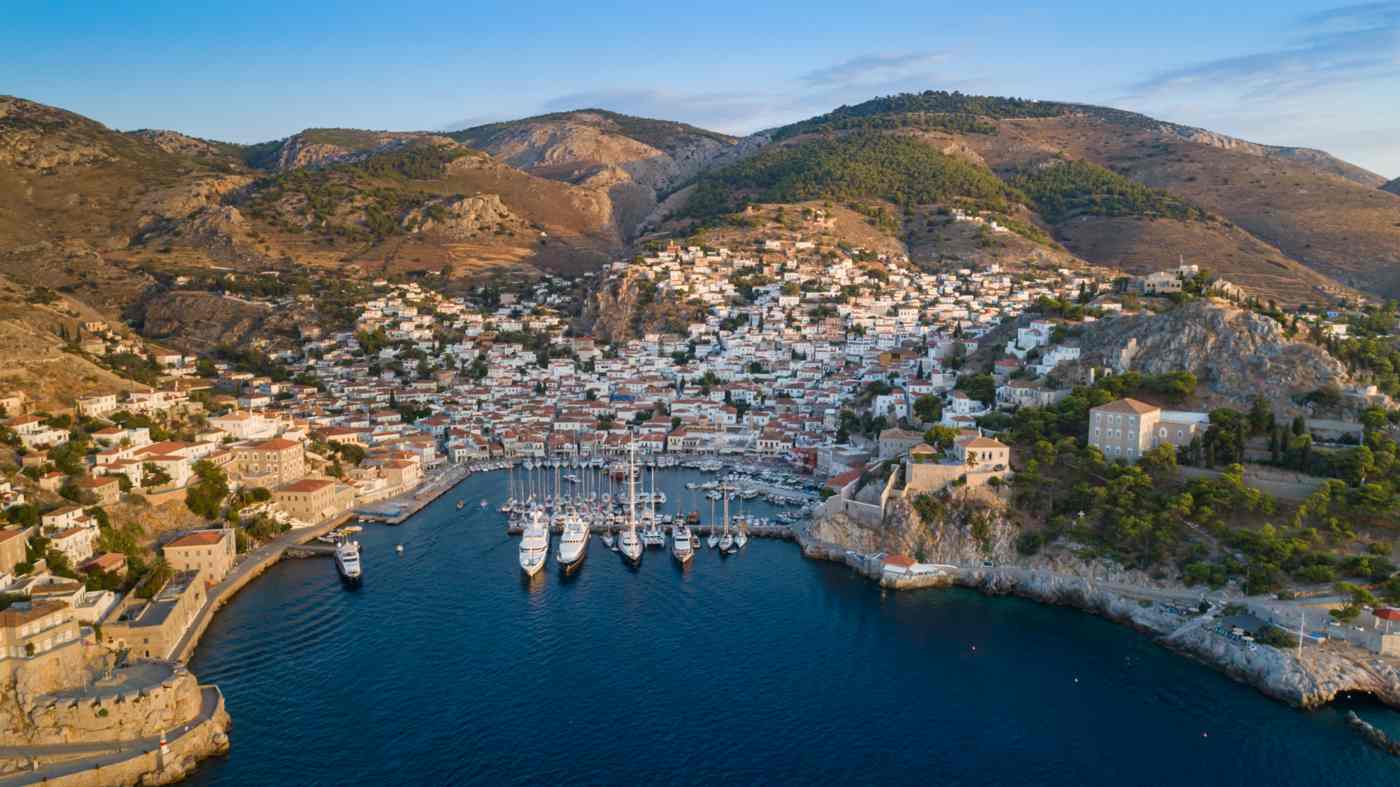
Hiking in Hydra is one of the great pleasures of this car-free island, where the total absence of roads and traffic turns the whole landscape into a walker’s paradise. Beyond the elegant stone town, a network of old mule paths and stone-paved trails climbs into pine-clad mountains and threads along a rugged. Cove-scattered coast, leading to hidden beaches, mountain monasteries and sweeping viewpoints over the Saronic Gulf. The trails range from gentle seaside strolls to steep mountain ascents, and because nothing on the island moves faster than a donkey, every walk is quiet, unhurried and wonderfully scenic. Plan the whole trip with Greece Tours.
For anyone who loves walking, Hydra is among the finest hiking islands anywhere in Greece, and its trails are a highlight of any visit.
The island’s trails are generally well marked with wooden signs, and most follow centuries-old paved paths built for the mules that still carry goods today. You can choose an easy coastal walk from the town to a swimming cove. A half-day climb to a working monastery, or a demanding ascent to the highest peak in the Saronic Gulf. This guide covers why Hydra is so good for hiking, the best trails on the island, the beautiful coastal path from Kamini to Vlychos, the classic climb to the monasteries and Mount Eros, the long walk out to remote Zourvas. The scenery and highlights you will see along the way, the best time of year to hike.
Everything you take with you for walking in Hydra, so you can plan a walking trip that suits your own pace and fitness.
Is Hydra good for hiking?
Yes, Hydra is excellent for hiking.
Few places in Greece are as rewarding for walkers as Hydra. Wheeled vehicles are forbidden across the whole island. There is no traffic to contend with and no engine noise to break the quiet. The only transport is on foot, by donkey or by boat. This unique car-free character means that the moment you leave the harbour. You step onto a network of ancient paths that have carried people and mules for centuries, winding up into the hills and out along the coast in perfect peace.
The terrain is dramatic and varied, giving hikes for every level of walker. Steep, rocky mountainsides clothed in pine rise straight from the sea, cut by valleys and dotted with chapels, monasteries and the ruins of old estates. Trails lead to secluded swimming coves, to mountain monasteries with panoramic views, and to the bare summit of the island’s highest peak. From gentle coastal ambles to lung-testing climbs, the range is wide, and the scenery is superb throughout.
Most walks can be completed in half a day or less, making it easy to combine a morning hike with an afternoon swim or a leisurely lunch back in town. The paths are among the best-maintained on any Greek island. Most of them beautifully paved in stone. The network is dense enough that you can walk a different route every day of a stay. For walkers, hiking in Hydra is not just possible but a genuine highlight of the island.
What are the best hiking trails on Hydra?
The best hiking trails on Hydra are the coastal path from Kamini to Vlychos and Agios Nikolaos, the stone-paved climb to the monasteries of Profitis Ilias and Agia Efpraxia, the ascent of Mount Eros, and the long remote trail east.
Hydra has a handful of classic routes that between them capture the best of the island’s walking. Along the coast, the path west from the town through the little harbour of Kamini to Vlychos and on to the beaches beyond is the most popular and one of the loveliest. A fairly easy walk with the sea always at your side. It is the natural first hike for most visitors and can be as short or as long as you like. Turning back whenever you find a cove you want to swim in.
For those who want to climb, the stone-paved path up to the monasteries of Profitis Ilias and Agia Efpraxia is the great half-day walk. Zigzagging through pine forest to a pair of working religious houses high on the mountain. Fitter and more ambitious walkers can push on and up to the summit of Mount Eros, the highest point in the Saronic Gulf, for the widest views on the island. Each of these routes offers something different, from shady forest to open ridge.
The most demanding of the well-known walks is the long trail east to the remote monastery of Zourvas. Near the far tip of the island, a full day out through wild, empty country far from the town. Between these headline routes run shorter link paths, so you can mix and match: a coastal stroll one morning, a monastery climb the next. Together they make a varied menu of the best hiking on Hydra, from the easiest seaside walk to a serious mountain day.
How do you hike the coastal path from Kamini to Vlychos?
The coastal path from Kamini to Vlychos is an easy, mostly level walk of about half an hour each way, following the shore west from Hydra town through the fishing harbour of Kamini to the pebble beach and old stone.
The Kamini to Vlychos walk is the gentlest and most popular hike on Hydra, and the perfect introduction to the island on foot. Starting from the western edge of the town, the path hugs the coast. Passing grand old sea captains’ mansions before reaching the small fishing harbour of Kamini, with its bobbing boats and a couple of tavernas. From here the route continues along the shore, sometimes on a paved path and sometimes on a track. With the clear water lapping the rocks just below you all the way.
A pretty hamlet with a pebble beach, a scattering of houses and an old arched stone bridge that is one of the island’s landmarks. The pebbled cove here, and the nearby beach at Plakes, are lovely places to swim and cool off, and there are tavernas for lunch by the water. Many walkers time the outing so they arrive hot and ready for a dip, then rest over a long lunch before strolling back.
The path can be extended beyond Vlychos toward the quieter beaches and coves further west. Or shortened simply by turning back whenever you please, which makes it suitable for families and casual walkers. Being low and coastal it is walkable across three seasons, though it offers little shade, so it is best in the cooler hours. This seaside route is also the easiest way to reach the island’s finest beaches on foot.
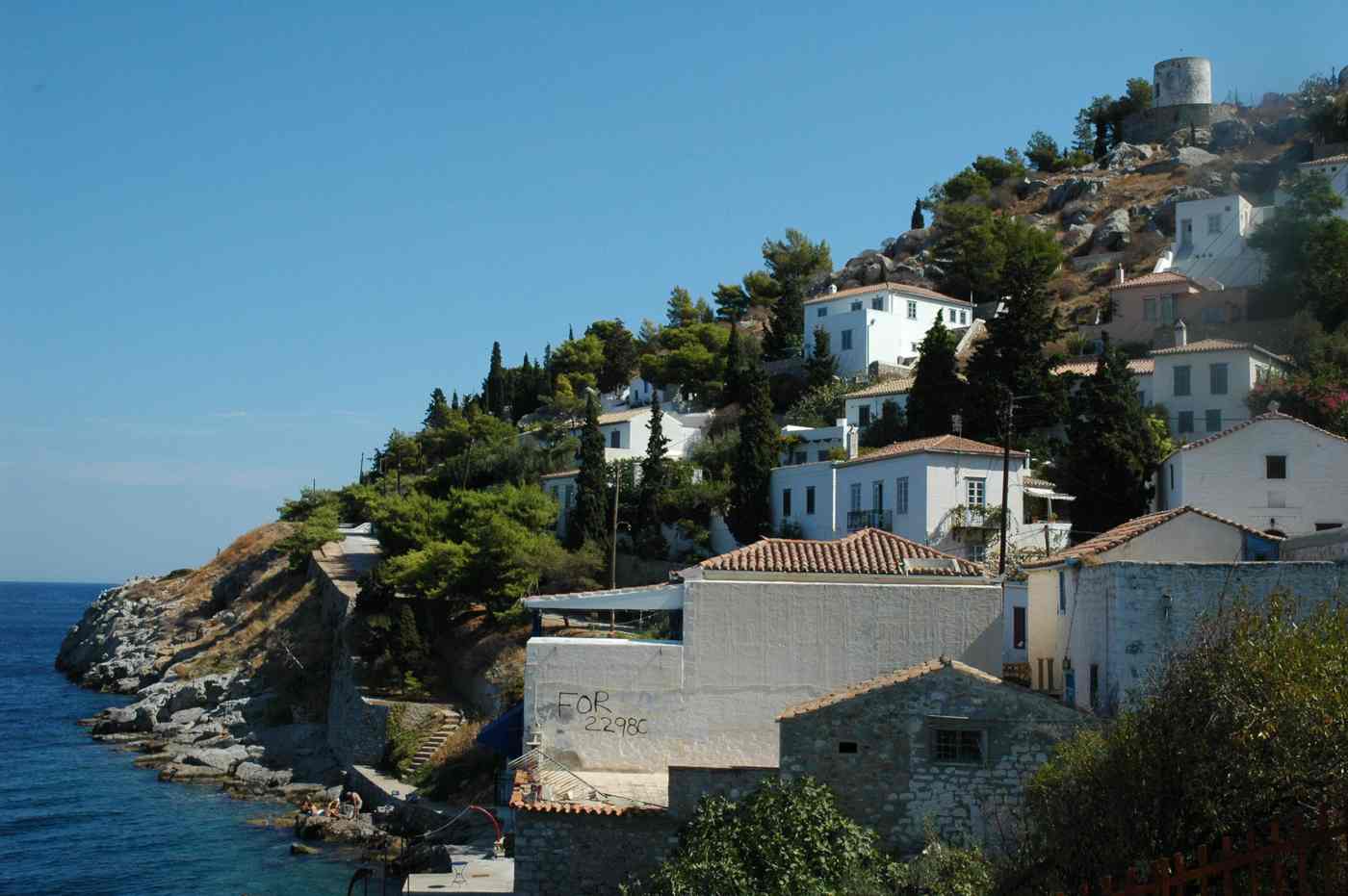
What is the walk to the monasteries and Mount Eros?
The walk up to Hydra’s monasteries climbs a stone path from the town to Profitis Ilias and Agia Efpraxia in about an hour to ninety minutes.
The climb into the mountains above the town is Hydra’s classic uphill hike. A stone-paved path zigzags up through the pines from the edge of the settlement, gaining height steadily until, after an hour to ninety minutes, it reaches the monastery of Profitis Ilias and the neighbouring convent of Agia Efpraxia. These working religious houses, set high on the slope with sweeping views over the town and sea. Are the goal for most walkers. The shady, well-built path makes the ascent a pleasure despite the climb.
The full story of this route, the monasteries themselves and their history is covered in our guide to the monasteries of Hydra, but as a hike it stands among the best on the island: a real climb with a rewarding destination and one of the finest panoramas in the Saronic Gulf. Modest dress is needed to enter the monasteries, and it is worth timing your arrival for their morning opening hours, before they close for the middle of the day.
Strong walkers with energy to spare can continue beyond the monasteries onto the bare upper slopes and up to the summit of Mount Eros. At 588 metres it is the highest peak in the whole Saronic Gulf. The reward is a truly vast. All-round view taking in the island, the surrounding sea and the mountains of the Peloponnese across the water. This upper section is steep, rocky and exposed, with no shade, so it is only for the fit and well prepared, but the summit view is the grandest on Hydra.
Can you hike to Zourvas and the remote east of Hydra?
Yes, a long, demanding trail runs east from the town to the remote monastery of Zourvas near the island’s far tip, a full-day hike of three to four hours each way through wild, empty country.
For serious walkers, the great expedition on Hydra is the trek east to Zourvas, the isolated monastery near the far eastern end of the island. The trail leads away from the town and its familiar coastal paths into the wild, sparsely inhabited interior and eastern shore. A landscape of bare hills, scattered chapels and long sea views with barely a building in sight. It is a full day’s undertaking, three to four hours of walking each way. There are no facilities along the route, so it must be treated as a proper mountain hike.
The rewards match the effort. This is Hydra at its most remote and untouched, a side of the island scarcely any visitors ever see. Ending at a beautiful and solitary monastery perched near the sea at the island’s tip. The sense of wildness and space is complete, and the walking, though long, is deeply satisfying for those who enjoy getting well off the beaten track. Reliable navigation, ample food and water, and an early start are all essential for the round trip.
Many hikers arrange to come back from Zourvas by boat or water taxi, turning the day into a one-way traverse of the island. This makes a notable combination, walking out through the wild east and sailing home along the coast, and it removes the strain of retracing the whole route on tired legs. However you do it, the Zourvas trail is the ultimate hike on Hydra and a memorable adventure for experienced walkers.
When is the best time of year to hike on Hydra?
The best time to hike on Hydra is spring and autumn, roughly April to June and September to October, when the weather is mild, the light is clear and the hills are green or golden.
Timing makes a real difference to hiking in Hydra. Spring, from April into June, is the finest season, when the temperatures are comfortable for climbing. The days are long and the island is green and covered in wild flowers. Autumn, in September and October, is almost as good, with the sea still warm for a post-walk swim and the fierce heat of summer fading. Giving clear, pleasant conditions for the longer and higher routes.
High summer, in July and August, is the hardest time to walk. The exposed mountain trails to the monasteries. Mount Eros and Zourvas offer little shade and can be punishingly hot in the midday sun. Any climbing is best done in the early morning or late afternoon, with ample water. The low coastal path to Kamini and Vlychos is more forgiving, but even there the cooler hours are far more enjoyable. Sensible timing is the key to a good summer hike.
Winter brings mild but changeable weather, and while the coastal walks remain pleasant on a fine day, the higher routes can be cold, wet and less inviting. For the full range of hikes at their best, the shoulder seasons are ideal, which happens to be a lovely time to enjoy the island in general. Our guide to the best time to visit Hydra gives more detail on the island’s seasons and weather for planning your walking trip.
What scenery and highlights will you see hiking on Hydra?
Hiking on Hydra you pass through fragrant pine forest and terraced hillsides, past grand stone captains’ mansions, tiny whitewashed chapels and the ruins of old estates, with the deep blue Saronic Gulf almost always in view and, in spring, the.
Part of the joy of walking on Hydra is the constant unfolding of scenery. Leaving the town, the trails climb through cool pine forest whose resin scents the air. Cross open terraces once farmed by the islanders. Skirt bare grey ridges that fall away to the sea. The deep blue of the Saronic Gulf is your companion on nearly every route. Framed between the pines on the coastal walks and spread out far below on the mountain climbs. This ever-present sea, set against the green and grey of the land, gives the island’s hikes their distinctive beauty.
The paths are also rich in the marks of the island’s history. On the coastal walk to Kamini you pass the imposing stone mansions built by Hydra’s sea captains and merchants in the island’s golden age. Their proud facades looking out over the water. Scattered across the hills stand countless small white chapels, some no bigger than a shed. Along with the crumbling walls of old farmsteads, cisterns and threshing floors that tell of a busier rural past. Every walk becomes a quiet journey through the island’s story as much as its landscape.
Nature adds its own rewards. In spring the hillsides come alive with wild flowers, from scarlet poppies to purple thyme and yellow broom. The air hums with bees and birdsong, while the resident donkeys and mules that do the island’s carrying are a charming sight along the paths. Lizards dart over the warm stones, hawks wheel above the ridges, and the clear light picks out the colours of rock, sea and sky. This blend of pine-scented forest, historic stone and open sea view is the essence of the scenery that makes hiking on Hydra so memorable.
What you take hiking on Hydra?
For hiking in Hydra take sturdy walking shoes for the stone and rocky paths, ample water, sun protection and a hat, as most trails are exposed.
Good preparation makes hiking in Hydra safer and far more enjoyable. Footwear is the first priority: the paths are often paved in worn. Uneven stone or run over loose rock. Proper walking shoes or boots with grip are strongly advised over sandals. Because most of the mountain trails have little shade, sun protection is essential, meaning a hat, sunglasses, sunscreen and light but covering clothing. You always carry more water than you think you will need, especially in the warmer months.
On the longer routes to Zourvas or Mount Eros, where there are no shops or tavernas. Pack snacks or a picnic and make sure you have enough food and water for the whole day. A charged phone, a basic map or downloaded route, and an awareness of the time it will take to return are all sensible, as these eastern trails are genuinely remote. If you plan to enter the monasteries, bring clothing that covers your shoulders and knees, as modest dress is required at these working religious sites.
Finally, plan your timing around the heat and the daylight: set off early for any climb in summer. Allow ample time to get back before dark. Keep the toughest routes for the cooler seasons. With the right shoes, enough water, sun protection and a sensible plan, you are free to enjoy the island’s superb network of trails. Well equipped, hiking in Hydra is a safe, simple pleasure and one of the very best ways to experience the island.
Frequently Asked Questions
How long is the hike up Mount Eros on Hydra?
The ascent of Mount Eros, the highest peak in the Saronic Gulf at 588 metres, is usually done as a continuation of the climb to the monasteries above Hydra town. Reaching the monasteries takes about an hour to ninety minutes. Pushing on to the summit adds further steep. Rocky walking, so the full round trip is a demanding half-day to most of a day depending on your pace. The upper slopes are exposed and shadeless, so it be tackled early in the day and only by fit, well-prepared walkers carrying ample water.
The reward is the widest, most spectacular view anywhere on the island, taking in the whole of Hydra, the surrounding sea and the mountains of the Peloponnese.
Are the hiking trails on Hydra marked?
Yes, the main hiking trails on Hydra are generally well marked. With wooden signposts at junctions and along the popular routes such as the coastal path to Kamini and Vlychos and the climb to the monasteries. Many of the paths are also old stone-paved mule tracks that are easy to follow. That said, on the longer and more remote routes, particularly the trail east to Zourvas and the higher mountain sections. The waymarking is sparser and the paths fainter. It is wise to carry a map or a downloaded route and to keep track of your progress. For the well-travelled walks nearer the town, the signs and clear paths make navigation straightforward for most visitors.
Do you need a guide to hike in Hydra?
For the popular, well-marked walks on Hydra, such as the coastal path from Kamini to Vlychos or the climb to the monasteries. You do not need a guide. These routes are straightforward to follow on your own with a little care. A guide can be worthwhile for the longer and more remote hikes, especially the trail to Zourvas and the higher mountain routes. Where the paths are fainter and the terrain wilder, or simply if you like to learn more about the island’s history, plants and landscape as you walk. Local walking guides and organised hikes are available on the island, but most visitors happily explore the main trails independently using a map or a downloaded route.
What is the easiest walk on Hydra?
The easiest walk on Hydra is the coastal path west from the town to the fishing harbour of Kamini and on to Vlychos. A mostly level route of about half an hour each way that follows the shore with lovely sea views throughout. It involves no serious climbing, passes tavernas and swimming coves, and can be shortened by simply turning back whenever you like, which makes it ideal for families and casual walkers. Because it stays low along the coast it is walkable across three seasons, though it offers little shade, so the cooler parts of the day are most comfortable.
It is the perfect gentle introduction to hiking in Hydra before tackling any of the steeper mountain trails.
Can you combine hiking and swimming on Hydra?
Yes, combining hiking and swimming is one of the great pleasures of Hydra, as many of the island’s trails lead directly to swimming spots. The easy coastal path west of the town passes the pebble beaches of Kamini, Vlychos and Plakes. Where you can cool off part-way through the walk. The route on to Agios Nikolaos ends at a beautiful cove. Even the mountain hikes can be paired with a swim by returning to a harbour beach afterwards. Or by arranging a water taxi to collect you from a remote bay such as Bisti. Carrying swimwear, a towel and water on any coastal walk lets you turn a hike into a notable mix of exercise and sea.
Which is exactly how visitors enjoy the island on foot.
Is Hydra suitable for hiking with children?
Hydra can be a lovely place to walk with children, provided you choose the right trail. The easy coastal path from the town to Kamini and Vlychos is ideal for families: it is mostly level. Never far from a taverna or a swimming cove. Can be cut short at any point if young legs tire. The reward of a beach and an ice cream at Vlychos makes a fine goal for the walk. The steep mountain climbs to the monasteries, Mount Eros and Zourvas, by contrast, are long. Hot and exposed. Are better left for older children and teenagers who are used to walking.
With sun hats, water, snacks and sensible timing away from the midday heat, a gentle coastal hike is a memorable and manageable adventure for the whole family.
How days do you explore Hydra’s hiking trails?
You can enjoy the best of Hydra’s hiking in two to three days, which is enough time to walk the classic routes without rushing. A first day take in the easy coastal path to Kamini and Vlychos with a swim, a second the half-day climb to the monasteries and, for the fit. On up towards Mount Eros, leaving a third for a longer adventure such as the remote trail to Zourvas or a quieter link path to a hidden cove.
Keen walkers happily fill a week, as the network of paths is dense enough to offer a different route every day, while those with only a day can still savour the island on foot by choosing the coastal walk. Building your visit around the cooler mornings gives the most comfortable and rewarding walking.