
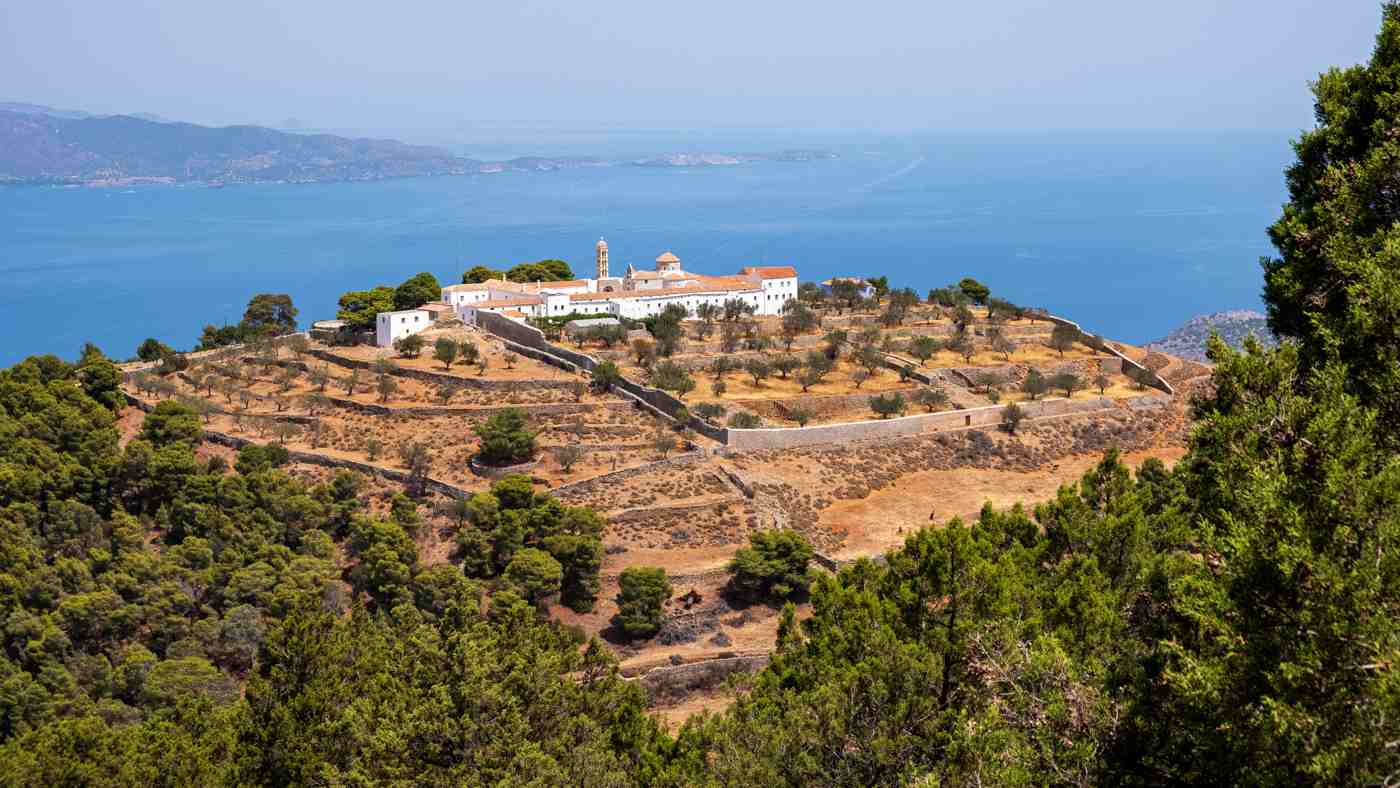
The Hydra monasteries are among the island’s most rewarding sights, set high on the mountain above the town and reached by a beautiful stone-paved hike through the pines. The two most visited are the monastery of Profitis Ilias, the island’s only male monastery, and the neighbouring convent of Agia Efpraxia, home to nuns famed for their embroidery. Climbing to them from the harbour, on a path that zigzags up through the trees, rewards walkers with peaceful. Working religious houses and some of the finest views in the whole Saronic Gulf. For anyone who enjoys a walk with a purpose, the Hydra monasteries are a highlight of a visit. Plan the whole trip with Greece Tours.
This is a classic half-day outing on car-free Hydra, combining exercise, history and spectacular scenery. The climb takes around an hour to an hour and a half from the town. On a renovated stone path. Can be broken at the convent before continuing to the monastery at the top. Along the way the town, the harbour and the sea open up below. At the summit the panorama stretches across the island and the gulf to the mountains of the Peloponnese. This guide covers what the Hydra monasteries are, the monastery of Profitis Ilias, the convent of Agia Efpraxia. How to make the hike, the views, the other monasteries on the island. Practical tips for visiting.
What are the monasteries of Hydra?
Hydra’s main monasteries are Profitis Ilias, the island’s only male monastery, and the convent of Agia Efpraxia, both set high on the mountain above the town.
The best-known Hydra monasteries sit high on the slopes above the town, a pair of working religious houses reached on foot up a scenic mountain path. The larger is the monastery of Profitis Ilias, or Prophet Elias, the only male monastery on Hydra, and just below it stands the convent of Agia Efpraxia, home to a small community of nuns. Together they are the spiritual heart of the island’s mountain and one of its most rewarding destinations, combining peace, history and extraordinary views.
Reaching the Hydra monasteries is part of their appeal. Because the island is car-free, the only way up is on foot along a stone-paved path that climbs from the town through pine forest and rocky slopes, a walk of around an hour or so. The effort is well rewarded, not only by the quiet, beautiful monastery buildings but by the panorama that unfolds as you climb. For walkers and for anyone interested in the island’s religious life and history, the monasteries are among the very best things to see on Hydra.
What is the monastery of Profitis Ilias?
Profitis Ilias, or Prophet Elias, is the only male monastery on Hydra, set near the top of the mountain above the town.
The monastery of Profitis Ilias crowns the mountain walk and is the goal of most visitors. It is the island’s only male monastery, founded in 1813 by monks of the Kollyvades movement, and it grew into an important spiritual centre. Behind its stone walls lie a beautiful church and a rich library, organised later in the 19th century, that reflects the monastery’s long tradition of learning. Its position near the summit, above the pines and the town, gives it a serene, remote atmosphere and some of the widest views on the island.
For visitors, arriving at Profitis Ilias after the climb is a moment of calm and achievement. The monks keep the buildings and gardens, and the setting, high above the harbour with the sea stretching away below, is unforgettable. The monastery has played its part in the island’s history as well as its faith. Standing at its walls. Looking down over Hydra and out across the Saronic Gulf, is one of the defining experiences of a visit. Modest dress and quiet respect are expected, as it is a working monastery.
What is the convent of Agia Efpraxia?
Agia Efpraxia is a women’s convent on the mountain just below Profitis Ilias, founded in the early 19th century. A small community of nuns lives there, famous for their fine embroidery and handiwork, which visitors can sometimes see or buy.
A little below the monastery of Profitis Ilias, reached by a short side path as you climb, stands the convent of Agia Efpraxia, dedicated to Saint Efpraxia. Founded in 1821, around the time of the Greek revolution, it is a women’s monastery where a small community of nuns still lives today. Set among the pines with the same magnificent outlook over the town and sea. It makes a natural stop on the walk up to Profitis Ilias. Its peaceful courtyard is a lovely place to pause.
The nuns of Agia Efpraxia are especially known for their handiwork, above all their fine embroidery, and they run a workshop that continues this tradition. Visitors are sometimes able to see the work and buy pieces, a memorable souvenir with a genuine story. The convent’s combination of a quiet religious community. Beautiful craftsmanship and a spectacular mountain setting makes it a rewarding place to visit in its own right. Together with Profitis Ilias it forms the classic pairing of the Hydra monasteries.
How do you hike to Hydra’s monasteries?
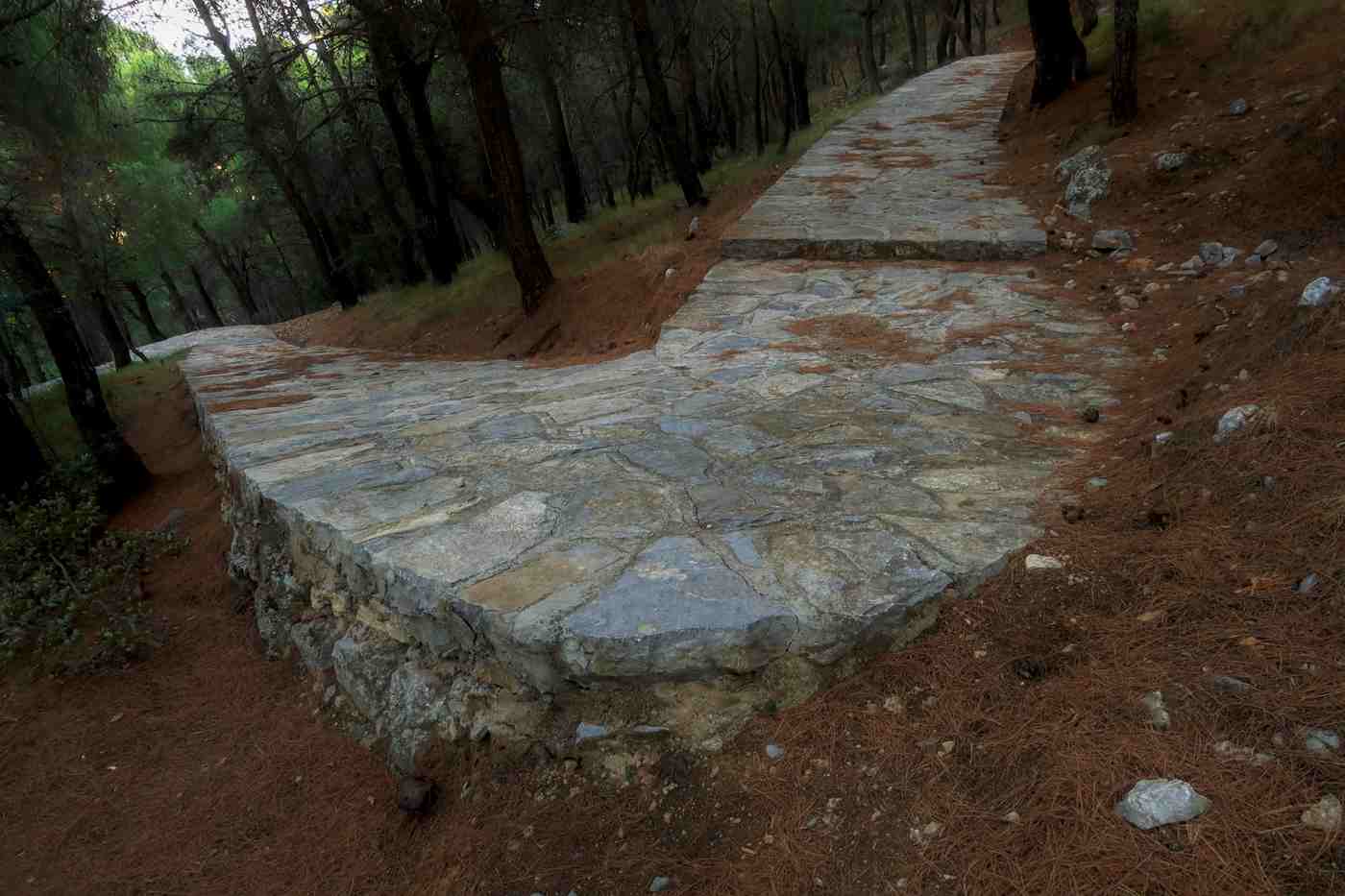
You hike to Hydra’s monasteries on a stone-paved path from the town, starting near the harbour along Miaouli street.
The walk to the Hydra monasteries starts in the town, as there are no cars on the island. From the harbour, the route heads inland and uphill, following the road named after Admiral Miaoulis and then a stone-paved path that climbs steadily toward the summit. The ascent to Profitis Ilias takes roughly an hour to an hour and a half at a steady pace, through pine forest and over rocky ground. With the convent of Agia Efpraxia reached by a short branch path shortly before the top. The path has been renovated and, while longer than the old route, is less tiring and clearly marked.
The hike is moderate rather than hard, but the last section climbs quickly, so a reasonable level of fitness helps. It can be done at any easy pace, and part of the way up can be covered by donkey for those who prefer not to walk the whole climb. Good shoes are important on the stone steps and rocky sections, and it is best to set off early in the day, before the heat. This classic walk, from the sea to the mountain monasteries, is one of the finest things to do on Hydra.
What are the views like from the Hydra monasteries?
The views from Hydra’s monasteries are among the best in the Saronic Gulf.
The views are one of the greatest rewards of climbing to the Hydra monasteries. As the path rises, the town falls away beneath you, and from the heights around Profitis Ilias and Agia Efpraxia the panorama opens up in every direction. Directly below lie the stone town and its horseshoe harbour, tiny with distance. Beyond. The blue Saronic Gulf spreads out, dotted with boats. And across the water rise the mountains of the Peloponnese. It is a sweeping, uplifting outlook that puts the whole island in context.
The scenery changes with the light and the time of day. The clear air of the morning gives the sharpest views and the most comfortable walking before the heat builds, while the late afternoon bathes the landscape in golden light. The contrast between the quiet, timeless monasteries and the vast view is part of what makes the climb so memorable. For photographers, walkers and anyone who loves a fine outlook, the panorama from the Hydra monasteries alone justifies the effort of the ascent.
Are there other monasteries and churches on Hydra?
Yes, beyond Profitis Ilias and Agia Efpraxia, Hydra has other monasteries and chapels scattered across its rugged interior and coast, including the remote Zourvas monastery at the eastern tip. Countless small churches also dot the town and hills.
They are not the only religious houses on the island. Hydra’s rugged interior and coastline hold other monasteries and chapels, most notably the monastery of Zourvas at the far eastern end of the island. A remote and beautiful spot reached by a long hike or by boat, far from the town. Above the monasteries, the higher slopes of the mountain, including the peak sometimes called Eros, reward the very fit with even wider views.
The town and hills of Hydra are also scattered with countless small churches and chapels, from the grand cathedral of the Dormition of the Virgin by the harbour to tiny whitewashed chapels tucked into the lanes and perched on the slopes. This deep religious heritage reflects the island’s traditional faith and its long history. For most visitors, though, the classic monastery experience is the walk up to Profitis Ilias and Agia Efpraxia. Which combines the finest of the Hydra monasteries with the best of the island’s mountain scenery.
What tips help for visiting the Hydra monasteries?
To visit Hydra’s monasteries, set off early to avoid the heat, wear good shoes and modest clothing that covers shoulders and knees, carry water, and be quiet and respectful as they are working religious houses.
A little preparation makes the visit to the Hydra monasteries far more enjoyable. Because the climb is exposed and can be hot, it is best to set off early in the morning, carrying plenty of water and wearing good shoes for the stone steps and rocky path, along with a hat and sun protection. As the monasteries are working religious houses, modest dress is required to enter, with shoulders and knees covered. Visitors be quiet and respectful, avoiding photography where it is restricted.
It is also worth checking opening times before you set out, as monasteries typically close for hours in the middle of the day. Timing your arrival for the morning both beats the heat and fits their hours. Allow a relaxed half-day for the round trip, with time to rest at the top and enjoy the views. With sensible timing, respectful behaviour and the right gear, the walk up to the Hydra monasteries is a rewarding, peaceful and unforgettable part of a stay on the island.
Frequently Asked Questions
How long does it take to hike to the Hydra monasteries?
The hike to the monastery of Profitis Ilias, the main goal, takes around one hour to an hour and a half from the town at a steady pace. With the convent of Agia Efpraxia reached shortly before the top. The path is stone-paved and climbs steadily through pine forest, becoming steeper in the last section, so a reasonable level of fitness helps, though it can be taken slowly. Allowing a relaxed half-day lets you enjoy the climb, rest and take in the views at the top, and walk back down comfortably. Part of the ascent can also be done by donkey for those who prefer not to walk the whole way up to the Hydra monasteries.
Can you go inside the monasteries in Hydra?
Yes, visitors can usually enter the monastery of Profitis Ilias and the convent of Agia Efpraxia, as they welcome respectful guests, though they are working religious houses so access be limited to certain areas and hours. Modest dress is required, with shoulders and knees covered, and quiet, respectful behaviour is expected. At Agia Efpraxia you be able to see the nuns’ famous embroidery and buy pieces. Opening times generally include a midday closure, so it is best to visit in the morning, which also suits the cooler walking conditions. Always be mindful that these are places of worship and living communities, not just tourist sights.
Are the Hydra monasteries worth visiting?
Yes, the Hydra monasteries are well worth visiting and are one of the highlights of the island for many people. The walk up to Profitis Ilias and Agia Efpraxia combines gentle adventure, history and spirituality with some of the finest views in the Saronic Gulf. Looking down over the town and harbour and across the sea to the Peloponnese. The monasteries themselves are peaceful, beautiful and steeped in the island’s history, and the convent’s embroidery adds a special touch. For anyone who enjoys walking, scenery or culture. The climb to the mountain monasteries is a rewarding half-day out and a memorable contrast to the harbour life of the town below.