
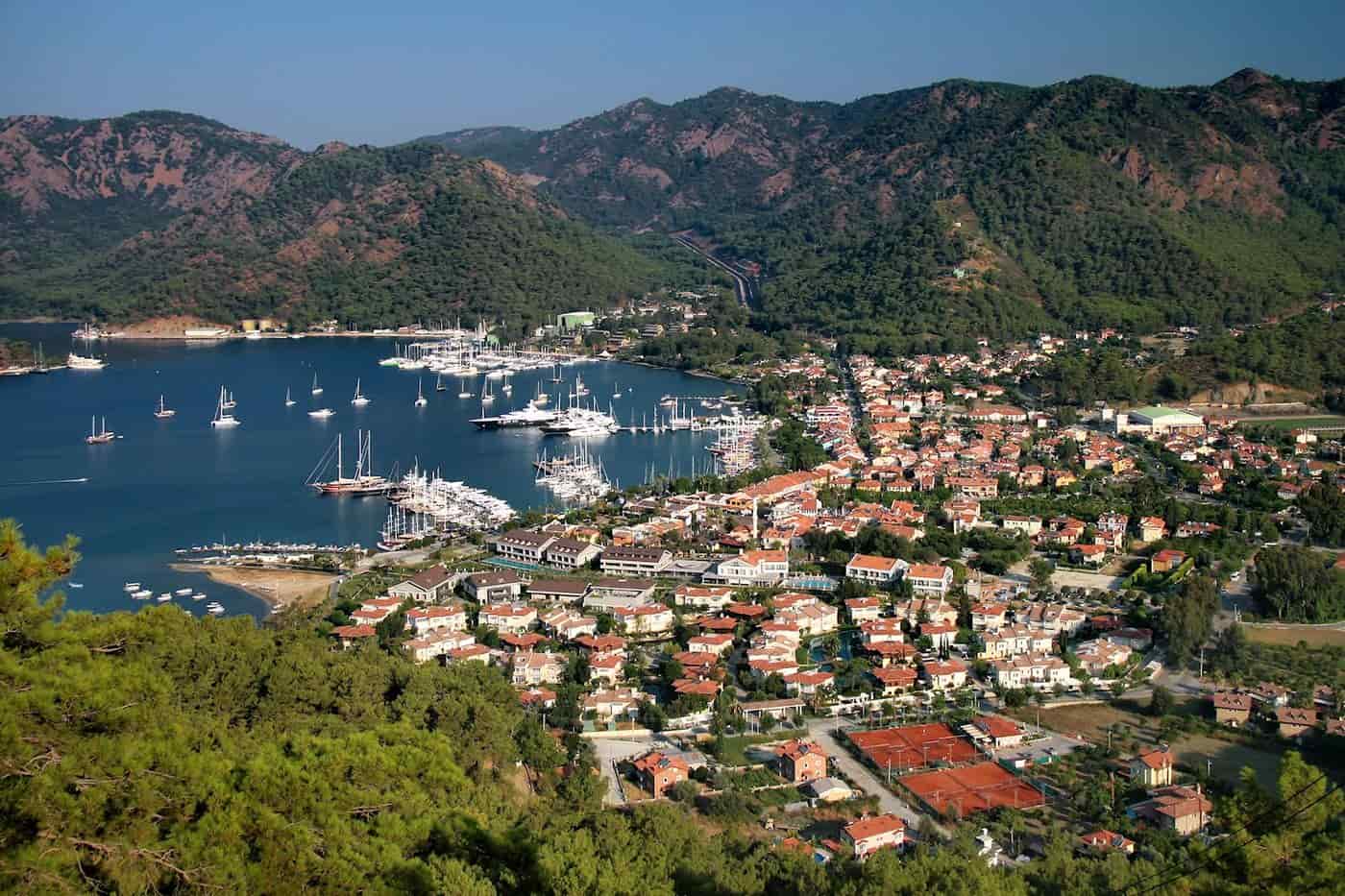
Gocek tours start in Göcek, the marina town at the north-west end of the Gulf of Fethiye in Muğla Province, on the south-west coast of Turkey. The routes cover the Twelve Islands, Cleopatra Baths Bay, the gulet and yacht charters, the Blue Voyage, the coves, the ancient sites and the Dalaman river. Greece Tours lists the trips that cross to this coast from Rhodes.
This page covers which islands and coves Gocek tours sail to, which boats run the day trips and the charters, what the town and the hills around it hold, how visitors reach Göcek from Dalaman Airport and Rhodes, and which season suits each route. The tours below are checked on GetYourGuide and leave from Göcek, Fethiye, Marmaris and Sarıgerme.
What do Gocek tours cover?
Gocek tours are boat trips that leave Göcek, a neighbourhood of Fethiye district in Muğla Province, and sail the islands and coves of the Gulf of Fethiye. The town sits in a large, secluded bay, and its coves and 12 islands anchor its tourism.
The Gulf of Fethiye is a branch of the Mediterranean Sea in southwestern Turkey, bounded by Cape Kurdoğlu in the west and Cape İblis in the east. Until 1923 it carried the name Gulf of Makri, from the former Greek-origin name of Fethiye. The larger resort of Fethiye lies on the eastern shore of the same gulf and runs its own Fethiye tours.
Visitors join public Gocek tours from the marinas or from the port in the original town, or rent their own boat. The enclosed gulf makes Göcek a calm, safe harbour for long-distance sailors arriving from international waters.
- Full day: Gocek tours around all 12 islands fill an entire day on the water.
- Protected area: 805.37 km² of land around the whole gulf forms the Fethiye-Göcek Special Protection Area.
- Hillsides: maquis covers the slopes up to 600 metres, with red pine, cedar and black pine forests above it.
Which Gocek tours sail to the Twelve Islands of Gocek?
The 12 Islands Tour is the popular route among Gocek tours. It follows the chain that runs northeast to southwest in the western Gulf of Fethiye, known in Turkish as On İki Adalar, with Tersane, Domuz, Zeytinli, Kızılada, Şövalye and Katrancı among its main islands.
Göcek Island lies closest to the town centre and acts as a natural breakwater for Göcek. The uninhabited island runs 2 kilometres from north to south and sits about 700 metres off the mainland. Gocek tours and other boat services from the town use İncirli, the quay on its east shore, and a sea taxi also runs there. Facilities on the island rent sunbeds and parasols and serve food and drink.
The Yassıca Islands are a group of islands of differing sizes in the bay of Fethiye, covered with pine and olive trees. One of them holds a small lagoon, and Yassıca Island offers hiking. In the summer months, locals open small stalls that sell refreshments and knick-knacks to visitors.
- Tersane Island: the largest island on Gocek tours, a triangle of about 2.5 km² named Shipyard Island, with a winter harbour, a summer port and Lycian and Ottoman ruins.
- Domuz Island: Pig Island, named after the wild boars thought to live there, 250 metres west of Tersane and once owned by Sedat Simavi of the Hürriyet newspaper.
- Kızılada: ancient Lagusa, 6.4 km off the Fethiye shore, with a 19th-century lighthouse turned seafood restaurant in 2007 and a sandy east shore for swimming and anchoring.
What do Gocek tours see at Cleopatra Baths Bay and the coves?
Gocek tours at Cleopatra Baths Bay find historical ruins and sunken baths in blue and green water. The story goes that friends of the Egyptian queen Cleopatra built the bathhouse as a gift during her visit, after finding a hot water source in the bay.
The same account says the hot water is good for treating skin diseases and names it as the source of Cleopatra’s legendary beauty. Near Kapukargın in Dalaman district, the surviving walls of ancient Arymaxa overlook both Gökgemile Koyu and Hamam Koyu, a cove that draws attention with bath ruins lying in the water.
The coves inside Dalaman district are known as the Göcek coves and suit yacht tourism well; Kurşunlu, Akbükü, Göbün, Boynuzbükü and Sarsala are the main ones. The gulf formed where land sank during tectonic movements in the 3rd and 4th geological eras. The sea filled the sunken valley floors, and the valleys of small side streams became the inner coves that Gocek tours enter.
- Bedri Rahmi Bay: the former Taşyaka, renamed after the painter Bedri Rahmi visited in 1974, with his fish-shaped artwork on a large stone that hides 6 animals.
- Göbün Bay: a small, narrow cove reached through two high hills, with century-old olive trees and rock tombs at its end.
- Killebükü Bay: a large bay between Boynuzbükü and Taşyaka, with the ruins of a church and ornamented stones.
- Sıralıbük Cove: a popular stop for daily Gocek tours, where a fresh water source meets the salt water.
- Cennet Bay: a bay just west of the Yassıca Islands, where swimmers enjoy the shade of pine trees.
Which Gocek tours charter a gulet or a yacht?
Gocek tours charter sailing and motor yachts through about 20 charter and brokerage companies in Göcek. Private charter boats, fishing boats and larger yachts reach the Twelve Islands, and a rented boat stays in any bay for as long as its guests want.
The gulet is the traditional wooden sailing vessel of Turkey, with two or three masts, built especially in the coastal towns of Bodrum and Marmaris. The type measures 14 to 35 metres and is popular for tourist charters, Gocek tours included, and diesel power now drives almost every gulet for crew economy. The Turkish word comes from Venetian gołéta, itself from French gouëlette, meaning schooner.
- Karpuz kıç: the Bodrum gulet hull, with a clipper stem and a rounded “watermelon” stern.
- Aynakıç: a gulet hull with a square or transom stern, developed for greater capacity and larger deck space.
- Tırhandil: an older double-ended Aegean boat type, with only a small number left among Blue Voyage boats.
A classic Bodrum gulet has a wide aft deck, a sunbathing and resting area called the bangaça, and wide, high cabins, which place it among the boats best suited to charter. Modernised in form, equipment and decoration, Turkish gulets have become an export product and now work as charter boats in Croatia, Italy and Greece. Gocek tours on chartered yachts also find technical yacht services, chandlers and maintenance services in the town.
Which Gocek tours follow the Blue Voyage?
Gocek tours that follow the Blue Voyage, Mavi Yolculuk in Turkish, are gulet cruises of 3, 4, 7 or 14 nights along the Turkish coast, and Göcek serves as a starting and ending point of the route, with heavy yacht traffic in its closed gulf.
Gocek tours borrow the name from Azra Erhat’s travel book Mavi Yolculuk, first published in 1957 and expanded in 1962 and 1979. The same trip goes by Blue Cruise and Blue Tour, Mavi Tur in Turkish.
- Cevat Şakir Kabaağaçlı: the founder, the Fisherman of Halicarnassus, exiled to Bodrum in 1925.
- Sabahattin Eyüboğlu: the name-giver, on a 1945 voyage along the Aegean and Mediterranean coasts.
- Bedri Rahmi Eyüboğlu: the painter brother of Sabahattin, on the same 1945 voyage.
Kabaağaçlı sailed with friends on the sponge divers’ gulets. The first crews packed cheese, water, İstanköy rusks, tobacco and rakı, left newspapers and radios behind, and stayed at sea for weeks, landing only for urgent supplies. Today’s Blue Voyage offers every kind of luxury, a stark contrast to those early trips.
Göcek became known to artists, poets and Bodrum fishermen through these cruises. On a 1974 voyage, Bedri Rahmi stopped at Taşyaka Cove, 14 km southeast of Dalaman town, and painted a large fish on a rock that hides 6 animals, among them a bird and a snake. Gocek tours on the 12 Islands route include the cove, now named after him.
Until the 1980s, only a lucky minority with their own boats made the Blue Voyage; then it settled into Turkish tourism. Routes run from a couple of days among nearby coves to the whole Turkish Riviera over weeks, and they can cross to Greece and the Greek islands.
West of Göcek, Gocek tours head for Marmaris, Datça and Gökova, all busy departure points, and on to Bodrum, a gulet-building town like Marmaris. Eastbound Gocek tours sail toward Kekova, one of the popular stretches of the route, and Kaş, a small fishing, diving and yachting town covered by our Kas tours.
Which Gocek tours go diving, kayaking and paddleboarding?
Gocek tours on the water include freediving and snorkelling stops from day boats, sea kayaking trips that start in Göcek and continue east to Kekova, and stand up paddleboard sessions in the sheltered coves, which agencies in Göcek offer alongside boat tours.
Freedivers choose the Göcek coves for their suitable sea temperature and long visibility, Anadolu Agency reported in 2021. Gocek tours carry them out by boat, and with only a snorkel and fins they meet schools of fish, sea turtles and rows of rock. The area also suits swimming among sunken ancient ruins, windsurfing and diving.
Divers on Gocek tours share the water with the endangered Mediterranean monk seal, which breeds along the coasts, islands and rocks of the Gulf of Fethiye, so responsible scuba instructors hesitate to lead trips to known seal caves.
Kayak-based Gocek tours use long, stable sea kayaks that are easy to steer, need no previous experience and reach beaches and inlets where larger craft cannot go. One 7-night itinerary starts in Göcek with a safety briefing and basic exercises, then paddles the bays and coves with swimming stops.
- Göcek: a last half day on the water before the kayaks go onto the trailer.
- Üçağız: the Kekova base, a 2 hr 40 min transfer east of Göcek.
- Kekova Island: a swim stop in Tersane Bay and a paddle over the Sunken City.
- Simena: a walk up to a castle that no road reaches, with 360-degree views.
- Kaş: the finish, a 50-minute transfer from Üçağız, with optional scuba diving.
Stand up paddleboarding needs no waves, and calm, windless water with little boat traffic suits beginners, who kneel on the board until they find their balance and then stand. Gocek tours for paddleboarders follow the shore in the calm early-morning water, or carry the boards by boat to the Yassıca Islands, Bedri Rahmi Cove and Cleopatra’s Bath Cove.
First-timers start with short sessions inside the coves and lengthen the route as their confidence grows, up to crossings between the islands. Gocek tours to the Yassıca Islands find pine and olive trees, a small lagoon on one island and shores ideal for water sports.
Which beaches do Gocek tours reach?
Gocek tours reach İnlice Beach, a free public beach a 10-minute drive from town, the island beach across the harbour by sea taxi, the D-Resort Göcek beach, and by road Katrancı Bay, Kille Bay, Sarsala Bay and the long sands of Sarıgerme.
İnlice Beach lies in the İnlice neighbourhood, which borders Göcek to the east and sits 22 km from Fethiye. First Göcek Municipality and then Fethiye Municipality ran the public beach for years. Gocek tours by road find a long shore of fine pebbles and clean water where the sea deepens slowly, a fit for families and swimmers.
Ancient remains of a Lycian-era harbour lie right behind İnlice Public Beach, which makes the area an archaeological site. İnlice residents say almost no free public beach is left nearby.
Gocek tours to the nearest island beach take the sea taxi to Göcek Island, about 700 m off the mainland, with a quay called İncirli on its east side. The island rents sunbeds and parasols and serves food and drinks. On the mainland, the D-Resort Göcek beach opens to visitors with a day pass or a seasonal membership.
- Katrancı Bay: a pine-shaded beach 17 km from Fethiye on the road to Göcek, suited to camping.
- Kille Bay: a wide beach 30 minutes by car from Göcek centre, shallow far out from the shore.
- Sarsala Bay: shallow water, soft sand and a light wind near Dalaman, with a large car park and a small restaurant.
- Sarıgerme: a long sandy beach near Osmaniye village in Ortaca district, 12 km from Dalaman.
Gocek tours by car, bus or dolmuş reach Sarıgerme in 30 to 45 minutes. Its pristine sand draws Turkish and foreign guests alike.
What do Gocek tours see in the town and the marinas?
Gocek tours in the town follow a seafront promenade lined with restaurants, cafés and bars, and pass six marinas: Club Marina, Skopea Marina, the Municipality Marinas, Marinturk Göcek Village Port, Marinturk Göcek Exclusive and D-Marin Göcek, all inside a large, secluded bay.
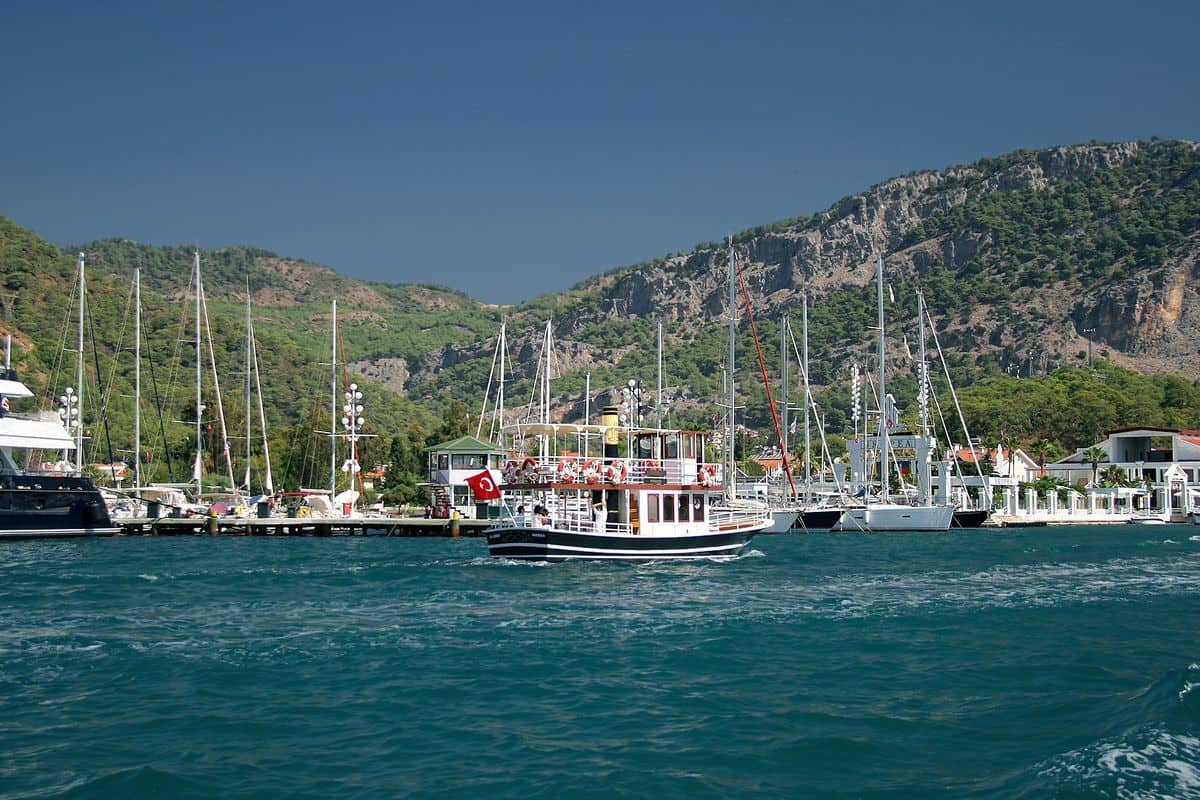
Göcek sits on the Gulf of Fethiye in Muğla Province, and Gocek tours find a low skyline there. The town allows no multi-storey buildings, so its hotels, motels, apartment hotels and pensions rise two storeys, both in the town centre and on its edges.
Gocek tours start from a lively shore that offers daily boat tours and seaside entertainment, and the town has technical yacht services, chandlers and maintenance services. Göcek Island, uninhabited and 2 kilometres long from north to south, lies about 700 metres off the mainland as a natural breakwater that shields the town from the wind.
The town calendar adds events to Gocek tours. A club named GYC holds two regattas (sailing races) every year, one in the week of 10 November, and since 1999 the Ekin (Culture) and Gezim (Tourism) Association has organised a children’s festival each 23 April, a Yayla (highland pasture) Walk at the end of spring and a Yayla Return at the start of autumn.
- D-Marin Göcek: berths for up to 388 yachts, superyachts up to 85 metres, set in a pine forest beside Göcek Bay.
- D-Marin yard: a dry dock capacity of 150 boats and a 75-tonne travel lift.
- Club Marina: founded in 1990 at the Büngüş locality as the first natural and private marina in Turkey.
Which Gocek tours visit the ancient sites near the bay?
Gocek tours to ancient sites near the bay focus on four cities: Lydae on the Kapıdağ Peninsula, Daedala at İnlice, Calynda near Şerefler in Dalaman district and Crya near Taşyaka. The first three keep tombs, walls or a theatre; Crya’s exact site is unknown.
Lydae stands on the Kapıdağ Peninsula, which ends at Cape Kurdoğlu and closes the Gulf of Fethiye on the west. Gocek tours find extensive Roman and Byzantine ruins there, including a theatre and an agora, with tombs and mausoleums scattered across the site. The British antiquaries Theodore and Mabel Bent identified Lydae in March 1888.
Inscriptions record the family of Gaius Iulius Heliodoros from Lydae, which produced Lycian federal priests, an archiphylax and a Roman senator. In Roman imperial times Arymaxa and Kreneis, once separate communities, served as demoi (urban units) of Lydae after merging with it through sympoliteia.
Daedala lies in İnlice, which borders Göcek on the east, 29 kilometres from Fethiye, on the west side of a small river named Inigi Chai. Gocek tours see rock-cut tombs in the Lycian style there and an acropolis on a detached hill, with the remains of a well and a large cistern. Legend says Daedalus died there from a water-snake bite, and the city took his name.
Gocek tours to Calynda reach a city about 4 kilometres east of Dalaman, where a wall enclosed about 4 hectares around a small Hellenistic acropolis and a rock-tomb necropolis. Its king Damasithymos fought at Artemisium and Salamis with a ship on the side of Xerxes. Crya was a polis and a member of the Delian League, and the Stadiasmus Maris Magni places it 160 stadia west of Telmissus.
- Lydae: Ptolemy wrote the name as Chydae, and the Stadiasmus Maris Magni as Clydae.
- Daedala: Livy called it a parvum castellum, a small castle.
- Calynda: Pliny wrote Calydna, and the city struck coins in the Roman period.
- Crya: Pliny counted three islands off it, the Cryeon tres, and Ptolemy wrote Carya.
What history do Gocek tours tell?
Gocek tours tell a history that runs from the Lycian–Carian frontier and the lands of Rhodes on the opposite coast, through Menteşe and Ottoman rule, to a protected yachting town. In antiquity Göcek bore the name Callimache, and the gulf was the Glaucus Sinus.
Gocek tours place ancient Göcek between Telmessos and Caunos, and local legend holds that Icarus fell into the sea in the Göcek area after his flight from the tower where he was imprisoned. Lycia, whose Teke peninsula met the Gulf of Fethiye on the west, appears as Lukka from the 15th–14th centuries BC, and Homer’s Iliad names Sarpedon and Glaucus, son of Hippolochus, as leaders of its contingent.
Gocek tours also cross the Rhodian Peraea, which held Lydae and ended in the east at Daedala; Calynda, after a revolt against Caunus, put itself under Rhodian protection. Under Achaemenid rule, the Carian dynast Mausolus took control of neighbouring Lycia. After a heavy earthquake struck Lycia in 141 AD, the benefactor Opramoas of Rhodiapolis sent gifts to Calynda, and a letter of 458 names Leontius as its bishop.
Turkmen under Menteşe Bey began conquests around Muğla after 1261, and the Menteşe lands joined the Ottoman state in full in 1424. Gocek tours hear that, in the Ottoman period, ships loaded chrome ore at Göcek from the mines under the nearby mountains, while the province kept the name Menteşe until the early 20th century, when it became Muğla Province.
After World War I, the Treaty of Sèvres assigned Lycia to the kingdom of Italy, which occupied it for a short period, and in 1923 Lycia passed to Turkey; its Greek community was forced to migrate to Greece in the population exchange of the 1920s. Gocek tours meet a town of around 4,500 permanent residents that grows past 7,000 in summer, named after a group called Göçek that once lived in the area.
- 1928: the village list of the Ministry of the Interior in Ankara recorded Göcek as Köycek İskelesi.
- 1987: Göcek gained municipal status as a town (belde) on 30 December.
- 1988: Göcek became a Registered Area of Special Protection.
- 2012: Law 6360, accepted by the Grand National Assembly on 12 November, made Göcek a neighbourhood.
Which Gocek tours go rafting on the Dalaman river?
Gocek tours that add rafting head inland to the Dalaman Çayı, or Dalaman River, a 229 km river in Muğla Province. Rafters run a 26 km stretch with rapids of grade 3 to 4, and rafting on the river takes place all year round.
The river rises in the Yeşilgöl mountains south of Gölhisar and traces the borders of the Çameli, Acıpayam, Ortaca and Dalaman districts. Gocek tours meet it close to home, since Göcek lies on the border of the Dalaman district and the river forms much of that district’s western border.
Gocek tours raft a river with two faces. In its upper course the Dalaman Çayı runs fast through a narrow, deep valley, while on the plain its flow slows. Karstic springs in high, rainy mountains feed it, so its discharge stays high although its basin is not wide. The mean flow is 43 m³ per second, the highest flow reaches 1,050 m³ per second, and the lowest, 10 m³ per second, comes in August.
The Bereket and Akköprü dams stand on the river, and the Akköprü Dam with its hydroelectric plant, inside the Dalaman district, is Turkey’s 6th largest dam. Trekking trails follow the river along its whole length, so Gocek tours can pair a rafting run with a riverside walk.
- Basin: 3,500 km², fed by small streams from the Akdağlar.
- Tributaries: Hüsniye and Gürlek from the east, Gökçay and Ören from the west.
- Mouth: the Mediterranean, 8 km south of Ortaca.
- Water use: 8.54 hm³ of drinking water and 9.21 hm³ of irrigation water a year.
Which wildlife do Gocek tours meet in the bay and the hills?
Gocek tours sail inside the Fethiye-Göcek Special Protection Area, 805.37 km² declared in 1990. Its shores, islands and cliffs are a breeding ground for the endangered Mediterranean monk seal, its beaches are Caretta caretta nesting sites, and endemic sweetgum trees grow on land.
Researchers estimate that around 100 Mediterranean monk seals live on Turkey’s coasts, and studies have identified 31 to 44 of them one by one. On Turkey’s Mediterranean shore, seals still hold on along the coast between Datça and Kemer, the coast that Gocek tours sail. The seals off Turkey tend to roam alone and are rarely seen together.
Through the work of DHKD, a nature society founded in Istanbul in 1975, the Fethiye-Göcek, Patara, Belek-Acısu and Göksu Delta coasts, all key sea turtle breeding grounds, were declared Special Environmental Protection Areas. A WWF survey of the coast between Kuşadası and Samandağ identified 17 important sea turtle nesting areas. The Special Environmental Protection Agency, set up in 1988, runs these zones with goals that include protecting forests, preventing water pollution and conserving rare wetlands across the waters that Gocek tours cross.
On land, Gocek tours climb through maquis, which covers the slopes around the gulf up to 600 m, into forests of Turkish red pine, cedar and black pine. Oriental sweetgum, up to 40 m tall, grows around Göcek, Küçük Kargı and İnlice. It occurs as pure stands mainly in the floodplains of southwestern Turkey and on the Greek island of Rhodes. Krüper’s nuthatch, a 12.5 cm bird found almost entirely in Turkey, lives in Turkish pine forests, and its range almost completely overlaps that of the tree.
- Seal research: SAD-AFAG, the Mediterranean Seal Research Group of Turkey’s Underwater Research Foundation.
- Muğla pine: the variety pendulifolia carries drooping needles 24 to 29 cm long.
- Sweetgum balsam: taken from the trunk for cosmetics and pharmacy.
Which local food do Gocek tours taste?
Gocek tours taste the Aegean and Mediterranean side of Turkish cuisine, where olive oil is the main cooking oil and dishes are rich in vegetables, herbs and fish. Local produce adds Göcek citrus, Dalaman plain fruit and pine honey from Muğla’s pine forests.
On Gocek tours, the fish course follows Turkish coastal methods. Fish is grilled, fried or cooked by buğulama, which steams it with lemon and parsley under a lid. Pazıda levrek wraps sea bass in chard leaves, and fish soup with vegetables, onion and flour is common in coastal towns. Popular sea fish include sea bass (levrek), gilt-head bream (çipura), red mullet (barbun), red pandora (mercan) and white grouper (lagos).
Meze, the appetizer course, leans on the sea. Coastal mezes include stuffed mussels, fried mussels and fried kalamar, or squid, with tarator sauce, while ahtapot, octopus, comes as a salad or grilled in sea towns. Gocek tours also meet deniz börülcesi salatası, young shoots of marsh samphire with garlic, lemon juice and olive oil.
Summer tables swap soup for zeytinyağlı yemekler, cold vegetables cooked in olive oil. Artichoke dolma, or enginar dolması, is an Aegean region specialty, and in Aegean coastal towns the brine of turşu pickles is drunk as a drink. Muğla and Marmaris each have their own tavuk dolması, chicken stuffed with iç pilav.
Because of its climate, Göcek is known for growing tangerines, lemons and oranges. Silt from the Dalaman Çayı built the neighbouring Dalaman plain, the richest farm plain in Muğla Province, where farmers grow corn, citrus, wheat, cotton, avocados, figs and pomegranates. For Gocek tours, the Dalaman district next door also breeds dairy cows for milk production.
On Gocek tours, the pine forests supply pine honey, or çam balı, a honeydew honey with a sweet and spicy taste, woody notes and a dark amber colour. Bees make it from the sugary secretions of Marchalina hellenica, a scale insect on Turkish pine that lives along the Aegean coastal strip of Muğla, Aydın, İzmir, Balıkesir, Çanakkale and Antalya. It is a common breakfast dish in Turkey and Greece, drizzled over kaymak and eaten with bread.
- Breakfast dish: menemen, with tomatoes, green peppers, onion, olive oil and eggs.
- Cookie: Muğla halkası, made since the Ottoman period in snake, S, braid and horseshoe shapes.
- Honeydew months: the pine insect secretes its sugary liquid between July and October.
How do visitors reach Gocek on Gocek tours?
Gocek tours begin for air travellers at Dalaman Airport (DLM), a 30-minute coach transfer west of Göcek through the Göcek Tunnel on the D400 highway. Visitors from Greece cross by ferry from Rhodes to Fethiye, then ride a Muttaş bus or dolmuş west to Göcek.
Dalaman Airport sits 6 km south of Dalaman town centre. Its old terminal handles domestic flights, and the new terminal serves international routes to over 120 destinations in Turkey, Europe, North Africa and the Middle East. The airport opened in 1981 as an aerodrome and gained airport status in 1989. For Gocek tours without a transfer, the Havaş bus runs from the airport via Göcek to Fethiye.
The 980-metre Göcek Tunnel opened on 9 September 2006 and cut the road distance between Göcek and Dalaman Airport from 22 km to 18 km. Before it, drivers took a narrow, winding road from Dalaman, and self-drive Gocek tours can still use that switchback lane over the ridge for its view. The tunnel charges a toll in both directions, and the state built its second tube in 2015.
The D400 is a 2,057 km east–west state road from Datça to the Iranian border at Esendere, and it bypasses Göcek to the north. Gocek tours by public transport rely on Muttaş, the regional bus company of Muğla: bus 48-2 runs every 15 minutes between Dalaman town and Fethiye via Göcek, bus 3-50 runs every 30 minutes between Fethiye and Göcek, and dolmuş minibuses ply both routes. Havaş buses and intercity coaches from Istanbul and Izmir stop at the filling station on the D400 at the north edge of Göcek, a 1 km walk southwest along Atatürk Boulevard to the centre. Metro Turizm, Pamukkale and Flixbus serve Dalaman:
- From Istanbul: buses to Dalaman take 13 hours.
- From Ankara: buses to Dalaman take 10 hours.
- From Izmir: buses to Dalaman take 4 hours 30 minutes.
For Gocek tours from Rhodes, which lies 18 km off the southern shore of Turkey, Sky Marine Ferries run a fast catamaran to Fethiye daily from April to October, a crossing of 1 hour 45 minutes. The Central Port of Rhodes serves the island’s international traffic, including scheduled services to and from Turkey, and the Fethiye ferry terminal stands on the east side of the marina.
When do Gocek tours run best?
Gocek tours run best in early summer and in autumn. Göcek’s summer highs average 34 °C and reach 40 °C at times, while in September and October the sea of the Gulf of Fethiye still holds 24 °C and the air has cooled.
Göcek has a subtropical Mediterranean climate with sun on over 300 days a year, and summer nights on Gocek tours cool to around 20 °C. The winter average maximum is 14 °C. Neighbouring Dalaman is sunny all year, especially in June and July, and holds one of the highest recorded air temperatures in Turkey.
The meltem, the Turkish name for the etesian winds, blows for about four months and dies away in mid-September. It peaks in the afternoon, drops at night and can reach force 7 to 8 on the Beaufort scale, rising in clear weather without warning, yet leisure sailors on Gocek tours favour its steady breeze. Göcek Island, 2 km long, acts as a natural breakwater for the town.
The sailing calendar of Gocek tours includes two regattas a year, one in late spring and one in the week of 10 November. Winters bring heavy rainfall and strong winds: January at the Fethiye weather station averages 174.4 mm of rain over 10.5 days, against 0.7 mm in July. Its 1991 to 2020 averages:
- June: average high of 32.1 °C, with 344.6 hours of sun.
- July: average high of 35.1 °C, with 367.8 hours of sun.
- September: average high of 31.9 °C, with 294.1 hours of sun.
- October: average high of 27.2 °C, with 238.7 hours of sun.
Frequently Asked Questions
Can Gocek tours run as a day trip from Rhodes?
No same-day return from Rhodes fits the Sky Marine timetable: the fast catamaran leaves Fethiye in the morning and sails back from Rhodes in the afternoon. The day trip works only from Fethiye, with six hours ashore in Rhodes. Visitors starting on the Greek island need at least one night in Göcek or Fethiye.
Can yachts on Gocek tours clear customs in Göcek?
Yes. Göcek is an official Port of Entry into Turkey, as is Fethiye, so skippers arriving from Greek waters clear immigration and customs in Göcek if they have not cleared at another Turkish port. The enclosed gulf of Göcek gives long-distance sailors coming from international waters a calm and safe harbour.
Do Gocek tours need a hire car?
No. Göcek is a town for walking. Drivers find car hire at Dalaman Airport and car and scooter rental in Fethiye from Avis, Abalı, Fetcar, Europcar, Atlantic and Eskol. A drive from Istanbul follows the O-7 and O-5 toll motorways south to Izmir, then the D550 through Aydın and Muğla, and the D400.
Which airports and airlines serve Gocek tours?
Dalaman Airport is one of three airports serving southwest Turkey; Milas–Bodrum Airport and Antalya Airport are the other two, and Antalya Airport (AYT) sits a 3-hour drive east of Fethiye. At Dalaman, Turkish Airlines flies daily to Istanbul, while Pegasus Airlines and Free Bird Airlines use the airport as a seasonal base.
Which local festivals can visitors join on Gocek tours?
Göcek marks 23 April, National Sovereignty and Children’s Day, with a children’s festival held since 1999 with the support of the Ekin (Culture) and Gezim (Tourism) Association. The same association runs a plateau walk, Yayla Yürüyüşü, at the end of spring and a plateau return, Yayla Dönüşü, at the start of autumn.