
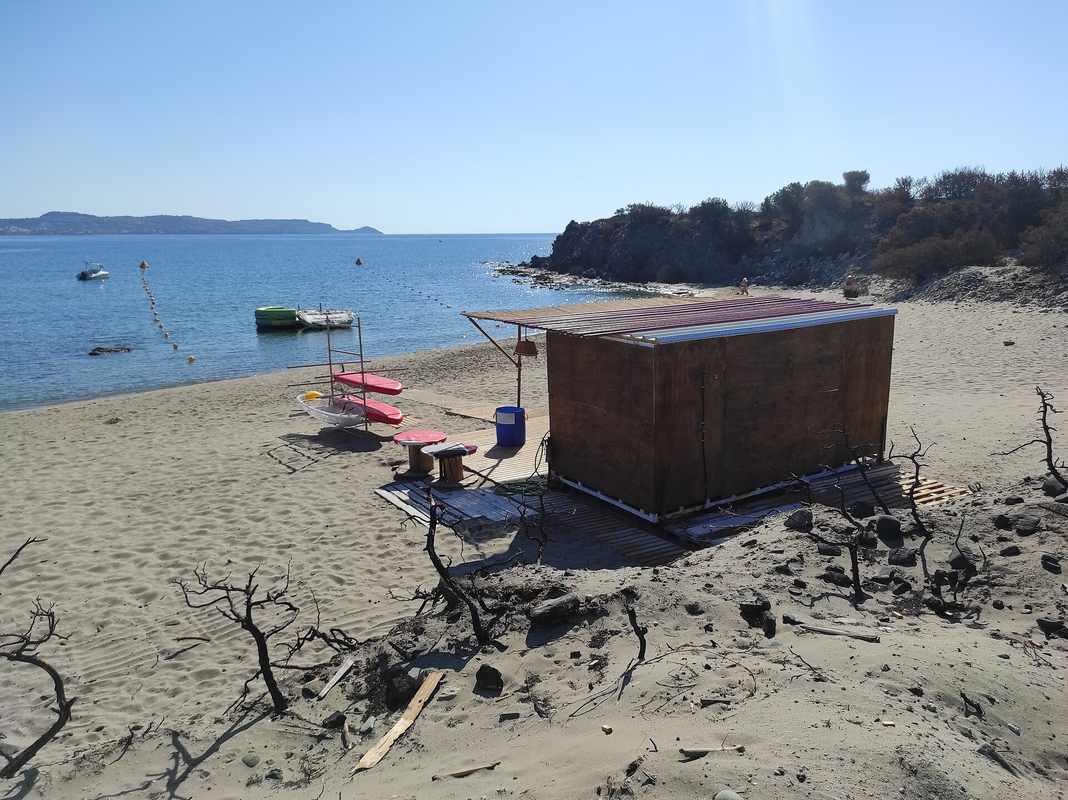
Glystra Beach is a small, crescent-shaped cove on the east coast of Rhodes, tucked into the coastline between the villages of Lindos and Pefkos along the road that continues south towards Kiotari. The beach is a compact arc of soft sand and fine shingle, framed by low rocky headlands that wrap around each end and shelter the bay from the open sea. The water shelves gently and stays shallow and clear for a long way out, which is why families with young children and unhurried swimmers return to it year after year. Because the cove is genuinely small, it has an intimate, sheltered feel that larger east-coast beaches cannot match, and it has become one of the most photographed swimming spots on this stretch of coast. For more on planning a Rhodes trip, visit My Greece Tours.
This page sits within our wider Rhodes travel guide and focuses on what makes this particular cove worth the short detour. The sections below cover where Glystra sits and how to reach it, what the sand and water are actually like, the snorkelling around the rocks, the sunbeds and canteen on the sand, and the practical timing that keeps a visit relaxed rather than crowded.
Where is Glystra Beach and how do you get there?
Glystra Beach lies on the east coast of Rhodes between Lindos and Pefkos, signposted directly off the main Lindos to Pefkos and Kiotari road. It is roughly a couple of kilometres south of Lindos, reached by a short, steep access lane that drops from the roadside parking down to the sand.
The cove is one of the easiest beaches on this coast to fit into a day out, because it sits right beside the principal route linking the resorts of the south-east. Drivers coming from Rhodes Town follow the main road past Lindos, and within a few minutes a brown beach sign marks the turning towards the sea. The descent to the shore is short but noticeably steep, so it pays to take the access lane slowly, particularly with a hire car. Many visitors combine Glystra with a morning in nearby Lindos or an afternoon in Pefkos, since all three lie within a small radius and share the same coastal road.
Public buses running the Rhodes Town to Lindos and Kiotari routes pass the top of the access road, and the stop leaves only a short walk down to the beach, though the climb back up in the heat is the harder half. There is free parking on the flat ground above the cove, but the area is modest in size and fills early on busy summer days, so an earlier arrival usually secures both a space and a quieter patch of sand. Our guide to Lindos covers the acropolis and old town nearby, and the next section covers the sand and water themselves.
What is the sand and water like at Glystra Beach?
Glystra has a shore of soft sand mixed with fine pale shingle, sloping into water that stays shallow and exceptionally clear close in. The gentle gradient and the shelter of the headlands keep the sea calm on most days, giving the cove its reputation as a safe, easy swimming spot.
The blend of sand and fine shingle underfoot makes the entry comfortable, and water shoes are rarely necessary in the shallows, though they help once you reach the rockier edges. Because the bay is enclosed by headlands on either side, the surface is usually flat and protected even when a breeze ruffles the more exposed beaches further along the coast. The shallow water warms quickly through the day and holds a vivid turquoise colour over the pale seabed, which is part of why the cove looks so striking in photographs taken from the road above.
The gradual shelf is the feature parents value most, since small children can paddle and play well away from any sudden drop. Stronger swimmers can strike out towards the mouth of the cove, where the depth increases steadily rather than abruptly. The clarity of the water also means you can see the bottom clearly across much of the swimming area, which adds to the sense of safety and makes it simple to keep an eye on children. Our guide to Pefkos covers the longer resort beaches just to the south, and the next section covers snorkelling around the rocks.
Is Glystra Beach good for snorkelling?
Yes. The rocky headlands at each end of the cove create the best snorkelling at Glystra, where clear water over rock and weed attracts small fish. The sheltered, shallow conditions make it an easy place for beginners and children to try snorkelling close to shore.
The sandy centre of the bay is open and bright but holds less to look at, so snorkellers do best by swimming a short way towards either rocky point. There the seabed changes from pale sand to rock and patches of sea grass, and the structure draws in shoals of small fish that are easy to watch in the calm, transparent water. Visibility is generally good thanks to the shelter of the cove, and the gentle conditions mean you can drift along the rock edges without fighting any current.
Because the water stays shallow over the rocks, this is a forgiving place to learn, and families often use it as a child’s first taste of snorkelling. It is worth bringing your own mask and snorkel, as a small cove like this is not the place to rely on finding hire gear. Reef-safe footwear is useful around the rougher stones at the margins, where the surface can be uneven. Our guide to Rhodes beaches covers the wider choice across the island, and the next section covers the sunbeds and canteen on the sand.
Are there sunbeds and a beach bar at Glystra?
Glystra has rows of sunbeds and umbrellas for hire across much of the sand, plus a small beach bar and canteen serving drinks, snacks and light meals. The facilities are modest and seasonal, in keeping with the size of the cove rather than a large resort beach.
Organised sunbeds and parasols cover a good part of the small beach, which is welcome given how exposed the sand can feel under the midday sun. The canteen behind the loungers handles cold drinks, coffee, ice creams and simple food, enough to see you through a half or full day without needing to leave. Facilities are limited by the modest scale of the cove, so visitors who want a wide choice of tavernas usually pair the beach with lunch in one of the neighbouring villages instead.
It is sensible to treat Glystra as a swimming and sunbathing stop rather than a full-service resort, and to bring water and any specific food you need on a busy day. Shade away from the hired umbrellas is scarce, so an early claim on a sunbed pair matters when the cove fills. The small bar and the steady stream of visitors give the beach a friendly, low-key atmosphere through the season. Our guide to Kiotari covers the longer beach and tavernas just down the coast, and the next section covers the best timing for a visit.
When is the best time to visit Glystra Beach?
Visit Glystra early in the morning or later in the afternoon during peak summer, since the small cove fills quickly and parking is limited. Late spring and early autumn offer warm, calm water with far fewer people and an easier choice of sunbeds and spaces.
The very feature that makes Glystra appealing, its compact size, is also what makes timing important, because a beach this small reaches capacity faster than the broad sands further along the coast. In the peak summer months the parking above the cove can be full by mid-morning, and the sunbeds along with the best patches of free sand go quickly. Arriving soon after the beach opens, or coming back in the cooler late afternoon, gives a calmer experience and a better chance of a comfortable spot.
Outside the high season the cove is at its best, with the sheltered water still warm well into autumn and the crowds much thinner in late spring and early autumn. Day-trippers often link Glystra with the nearby calm shallows of St Paul’s Bay below Lindos for a contrast of two sheltered swimming spots in one outing. Plan your visit and tours through our Rhodes travel guide.
Frequently Asked Questions
Is Glystra Beach suitable for young children?
Glystra is one of the more child-friendly beaches on the east coast of Rhodes, mainly because of how the water behaves. The shore slopes very gently into the sea, and the water stays shallow and clear for a long way out, so small children can paddle and play without reaching a sudden drop. The headlands at each end shelter the cove, keeping the surface calm on most days and reducing the waves that unsettle younger swimmers on more exposed beaches. The mix of soft sand and fine shingle is comfortable underfoot, and the clarity of the water makes it easy for parents to keep watch. Sunbeds, umbrellas and a canteen on the sand mean a family can settle in for several hours. The main caution is the small size of the cove, which fills quickly in peak summer, so arriving early helps secure shade and space for a relaxed day with children.
Does Glystra Beach have parking?
Yes, there is free parking on the flat ground directly above the cove, at the top of the short access lane that drops down to the sand. The area is straightforward to find, as it sits right off the main Lindos to Pefkos and Kiotari road and is signposted from the roadside. The important thing to know is that the parking is modest in size, in keeping with the small scale of the beach itself. During the peak summer months it can fill by the middle of the morning, after which later arrivals may struggle to find a space nearby. The access lane down to the beach is short but steep, so drivers should take it slowly, particularly in a hire car. For the easiest day, arrive early to claim both a parking spot and a quieter patch of sand, or visit in the cooler late afternoon once the morning crowd has begun to thin out and spaces open up again.
How does Glystra compare to other beaches near Lindos?
Glystra offers something different from its better-known neighbours, which is why many visitors include it alongside them rather than instead of them. It is far smaller and more sheltered than the long resort beaches at Pefkos and Kiotari to the south, trading their space and abundance of tavernas for an intimate cove with calm, shallow, strikingly clear water. Compared with St Paul’s Bay below Lindos, another sheltered swimming spot, Glystra is more open to the sea and easier to reach directly off the main road, while St Paul’s sits in a near-enclosed natural pool beneath the acropolis. The town beaches at Lindos itself are busier and more central to the village. Glystra’s appeal lies in its scenery, its safe shallow water and its low-key facilities, making it ideal for a swimming and snorkelling stop rather than a full resort day. Pairing it with Lindos sightseeing or a Pefkos lunch makes the most of the area.