
Cretan hieroglyphics are the earliest known writing system of Minoan Crete, a script of pictorial signs engraved on seals and small clay documents during the Old Palace period at sites such as Knossos and Malia. The script remains undeciphered and its language is unknown. Plan tickets and tours through My Greece Tours.
This script first emerged in the palace world centred on the Palace of Knossos, where Minoan administration and craft reached their height. The sections below cover what Cretan hieroglyphics are, how they relate to Linear A and Linear B, what objects carry the script, whether it has been deciphered, and where you can see examples today.
What are Cretan hieroglyphics?
Cretan hieroglyphics are the earliest known writing system of Minoan Crete, a pictographic script of small engraved signs used during the Old Palace period, mainly at Knossos and Malia. The signs depict heads, hands, tools, plants, animals and ships, and remain undeciphered.
Cretan hieroglyphic writing belongs to the early-to-middle phase of Minoan civilisation, the period when the first great palaces were built and Crete became a centre of trade and administration. The script is called hieroglyphic because its signs are pictorial: each one resembles a recognisable object such as a human head, a hand, a tool, a plant, an animal or a ship. These pictures were not casual drawings but a working writing system, used by palace scribes and seal-cutters to record and authenticate information. The signs appear in fixed, repeated forms, which marks them out as true script rather than decorative imagery.
Unlike Egyptian hieroglyphics, with which it shares only the descriptive label, the Cretan script developed independently within the Aegean world. It served a society organised around palace economies, where records of goods, ownership and transactions mattered. The surviving texts are short and hold only a short run of sign-groups, so scholars cannot read the words behind the pictures, yet the consistency of the signs shows a literate administrative culture. Our guide to the Minoan seals covers the carved stones that carry the bulk of this writing, and the next section covers how Cretan hieroglyphics relate to Linear A and Linear B.
The term “hieroglyphic” was applied by Arthur Evans, the excavator of Knossos, who first grouped these pictorial signs and distinguished them from the linear scripts he also found on the site. Evans set out an early classification of the material, and later specialists refined it into the standard reference catalogue used today. The script is treated as a genuine writing system rather than a set of decorative motifs because its signs recur in the same shapes, combine into repeated sign-groups, and sit beside numerals in ways that point to record-keeping rather than ornament.
How do Cretan hieroglyphics relate to Linear A and Linear B?
Cretan hieroglyphics are the oldest of the three Minoan-Crete scripts. They partly overlap in time with Linear A, the later undeciphered Minoan script, and they predate Linear B, the far later script that records an early form of Greek and has been deciphered.
The three scripts of Bronze Age Crete form a rough sequence. Cretan hieroglyphic is the earliest, a pictorial system tied to the Old Palace period. Linear A followed and partly coexisted with it; its signs are more abstract and stroke-based, and it too remains undeciphered, recording an unknown Minoan language. Linear B is the latest of the three and the only one that can be read, because the script was shown to record an early form of Greek used by the later Mycenaean administration at Knossos and on the mainland.
The scripts share a setting and a small stock of signs that look related, yet a clear line of descent between them is not proven, and each must be studied on its own terms. The pictorial hieroglyphics and the more linear strokes of the other two suggest a shift in how scribes wrote rather than a simple copy. A small stock of signs in the hieroglyphic and Linear A repertoires resemble each other closely enough that scholars suspect a shared root, while others have no counterpart, so the two systems are neither identical nor wholly separate. Our guide to Minoan Linear A covers the sister Minoan script in detail, and the next section covers what objects carry the Cretan hieroglyphic script.
The decipherment of Linear B sets the contrast sharply. Michael Ventris, working with John Chadwick, showed in the middle of the twentieth century that Linear B recorded Greek, which turned the tablets into readable accounts of the palace economy. That breakthrough depended on a known underlying language, a larger body of tablets and a grid of sign relationships. Cretan hieroglyphics offer none of these advantages, so the question of whether the earlier script fed directly into Linear A, and then into Linear B, or whether the resemblances reflect shared borrowing, remains debated among specialists.
What objects carry the Cretan hieroglyphic script?
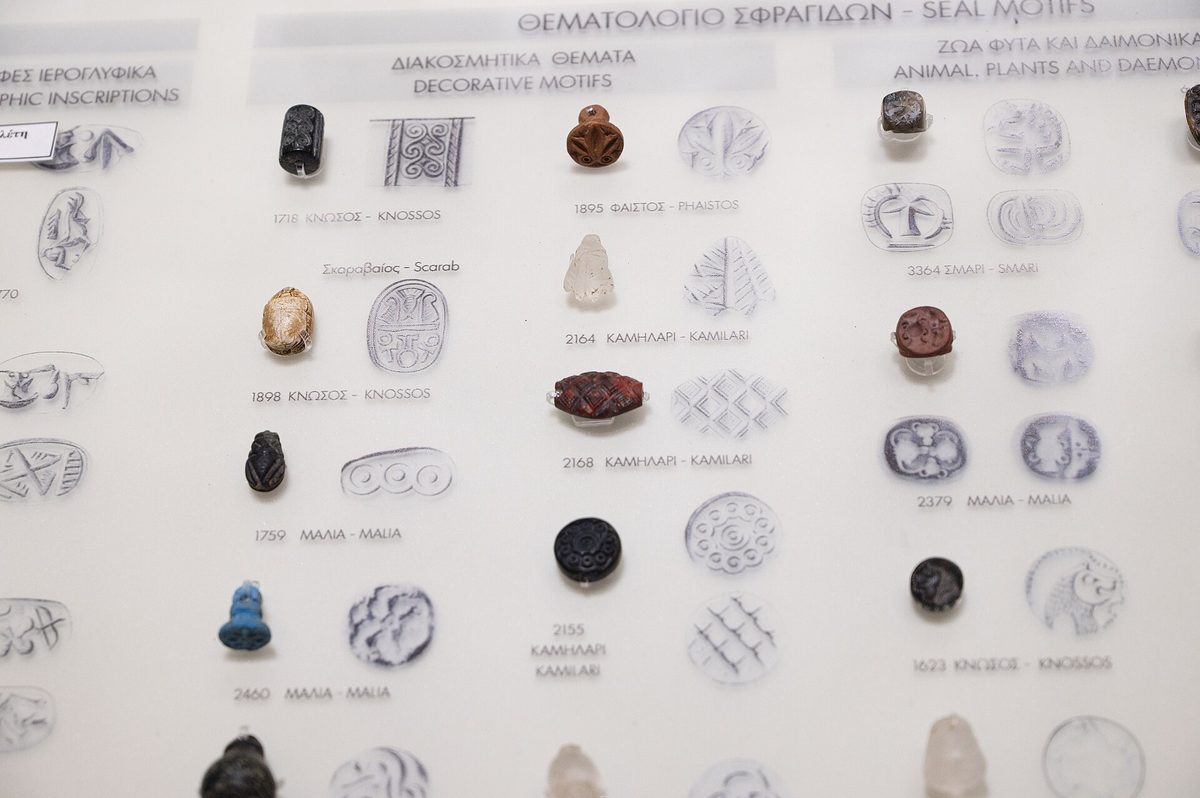
Cretan hieroglyphics survive mainly on engraved seals and sealstones, on the clay sealings stamped by them, and on small clay documents such as bars, medallions and cones. These objects are small, which is one reason the surviving texts are short.
Most Cretan hieroglyphic inscriptions appear on seals and sealstones, the small carved stones that Minoans used to mark ownership and authenticate goods. A seal was pressed into soft clay to leave a stamped impression, and the resulting clay sealings survive even where the original stone does not. The script also appears on small clay documents created by palace administrators, including bars, medallions or labels, and cone-shaped nodules that seem to have recorded short administrative notes. Together these objects show writing embedded in the daily running of the palace economy.
The medium was so compact that each inscription carries only a short run of characters, and the complete corpus is modest in size, with the catalogued sign-groups numbering in the hundreds across all supports. This is a practical obstacle to reading the script, because short texts give scant repeated patterns for scholars to analyse. The seals themselves are also prized as art, combining fine engraving with the earliest Aegean writing. Our guide to the Linear B at Knossos covers the later, deciphered script for comparison, and the next section covers whether Cretan hieroglyphics have been deciphered.
The clay documents fall into recognisable shapes that scholars name by form. Bars are four-sided lengths of clay inscribed on each face; medallions are flattened discs or labels, sometimes pierced so they could hang from an object or container; and cones or nodules are small lumps once attached to strings or goods. Each shape seems to have suited a particular administrative task, from noting a quantity to tagging a sealed parcel. This variety of supports, small and functional, tells us the writing lived inside the storerooms and workshops of the palace rather than on public monuments.
The materials themselves reward a close look. Seal-stones were cut from hard gems, so their signs stayed crisp under repeated stamping. Clay bars and medallions were formed by hand, dried rather than fired, and inscribed with a fine point while still soft. That difference in material matters for survival. Fired clay endures, while unbaked clay crumbles unless a fire or careful burial hardens it. The bulk of what remains was preserved by accident, hardened when a palace store caught fire, which skews the record toward the sites that burned. Scholars read this survival bias with care when they weigh how common the script once was across Crete.
Which sites have produced the hieroglyphic archives?
The main finds come from Knossos, where Arthur Evans recovered a “hieroglyphic deposit,” and from Malia, especially the Quartier Mu workshops. Further inscribed material has been found at Petras in eastern Crete and at other Minoan sites, all within the palace world.
Knossos gave the script its first large body of evidence. Arthur Evans uncovered a group of inscribed clay documents that came to be known as the hieroglyphic deposit, a find-spot that concentrated bars, medallions and sealings in one context and confirmed that the pictorial signs formed a working archive. Because Knossos was the largest of the Minoan palaces, its administrative rubbish preserved a fuller picture of how the script was used to track goods and authenticate transactions than any single object could.
Malia, on the north coast, produced the other principal concentration, above all in the district that archaeologists call Quartier Mu. This was a complex of workshops and storerooms where seal-cutters, potters and metalworkers operated, and where inscribed sealings and clay documents turned up together with the tools of craft production. The Malia material ties the script directly to manufacture and trade, showing writing at the point where goods were made, counted and dispatched rather than only where they were finally stored.
Beyond these two centres, inscribed pieces have come from Petras in eastern Crete, where excavation revealed sealings and documents that extend the geography of the script across the island, and from other Minoan sites that each add a small quantity of material. The spread confirms that Cretan hieroglyphic writing was not confined to one palace but belonged to a shared administrative culture. Our guide to the Palace of Knossos covers the site where the deposit was found, and the next section covers the kinds of signs the script uses.
What kinds of signs make up the script?
The script combines pictographic syllabic signs, which likely stood for sounds, with logograms that stood for whole words or commodities. Alongside these it used numerals and a system of fractions, so scribes could record both what was counted and the measured share.
Scholars divide the Cretan hieroglyphic repertoire into working classes. The larger group is made of syllabic signs, pictures that probably represented sounds or syllables and combined into the sign-groups that behave like words. A second group is made of logograms, single signs standing for a whole word or, more often, for a commodity such as a type of grain, an animal or a vessel. This mix of sound-signs and word-signs is typical of early administrative scripts, which needed to name goods quickly and mark quantities beside them.
Numbers were written with their own marks. The script used numerals built from strokes and dots to record quantities, and it added a set of fraction signs for parts of a unit, so an entry could note not just the item count but a measured share. This capacity for fractions points to careful accounting, the recording of rations, tribute or stored produce in precise amounts. The pairing of a logogram for a commodity with a numeral and a fraction is exactly the pattern one expects in a palace ledger.
How the script was written and read is only partly recovered. The direction of writing was not fixed in the way later alphabets are, and scribes seem to have arranged signs to fit the small surface of a seal or bar, sometimes reading in the direction the pictorial signs face. Word-dividers and grouping marks helped separate one entry from the next. These structural features let scholars catalogue and compare the signs even without reading them, and they are the reason the material is treated as script. The next section covers whether the writing has been deciphered.
The count of distinct signs guides how the script is read. A pure alphabet needs only a small set of letters. A logographic script needs thousands of word-signs. Cretan hieroglyphic sits between these, with a sign-list in the low hundreds once numerals and logograms are set aside. That size fits a syllabary, a script whose core signs each stand for a syllable. The match is not proof, yet it shapes how scholars model the writing. It also explains why so compact a sign-list can carry an account. A small syllabary plus commodity logograms and numerals is enough to run a storeroom ledger.
Have Cretan hieroglyphics been deciphered?
Cretan hieroglyphics have not been deciphered, and the language they record is unknown. The inscriptions are short, the corpus is small, and the pictorial signs cannot be tied to a known language, unlike Linear B, which records Greek.
Decipherment of an ancient script usually needs a large body of text, a known related language, or a bilingual document that pairs the unknown writing with a readable one. Cretan hieroglyphics offer none of these in sufficient measure. The corpus is small and the inscriptions are brief, so the repeated sequences that let scholars crack other scripts are scarce. The signs can be catalogued and compared, but assigning a sound or a meaning to them remains beyond reach.
This contrasts sharply with Linear B, which was deciphered once it was recognised as recording an early form of Greek, giving scholars a known language to test against. For Cretan hieroglyphics there is no such anchor, and the underlying language has no certain identification. Objects such as the famous Phaistos Disc and the inscribed Arkalochori Axe are sometimes discussed alongside the hieroglyphic material, but they are not straightforwardly the same script and bring their own puzzles. Our guide to the Phaistos Disc covers that singular object, and the next section covers what modern scholarship has achieved with the corpus.
Where reading has failed, cataloguing has succeeded. Scholars believe that even without sound values, a disciplined record of every sign and inscription is the foundation for any future breakthrough. That record now exists in a standard corpus that assigns each sign a fixed number, transcribes every document, and groups the inscriptions by find-spot and support. The catalogue lets researchers count how often signs occur, test which combinations recur, and compare the hieroglyphic stock with Linear A. It is patient groundwork rather than a solution, and most specialists accept that the script may stay unread until longer texts appear.
What role did the seal-stones play?
Minoan seal-stones were both artworks and administrative tools. Carved from hard stones, they marked ownership, authenticated goods, and sealed containers and documents when pressed into clay, so the same object served as a signature, a security device and a piece of engraving.
A seal-stone was a small carved gem or bead, often three or four sided, worked in hard materials such as agate, jasper or steatite and sometimes in ivory or bone. Each face could carry pictorial signs, and the cutting was fine enough that seals rank among the finest small-scale art of the Aegean Bronze Age. The engraver had to work in reverse so the impression read correctly, which demanded skill and made a well-cut seal a valued possession. Ownership of a distinctive seal marked a person’s standing within the palace system.
The administrative use was the reason the seals existed in such numbers. Pressed into soft clay, a seal left a stamped impression that closed a container, secured a door peg, or fixed a label to a parcel of goods. The impression identified who authorised the transaction and guaranteed that a sealed item had not been opened, so the seal worked as both a signature and a tamper-check. Clay sealings bearing these impressions survive in the palace deposits and let scholars reconstruct who was accountable for which goods, even when the stones are lost.
The seal-stones therefore sit at the meeting point of art and economy. They carry the earliest writing in the Aegean, they show the imagery Minoan craftsmen prized, and they document the flow of goods through the palace. Our guide to the Minoan seals covers these carved stones in detail, and the next section covers the two enigmatic inscribed objects most often linked to the script.
How do the Phaistos Disc and Arkalochori Axe relate to the script?
The Phaistos Disc and the Arkalochori Axe are inscribed Minoan objects often mentioned beside Cretan hieroglyphics. Both carry pictorial signs and both remain undeciphered, yet neither maps neatly onto the standard hieroglyphic corpus, so scholars treat them as related but distinct.
The Phaistos Disc is a fired clay disc stamped on both sides with rows of pictorial signs arranged in a spiral. Its signs were impressed with individual stamps, a technique found nowhere else in the Minoan record, which makes it a unique object rather than a typical hieroglyphic document. The signs on the disc do not match the standard hieroglyphic sign-list closely enough to be read as the same script, and its origin and purpose remain debated. It stays undeciphered, and its very singularity keeps it at the edge of the hieroglyphic material rather than at its centre.
The Arkalochori Axe is a bronze votive axe carrying a short engraved inscription. Its signs invite comparison with both the hieroglyphic corpus and the Phaistos Disc, yet they are not identical to either, and the text is far too short to support a reading. Because it comes from a cult context rather than a palace archive, it also raises the question of whether writing served religious as well as administrative ends on Minoan Crete. Like the disc, it is best seen as a related member of the wider world of early Aegean signs.
Both objects illustrate how varied and incompletely understood Minoan writing remains. Scholars treat them with caution, keeping them apart from the core hieroglyphic catalogue while acknowledging the family resemblance of their signs. They show that the pictorial habit of Minoan Crete reached beyond seals and clay bars into unique ceremonial and experimental pieces. Both can be seen in the Heraklion Archaeological Museum, and the next section covers where to encounter the script in person.
Where can you see Cretan hieroglyphics today?
You can see Cretan hieroglyphics in the Heraklion Archaeological Museum on Crete, which holds the seals, sealstones and clay documents that carry the script. The museum displays these alongside the wider Minoan collection, placing the writing in its palace context.
The Heraklion Archaeological Museum is the principal place to encounter Cretan hieroglyphics in person. Its collection brings together the engraved seals, clay sealings and small inscribed clay documents on which the script survives, drawn from Knossos, Malia and other Minoan sites. Seen up close, the tiny signs reveal the skill of the seal-cutters and the administrative world they served. The museum also displays Linear A and Linear B material, so visitors can compare all three Cretan scripts in one visit and follow the development of writing on the island.
Crete itself is the natural setting for understanding this writing, and a museum visit pairs well with the palace sites where the script was used. Standing among the seals and clay records, you grasp how writing supported the Minoan palaces rather than serving literature or display. Our guide to the Heraklion Archaeological Museum covers the collection and how to plan a visit. Plan your visit and tours through our Palace of Knossos guide.
A visit reads best in sequence. The museum in Heraklion holds the portable record, the seals and clay documents, while the nearby Palace of Knossos preserves the storerooms and workshops where such writing was produced and used. Seeing the objects first and then walking the site, or the reverse, ties the small pictorial signs to the rooms and routines they served. Combining the two turns a case of ancient gems into a lived account of how the earliest Aegean writing helped run a Bronze Age palace.
Frequently Asked Questions
Are Cretan hieroglyphics the same as Egyptian hieroglyphics?
No, Cretan hieroglyphics are not the same as Egyptian hieroglyphics, and the two systems are not directly related despite sharing the descriptive word hieroglyphic. The label simply means that both use pictorial signs resembling recognisable objects. Cretan hieroglyphic writing developed independently within the Aegean world during the Old Palace period of Minoan Crete, serving a society organised around palace economies at sites such as Knossos and Malia. Its signs depict heads, hands, tools, plants, animals and ships, but they are arranged as a working writing system rather than as art.
Egyptian hieroglyphics, by contrast, are a fully deciphered script recording the ancient Egyptian language over a long span and a far larger body of text. The Cretan script remains undeciphered, and the language behind its signs is unknown. Any comparison between the two therefore stops at the shared pictorial appearance and the common modern name, not a shared origin or a shared tongue.
Why have Cretan hieroglyphics not been read when Linear B has?
Cretan hieroglyphics have not been read mainly because the surviving inscriptions are short and hold only a short run of sign-groups, and because there is no known language or bilingual text to anchor a decipherment. Most examples appear on small seals, clay sealings and brief clay documents, so the repeated sequences that scholars rely on to crack a script are scarce. The underlying language has no certain identification, which removes another route to reading the signs.
Linear B succeeded where this script has failed because it was recognised as recording an early form of Greek. That gave scholars a known language to test their proposed sign values against, supported by a larger and more varied set of tablets. Cretan hieroglyphics offer no equivalent anchor: no confirmed related language, no bilingual document, and only a modest corpus. Until longer inscriptions come to light, or a decisive link to a known language is found, the script and its language remain unknown.
How do the Phaistos Disc and the Arkalochori Axe fit in?
The Phaistos Disc and the inscribed Arkalochori Axe are Minoan-Crete objects that are sometimes discussed alongside Cretan hieroglyphics, but they are not straightforwardly the same script and each presents its own puzzle. The Phaistos Disc is a fired clay disc stamped with rows of pictorial signs arranged in a spiral, a unique object whose signs do not map neatly onto the standard hieroglyphic corpus, and it too remains undeciphered. The Arkalochori Axe is a bronze axe carrying a short engraved inscription whose signs invite comparison with the hieroglyphic and Phaistos material without being identical.
These items are exceptional and isolated, so scholars treat them with caution rather than folding them into the main hieroglyphic record. They are best understood as related members of the wider world of early Aegean signs, illustrating how varied and incompletely understood Minoan writing remains. Both can be seen in the Heraklion Archaeological Museum on Crete, where they sit near the seals and clay documents that carry the core script.
What kinds of information did the script record?
The script recorded the everyday business of the palace economy rather than literature, law or prayer. Its documents pair logograms for commodities with numerals and fraction signs, the pattern of an account, so a typical entry seems to name a good, mark the unit count involved, and note any measured share. Seals and their clay impressions identified who owned or authorised a consignment, closing containers and tagging parcels so that goods could be tracked and their handling authenticated.
This administrative character fits the find-spots, the storerooms and workshops of Knossos and Malia, where writing served the counting, storing and moving of produce and manufactured items. The absence of long narrative texts is one reason the script resists reading. It was designed for brief, functional records, and those short entries give scholars little of the connected language a decipherment would need.
Who studies and catalogues Cretan hieroglyphics?
The study of the script began with Arthur Evans, the excavator of Knossos, who first identified the pictorial signs and separated them from the linear scripts on the same site. Later specialists built on his work, and the standard modern reference is the corpus of hieroglyphic inscriptions that assigns every sign a fixed number, transcribes each document and organises the material by find-spot and support. This catalogue is the tool researchers use to count sign frequencies, test recurring combinations and compare the hieroglyphic repertoire with Linear A.
Scholars believe that such disciplined cataloguing is the necessary groundwork for any future reading, even though it does not itself supply sound values. Work continues as new inscribed pieces are excavated at sites such as Petras, and each addition refines the sign-list and the picture of how the script was used across Minoan Crete.
How does seeing the script fit a visit to Knossos?
Seeing the script fits a Knossos visit as its portable half. The Palace of Knossos preserves the rooms, storerooms and workshops where administrators once pressed seals into clay and inscribed short documents, while the seals, sealings and clay bars themselves now sit in the Heraklion Archaeological Museum a short distance away. Pairing the two lets a visitor connect the physical setting with the objects it produced, so the palace stops being an empty ruin and becomes the workplace of the scribes who used this writing.
Travellers often combine the museum and the site in a single day, viewing the collection to understand the finds and then walking Knossos to see where they were used. Our guides to the Palace of Knossos and the Heraklion Archaeological Museum cover both halves of that visit.