
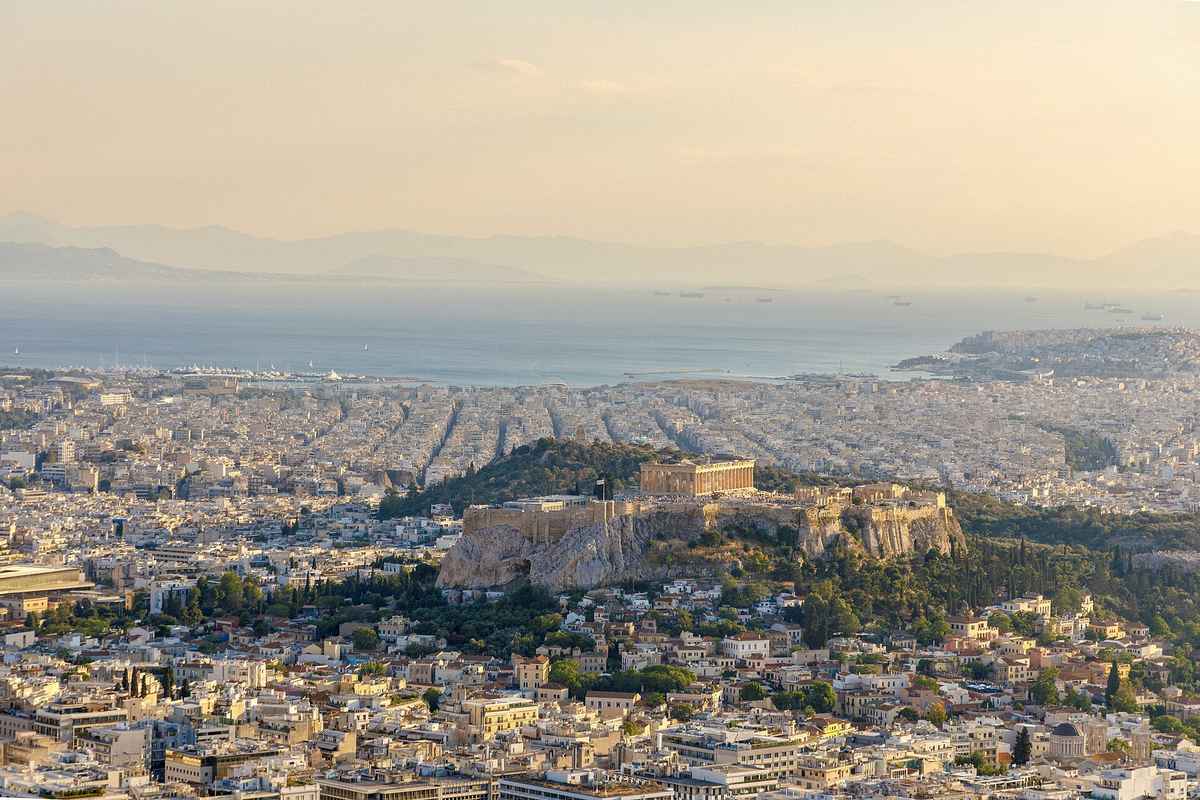
The best viewpoints in Athens reward you with sweeping panoramas of the Acropolis, the sprawling city and the sea, glorious at sunset from hills like Lycabettus and Filopappos. Combine these vistas with skip-the-line sightseeing tickets and tours from My Greece Tours for unforgettable views over the ancient city.
These panoramic spots are a scenic highlight of the Athens travel guide. The sections below cover Lycabettus Hill, Filopappos Hill, Areopagus and Pnyx, the rooftop bars, the Acropolis itself and other viewpoints, plus when and how to enjoy them.
What are the best viewpoints in Athens?
The best viewpoints in Athens are Lycabettus Hill at 277 metres, Filopappos Hill for the sunset Acropolis view, the rocky Areopagus and Pnyx beside the citadel, and the city’s rooftop bars. Each frames the Acropolis, the cityscape and the Saronic Gulf.
Athens is a city built among 7 hills and crowned by the Acropolis, which gives it a supply of vantage points. From these heights you take in the sweep of the ancient city, the sea of white buildings stretching to the mountains, and the Saronic Gulf beyond. The finest viewpoints fall into 4 clear groups. The great hills come first, chiefly Lycabettus, the loftiest peak in central Athens, and Filopappos, the hill facing the Acropolis that locals prize for sunset. The lower historic rocks beside the citadel form the second group, namely the Areopagus and the Pnyx, which frame the Parthenon close at hand. The rooftop bars and restaurants dotted across the centre make up the third, serving Acropolis views with a drink in hand.
Coastal and outlying points such as the Stavros Niarchos hill and Mount Hymettus round out the fourth group. Each layer of the city offers its own angle, from the highest peaks down to the sea-level terraces by the water.
Each of these offers a distinct perspective, whether a soaring bird’s-eye view of the whole basin or an intimate close-up of the floodlit temples. Almost all reach their peak in the golden hour before sunset, when the marble glows amber and the lights begin to twinkle. Choosing among them is part of the pleasure. The crown of them all is Lycabettus. It towers above the rest.
Why is Lycabettus Hill the top viewpoint?
Lycabettus Hill is the top viewpoint because, at 277 metres, it is the highest hill in Athens, giving 360-degree views over the whole basin, the Acropolis below and the Saronic Gulf. You hike up or ride the funicular from Kolonaki.
Lycabettus Hill delivers the single most commanding view in Athens. It rises as a steep, pine-clad cone behind the smart Kolonaki district to a height of 277 metres, the loftiest point in the central city. The summit view is a full 360-degree panorama. It takes in the entire basin of Athens spread out below, the Acropolis appearing small in the middle distance, and the ring of mountains, Hymettus, Penteli and Parnitha, that encircle the city. On a clear day the blue Saronic Gulf with the port of Piraeus and the islands lies beyond.
Reaching the top is easy and itself enjoyable. You hike up through the pine woods on winding paths, a moderately steep climb of around 30 minutes, or take the funicular railway. This tunnelled cable car whisks you to the summit from its station in Kolonaki in about 3 minutes.
At the top, a whitewashed chapel of Saint George crowns the peak beside a café and a viewing terrace. The spot ranks among the most celebrated in Athens for watching the sun set over the city and the sea, when the whole basin glows. It is the ultimate Athens panorama. The hill faces every direction at once, so both sunrise and sunset work here. Yet many locals prefer a different hill for the classic Acropolis sunset.
Why do locals love Filopappos Hill for sunset?
Locals love Filopappos Hill for sunset because it delivers the finest head-on view of the Acropolis, framed by the setting sun, in a free green park open 24 hours. Its pine-shaded paths lead to the Philopappos Monument at the summit.
Lycabettus offers the highest view, yet many Athenians and travellers reserve their affection for Filopappos Hill, also called the Hill of the Muses, as the place to watch the sunset. The hill lies directly opposite the Acropolis across a shallow green valley, just southwest of the citadel. This position provides an unobstructed head-on view of the Parthenon and its temples, seen at eye level rather than from far above. As the sun sinks, the ancient marble is bathed in warm golden and rose light. The hill is a public park, free to enter and open around the clock.
The hill stays quieter than Lycabettus, and its broad stone paths are easier and safer underfoot than the polished rock of the nearby Areopagus. The summit sits about 147 metres high, a 15-minute walk from the Acropoli metro station.
Shaded by pine trees and scented with herbs, the trails wind gently up past ancient remains to the summit. The Philopappos Monument crowns it, a Roman-era tomb that gives the hill its name. Finding a perch among the rocks here as the light fades, with the floodlights flickering on across the Acropolis, is one of the great free pleasures of Athens. It joins romance and history in one spot. The hill faces northeast toward the citadel, so the setting sun lights the Parthenon from behind you. Closer still to the citadel lie two ancient rocks.
What about the Areopagus and the Pnyx?
The Areopagus and the Pnyx are two ancient rocky hills beside the Acropolis that double as close-up viewpoints. The Areopagus, a bare marble outcrop, frames the citadel and the Agora. The Pnyx, birthplace of democracy, gives a quieter Parthenon panorama. Both are free.
The two rocky rises immediately beside the Acropolis join wide vistas with ancient history, and both are free to visit. The Areopagus is a bare, dome-shaped outcrop of marble standing just below the western entrance to the Acropolis. It is easily reached on foot and accessible at any time. From its smooth summit you gain a close-up panorama of the Acropolis rising directly above, the ruins of the Ancient Agora below, and the rooftops of Monastiraki and the city beyond, with Lycabettus on the horizon. The rock draws steady crowds at sunset.
One word of caution is warranted here. The ancient marble has been polished glass-smooth by millions of feet and turns genuinely slippery, so tread carefully and wear good shoes. Metal steps on the side offer a safer way up than the worn rock face.
A short distance away rises the Pnyx, the hill where the ancient Athenian assembly met, the birthplace of democracy. It offers a quieter and more contemplative view across the valley to the Parthenon, ideal for travellers seeking the vista without the crush. Together these historic rocks let you admire the Acropolis from beside rather than below. Their layered meaning enriches the view, as the Areopagus Hill guide explains. The Areopagus faces east toward the citadel, so morning light suits it best, while the Pnyx catches the western sun. Higher comfort comes from the rooftops.
Where are the best rooftop and other viewpoints?
Athens has dozens of rooftop bars with Acropolis views around Monastiraki, Plaka, Thissio and Syntagma, where you enjoy a drink with the floodlit Parthenon as a backdrop. Other spots include the free Monastiraki metro rooftop and the Acropolis Museum terrace café.
Beyond the hills, Athens offers more comfortable viewpoints, chief among them its rooftop bars and restaurants, which have turned the Acropolis view into an art form. Across the central districts of Monastiraki, Plaka, Thissio and Syntagma, hotels and bars run rooftop terraces where you sip a cocktail or eat dinner while gazing at the illuminated Parthenon floating above the city. This ranks as a quintessential Athenian experience, at its finest after dark. The best-known rooftops sit atop hotels around Monastiraki Square and the surrounding streets, offering the closest elevated views of the citadel.
Travellers wanting a fine view without the price of a drink have 3 free or low-cost alternatives. The rooftop terrace of the Monastiraki metro station has a small public area with an Acropolis view at no cost. The café terrace of the Acropolis Museum looks straight up at the Parthenon. The landscaped hill atop the Stavros Niarchos Foundation Cultural Centre near the coast gives sweeping views toward the sea and the city. Between the hills, the historic rocks and these rooftops, Athens never runs short of a memorable outlook. The choice depends on your mood. Timing and 3 tips make any viewpoint shine.
When and how should you enjoy the views?
Arrive 60 to 90 minutes before sunset to catch the golden hour and secure a spot before the crowds. Wear sturdy shoes for the rocky hills, and stay after dark to see the Acropolis floodlit. Spring and autumn bring the clearest air.
Timing turns a good view into a memorable one. The prime moment at almost every Athens viewpoint is the golden hour leading into sunset, when the low sun turns the marble of the Acropolis and the surrounding city warm shades of gold, amber and pink. Aim to arrive at your chosen spot around 60 to 90 minutes before the official sunset time. That window lets you soak up the changing light and secure a position before the popular places, especially the Areopagus and Lycabettus, fill with people. Lingering past sunset into the blue hour rewards you further. As darkness falls the Acropolis is floodlit and the city lights spread out like a carpet of stars, a different yet equally striking sight.
Practical preparation helps in 3 ways. Wear sturdy, non-slip shoes for the rocky hills and the polished marble of the Areopagus. Carry water and sun protection in the hot months of June, July and August. Bring a light layer for the cooler evening air on the exposed summits. The clear, mild evenings of spring and autumn deliver the finest visibility and the most comfortable conditions. A strong plan pairs a hilltop sunset with a rooftop dinner afterwards. The views of Athens stay with you long after the trip. The questions below cover the points travellers ask most.
Is Strefi Hill a good alternative viewpoint?
Strefi Hill is a good alternative for travellers who want an off-beat, local angle on Athens. It rises above the Exarchia district to about 105 metres, offering a panorama of the city, the Acropolis and Lycabettus without the crowds of the famous hills.
Strefi Hill sits above the artsy Exarchia neighbourhood, a 20-minute walk northeast of Omonia Square. The pine-dotted slope climbs to roughly 105 metres and rewards the effort with a rooftop-level panorama that few visitors reach. From the top you look across the terracotta and white grid of central Athens to the Acropolis on one flank and Lycabettus on the other. The hill has been landscaped with walking paths, a small café and a rock-climbing wall, so it works as both a viewpoint and a green escape. Locals treat it as their neighbourhood balcony, which keeps the atmosphere relaxed and unhurried.
The hill faces southwest toward the historic centre, so the late afternoon sun lights the cityscape and the Acropolis in front of you. This makes it a quieter substitute for Lycabettus, whose funicular station lies a short distance to the south. The climb is gentle enough for most visitors, taking around 10 minutes from the base. Bring water in summer, since the paths carry little shade near the summit. Pair Strefi with a coffee in Exarchia for a half-day away from the tourist trail, a slice of everyday Athens most guides skip.
Can you see Athens from Mount Hymettus?
Mount Hymettus gives the widest view of Athens from above. This ridge on the eastern edge climbs past 1,000 metres, and a paved road reaches viewpoints where the whole Attica basin, the Acropolis, the coast and the Saronic Gulf spread out below you.
Mount Hymettus, known to Greeks as Ymittos, forms the long grey-blue ridge that walls off Athens to the east. Its highest peak reaches 1,026 metres, far above every hill in the city centre. A paved mountain road climbs the western flank, passing the Byzantine Kaisariani Monastery and several lay-bys where the entire Attica basin opens up beneath you. From these heights the Acropolis shrinks to a pale dot amid the urban sprawl, while the coastline, the port of Piraeus and the islands of the Saronic Gulf fill the horizon. The mountain is famous in antiquity for its wild herbs and its honey, still sold at roadside stalls today.
You need a car, taxi or organised tour to reach the best viewpoints, since public transport runs only to the lower slopes. The mountain faces west over the city, so the sunset views are the strongest, with the sun dropping behind the far ranges and the city lights blinking on across the plain. Combine the drive with the frescoed Kaisariani Monastery, tucked in a wooded ravine partway up. This is the choice for travellers who want the grandest, most distant panorama rather than a close-up of the Parthenon. It rewards an unhurried half-day.
Why visit the Stavros Niarchos hill and coastal viewpoints?
The Stavros Niarchos Foundation Cultural Centre offers a free rooftop park with sweeping views over sea and city. Its green roof climbs to about 32 metres by the coast at Kallithea, where the Saronic Gulf and the distant Acropolis form a fresh, uncrowded panorama.
The Stavros Niarchos Foundation Cultural Centre, or SNFCC, sits by the water at Kallithea, a short tram ride south of the centre. Its architect designed the roof as a landscaped hill that visitors climb on gentle ramps to an open viewing deck about 32 metres up. From the top you look one way to the shimmering Saronic Gulf and the yachts of Faliro, and the other way back across the city to the Acropolis and the mountains behind it. The park below holds a canal, lawns and the national library and opera house, so a visit combines culture, greenery and a view in one free stop.
The rooftop faces the sea to the south and the city to the north, which means it catches both the sunset over the water and the floodlit Acropolis after dark. The coastal setting keeps the air cooler and cleaner than the dense centre, a welcome contrast on a hot day. Nearby, the Jacqueline de Romilly Square on the Filopappos slope and the Ardittos Hill above the Panathenaic Stadium give further low-cost angles on the citadel. Together these newer and lesser-known spots round out the classic hill viewpoints with sea air and open space.
Can you enjoy the view from the Acropolis itself?
The Acropolis itself doubles as a viewpoint. From the summit terrace beside the Parthenon you look over all of Athens, the surrounding hills, the Ancient Agora and the sea, a 360-degree panorama that rewards an early-morning or late-afternoon visit.
Standing on the Acropolis, most visitors focus on the marble temples, yet the rock is also one of the finest balconies in the city. From the edge of the summit you gaze down on the red-tiled roofs of Plaka and Monastiraki, across to Lycabettus and Filopappos, over the green expanse of the Ancient Agora and out to the Saronic Gulf glinting in the distance. The height of about 156 metres lifts you clear of the surrounding streets, so the whole basin lays itself out below. A skip-the-line ticket and a guided tour turn the climb into both a history lesson and a viewing platform.
The site opens early, which lets you beat both the heat and the largest crowds while the low sun rakes across the city. The last hours before closing offer a similar warm light and thinner queues. The rock has no shade on top, so a hat and water matter in summer. Since the Acropolis needs a paid ticket, plan it as the centrepiece of a sightseeing day rather than a quick sunset stop, and book ahead in the busy months to guarantee entry. The Athens travel guide lists the ticket options and tour combinations.
How do you choose the right viewpoint in Athens?
Choose your Athens viewpoint by matching the spot to your goal. Pick Filopappos for a free Acropolis sunset, Lycabettus for the highest panorama, the Areopagus for a citadel close-up, a rooftop bar for comfort, and the SNFCC or Hymettus for sea and distance.
The right viewpoint depends on what you value most on the day. Travellers chasing the classic postcard of the Parthenon at sunset head for Filopappos Hill, free and open all hours. Those after the grandest bird’s-eye sweep of the whole city ride up Lycabettus. Anyone wanting drama at the foot of the citadel climbs the Areopagus, provided the marble is dry and their shoes grip well. Comfort-seekers who prefer a seat and a cocktail choose a Monastiraki rooftop, while families and coast-lovers favour the breezy SNFCC hill by the sea.
Practical factors narrow the choice further. Budget travellers stick to the free hills and the metro rooftop. Visitors short on time pick a spot near their hotel or a stop on their sightseeing route. Those with a car or a tour can reach Mount Hymettus for the widest panorama of all. The table below sums up the key facts for each viewpoint so you can match the spot to your plans at a glance.
| Viewpoint | Height | Cost | Best for |
|---|---|---|---|
| Lycabettus Hill | 277 m | Free to hike, funicular fare | Highest 360-degree panorama |
| Filopappos Hill | 147 m | Free | Head-on Acropolis sunset |
| Areopagus rock | 115 m | Free | Close-up citadel view |
| Pnyx Hill | 109 m | Free | Quiet Parthenon vista |
| Strefi Hill | 105 m | Free | Off-beat local angle |
| SNFCC roof | 32 m | Free | Sea and city, coastal breeze |
| Mount Hymettus | 1,026 m | Free, car needed | Widest distant panorama |
| Rooftop bars | Varies | Price of a drink | Comfort with floodlit Parthenon |
Where should you stay for the best views in Athens?
Stay in Plaka, Monastiraki, Thissio or Koukaki for the best Acropolis views in Athens. These central districts sit at the foot of the citadel, so hotels offer rooms and rooftop bars that look up at the floodlit Parthenon, within walking distance of the main viewpoints.
Where you stay shapes how easily you reach the views. The neighbourhoods ringing the Acropolis put the best vistas on your doorstep. Plaka, the old town below the citadel, mixes neoclassical charm with rooftop terraces that face the rock. Monastiraki, just north, holds the highest concentration of Acropolis-view rooftop bars and buzzes late into the night. Thissio, to the west, looks across the Ancient Agora to the temples and sits beside the Filopappos and Pnyx hills. Koukaki, south of the Acropolis, has grown into a favourite for its quieter streets and its short walk to the Acropolis Museum terrace.
A hotel with a rooftop bar or an Acropolis-facing room lets you enjoy the floodlit citadel without leaving your base, a real bonus after a long day of sightseeing. Booking a room on a higher floor and asking for an Acropolis view when you reserve improves your odds of that skyline. Even without a view room, staying in these districts places you 5 to 15 minutes on foot from Filopappos, the Areopagus and the metro rooftop. This central base saves time and puts the sunset within easy reach every evening of your stay.
Frequently Asked Questions
Where is the best view of the Acropolis in Athens?
The best head-on view of the Acropolis is from Filopappos Hill, directly opposite the citadel, especially at sunset when the Parthenon glows golden. For a high panorama over the whole city with the Acropolis below, Lycabettus Hill is unbeatable, while the Areopagus rock and the rooftop bars of Monastiraki offer dramatic close-up views of the floodlit temples.
Which is the finest sunset spot in Athens?
Filopappos Hill is the local favourite for sunset, offering a beautiful framed view of the Acropolis as the sky turns gold, in a free, open park. Lycabettus Hill, the highest point in Athens, is another classic sunset spot with 360-degree views, while the Areopagus rock beside the Acropolis is hugely popular though its marble is slippery underfoot.
Are the Athens viewpoints free?
Most of the best Athens viewpoints are free, including Filopappos Hill, the Areopagus rock, the Pnyx, Strefi Hill, the SNFCC rooftop park and the Monastiraki metro station rooftop. Lycabettus Hill is free to hike, though the funicular to the summit has a fare. Rooftop bars require the price of a drink or meal, while the Acropolis itself needs a paid ticket.
How long does it take to climb Lycabettus Hill?
Climbing Lycabettus Hill on foot takes around 30 minutes from the base in Kolonaki, following winding paths through the pine woods to the 277-metre summit. The gradient is moderately steep but manageable in good shoes. Travellers who prefer to save their legs ride the funicular railway, which reaches the top in about 3 minutes.
Can you watch the sunset from Mount Hymettus?
Mount Hymettus offers one of the widest sunset views over Athens, since its west-facing slopes look straight across the whole basin toward the setting sun. You need a car, taxi or tour to reach the viewpoints along the mountain road. The nearby Kaisariani Monastery makes a rewarding stop on the way up or down.
Which viewpoint is best for families with children?
The Stavros Niarchos Foundation hill suits families best, with gentle ramps, open lawns, a canal and a shaded park alongside the free rooftop view. Filopappos Hill also works well, thanks to its broad, easy paths and green space. Both avoid the slippery marble of the Areopagus, which demands more care with young children underfoot.