
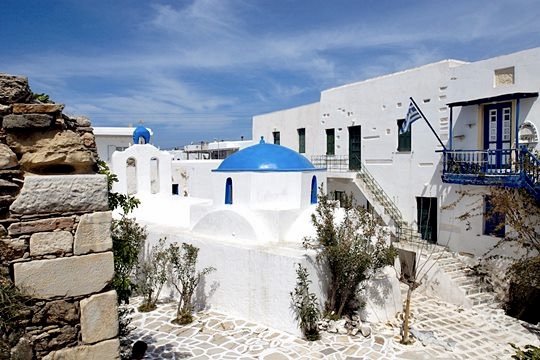
The history of Antiparos reaches far back into prehistory, to a time about four thousand years before the common era, when early settlers first arrived in this small Cycladic island. The nearby islet of Saliagos, set in the channel between Antiparos and Paros, holds the oldest known settlement in the whole Cyclades. From those Neolithic beginnings the island grew through an ancient period, a long Venetian chapter and Ottoman rule before it joined the modern Greek state. Each layer left its mark on the land, the cave and the fortified town. Trace that full story, from ancient times to today, with My Greece Tours.
This guide follows the island through its main historical layers, so the timeline stays clear as you read. The sections below cover the prehistoric roots on Saliagos, the ancient island once called Oliaros, and the great cave with its old inscriptions. They also trace the Venetian and Ottoman centuries that shaped the Kastro. The final section explains how Antiparos joined the modern Greek nation and how that past reads on the ground today. To place this history within a full picture of the island, read it alongside our Antiparos travel guide.
How far back does the history of Antiparos reach?
The history of Antiparos reaches into the Neolithic era, to a time about four thousand years before the common era. Early settlers arrived then, and the islet of Saliagos nearby holds the oldest known settlement in the Cyclades.
The earliest chapter of the island belongs to the Neolithic era, a time about four thousand years before the common era, when the first settlers arrived on these shores. That period sits far in advance of the ancient Greek world, in the deep prehistory of the Cyclades. The people who came then lived simply, close to the sea that both fed them and connected them to neighbouring islands. Their arrival marks the true beginning of a human story on Antiparos, long before any of the names later given to the island. This early presence gives the island a depth of settlement that stretches across a vast span of time.
It forms a foundation on which every later age would build.
The clearest window onto that prehistoric world lies just off the coast, on the small islet of Saliagos in the channel between Antiparos and Paros. Saliagos holds the oldest known settlement in the whole of the Cyclades. That fact places this quiet corner of the Aegean at the very start of the island group’s recorded human record. The site shows that people were already living and organising themselves here in Neolithic times, working the land and the water around them. Saliagos is the anchor point for anyone tracing the roots of the region. It is the spot where the long story of habitation in these islands can be seen to begin in solid form.
The islet gives the deep past a fixed address, grounded in real, visible remains.
The prehistoric layer of Antiparos matters because it frames everything that follows. People had already made a home here across the water from Paros long ahead of the ancient Greeks, the Venetian castle builders and the arrival of Ottoman rule. That continuity of settlement, from the Neolithic onward, is part of what gives the island its character today. To understand how the modern harbour and streets sit on such deep and ancient foundations, it helps to walk through Antiparos town with this timeline held clearly in mind. The present-day settlement then reads as the latest layer over a very old human presence on the island.
That presence runs long and unbroken, from distant prehistory to the harbour of the current day.
What was Antiparos called in ancient times?
In ancient times the island was called Oliaros. It was closely linked with neighbouring Paros, and at times the two were joined, sharing the fortunes of that larger and better-known island.
The ancient name of the island was Oliaros, a title that carries the memory of its classical past. Under that name Antiparos took its place among the islands of the central Aegean. It was a small member of the Cycladic group, set apart by the narrow channel from its larger neighbour. The name itself is a reminder that the island was known and settled in the ancient Greek world, a recognised piece of the island landscape rather than an empty outpost. Oliaros belongs to the vocabulary of antiquity. It survives in the record as the way the island was identified long before the Venetian and Ottoman chapters.
The old name is a thread linking the classical island to the deep prehistory that came before it, holding the two ages together in one story.
In antiquity the island was closely bound to neighbouring Paros, the larger and more prominent island across the channel. At times the two were joined, and Antiparos shared in the story of its bigger neighbour rather than standing apart. That link shaped how the island was seen and governed, tying its fortunes to those of Paros in a relationship that outlasted antiquity. The channel between them, so narrow that the crossing has always been short, made this closeness natural. This bond is one of the oldest threads in the history of Antiparos. It explains why the two names so often appear together in accounts of the region’s past.
The closeness of Paros runs right through the island’s story, colouring how its history has been told and remembered across the ages.
The ancient identity of the island as Oliaros forms the bridge between its prehistoric roots and its later medieval history. Understanding that classical layer helps travellers read the island as more than a beach destination, seeing instead a place with a name and a role in the ancient Aegean. This deeper story sits behind the modern attractions and complements the practical things to do in Antiparos that fill a visit today. A day of swimming and walking gains weight when you know that the ground underfoot was already Oliaros in antiquity. The island was named, settled and linked to Paros long before the harbour of the present town took shape.
That awareness turns a simple outing into a walk across layered history, where the ancient name still shadows the modern island underfoot.
What role does the great cave play in the history of Antiparos?
The great cave of Antiparos was known and visited in ancient times. It bears ancient Greek inscriptions on its walls, a rare written trace that ties the island’s deep landscape directly to the classical world.
The great cave stands among the most striking pieces of the island’s ancient story. It was known and visited in ancient times, so the underground chamber was part of the human world of Antiparos long before the medieval and modern periods. Visitors in antiquity descended into the cave, drawn by its scale and its setting deep within the rock. This early attention marks the cave as a place of meaning, a site people sought out and remembered rather than a mere natural cavity. Its role in the ancient life of the island gives it a standing beyond geology. That role sets it firmly within the human history of Antiparos, from the classical era onward.
The cave was a destination for the ancient world, which lifts it to enduring landmark.
What sets the cave apart is that it bears ancient Greek inscriptions, words cut into the rock by visitors of the ancient world. These inscriptions are a rare and direct written trace, a form of evidence that speaks in the language of antiquity from within the island. They confirm that the cave was reached, explored and honoured by ancient Greeks, who left their names and marks behind. Few sites offer such a plain link between a natural wonder and the written record of the classical past. The inscriptions turn the cave into a document of stone.
It carries the ancient history of Antiparos in a form that has endured across the long span of time since it was first written.
The cave draws together the natural and human layers of the island’s past in one place underground. Its ancient inscriptions and its early visitors make it a cornerstone of the historical story, a spot where the deep past can still be seen and read. Anyone following that story on the ground will want to descend into the Antiparos cave and stand where ancient visitors once stood. The experience joins the timeline of this guide to a real, physical place. The history of the island shifts from words on a page to carved letters on a cavern wall, worn but still legible after the passing centuries.
To descend into the chamber is to meet the ancient past directly, in the dark and cool of the rock where visitors of antiquity once left their mark.
How did Venetian rule and the Kastro shape Antiparos?
In the early thirteenth century Marco Sanudo took the island, which fell under the Duchy of Naxos and later passed to the Sommaripa family. To guard against pirates the Venetians built the fortified Kastro.
The Venetian chapter opened in the early thirteenth century, when the nobleman Marco Sanudo took the island. Under his hand Antiparos fell within the Duchy of Naxos, the Venetian state that governed much of the central Aegean then. This brought the island into a new political world, ruled from Naxos and tied to the fortunes of the wider duchy. The change marked a clear break from the ancient and prehistoric layers before it, opening a long era of Latin lordship over the island. Sanudo’s action set the frame within which the later castle and fortified town would rise. It began the Venetian story that still defines the island’s most famous surviving monument.
From this single early conquest flowed the Latin lordship that would leave the Kastro standing at the island’s centre for centuries to come.
Control of the island later passed to the Sommaripa family, and under this line the defining fortress took shape. Giovanni Loredan built the Castle of Antiparos in the mid fifteenth century, raising the stronghold that anchors the fortified settlement. Loredan also brought settlers to the island, drawing people to live within and around the new castle walls. This act of building and settling created a living town rather than a mere military post. It explains why the Kastro remains the heart of the modern settlement. The mid-fifteenth-century castle is the physical centre of the island’s Venetian history, raised to hold both people and defence in one fortified core.
The Sommaripa era and Loredan’s work gave Antiparos the stronghold that still anchors its main settlement.
The Venetians built the Kastro, the fortified town, chiefly to guard against pirates who threatened the islands of the Aegean in that age. Its design gathered the houses inward behind protective walls, turning the settlement itself into a stronghold. That defensive plan still reads clearly in the layout of the settlement today, where the old core keeps its inward, sheltered form. The streets of the fortified centre fold back on the castle at their heart, a plan born from the need to hold off raiders in the medieval and later centuries. This inward design is the clearest legacy the Venetians left.
It shapes how the island’s main town is built and lived in even now, long after the pirate threat that first called the walls into being had faded from the surrounding waters.
How did Antiparos become part of the modern Greek state?
In the sixteenth century the island came under Ottoman rule. The Antiparians took an early part in the Greek War of Independence, and the island joined the modern Greek state in the early nineteenth century.
The Ottoman chapter of the island opened in the sixteenth century, when Antiparos came under Ottoman rule. This shift ended the long Venetian era and placed the island within the Ottoman world that then held much of the Aegean. Life under this new order continued around the Kastro the Venetians had raised, the fortified town remaining the focus of the settlement through the change of rulers. The Ottoman period forms the layer between the medieval Venetian centuries and the coming of the modern Greek nation. It is part of the island’s continuous story of successive rulers, each leaving the fortified core in place.
The Kastro endured through this handover of power, its walls outlasting the Venetian lords who first raised them and standing on into the age of Ottoman rule.
The struggle for Greek freedom drew the island into the national cause, and the Antiparians took an early part in the Greek War of Independence. Their involvement placed this small island within the movement that reshaped the Aegean in the early nineteenth century. That early participation shows the island was not a bystander to the great events of the age but a willing part of the fight for a Greek state. The war changed the map of the region, drawing the islands out of Ottoman rule and toward the new nation then being formed.
For Antiparos, this was the decisive turn that carried it from the long era of foreign lordship into the modern Greek world that shapes the island to the present day and its life now.
The island joined the modern Greek state in the early nineteenth century, closing the arc that had begun in Neolithic times on Saliagos. From ancient Oliaros through the Venetian Kastro and Ottoman rule, the long story reached its resolution in a free Greek Antiparos. That heritage now sits quietly beneath a calm island life. A modern trip weaves it together with the beaches, the cave and the wider islands offshore. Reaching the island is simple, and a look at getting to Antiparos shows how easily this historic place fits into a present-day Cycladic journey.
Its layered past waits at the end of a short crossing, so the whole arc of the island’s history sits within easy reach of any traveller who makes the trip today.
Frequently Asked Questions
What is the oldest settlement near Antiparos?
The oldest settlement linked to Antiparos lies not on the island proper but on the small islet of Saliagos, set in the channel between Antiparos and Paros. Saliagos holds the oldest known settlement in the whole of the Cyclades, dating to the Neolithic era, a time about four thousand years before the common era. This makes the area around Antiparos one of the very first places in the island group where people are known to have settled and organised a community. The find places this quiet corner of the Aegean at the start of the region’s recorded human story.
For a traveller, Saliagos is the deep root of the island’s history, the point where the long record of habitation begins. That prehistoric beginning frames every later chapter, from ancient Oliaros through the Venetian and Ottoman centuries to the free Greek island of the present day. It gives Antiparos a settlement history of great depth and continuity.
Why did the Venetians build the Kastro on Antiparos?
The Venetians built the Kastro, the fortified town, chiefly to guard against pirates who threatened the islands of the Aegean during that age. The design gathered the houses inward behind protective walls, so the settlement itself became a stronghold rather than an open village. Giovanni Loredan built the Castle of Antiparos in the mid fifteenth century and brought settlers to the island, creating a living town around the new castle walls. This gave the island both a defence and a permanent community in a single fortified core. The plan still reads in the town today, where the streets fold back on the castle at the heart of the old settlement.
Anyone tracing the island’s medieval history will find the Kastro the most complete surviving mark of the Venetian centuries. It shows how the threat of raiders shaped not only walls and towers but the very layout of the place where people lived, worked and sheltered on the island.
What ancient traces can visitors still see on Antiparos?
The clearest ancient trace on the island is the great cave, which was known and visited in ancient times and bears ancient Greek inscriptions cut into its walls. These carved words are a rare and direct written link to the classical world, left by visitors who descended into the chamber in antiquity. Standing among them lets a traveller read the ancient past in its own language, on the very rock where it was written. Beyond the cave, the island’s ancient identity survives in its old name, Oliaros, and in its close link with neighbouring Paros, to which it was at times joined.
Together these traces show that Antiparos was a named, settled and connected island in the ancient Greek world, not an empty outpost. A visit to the cave joins this history to a real place. It turns the timeline of the island’s past into carved letters that have endured across the long span of the centuries since.
How does the history of Antiparos connect to the rest of a modern trip?
The history of Antiparos runs beneath every part of a present-day visit, giving depth to the beaches, the cave and the islands offshore. A swim gains weight when you know the ground was ancient Oliaros, and a walk through the fortified town reveals the Venetian Kastro raised against pirates in the medieval age. The great cave ties a day of sightseeing straight to the classical world through its ancient inscriptions. Even a lazy afternoon on the sand sits within this long story, so time spent enjoying the Antiparos beaches becomes part of a wider heritage rather than apart from it. The offshore islet of Despotiko extends the ancient thread further, adding another layer to the region’s past.
A modern trip therefore weaves swimming, walking and exploring together with a history that reaches from Neolithic Saliagos to the free Greek island of today. Each stop on such a visit carries its own layer of that long story. The island rewards travellers who let its ancient, Venetian and modern chapters colour their days.