
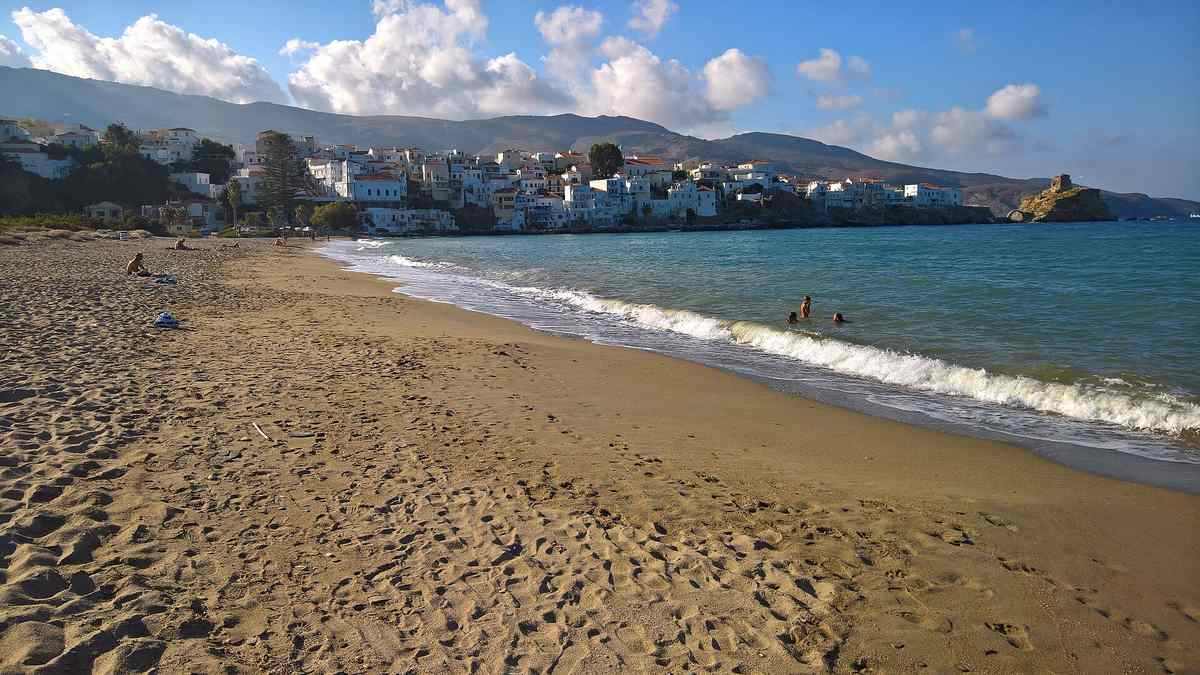
Andros, the lush northern Cyclades island, is a short ferry from Rafina near Athens — green, mountainous and famous for hiking trails, beaches and a handsome Chora. Plan the trip alongside skip-the-line sightseeing tickets and tours from My Greece Tours.
Andros is one of the more rewarding island escapes in the Athens travel guide. The sections below cover how to get there, what to see in Chora, the beaches, the hiking trails, and whether Andros works as a day trip.
How do you get to Andros from Athens?
You reach Andros by ferry from the port of Rafina, east of Athens, not from Piraeus. Rafina is about an hour from central Athens by bus, or twenty minutes from the airport. The crossing to Gavrio takes around two hours.
Andros is reached by sea, but unlike the islands served from Piraeus, the gateway here is Rafina, the smaller port on the east coast of Attica. Rafina lies about an hour from central Athens by KTEL bus. From Athens International Airport it is only twenty minutes or so away. That makes it especially convenient if you are arriving or based on that side of the city.
From Rafina the ferry crosses to Andros in around two hours, docking at Gavrio on the northwestern tip of the island. Several boats run each day, with more frequent crossings in the summer season. The first departure is usually around nine in the morning. The last return sails in the early evening, giving a workable window for a day on the island. Because Andros is the nearest of the major Cyclades islands to Athens, this short crossing puts it within reach for a long day trip.
What is there to see in Chora?
Chora, the capital of Andros, is among the most elegant towns in the Cyclades. It blends Cycladic, neoclassical and Venetian architecture along a marble-paved peninsula, with a ruined castle, a fine Museum of Contemporary Art, and views over two bays.
The capital of Andros, known like all island capitals as Chora, is a particular delight and quite different from the white-cubed towns of the southern Cyclades. It is built along a narrow peninsula of marble-paved streets. The town mixes typical Cycladic houses with grand neoclassical mansions and medieval Venetian touches. This is a legacy of the wealthy sea captains and shipowners who made the island prosperous.
A handsome pedestrian main street runs the length of the town. It passes a lively central square, churches and old houses, leading to the tip of the peninsula. There a ruined Venetian castle stands on a rocky islet, reached by a picturesque old stone bridge. Along the way, the bronze statue of the Unknown Sailor gazes out to sea, a reminder of the island’s maritime heritage. Culture lovers should not miss the Museum of Contemporary Art, founded by the Goulandris family and rated among the finest in the Cyclades. With its architecture, its two flanking bays and its refined atmosphere, Chora rewards an unhurried wander.
What are the beaches like?
Andros has a wide variety of beaches, from long sandy bays to quiet coves with clear water. Popular choices include Batsi, Golden Sand (Chrissi Ammos), Agios Petros, and the dramatic Tis Grias to Pidima with its offshore rock.
For an island so close to Athens, Andros has an exceptional range of beaches. Because it is greener and better watered than most of the Cyclades, many are framed by hills and trees rather than bare rock. This gives them a lush, almost un-Cycladic feel. They span long sweeps of golden sand and tiny hidden coves with brilliantly clear water.
Near the port of Gavrio and the resort village of Batsi you find easily accessible sandy beaches with facilities. These include the popular Batsi beach and the golden stretch of Chrissi Ammos, ideal if your time is short. Further afield lie quieter gems such as Agios Petros and the striking Tis Grias to Pidima, famous for the great rock standing just offshore and steeped in local legend. Whether you want an organised beach with sunbeds and a taverna or a wild cove to yourself, Andros delivers. The clean and often uncrowded swimming is one of the island’s greatest pleasures.
The east coast around Chora adds more choice, with sheltered bays and pebble beaches tucked beneath the town and its surrounding villages. Many of these are linked to the road network and to the walking trails, so you can reach a swim by car or on foot. Because the island faces open water on several sides, there is usually a sheltered beach whatever the wind is doing, a useful thing to know when planning a day. On a short visit, choosing one accessible bay near Batsi or Chora leaves more time to enjoy it than chasing distant coves.
What are the hiking trails like?
Andros is one of Greece’s premier hiking islands, with around 300 kilometres of waymarked trails known as the Andros Routes. Paths wind through green valleys past springs, watermills, stone villages, monasteries and terraced fields down to hidden beaches.
What truly sets Andros apart from its neighbours is hiking, and the island has become one of the leading walking destinations in Greece. It has around three hundred kilometres of marked footpaths, known collectively as the Andros Routes. These are certified by the European Ramblers Association as a Leading Quality Trail, a mark of their signposting and upkeep.
The trails make the most of the island’s unusual greenery and abundant water. They lead walkers through fertile valleys past gushing springs, old stone watermills, terraced fields, traditional villages and quiet monasteries, often ending at a remote beach for a swim. Routes range from gentle strolls to longer mountain hikes, so there is something for every level. A much-loved easy walk runs from the lush springs of Menites down to Chora. The remarkable thing is the variety packed into a single day: you can swim in turquoise water in the morning and hike a green mountain trail in the afternoon.
What makes Andros different from the other Cyclades?
Andros is green and well watered, with springs, streams and lush valleys that feed terraced fields. This verdant character sets it apart from the sun-baked southern Cyclades and shapes its twin draws of hiking and beaches.
It helps to understand what makes Andros special, because it shapes how you spend your time. Unlike the famous, sun-baked islands, Andros is green and well watered. Springs, streams and lush valleys feed its terraced fields. They give it a verdant character closer to a mainland landscape than a typical Cycladic rock. This greenery is the key to the island’s twin draws of hiking and beaches.
The same greenery is why the island has long been the preserve of Athenian and shipowning families rather than mass tourism. That has kept it quieter and more authentic. For the visitor this means an island that rewards the active and the curious: walkers, swimmers and those who enjoy real village life and good local food, rather than nightlife-seekers. Knowing this helps you plan a day, or better a longer stay, around the island’s genuine strengths.
What are the villages and monasteries worth visiting?
Inland Andros hides stone villages such as Menites, Apikia and Stenies, set among plane trees and running water. The island’s monasteries, including Panachrantou high on the mountainside, reward a short drive or a walk along the Andros Routes.
Beyond Chora and the coast, the interior of Andros is dotted with old stone villages that feel a world away from the beach resorts. Menites is famous for its springs, where water pours from carved marble spouts beneath a canopy of plane trees. Nearby Apikia is known for its mineral spring, while Stenies, with its captains’ mansions, ranks among the most handsome villages on the island. These settlements are linked by footpaths as well as roads, so many walkers thread several together in a single outing.
Andros also has a strong monastic tradition, and its monasteries make rewarding stops. The most celebrated is Panachrantou, perched high on the slopes of Mount Petalo and reached by road or on foot. Others, such as the convent of Zoodochos Pigi, keep centuries-old icons and manuscripts. A short drive links several villages and a monastery in an easy loop, giving a real sense of the island’s inland character, which many day-trippers miss entirely by staying near the port.
These inland settlements also make natural starting points for the walking trails. From Menites and Apikia you can pick up sections of the Andros Routes that drop through valleys towards Chora or climb towards Panachrantou. Even a short stroll from a village square, past a spring or a chapel, gives a flavour of the quiet interior. For a day visitor with a car, an hour spent in one of these villages is time well used.
What food and local flavours should you try?
Andros is known for fresh fish, local cheeses such as volaki and the soft petroti, fouskakia doughnuts, and the amygdalota almond sweets. Village tavernas serve produce grown on the island’s terraced fields and washed down with local wine.
Andros is greener and better watered than its neighbours, so its food leans on genuine local produce rather than imported goods. Village gardens and terraces supply vegetables and herbs, while the surrounding sea keeps tavernas stocked with fresh fish and seafood. Cheese is a point of pride: look for the round volaki, the softer petroti and the sharp kopanisti, often served simply with bread and olive oil as a starter.
For something sweet, the island is famous for amygdalota, delicate almond biscuits dusted with sugar, and for fouskakia, light fried doughnuts soaked in syrup and honey. A leisurely lunch at a taverna in Chora, Batsi or an inland village is one of the pleasures of a visit. Pair local dishes with wine or a glass of something from the island, and you begin to understand why Athenian families have kept coming here for generations.
When is the best time to visit Andros?
Late spring and early autumn suit Andros best. May, June, September and October bring warm seas, quieter trails and comfortable walking weather. High summer is hot and busiest, while winter is green but wet, with reduced ferry schedules.
Andros rewards visitors across much of the year, but the shoulder seasons are the sweet spot. In late spring the island is at its greenest, with wildflowers along the trails and springs running full, and the sea is already warm enough to swim. Early autumn offers a similar balance, with warm water, mild days for hiking and thinner crowds once the peak of summer has passed. These months make walking the Andros Routes far more comfortable than the heat of July and August.
High summer brings the warmest seas and the liveliest atmosphere in Batsi and Chora, along with the most frequent ferries from Rafina. It is also the busiest and hottest time, so long hikes are best done early or late in the day. Winter turns the island lush and dramatic, but many tavernas and hotels close and ferry schedules thin out, so it suits a quiet, off-season escape rather than a beach-and-hiking break.
What is Tis Grias to Pidima and why is it famous?
Tis Grias to Pidima is one of the most photographed sights on Andros: a tall, freestanding rock rising from the sea just off a pretty pebble-and-sand beach on the east coast, wrapped in local legend and framed by cliffs.
The name translates roughly as “the old woman’s leap,” and a well-known folk tale attaches to the great pillar of rock that stands offshore. In the story, an old woman is said to have betrayed the island to invaders, then leapt from the cliff in shame or grief, and the rock marks the spot. Whatever the truth of the legend, the setting is striking, with clear water lapping a quiet beach beneath steep slopes, a short walk from where you can leave a car.
The beach itself is a rewarding stop for a swim, less developed than Batsi and all the more atmospheric for it. The rock frames the view out to sea and makes an obvious focus for photographs, especially in the softer light of morning or late afternoon. Many visitors pair Tis Grias to Pidima with a short section of the Andros Routes that passes nearby, turning a swim into a memorable half-day on the island’s eastern shore.
How do you get around Andros?
A rented car or scooter is the easiest way to explore Andros, as the island is large and villages are spread out. Local buses link Gavrio, Batsi and Chora, while taxis and the Andros Routes cover shorter distances.
Andros is one of the larger Cyclades, and its sights are scattered from the port at Gavrio in the northwest to Chora on the east coast and the inland villages between them. For that reason, a hired car or scooter gives you the freedom to reach quiet beaches, mountain monasteries and stone villages that public transport skips. Rental agencies operate at Gavrio and Batsi, so you can collect a vehicle soon after stepping off the ferry and cover a great deal of ground in a single day.
Non-drivers have options too. Local KTEL buses connect the main points of Gavrio, Batsi and Chora, timed loosely around ferry arrivals, though services are sparser out of season. Taxis fill the gaps for shorter hops and for reaching trailheads. Walkers can also rely on the Andros Routes themselves, linking villages, beaches and monasteries on foot. A common plan is to drive or bus between two or three areas, then walk a marked section in between, which combines efficient transport with the island’s finest scenery.
Which museums and cultural sites are in Chora?
Chora holds the celebrated Museum of Contemporary Art founded by the Goulandris family, plus an Archaeological Museum and a Maritime Museum. Together they reflect the island’s ancient past, its shipowning wealth and its standing in modern Greek art.
For a small island capital, Chora has an unusually rich cultural life, a legacy of the wealthy shipping families who endowed it. The Museum of Contemporary Art, established by the Goulandris family, is the headline draw, staging exhibitions of Greek and international artists that would not look out of place in a major city. Its permanent collection and changing summer shows make it one of the reasons art lovers single out Andros among the Cyclades.
The Archaeological Museum, close by in the town, gathers finds from ancient Andros, including sculpture and pottery that trace the island’s long history from antiquity. The Maritime Museum, meanwhile, tells the story of the sea captains and shipowners whose fortunes shaped Chora’s neoclassical mansions and the statue of the Unknown Sailor on the seafront. Visiting one or two of these on a day trip adds real depth to a wander through the town, linking the elegant streets you walk with the history that built them.
Does Andros work as a day trip?
Andros works as a long day trip from Athens with careful planning. Take the early ferry from Rafina and return on the last evening boat for roughly seven to eight hours. An overnight stay suits the island far better.
A day trip to Andros is genuinely feasible, which is not true of every Cycladic island, thanks to the short two-hour crossing from Rafina. By taking the early morning ferry, around nine o’clock, and returning on the last boat in the evening, you can enjoy roughly seven to eight hours on the island. That is enough for a real taste rather than a fleeting glimpse.
With that time you can comfortably explore the elegant Chora, relax on an accessible beach near the port at Batsi or Chrissi Ammos, and enjoy a leisurely seaside lunch. You might also fit in a short walk, focusing on one part of the island rather than trying to see it all. What a single day cannot do is justice to the island’s three hundred kilometres of trails, its scattered villages and its many remote beaches. That is why Andros truly rewards an overnight or a two-night stay. If you only have a day, plan around the ferry times, pick one area, and resist the temptation to cram in too much. The questions below cover what visitors ask most.
Frequently Asked Questions
How do you get from Athens to Andros?
You get from Athens to Andros by ferry from the port of Rafina, east of the city, not from Piraeus. Rafina is about an hour from central Athens by bus, or twenty minutes from the airport. The crossing takes around two hours and arrives at Gavrio on Andros. There are several daily departures, more in summer, with the first boat around nine in the morning. Andros is the closest major Cyclades island to Athens.
Is Andros worth visiting?
Yes, Andros is well worth visiting, especially for those who enjoy hiking, beaches and authentic island life. It is greener than most Cyclades islands, with around three hundred kilometres of waymarked trails and a wide variety of beaches. Its elegant capital, Chora, has neoclassical mansions and a fine contemporary art museum. Quieter and more authentic than the famous islands, Andros rewards both a day trip and a longer stay.
Can you visit Andros as a day trip from Athens?
Yes, you can visit Andros as a long day trip from Athens if you plan around the ferry. Take the early boat from Rafina and return on the last evening ferry, giving about seven to eight hours on the island. That is enough to see Chora and a beach near Batsi. To fully explore the island’s hikes, villages and remote beaches, an overnight or two-night stay is much better.
Where do you stay on Andros?
Most visitors stay in or near Chora, the elegant capital, or in the lively resort village of Batsi close to the ferry port at Gavrio. Chora offers neoclassical hotels and easy access to museums and restaurants, while Batsi is convenient for beaches and boats. Inland villages such as Apikia and Stenies suit walkers who want to be on the Andros Routes. Book ahead in high summer, when rooms fill quickly.
Can you take a boat trip or watch the sunset on Andros?
Yes. In summer small boats run from Batsi and Gavrio to beaches and coves that are hard to reach by land, and some circle nearby islets for swimming and snorkelling. For sunsets, the west coast around Batsi and Gavrio faces the sea and catches the evening light, while Chora’s twin bays glow at dusk. A seaside taverna at sundown is a fitting close to a day on the island.