
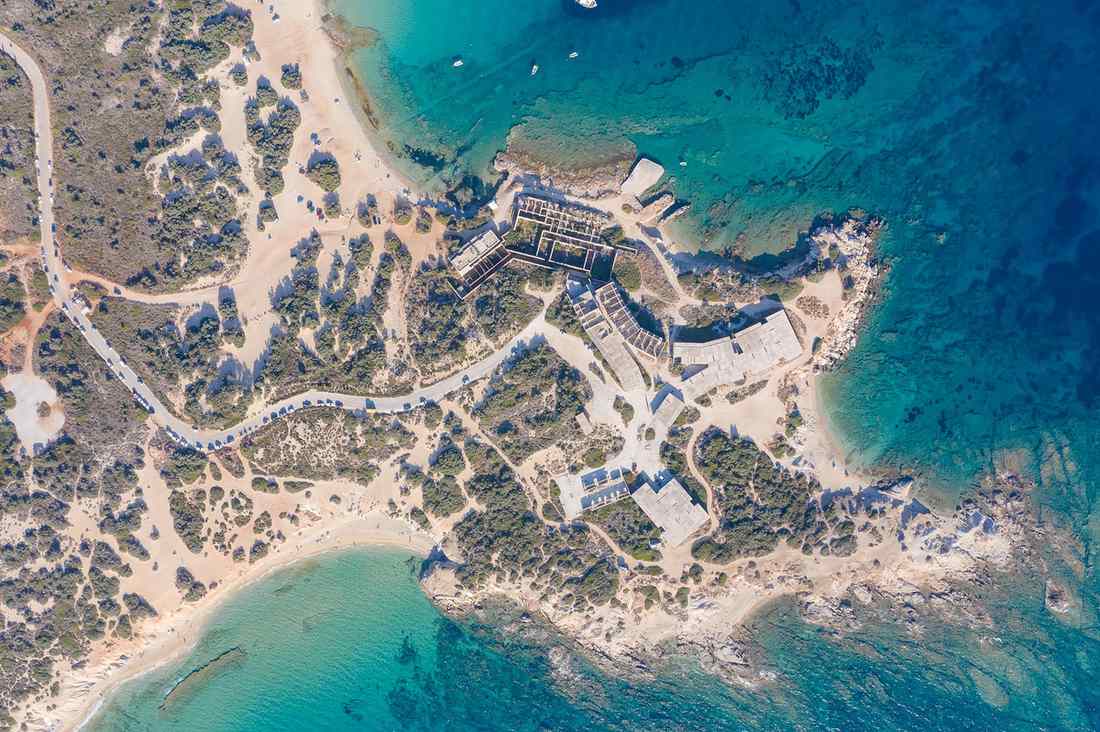
Alyko Beach sits on the southwest tip of Naxos, where a string of small sandy coves opens onto certain of the clearest, most sheltered water in the Cyclades. It stays quiet and undeveloped, backed by low dunes and a rare cedar forest that grows straight out of the sand. There are no big resorts here, no rows of loungers, just pale sand, turquoise shallows, and the scent of juniper on the wind. Swimmers, snorkellers, and anyone chasing a wild, natural corner of the island come here to escape the busier northern beaches. You can reach it easily on a self-drive day or as a relaxed stop with My Greece Tours.
This guide explains what makes Alyko worth the short drive from Naxos Town, and how to enjoy it without missing its quieter corners. For wider island planning, see our Naxos travel guide. The sections below cover what Alyko beach actually is, what makes its protected cedar forest special, what the coves and water are like for swimming and snorkelling, the abandoned street-art hotel that has become an offbeat local sight, and the practical details of how you visit.
What is Alyko beach?
Alyko is a group of small, wild sandy coves on the southwest tip of Naxos, roughly a twenty-minute drive from Naxos Town.
Rather than one long strip, Alyko is a cluster of separate coves tucked into a low, rocky headland at the island’s southwestern edge. Each pocket of sand is framed by dunes and juniper, so you can walk a short path between them and pick whichever feels quietest on the day. The sand is pale and soft, the seabed shelves gently, and the water shifts from clear shallows to deep turquoise a handful of metres out. The coves keep an unspoiled character that sets them apart from the organised beaches further north because there is no resort development here. Alyko sits at the end of the same southwest coastline that holds most of the finest beaches of Naxos.
It is that wild, protected setting that gives the area its distinctive appeal.
The whole area feels removed from the island’s tourist rhythm. There are no beach bars lining the shore, no music, and only a scattering of visitors even in high season, which keeps the atmosphere calm and slow. Families with young children like the sheltered coves because the water stays shallow and gentle for a long way out, while couples and solo travellers come for the quiet and the sunsets. Fall directly over the sea from this west-facing coast. The mix of open sand, low dunes, and dark green forest gives Alyko a landscape you do not see elsewhere on Naxos.
That forest is not just a backdrop but the reason the whole area is protected, and it is worth understanding why.
What makes the cedar forest special?
Alyko is backed by a rare coastal forest of prickly juniper, often called cedar, growing directly out of the sand dunes.
The trees here are prickly juniper, a hardy evergreen that tolerates salt, wind, and poor sandy soil where a handful of other plants survive. Their roots knit the dunes together, holding the sand in place against the strong summer winds that sweep this coast, so the forest quietly protects the beaches it shades. Walking the sandy tracks between the coves takes you under twisted, low canopies that offer natural shade, a rare thing on an open Cycladic shore. The habitat supports birds, insects, and dune plants that depend on this specific mix of forest and sand. This is why the area is recognised as ecologically important and kept free of building.
Signs ask visitors to stay on the paths and take nothing, small steps that keep the dunes intact.
The way you move through it matters because the forest is fragile. Keeping to the marked tracks, avoiding lighting fires. Carrying out all rubbish are the basic courtesies that protect a landscape that took a very long time to form and can be damaged quickly. The shade also changes how you use Alyko compared with a bare beach, since you can retreat under the junipers during the hottest midday hours and still feel the sea breeze. Photographers love the contrast of dark green trees against pale sand and bright water, especially in the softer light of late afternoon.
This green fringe wrapping the shore is what shelters the coves themselves, and those coves and their water are the next thing to understand.
What are the coves and water like?
Alyko is made up of a cluster of small sandy coves with shallow, sheltered entries and strikingly clear turquoise water.
Each cove has its own character. A portion of are wide and open with long stretches of shallow sand, ideal for wading and for children. Others are smaller and more hidden, framed by rock and juniper so they feel almost private. The water clarity is a highlight throughout: on a still day you can see the sandy bottom clearly a series of metres from shore. The colour ranges from pale aquamarine in the shallows to deeper blue where the seabed drops away. A handful of coves stay comparatively calm when other beaches are choppy, though conditions still change with the wind because the headland gives part of shelter.
Snorkellers find the most interest around the rocky points that divide the coves, where small fish gather among the stones and the visibility rewards a mask and fins.
The lack of facilities shapes the experience in a good way for a wide range of visitors, since it keeps the coves natural and uncrowded, but it also means you should arrive prepared. There is little natural shade on the open sand itself, so beyond the forest edge an umbrella helps. The seabed near the rocks can be uneven, so water shoes are useful for snorkelling. On windier days the exposed coves can pick up small waves and a bit of current. It is worth choosing a more sheltered pocket and keeping an eye on children.
Beyond the sand and water, Alyko has one more unexpected feature that draws curious visitors inland from the shore: an abandoned building that has taken on a strange second life. The sheltered coves and cedar-backed dunes here suit sea kayaking in Naxos on calm mornings.
What is the abandoned hotel and street art?
Near Alyko stands the shell of an unfinished hotel, left incomplete for decades and now covered inside and out with murals and graffiti.
The building was started long ago and never completed, leaving a bare concrete structure standing quietly behind the dunes. Over time, artists turned its empty walls, corridors. Stairwells into a sprawling canvas, and today the ruin is layered with colourful faces, patterns, and large-scale murals that change as new work is added and old work fades. Wandering through the roofless rooms feels unlike anywhere else on the beach: you step from soft sand and juniper into a raw, painted maze with sudden framed views of the sea through empty window openings. For photographers and the simply curious, it is one of the more memorable offbeat sights on Naxos, an accidental gallery in a wild setting.
The mix of decay, art, and turquoise backdrop is exactly why it has become a small pilgrimage for travellers who like the unusual.
A couple of sensible precautions make a visit safer. The structure is unfinished and unmaintained, so floors and edges can be uneven, there are no railings. Open drops exist between levels, which means watching your footing and keeping children close is essential. Sturdy shoes are far better than flip-flops for exploring the concrete, and it is wise to go during daylight and avoid climbing on unstable sections. Treat the murals with respect, take photos rather than souvenirs, and remember it is a ruin, not a managed attraction. Seeing it does not take long, so most people pair a short wander here with a longer stretch on the sand.
With the forest, coves, and this curiosity in mind, the last thing to sort out is simply how to get there and what to bring.
How do you visit Alyko?
Alyko lies about twenty minutes southwest of Naxos Town by car, reached on the coastal road toward the island’s southern tip.
A hire car or scooter is the simplest way to reach Alyko, following the road south from Naxos Town past the villages and down toward the coast, with the final approach on smaller lanes and sandy tracks. Parking is informal, on cleared ground near the coves, so arrive earlier in the day for the easiest spot and the calmest water. Kiosks, or sunbed rentals at the beach itself, self-sufficiency is the rule: pack no shortage of drinking water, snacks or a picnic, an umbrella for shade. A bag to carry all your rubbish out again because there are no tavernas. Water shoes, a mask, and sunscreen round out the kit.
Nearby, the neighbouring bays of Pyrgaki Beach and Kastraki Beach make easy add-ons if you want to string a handful of southwest beaches into one relaxed day.
Timing and mindset matter as considerable as logistics here. The west-facing coves are famous for their sunsets, so a wide range of people stay into the late afternoon, but that also means carrying enough water and leaving nothing behind when the light fades. Wind can pick up in the afternoon on this exposed coast, so if the sea looks choppy, move to a more sheltered cove or shift your swim to the calmer morning hours. Keep to the forest paths to protect the dunes, respect the quiet that makes Alyko special, and treat the abandoned hotel with care if you explore it. With a little preparation, this is one of the most rewarding low-key days on the island.
Plan your visit and tours through our Naxos travel guide.
Frequently Asked Questions
Is Alyko beach worth visiting on Naxos?
Alyko is well worth the short trip for travellers who prefer wild, quiet nature over organised resort beaches. Its combination of clear turquoise coves, a rare protected cedar forest growing out of the dunes. An offbeat abandoned hotel covered in street art gives it a character you will not find at the busier northern beaches near Naxos Town. The coves are excellent for gentle swimming and light snorkelling, the sunsets over the west-facing sea are memorable. The whole area keeps a slow, undeveloped feel even in high season. The trade-off is that there are no facilities, so you need to bring everything you need for the day, including water, food, shade, and sun protection.
For anyone happy to be self-sufficient and looking to escape the crowds, Alyko is one of the most rewarding and distinctive corners of the island, easily combined with the other southwest beaches nearby.
Are there facilities, sunbeds, or tavernas at Alyko?
No, Alyko has essentially no facilities, and that is a large part of its appeal. There are no sunbed or umbrella rentals on the sand, no beach bars, no kiosks. No tavernas directly at the coves, so you should treat it as a wild beach and come fully prepared. Bring ample drinking water, food or a picnic, your own umbrella or a way to make shade, sunscreen. A bag to take all your rubbish home again, since there is no rubbish collection here. Toilets are not available at the beach, so plan accordingly before you drive out.
The forest offers a portion of natural shade under its low junipers, which helps during the hottest hours, but on the open sand you are exposed to the sun. Water shoes are useful for the rockier sections and for snorkelling. The more developed beaches closer to Naxos Town are a reasonable drive away if you want facilities partway through the day.
How do you get to Alyko beach from Naxos Town?
The easiest way to reach Alyko is by hire car or scooter, driving roughly twenty minutes southwest from Naxos Town along the coastal road toward the island’s southern tip. You follow the main road south past the surrounding villages, then turn onto smaller lanes and sandy tracks for the final approach to the coves. Parking is informal on cleared ground rather than a proper car park. Public transport to Alyko is limited and not reliable for a flexible beach day, which is why most visitors drive or join a tour. Arriving earlier in the day usually means an easier parking spot, calmer water, and cooler walking through the forest.
The route also passes close to other quiet southwest beaches such as Pyrgaki and Kastraki, so it is simple to combine a series of bays into one relaxed itinerary. Planning the trip as part of a guided day out removes the logistics entirely if you would rather not drive.