
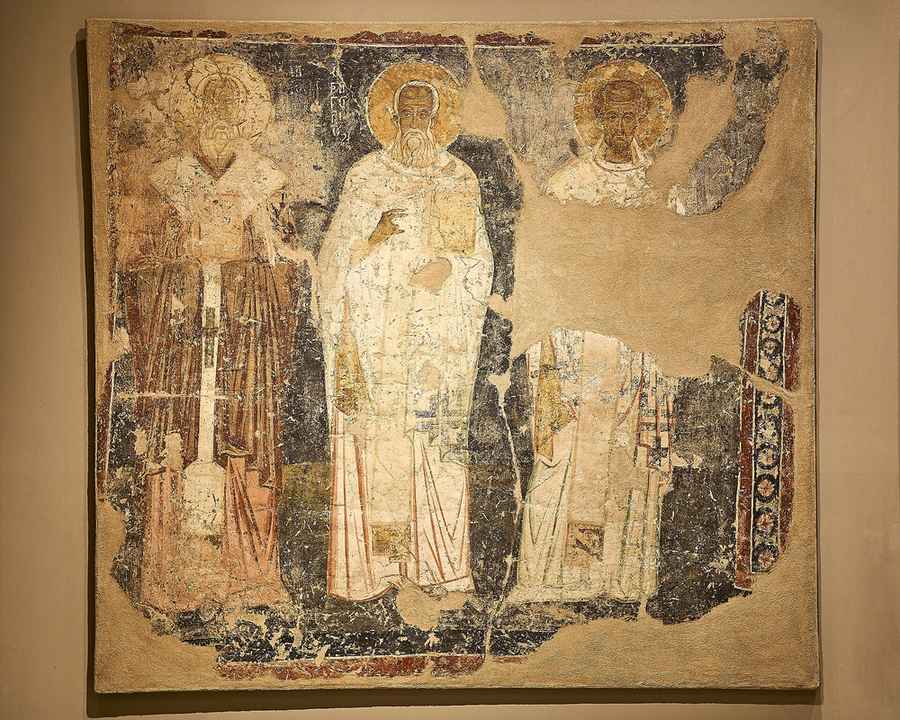
Agios Georgios Diasoritis stands alone among the olive groves of the Tragaea valley, a short walk from the village of Halki on Naxos. This modest stone church hides one of the richest cycles of Byzantine wall painting in the Cyclades. Its domed cross-in-square plan dates to the 11th century, and its interior glows with saints, martyrs and archangels rendered in deep ochre and blue. The building rewards travellers who value quiet monuments over crowded ruins. This guide explains what the church is, how it is dated, why its frescoes matter, and how to reach it on foot. Explore the wider island with My Greece Tours.
The church sits at the heart of the Tragaea, the green upland basin that our Naxos travel guide treats as the island’s Byzantine core. Pair a visit here with the nearby chapels and terraced fields that define this landscape. The sections below cover the identity and dedication of the monument, its dating and history, the surviving frescoes and their meaning, the domed architecture, and the practical route from Halki through the olive groves to the church door.
What is Agios Georgios Diasoritis?
Agios Georgios Diasoritis is a small Byzantine church near Halki on Naxos, dedicated to Saint George. It stands isolated among olive groves in the Tragaea valley and preserves an outstanding cycle of medieval frescoes.
The church takes its name from Saint George, the soldier-martyr, joined by the epithet Diasoritis, which locals link to the surrounding landscape and its older place names. It is a single-aisle domed structure built from local stone and roofed with schist. The exterior reads as plain and almost agricultural, blending with the drystone walls and olive terraces around it. That restraint is deliberate. Rural Byzantine builders on Naxos favoured sturdy compact forms that could survive centuries with little maintenance. The plain shell conceals a painted interior of real ambition. Visitors approaching from the fields near Halki often pass the building before recognising its importance.
Only inside, where saints crowd every surface, does the church reveal why scholars rank it among the finest Byzantine monuments on the island.
The church belongs to a dense network of medieval chapels that fills the Tragaea basin. This upland valley held one of the most settled Christian communities in the Cyclades, and its churches served scattered farming hamlets rather than a single town. Agios Georgios Diasoritis stood as a spiritual anchor for the families who worked the surrounding groves. Its dedication to Saint George suited a rural congregation who prized the saint as a protector of crops and livestock. The building sits within easy reach of other painted churches such as Panagia Protothronos in Halki itself.
Together these monuments form a walking circuit that reveals how thoroughly Byzantine faith and art shaped the interior of Naxos, far from the harbour and the ancient marble quarries near the coast.
How old is the church and what is its history?
The church dates to the 11th century, the middle Byzantine period, though its fresco layers span later centuries too. It served a rural Christian community in the Tragaea and remained in use across the medieval and post-Byzantine eras.
Art historians date the core structure and its principal frescoes to the 11th century, placing it within the middle Byzantine revival that produced painted churches across Naxos. The dating rests on the architectural type, the style of the wall paintings, and comparison with securely dated monuments elsewhere in the Cyclades. Naxos held a special position during this period because the island lay within the Byzantine sphere and supported a settled Christian population inland. The Tragaea valley, sheltered and fertile, became a stronghold of church building. Agios Georgios Diasoritis reflects that confidence. Its patrons commissioned a full painted programme rather than a bare whitewashed shell, a sign of real resources.
The broader history of Naxos frames this church as one chapter in a long Christian presence that outlasted successive rulers of the island.
The church survived the Venetian conquest that reshaped Naxos in the later medieval period and continued to serve worshippers through the centuries that followed. Rural chapels like this one rarely appear in written chronicles, so their history is read mainly from their walls. Successive fresco campaigns, repairs to the roof, and the wear of generations of candles tell the story more clearly than any document. The isolation that now makes the church feel remote once reflected a living agricultural world, where each hamlet maintained its own place of worship. Conservation work in recent times has stabilised the structure and cleaned the paintings, allowing the 11th-century programme to be studied properly.
The church now stands as a protected monument, cared for by the archaeological authorities, and forms part of the recognised Byzantine heritage that draws visitors into the interior of the island.
Why are the frescoes at Agios Georgios Diasoritis famous?
The frescoes rank among the best-preserved middle Byzantine wall paintings on Naxos. They fill the interior with saints, archangels and Gospel scenes in vivid ochre and blue, giving a rare complete picture of an 11th-century painted church.
The painted programme covers the walls, the vaults and the dome in a coherent hierarchy typical of Byzantine churches. Christ Pantokrator commands the crown of the dome, gazing down over the congregation below. Ranks of saints, bishops and martyrs line the lower walls, each identified by name and rendered with individual features. Archangels and Gospel scenes fill the higher zones, carrying the eye upward toward heaven. The colours remain unusually strong, with deep reds, warm ochres and rich blues surviving where many rural churches have lost their plaster entirely. This completeness is what makes the church so valued. Visitors gain a sense of how a middle Byzantine interior was meant to feel, wrapped in painted holiness.
The frescoes reward slow looking, and travellers exploring the villages of Naxos often list this church as the highlight of the interior.
The frescoes also carry real value for scholars of Byzantine art. Their style helps historians trace how metropolitan trends from Constantinople reached provincial islands and how local painters adapted them. The figures combine solemn dignity with a directness that suits a village audience. Saint George, the church’s patron, appears prominently, a warrior saint honoured across the Aegean. The paintings preserve details of dress, gesture and inscription that illuminate medieval piety on Naxos. Their survival owes much to the church’s isolation, which spared them the alterations that damaged art in busier settlements. The nearby Panagia Drosiani holds even older layers, and together the two churches let visitors read the evolution of Byzantine painting across several centuries.
This concentration of surviving frescoes is unmatched elsewhere in the Cyclades and gives the Tragaea its quiet fame.
What kind of architecture does the church have?
The church is a domed cross-in-square building, a compact middle Byzantine type. A central dome rises over the crossing on stone masonry, and the plan organises the interior into a clear cross shape with a sanctuary apse at the east end.
The cross-in-square plan places a dome at the centre of the building, carried on the arms of an internal cross. This form dominated middle Byzantine architecture and appears across the empire in both grand and humble examples. At Agios Georgios Diasoritis the type is realised at village scale, in local stone rather than expensive marble. The dome sits on a low drum and rises modestly above the schist roof, visible from the surrounding fields. Inside, the four arms of the cross frame the painted zones and lead the eye toward the sanctuary. The masonry is thick and plain, built to endure the centuries with little upkeep. This structural honesty gives the church its enduring, rooted character.
Travellers planning their island itinerary through our resources on things to do in Naxos will find the building a compact lesson in Byzantine design.
The sanctuary occupies the eastern end, marked by a semicircular apse where the altar stood and where the liturgy centred. Small windows pierce the walls, throwing narrow shafts of light across the frescoes and shifting the mood as the day moves. The builders worked with the materials at hand, so the church feels of its landscape rather than imposed upon it. Its proportions are intimate, drawing worshippers close to the painted saints and to one another. This human scale suited a farming congregation who gathered here across the medieval centuries. The dome, the apse and the barrel vaults together create the layered interior that Byzantine liturgy required, mapping heaven onto the building itself.
The architecture and the frescoes were conceived as a single whole, each reinforcing the other, which is why the church reads so clearly as a complete middle Byzantine monument.
How do you reach and visit the church?
The church lies near Halki in the central Tragaea valley, reached by a short walking path through olive groves from the village. Visitors drive to Halki, then follow signed footpaths on foot to the isolated church among the fields.
Halki serves as the natural base for a visit, sitting at the heart of the Tragaea and easily reached by road from Naxos Town. From the village a marked path leads out through the olive groves and terraced fields toward the church, a gentle walk of a few minutes across quiet farmland. The route itself is part of the pleasure, passing drystone walls, grazing land and old chapels along the way. Wear sturdy shoes, since the ground is uneven, and carry water in the warmer months. The church stands alone with no café or facilities nearby, which preserves its contemplative calm. Opening times can vary, so travellers often confirm access locally before setting out.
The village of Halki also holds the painted church of Panagia Protothronos, making a combined visit an easy and rewarding half-day on foot.
A visit here pairs naturally with the wider exploration of inland Naxos. The Tragaea valley rewards slow travel, with its Byzantine chapels, olive presses and mountain villages spread across the green basin. The church of Agios Georgios Diasoritis anchors this network, and many walkers link it with a longer loop through the surrounding hamlets. Photography inside may be restricted to protect the frescoes, so respect any posted guidance and avoid flash. The best light falls in the morning, when low sun warms the eastern apse and the colours of the paintings deepen. This corner of the island belongs to those willing to walk, look closely and linger. Plan your visit and tours through our Naxos travel guide.
Frequently Asked Questions
Is Agios Georgios Diasoritis open to visitors?
The church is a protected Byzantine monument and can be visited, though its opening hours are irregular and not fixed like a museum. Access depends on local arrangements, and the door is sometimes locked to protect the fragile frescoes inside. Travellers usually confirm in the village of Halki whether the church is open and where a key may be held. Reaching it involves a short walk from Halki through the olive groves, so plan the visit as part of a wider exploration of the Tragaea rather than a quick stop. The setting is remote, with no ticket office, café or shop nearby, which keeps the atmosphere quiet and contemplative.
Respect any posted rules about photography and flash, since the middle Byzantine wall paintings are sensitive to light and touch. Morning visits work best, both for cooler walking and for the warm light that falls across the painted apse and deepens the colours of the saints.
What is the meaning of the name Diasoritis?
The epithet Diasoritis attaches to Saint George in the church’s dedication and sets this monument apart from the many other chapels of Saint George across Greece. Local tradition links the name to the surrounding landscape and to older place names of the Tragaea valley, though its precise origin is debated. Byzantine churches often carried such topographical or descriptive epithets that fixed a saint to a particular site, a spring, a hill or a stretch of farmland. The name would have been meaningful to the medieval farming community who worshipped here and who knew every field and boundary around the building.
For the modern visitor the epithet mainly serves to identify this specific church among the dense cluster of monuments near Halki. Saint George himself was honoured across the Aegean as a warrior saint and a guardian of crops and herds, which suited the agricultural world of the Tragaea, where the olive groves and terraces still frame the church today.
How does this church compare with other Byzantine churches on Naxos?
Naxos holds one of the densest concentrations of Byzantine churches in Greece, and Agios Georgios Diasoritis ranks among the finest of them. Its 11th-century frescoes stand out for their completeness and strong colour, giving a fuller picture of a middle Byzantine interior than many rival monuments. The nearby Panagia Drosiani preserves even older painted layers, some among the earliest in the Aegean, so the two churches complement rather than repeat each other. Panagia Protothronos in Halki adds a third major painted church within a short distance, letting visitors trace the development of Byzantine art across several centuries in a single valley.
Agios Georgios Diasoritis distinguishes itself through its isolated setting among the olive groves and its clear domed cross-in-square form. That combination of architecture, frescoes and landscape makes it a favourite of travellers who value quiet monuments. Together these churches confirm the Tragaea as the Byzantine heart of Naxos and a rewarding region for walkers and art lovers alike.