

Symi built its nineteenth-century wealth on sponge diving and the sponge trade. The small Dodecanese island sent a large fleet across the Aegean and down to the North African coast to work the seabeds for natural sponges. Profits from the trade paid for the neoclassical mansions that ring the harbour and the upper town, and for a large shipbuilding industry. Divers first worked by holding their breath, weighted with a stone, and later wore the heavy skafandro diving suit. The suit reached deeper beds but brought the crippling and fatal sickness known as the bends. This guide traces the trade, the divers, the dangers, the wealth, the decline and the sponges still sold on the waterfront.
The sponge story sits at the centre of any visit to Symi, the island whose harbour of tiered mansions grew straight from the trade. Sponge money made the island one of the largest sponge centres in the Mediterranean, and its population then ran far higher than today. The trade declined after the wars, a change of borders, overfishing and a sponge disease that struck the beds. Cleaned sponges still hang outside shops along the harbour front, sold to visitors as a living link to that past. The pages below cover the harbour town, the stepped street to the old town and the monastery tied to the island’s seafarers.
What was the sponge trade that made Symi wealthy?
Symi’s sponge trade harvested natural sponges from the seabeds of the Aegean and the North African coast during the nineteenth century. The island’s fleet gathered, cleaned and sold the sponges across the Mediterranean, turning Symi into a wealthy maritime centre.
Natural sponges are simple sea animals whose soft skeletons dry into the cleaning sponges sold in shops. Symi’s divers cut them from rocks on the sea floor, where the sponges grow in dark, deep water. The island’s boats worked beds across the Aegean and along the North African coast, from the waters near the island to the shores of Libya and Egypt. Crews left the harbour for long summer voyages and returned with the season’s catch. Traders then cleaned, trimmed and graded the sponges for sale. Buyers carried them to markets across the Mediterranean and into Europe. This chain, from the seabed to the foreign market, formed the backbone of the island’s economy through the nineteenth century.
Sponge diving suited Symi because the island held few farms and little flat land. Rock and steep slope cover most of the ground, so the sea offered the surest income. Boys learned to swim and dive young, and diving became the trade of the island’s men. Each summer the fleet sailed east and south to the richest beds, staying at sea for weeks. Merchants financed the voyages, paid the crews and took a share of the catch. The system tied the whole island to the sponge, from the diver to the trader on the quay. Wealth flowed back to the harbour, where it paid for houses, boats and the workshops that served the fleet.
The trade ran on a yearly rhythm fixed by the weather and the sea. Crews prepared boats and gear through the spring, then sailed once the summer calm settled over the Aegean. Diving filled the warm months, when the water stayed clear and the beds lay within reach. Boats returned to Symi in autumn, heavy with sponges for cleaning and sale. Winter went to repair, trade and the sharing of the season’s profit. Families waited through each voyage for news of the catch and the safe return of the divers. This cycle repeated across generations and built the fortune that shaped the island’s harbour and its two towns above the water.
Sponge wealth reached beyond the divers and merchants into the wider life of the island. Ropemakers, sailmakers, carpenters and traders all drew a living from the fleet. The harbour filled with boats built and repaired for the diving voyages. Shops, workshops and warehouses lined the waterfront to serve the trade. Money from the sponges funded schools, churches and grand private houses. The island grew crowded and busy, its population swollen by the work the sponge brought. This concentration of trade, craft and people turned a small, rocky island into one of the leading sponge centres of the Mediterranean, known across the region for the quality of its catch.
How did the sponge divers of Symi work underwater?
Symi’s divers first worked by holding their breath, weighted with a heavy flat stone that pulled them to the seabed. Crews later used the skafandro, a sealed diving suit fed with air from the surface, which let divers reach far deeper beds.
The oldest method on Symi used no equipment beyond a stone and the diver’s own lungs. A diver gripped a flat, heavy stone, called the skandalopetra, and let its weight drag him straight to the bottom. He cut sponges from the rock, filled a net, then tugged a rope for the crew to haul him up. A single dive lasted only as long as the diver could hold his breath. Divers repeated the plunge over and over through the working day. The naked diver reached the shallower beds within the range of a held breath, and no deeper. This ancient method fed the trade for generations before machines arrived, and it demanded strong lungs, steady nerves and a hard, practised body.
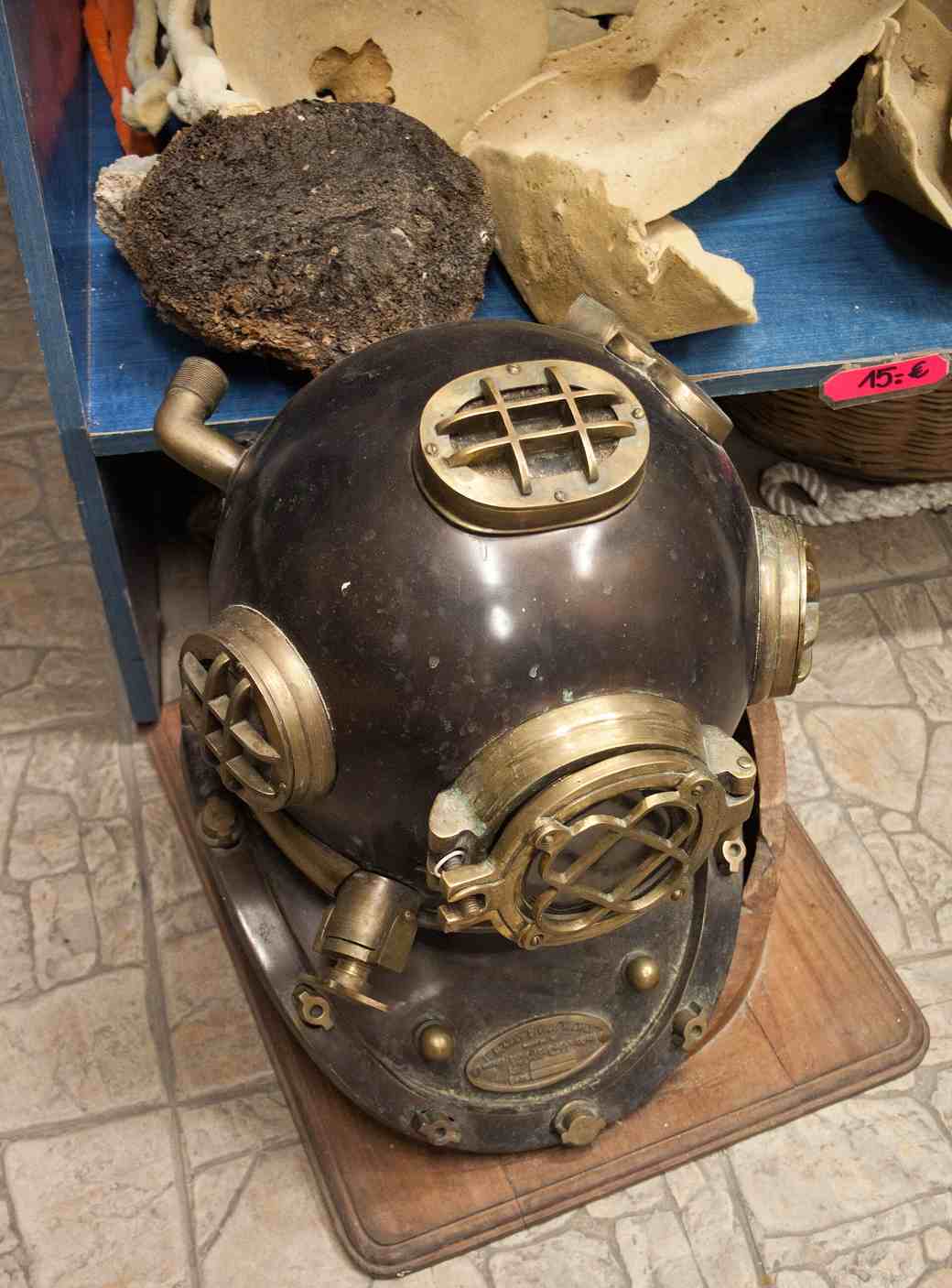
The skafandro changed sponge diving on Symi and across the Dodecanese. The word names a sealed suit of rubberised canvas with a heavy metal helmet, bolted to a collar over the diver’s shoulders. A pump on the boat forced air down a hose into the helmet, so the diver breathed at the bottom. The suit freed him from the limit of a single breath and let him stay down far longer. Divers walked the seabed and reached beds that no breath-hold diver could touch. The catch grew as the suit opened deeper, richer grounds to the fleet. Boats fitted with pumps and hoses became the standard of the trade, and pushed the divers of the island into ever deeper water.
The skafandro suit reshaped the economics of the sponge fleet. Deeper beds held larger and finer sponges, which fetched higher prices at market. Owners who fitted the suits gathered more sponges on each voyage than breath-hold crews. The rewards drew boat after boat to adopt the gear across the island. Divers who mastered the suit earned more, and the trade leaned on their skill. Competition pushed crews to work longer hours and deeper ground each season. The suit turned sponge diving from a test of breath into an industry of pumps, hoses and paid, specialist divers. This drive for depth and yield fed the island’s wealth, yet it carried a hidden cost that the divers would pay in their own bodies.
Work in the skafandro followed a hard daily routine on the diving boats. A diver dressed in the heavy suit, fixed the helmet and stepped over the side into deep water. He walked the bottom, cut sponges and packed them into a net while the pump fed him air. The crew tracked his time below and worked the pump and the lines from the deck. A diver made repeated descents through the day, each one deeper and longer than a breath-hold plunge. The reach of the suit tempted crews to send divers too deep and keep them down too long. This pressure for depth and speed set the stage for the sickness that would cripple and kill the men of the fleet.
Why was sponge diving on Symi so dangerous?
Sponge diving on Symi turned deadly with the skafandro suit, because divers reached depths that caused decompression sickness, known as the bends. Rising too fast from deep water crippled and killed large numbers of the island’s divers over the years.
The bends struck divers who rose too quickly from deep water in the skafandro suit. Breathing air under pressure forces gas into the blood and tissues of the body. A slow return lets that gas leave safely, but a fast rise traps it as bubbles. The bubbles lodge in the joints, the spine and the brain, causing pain, paralysis and death. Sponge crews, driven for depth and yield, brought divers up too fast and too often. The result crippled strong young men and killed others outright on the deck. Divers returned from a season bent, lame or paralysed, their working lives ended. This sickness, poorly understood at the time, turned the richest tool of the trade into its deadliest hazard for the island’s men.
Decompression sickness spread through the sponge islands as the skafandro suit took hold. Symi and its neighbours counted a heavy toll of dead and disabled divers. Whole streets held men crippled by the bends, unable to walk or work. Families lost fathers and sons to a sea that had once fed them safely. The naked breath-hold divers had faced drowning and the crush of depth, yet the suit added a slower, wider killing. Crews knew the danger but chased the deep beds and the higher pay. The pressure of the trade outweighed the risk to the diver’s body. This human cost sat beneath the wealth of the harbour, paid in the health and lives of the men who gathered the sponges.
The dangers reached beyond the bends into every part of a dive. A torn hose or a failed pump cut off the diver’s air far below the surface. A fouled line trapped a diver on the bottom until his air ran out. Cold, currents and the weight of the suit wore down even the strongest men. Sharks and the plain risk of drowning shadowed the naked divers too. Each voyage carried the chance that a diver would not come home. Crews accepted the odds as the price of the trade, and the sea took its share each season. This constant threat marked the sponge diver of Symi as a man who staked his life on every descent to the beds below.
The bends left a lasting mark on the society of Symi. The island carried a population of injured divers who could no longer dive or work. Widows and orphans depended on family and the church after a diver’s death. The wealth of the trade masked a steady loss of young, able men. Later understanding of pressure and slow ascent came too late for the divers of the sponge era. The suit that had opened the deep beds had also filled the island with the crippled and the dead. This shadow ran through the great days of the trade, so the mansions of the harbour stood beside households broken by the sea. The sponge paid for the island in money and in lives alike.
How did sponge money build the mansions of Symi?
Sponge profits paid for the neoclassical mansions that ring the harbour and the upper town of Symi. Captains, merchants and boat owners built tall, coloured houses with carved pediments, turning the wealth of the trade into the island’s lasting architecture.
The mansions of Symi Town and Gialos rose directly from sponge money in the nineteenth century. Captains and merchants who prospered from the trade built tall houses around the harbour and up the slopes to the old town. The style followed the neoclassical fashion of the age, with symmetrical fronts, carved pediments and painted plaster. Owners competed to raise the finest house, so the harbour filled with grand facades in ochre, blue and deep red. The wealth of a single good season could fund a mansion above the water. These houses climbed the two hillsides in tight tiers, forming the amphitheatre of colour that rings the port. The sponge trade wrote itself onto the island in stone, plaster and paint.
Neoclassical design gave the island’s mansions their shared, formal look. Builders framed doors and windows with pilasters, cornices and triangular pediments in the classical manner. Tall shuttered windows lined the upper floors, and grand staircases climbed inside. Painted plaster in warm colours covered the stone, trimmed with white detail. The houses stood two or three storeys high, taller than the older cottages of the island. Wealthy owners drew craftsmen, materials and ideas from the wider Aegean and beyond. The result matched the harbour fronts of other rich trading islands of the age. This architecture, funded by the sponge, gave Symi the tiered, coloured harbour that defines the island’s face to arriving boats.
The mansions ring both halves of the town, the harbour of Gialos and the upper town of Chorio. Gialos holds the grandest houses, built at the water’s edge for the captains and traders. Chorio, on the ridge above, carries older and plainer mansions among its lanes and chapels. The two towns climb the facing slopes, so the houses rise in tiers from the sea to the skyline. Grand fronts face the port, while quieter homes fill the streets behind. The layout packed a dense population into a steep, narrow site. This ring of mansions, from the quay to the hilltop, records the reach of the sponge fortune across every part of the island’s settled ground.
The mansions outlasted the trade that built them and now define the island’s protected townscape. Decline emptied the streets, and neglect left grand houses to fade and fall. The tiered harbour survived as one of the finest neoclassical ensembles in the Aegean. Preservation rules now guard the fronts, the colours and the roofs of the old houses. Owners restore the mansions as homes and guest houses, keeping the historic face intact. The colour and symmetry that sponge money bought still draw visitors to the port. This built inheritance, raised on the sponge, remains the clearest sign of the wealth that the trade once poured into the harbour and the hillsides of the island.
What role did shipbuilding play in Symi’s sponge economy?
Symi’s sponge wealth funded a large shipbuilding industry that supplied and served the diving fleet. Yards along the harbour built and repaired the boats that carried divers to distant beds, tying the island’s timber trades to the fortunes of the sponge.
Shipbuilding grew alongside sponge diving as the second great trade of Symi. The fleet needed boats built for long summer voyages to distant beds, and the island’s yards supplied them. Carpenters, caulkers and sailmakers worked the harbour to build and fit the diving craft. Timber, rope and canvas arrived to feed the yards that lined the waterfront. A strong fleet demanded constant building and repair, so the trade ran through the year. The skill of the island’s shipwrights carried a reputation across the Aegean. Boats built on Symi served the sponge voyages and also traded goods around the region. This craft turned sponge money into vessels, and the vessels in turn gathered more sponges for the island’s wealth.
The yards of the harbour built the whole range of craft the trade required. Small boats carried divers and gear to the beds and back to the mother ship. Larger sailing vessels made the long passages to the North African coast. Trading caiques moved sponges, timber and supplies around the Aegean. Each hull rose from local skill and imported timber on the slipways of the port. Owners ordered new boats when a good season filled their purses. The building trade thus rose and fell with the fortunes of the sponge. This tight link bound the shipwright to the diver, and both to the merchant who financed the voyage and sold the catch across the region.
The island’s seafaring life centred on the sea and on its patron of sailors at Panormitis Monastery, set in a sheltered bay in the south. Crews called at the monastery to pray before the long and dangerous voyages to the beds. The saint of the monastery served as the protector of the island’s sailors and divers. Boats bound for the sponge grounds sought a blessing for a safe return. The sheltered bay gave anchorage to vessels waiting out the weather. Devotion and seafaring ran together through the sponge era, when every voyage risked the crew. This bond between the fleet and the monastery shows how deeply the sea, the sponge and faith wove through the life of the island.
Shipbuilding and sponge diving together made Symi a maritime power in the eastern Aegean. The island held a large fleet, a skilled body of builders and a network of traders. Boats from the port ranged far beyond the sponge beds into general trade. The two industries fed each other and drew workers, timber and money to the harbour. A dense, busy population supported the yards, the fleet and the market. The wealth of the sea raised the island far above the scale of its rocky land. This double strength, in diving and in building, placed Symi among the leading seafaring islands of the region until the trade began to fail after the wars.
How large was Symi’s sponge industry and population?
Symi ranked as one of the largest sponge centres in the Mediterranean during the nineteenth century. The trade drew a dense population to the small island, and far more people lived there then than live on Symi today.
Symi grew into one of the largest sponge centres of the whole Mediterranean. The island’s fleet ranked among the biggest working the eastern seas for sponges. Its market gathered sponges from the island’s own boats and from the wider region for cleaning and sale. Traders shipped the graded sponges to markets across Europe. The scale of the trade lifted a small, rocky island to a place of real weight in the sponge world. Buyers knew the island’s name for the quantity and quality of its catch. This standing rested on the fleet, the divers and the merchants who ran the trade. No island of its size carried a sponge industry to match the one based in the harbour of Symi.
The trade packed the island with people far beyond what the land could feed. Sponge wealth drew divers, sailors, builders and traders to the harbour and the upper town. The population climbed to a level far higher than the island holds today. Houses filled every slope around the port, and the two towns spread up their hillsides. The busy quays, yards and markets employed a dense working population. The island lived from the sea, not the soil, so numbers rose with the trade, not the harvest. This crowding built the tiered town of mansions that still rings the harbour. The sheer size of the sponge economy explains why so grand a settlement grew on so small and rocky an island.
The scale of the trade reached into every corner of island life. Markets, workshops and warehouses filled the waterfront to handle the sponge. Schools and churches served the large population the trade supported. The harbour stayed busy with boats loading, unloading and heading for the beds. The rhythm of the diving season set the calendar of the whole island. Wealth and work concentrated in the port, drawing people from the countryside and beyond. This depth of activity marked Symi as a true industrial centre of the sponge, not a mere fishing island. The trade shaped the streets, the buildings and the daily lives of the thousands who lived from the sea around the island.
The size of the sponge economy set Symi apart from ordinary Aegean islands. Farming islands lived from the land and held small, steady populations. Symi instead lived from a single sea trade that swelled its numbers and its wealth. The fortune of the harbour rested on the health of the sponge beds and the market abroad. This narrow base made the island rich while the trade held, and exposed once it failed. A population built on the sponge would shrink hard when the sponge declined. This dependence on one trade both raised the island to its height and left it fragile before the changes that later broke the sponge economy for good.
Why did Symi’s sponge trade decline?
Symi’s sponge trade declined through a run of blows, the wars, a change of borders, overfishing of the beds and a sponge disease. Together these cut the catch and the market, and the island’s population fell far from its peak.
The decline of the sponge trade came from a combination of blows rather than a single cause. The wars of the era disrupted the voyages, the crews and the markets that the trade relied on. A change of borders cut the island off from grounds and routes it had long worked. Overfishing thinned the nearest beds after generations of intense harvesting. A disease then struck the sponge beds and killed off the stock across wide areas. Each blow alone would have hurt the trade, and together they broke it. The fleet shrank, the market faltered and the wealth of the harbour drained away. This layered collapse ended the era that had built the mansions and filled the island with people.
War struck hardest at a trade that depended on long, distant voyages. Conflict closed sea lanes, seized boats and scattered the crews who dived the beds. The distant grounds off the North African coast slipped out of safe reach. A change of borders in the region redrew the map around the island. New frontiers and rules cut Symi off from waters and ports it had used for generations. The fleet lost grounds, markets and the free run of the sea it had once enjoyed. These political shocks struck the trade from outside, beyond the power of any diver or merchant to mend. The island’s sponge economy could not hold once the sea itself was closed and divided.
Overfishing and disease attacked the sponge beds themselves, the root of the whole trade. Generations of diving had stripped the nearest grounds of their best sponges. The skafandro suit deepened the reach and quickened the harvest, so the beds thinned faster. A sponge disease then swept the eastern seas and killed the stock across wide stretches of seabed. The beds that survived yielded less, and the catch fell year by year. Fewer sponges meant less work, less trade and less reason to fit out a fleet. The natural resource that had made the island rich failed under the weight of its own harvest and the spread of the blight. This loss of the beds struck at the heart of the trade.
The end of the sponge trade emptied the island as surely as it had once filled it. Work vanished, so families left the harbour for the mainland and for lands overseas. The population fell far from its crowded peak, and whole houses stood shut. The grand mansions, raised on the sponge, faded as their owners moved away. The fleet dwindled, the yards fell quiet and the market lost its trade. A living once drawn from the sea no longer held the island’s people. This long decline turned a dense, wealthy sponge centre into a quiet island, its great days written only in the silent tiers of houses above the port.
Where are sponges still sold on Symi today?
Cleaned natural sponges still hang outside shops along the Gialos waterfront of Symi. Traders trim, wash and sell them to visitors on the harbour front, keeping the old sponge trade alive as a living link to the island’s past.
Cleaned sponges still hang in nets and baskets outside the shops of the Gialos waterfront. Sellers display them in pale golden clusters along the harbour front, a sight that draws every visitor. The sponges come from the sea trade that once made the island rich, now shrunk to a handful of shops. Traders wash, trim and bleach the raw sponges into the soft, pale goods on sale. Visitors buy them as a practical souvenir and a piece of the island’s history. The stalls keep the word sponge tied to the harbour long after the great fleet is gone. This small trade on the quay carries the memory of the industry that built the whole town behind it.
The sponges on sale pass through the same cleaning steps the old trade used. Raw sponges come from the sea dark, soft and full of living matter. Workers wash, squeeze and dry them to leave the pale skeleton behind. A trim shapes each sponge, and a mild bleach lightens its colour for sale. The finished sponge serves for bathing, cleaning or craft, as it long has. Shops grade the sponges by size, softness and shape, and price them to match. This handwork on the harbour links the modern stall to the divers who once filled the fleet. The craft of cleaning the sponge outlived the great trade and still shapes the goods sold on the quay.
The sponge stalls form part of the harbour scene that greets arriving boats at Symi. Ferries and day boats tie up along the Gialos quay, right beside the sponge shops. Passengers step ashore into a front lined with sponges, cafes and the tiered mansions above. The sellers explain the trade, the diving and the history to the visitors who stop. A sponge bought on the quay carries a direct link to the island’s past. The stalls turn the harbour’s history into a living, working sight rather than a museum piece. This meeting of trade and memory on the waterfront keeps the sponge at the centre of the island’s identity for every visitor who lands.
The surviving sponge trade stands as a small but real thread of continuity on Symi. The fleet has gone, the beds have thinned, yet the sponge still reaches the harbour front. Local sellers keep the knowledge of grading, cleaning and using the sponge alive. The trade now serves visitors rather than the markets of Europe, but the product stays the same. Each sponge sold repeats, in miniature, the old chain from the seabed to the buyer. The stalls hold the last working link to the industry that raised the town. This thin survival lets the island tell its own story in the very goods that once made its fortune, sold where the fleet once moored.
Where can visitors see Symi’s sponge heritage in the town?
Visitors read Symi’s sponge heritage across the harbour of Gialos, the upper town of Chorio and the stepped street between them. The mansions, the sponge stalls, the local museum and the old captains’ houses all trace the wealth the trade brought.
The stepped street called the Kali Strata climbs from the harbour of Gialos to the old town of Chorio, past the mansions the sponge built. Hundreds of stone steps rise between tall neoclassical houses raised in the trade’s rich years. Walkers pass grand fronts, carved doorways and faded plaster on the way up. The street records the wealth of the sponge in a single climb through the town. Certain houses stand restored, while others wait behind shuttered fronts. The view from the steps takes in the tiered harbour that the trade filled. This walk links the two towns and lays the whole sponge fortune out along its length for the visitor to read.
The harbour of Gialos gathers the clearest signs of the sponge era at the water’s edge. The tiered mansions rise straight from the quay in their ranks of colour. Sponge stalls line the front, still selling the product that built the town. Cafes and shops fill the ground floors of the old merchant houses. The clock tower and the war memorial stand among the harbour landmarks. The scale and the grandeur of the port speak of the wealth the sponge once poured in. This waterfront, read as a whole, shows a visitor how a single sea trade raised a town far above the means of its rocky island in the Dodecanese.
Chorio, the old upper town, holds the quieter, older layer of the sponge heritage. Lanes wind between houses and chapels raised in the trade’s long years. A castle crowns the ridge, and a local museum gathers relics of the island’s past. From the height the whole harbour and its tiers of mansions spread below. The upper town shows how the settlement climbed the slope as the population grew with the trade. Faded and restored houses stand side by side along the narrow streets. This higher ground gives the visitor the long view of a town shaped, from top to bottom, by the fortunes of the sponge across the great years of the island.
A visitor can trace the sponge story across the island in a single day on foot. The harbour front, the sponge stalls and the mansions set the scene at sea level. The Kali Strata carries the walk up through the wealth of the trade to Chorio. The upper town, its museum and its castle add the older layers and the long view. The monastery in the south recalls the seafarers who dived the distant beds. Each stop reads a chapter of the trade, from the diver to the merchant to the fallen fleet. This layered townscape, built and then half-emptied by the sponge, lets the island tell the whole arc of its greatest industry in stone.
Frequently Asked Questions
What is Symi famous for in its history?
Symi is famous as one of the largest sponge-diving and sponge-trading centres of the Mediterranean in the nineteenth century. The island’s fleet worked the seabeds of the Aegean and the North African coast for natural sponges. Profits from the trade paid for the neoclassical mansions that ring the harbour and for a large shipbuilding industry. The island then held a population far greater than today. Cleaned sponges still sell on the Gialos waterfront, a living reminder of the trade that built the town.
How did sponge divers on Symi reach the seabed?
Sponge divers on Symi first reached the seabed by holding their breath, weighted with a heavy flat stone that dragged them down. A dive lasted only as long as the diver held his breath, so the naked divers worked the shallower beds. Crews later adopted the skafandro, a sealed diving suit fed with air pumped from the boat. The suit let a diver walk the bottom and reach far deeper grounds. This deeper reach raised the catch, yet it also brought the deadly sickness known as the bends.
What are the bends that harmed Symi’s divers?
The bends are decompression sickness, an injury caused by rising too fast from deep water. Breathing air under pressure forces gas into the body, and a quick ascent traps that gas as bubbles in the joints, spine and brain. The skafandro suit let Symi’s divers work deep, and crews often brought them up too fast. The result crippled and killed large numbers of the island’s divers. Whole streets held men left lame or paralysed by the sickness. This human cost sat beneath the wealth that the sponge trade brought the island.
Why is Symi full of grand old mansions?
The mansions of Symi stand because sponge money paid to build them in the nineteenth century. Captains, merchants and boat owners who grew rich from the trade raised tall neoclassical houses around the harbour of Gialos and the upper town of Chorio. The houses carry symmetrical fronts, carved pediments and plaster painted in ochre, blue and red. They climb the two facing slopes in tight tiers above the port. The tiered harbour survives as one of the finest neoclassical townscapes in the Aegean, built on the wealth of the sponge.
Are sponges still sold on Symi?
Sponges are still sold on Symi, mainly from shops and stalls along the Gialos waterfront. Sellers hang cleaned natural sponges in pale golden clusters beside the harbour, where ferries and day boats tie up. The sponges pass through the same washing, trimming and bleaching that the old trade used. Visitors buy them as a practical souvenir and a link to the island’s history. The stalls form the last working thread of the industry that once built the town, now serving travellers rather than the markets of Europe.
How did the skafandro diving suit change sponge diving on Symi?
The skafandro diving suit changed sponge diving on Symi by freeing the diver from a single held breath. The sealed suit, fed with air pumped from the boat, let a diver walk the seabed and stay down far longer. Crews reached deeper beds that held larger, finer sponges, so the catch and the profits grew. The suit turned diving into an industry of pumps, hoses and paid specialists. It also carried a heavy cost, since the depth brought the crippling and fatal sickness called the bends to the island’s divers.
What caused the decline of Symi’s sponge trade?
The decline of Symi’s sponge trade came from a run of blows rather than one cause. The wars of the era disrupted the voyages and the markets, and a change of borders cut the island off from grounds it had long worked. Overfishing thinned the nearest beds after generations of harvesting. A sponge disease then killed the stock across wide stretches of seabed. Together these losses shrank the fleet and emptied the harbour, and the island’s population fell far from its crowded peak. The great sponge era closed, leaving the mansions behind.