
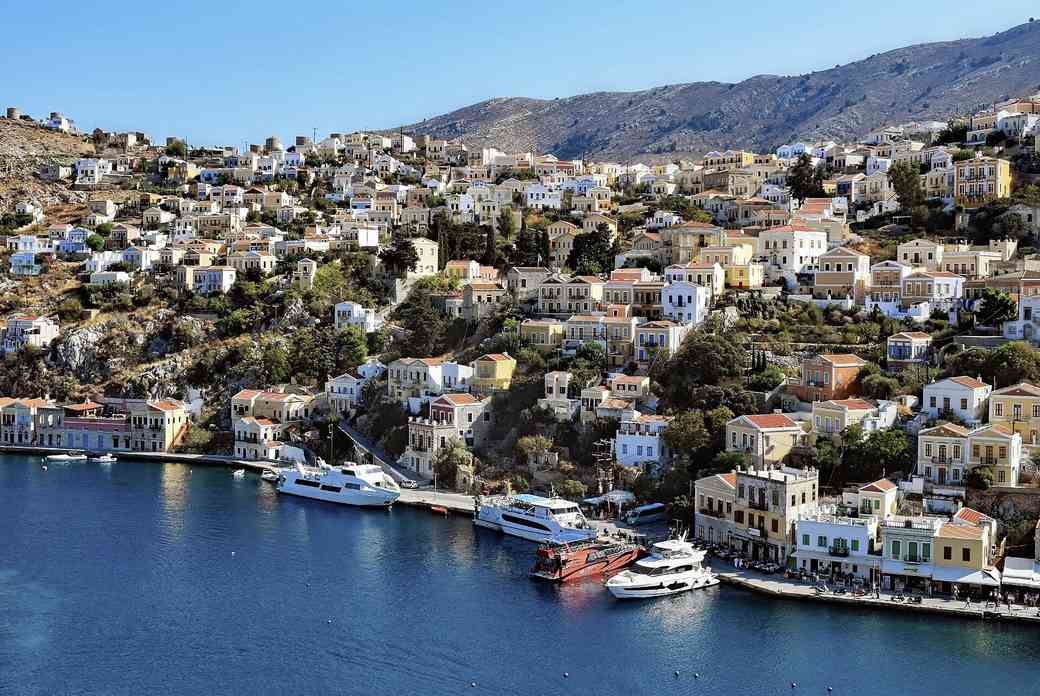
The Kastro is the castle that crowns Chorio, the upper town of Symi. The fortress stands at the highest point of the hill, above the harbour of Gialos. Knights of Saint John raised its walls on the site of the ancient acropolis. The medieval builders reused ancient stone blocks in the ramparts, and carved coats of arms mark the gates. Inside the walls stands the church of Megali Panagia, the Great Virgin. A war memorial records a wartime ammunition explosion that damaged the site. The Kastro gives the widest views over Gialos, Chorio and the sea toward Turkey. This guide covers the castle, the acropolis beneath it, the Knights, the church, the memorial, the views and the climb through Chorio.
Reaching the Kastro means climbing the stepped lanes of Chorio, above the top of the Kali Strata. The castle sits beyond the squares of the upper town, at the summit of the ridge. Three layers of history meet on this ground. The ancient acropolis formed the first fortified crown of the hill. The Knights of Saint John built the medieval castle over those foundations. The church of Megali Panagia holds the religious life of the site within the walls. This page anchors the Kastro inside the wider Symi vertical, linking the harbour, the upper town and the routes across the island. The climb rewards walkers with the broadest outlook on the port, the rooftops and the coast.
What and where is the Kastro on Symi?
The Kastro is the medieval castle at the top of Chorio, the upper town of Symi. The fortress crowns the highest point of the hill, above the harbour of Gialos, on the site of the island’s ancient acropolis.
The Kastro forms the crown of Chorio, the upper quarter of Symi. The castle stands at the summit of the hill, the highest built point on the island’s main town. Its walls ring the flat top of the ridge, well above the harbour of Gialos. The fortress marks the oldest inhabited ground on the island, settled long before the port grew below. Stone ramparts trace the edge of the summit, broken by gates and towers. The position gave the medieval town a natural stronghold against raiders from the sea. Walkers reach the castle by climbing through the lanes of Chorio to the top. The Kastro reads as the historic core of the whole settlement, the point from which the town spread downhill.
The name Kastro means castle in Greek, and the site earns the label. Thick walls enclose the summit, built to defend the medieval town. The fortress occupies the same ground as the ancient acropolis of the island. The upper town of Chorio grew around and below the castle over the centuries. Houses, churches and lanes fill the slope between the walls and the harbour. The Kastro held the defensive heart of the community, the refuge in times of raid. Its commanding height let watchers see ships approaching from every direction. The castle and the town below formed a single fortified settlement. The stronghold on the summit and the houses on the slope tell one continuous story of life on the hill.
Finding the Kastro takes a steady climb through the upper town of Symi. The castle sits at the head of the stepped lanes that thread Chorio. Signs and the rise of the ground point walkers toward the summit. The route passes churches, courtyards and houses stacked up the hillside. The gradient steepens near the top, where the lanes narrow toward the gate. The walls appear above the rooftops as the climb nears its end. The last stretch opens onto the flat crown of the ridge inside the ramparts. The effort of the ascent guards the quiet of the site. The Kastro rewards walkers who trade the harbour tables for the climb to the highest ground on the island.
The Kastro layers the long history of Symi in one place. The ancient acropolis formed the first fortress on the summit of the hill. The Knights of Saint John built the medieval castle over those older foundations. The church of Megali Panagia rose within the walls to serve the upper town. A war memorial records the wartime explosion that scarred the site. Each of these marks a different age of the island in the same ground. Walkers stand on the acropolis, the castle and the church at a single point. The summit gathers the ancient, the medieval and the modern into one view. The Kastro holds the memory of the island across the centuries, stacked on the crown of Chorio.
What ancient acropolis lies beneath the Kastro on Symi?
The ancient acropolis of Symi lies beneath the Kastro, on the summit of Chorio. The medieval castle rose on this older fortified crown, and its walls reuse ancient stone blocks cut for the acropolis long before the Knights arrived.
The ancient acropolis marks the first fortress on the summit of Symi. The islanders fortified the crown of the hill in antiquity, choosing the highest ground for defence. The acropolis held the temples and the strongpoint of the early town. Its walls ringed the same summit that the Kastro later crowned. The choice of site set the pattern for every age that followed. Height gave the early settlement command of the sea approaches to the island. Stone cut and laid in antiquity formed the base of the defences. The acropolis fixed the heart of the town on this summit for the whole of its history. The ancient fortress laid the foundation, in stone and in position, for the medieval castle above the harbour.
The stones of the acropolis survive inside the walls of the Kastro. Medieval builders reused ancient blocks when they raised the castle ramparts. Large squared stones, cut for the acropolis, sit within the later masonry. The reuse saved labour and bound the two ages into one wall. Sharp ancient courses stand below rougher medieval work in places along the circuit. The practice was common where a castle rose on an older fortified site. Walkers who look closely read the join between the eras in the stonework. The acropolis lives on as the raw material of the castle above it. The ancient blocks carry the oldest fabric of Symi into the walls that still ring the summit of Chorio.
The acropolis explains why the Kastro stands where it does on Symi. Builders across the ages returned to the summit for the same reason of defence. The ancient fortress proved the value of the height above the harbour. The Knights of Saint John chose the crown for their castle for that command. The church of Megali Panagia later rose on the same guarded ground. Continuity of place binds the acropolis, the castle and the church together. The summit served as fortress and sanctuary through every century of the island. The acropolis set the precedent that every later builder followed on the hill. The oldest layer beneath the Kastro shaped the whole later history of the upper town of Chorio.
Standing on the acropolis ground rewards a visit to the Kastro on Symi. The summit carries the deepest layer of the island’s past underfoot. Ancient walls, medieval ramparts and a church share the same crown of rock. The outlook from the height matches the reason the early islanders built here. The acropolis gives the site its first chapter, older than the Knights and the church. Walkers cross antiquity, the medieval age and the modern memorial in a handful of steps. The ground holds the record of the island in stacked stone and worn paths. The acropolis turns the climb into a walk through the earliest history of Symi. The summit rewards the effort with the oldest ground the town can show.
How did the Knights of Saint John shape the Kastro on Symi?
The Knights of Saint John built the medieval Kastro on Symi over the ancient acropolis. They raised thick defensive walls, reused ancient stone blocks in the masonry, and set carved coats of arms above the gates as marks of their rule.
The Knights of Saint John built the Kastro as a link in their island defences. The order controlled this corner of the Aegean and fortified the harbours under its rule. Symi guarded the sea lanes near the coast of the mainland to the east. The Knights raised the castle on the summit to hold the town and the port. Thick ramparts enclosed the crown of Chorio against raiders from the sea. The fortress joined the wider chain of strongholds the order maintained. The castle gave the islanders a refuge behind stone walls in danger. The Knights of Saint John left their mark on the island in the walls of the Kastro. Their rule shaped the summit into the fortress that still crowns the upper town.
Carved coats of arms mark the Kastro as the work of the Knights. The order set its heraldry above the gates and along the walls of the castle. These carved shields recorded the ranks that governed the island under the Knights. Stone masons cut the arms into blocks built into the ramparts. The heraldry served as a signature of the order across its island fortresses. Walkers find the carved shields worn but legible on the surviving walls. The coats of arms tie the Kastro to the wider realm of the Knights of Saint John. Each shield marks the authority that raised and held the castle. The heraldry turns the walls into a record of the medieval rulers of Symi in carved stone.
The walls of the Kastro show the building method of the Knights on Symi. The order reused ancient blocks from the acropolis in the new ramparts. Squared stones cut in antiquity sit among the rougher medieval courses. The Knights bound the two ages into a single defensive circuit. The walls followed the edge of the summit to enclose the highest ground. Gates and towers broke the line where the lanes climbed to the crown. The reuse of ancient stone saved labour and rooted the castle in older work. The masonry of the Kastro records the practice of the Knights of Saint John. The walls stand as the clearest trace of the order’s rule on the summit of Chorio.
The rule of the Knights set the shape of the upper town on Symi. The castle on the summit anchored the medieval community around it. Houses and churches of Chorio grew below the walls of the Kastro. The order’s stronghold gave the town its refuge and its identity. The Knights held the island as part of their Aegean realm for generations. Their castle guarded the harbour trade and the population against raids. The layout of Chorio still reflects the pull of the castle on the crown. The Knights of Saint John built the frame that the upper town filled over time. The Kastro remains the medieval heart that the whole of Chorio grew around on the hill.
What is the church of Megali Panagia inside the Kastro on Symi?
The church of Megali Panagia, the Great Virgin, stands inside the walls of the Kastro on Symi. The church holds painted icons and a carved wooden screen, and it serves as the religious heart of the castle on the summit of Chorio.
The church of Megali Panagia stands within the walls of the Kastro on Symi. The name means the Great Virgin, and the church holds the highest sanctuary on the hill. The building occupies the crown of the summit inside the medieval ramparts. Its position places worship at the very heart of the old fortress. The church served the upper town of Chorio through the centuries of the castle. Walkers reach it at the top of the climb, within the circuit of the walls. The Great Virgin gives the Kastro a sacred core beside its defensive one. The church ties faith to the fortress on the summit of the island. Megali Panagia stands as the living use of the castle ground on Symi today.
Painted icons and a carved wooden screen fill the church of Megali Panagia. The screen, or iconostasis, separates the sanctuary from the body of the church. Carvers cut the wood into detailed patterns across the tall screen. Icons of the Virgin and the saints hang within and around the frame. The paintings carry the religious art of the island inside the castle walls. Lamps and offerings mark the devotion of the community to the Great Virgin. The interior rewards the climb with a quiet, decorated space on the summit. The screen and the icons give the Kastro a furnished, working church at its core. Megali Panagia holds the sacred art of Chorio at the highest point of Symi.
The church of Megali Panagia gives the Kastro a use beyond its walls. The fortress lost its military role, but the church kept the summit alive. The community gathered at the Great Virgin for worship and feast days. The church drew the people of Chorio up to the castle ground through the year. Its bell and its services marked the calendar of the upper town. The building saved the summit from standing as an empty ruin. The Great Virgin turned the castle into a place of faith and gathering. The church anchors the living tradition of the Kastro on the hill. Megali Panagia keeps the fortress woven into the daily life of Symi rather than left to the past.
Visiting the church of Megali Panagia crowns the climb to the Kastro on Symi. The building sits at the top of the walled summit, the goal of the ascent. Walkers step from the ramparts into the decorated interior of the Great Virgin. The icons, the screen and the lamps reward the effort of the climb. The church gives the site a focus beyond the walls and the views. Feast days fill the summit with the people of Chorio at the Great Virgin. The building marks the sacred layer of the Kastro above the acropolis and the castle. Megali Panagia turns the fortress into a destination of faith on the hill. The church completes the meaning of the summit for the town of Symi.
What war memorial and explosion marked the Kastro on Symi?
A war memorial inside the Kastro records a wartime ammunition explosion that damaged the site on Symi. The blast scarred the medieval castle on the summit of Chorio, and the memorial keeps the memory of the wartime destruction on the hill.
A war memorial stands within the Kastro to mark a wartime tragedy on Symi. An ammunition store on the summit exploded during the conflict that swept the Aegean. The blast tore through the medieval walls and the buildings on the crown. The explosion damaged the castle and the ground around the church. The memorial records the loss and the destruction of that wartime moment. Stone and inscription keep the memory fixed on the summit of Chorio. The site carries the scar of the blast alongside its older history. The memorial ties the Kastro to the wars of the last century. The wartime explosion marks the most recent layer of the long story on the hill of Symi.
The explosion left its mark on the fabric of the Kastro on Symi. The blast damaged sections of the medieval walls on the summit. Ruined stretches of masonry record the force of the wartime store igniting. The ground near the church carried the scars of the destruction. Repair and time have softened the damage across the site. Walkers read the wartime chapter in the broken and rebuilt walls. The explosion stands as the sharpest break in the long life of the castle. The damage marks the summit as a place touched by modern war. The Kastro carries the wound of the blast among the older layers of its stone on the hill.
The war memorial gives the Kastro a place of remembrance on Symi. The monument honours the loss caused by the wartime explosion on the summit. The community set the memorial within the castle walls to hold the memory. The stone marks the human cost of the conflict on the island. The memorial turns the ruined ground into a site of quiet reflection. The people of Chorio gather at the monument to remember the wartime dead. The memorial binds the recent past to the ancient and medieval layers of the site. The Kastro carries both its long history and its modern grief on the crown. The monument keeps the wartime story present on the summit of Symi for every visitor.
The wartime explosion adds the final layer to the history of the Kastro on Symi. The ancient acropolis, the medieval castle and the church already crowned the summit. The blast wrote the modern chapter into the same walls and ground. Damage from the store’s ignition marks the stone beside the older work. The memorial holds the memory where the acropolis and the castle stand. Walkers cross antiquity, the Knights and the war within the single circuit of walls. The explosion binds the recent conflict to the ancient hill of Chorio. The Kastro gathers every age of the island, down to the wartime loss, in one place. The summit records the whole span of the island’s history on its crown.
What views does the Kastro give over Symi?
The Kastro gives the widest views on Symi, over Gialos harbour, the rooftops of Chorio and the sea toward Turkey. The summit crowns the highest point of the upper town, and the outlook sweeps across the port, the bay and the coast.
The Kastro commands the widest views on the island of Symi. The summit stands as the highest built point above the harbour of Gialos. The outlook falls directly onto the port and its stacked mansions below. Tiered rooftops of Chorio drop away toward the water in ochre and terracotta. The bay opens beyond the harbour mouth to the open sea. The coast of the mainland to the east rises across the strait toward Turkey. Boats trace white wakes between the island and the horizon. The height gathers the whole of the town and the sea into one sweep. The Kastro rewards the climb with the broadest panorama that Symi can show from a single point.
The view from the Kastro sets the harbour of Gialos below the summit. The port fills the deep inlet with its ring of neoclassical houses. The mansions climb the slopes around the water in tiers of colour. The Kali Strata and the lanes of Chorio thread the hillside toward the crown. The harbour mouth opens to the sea beyond the sheltered basin. Ferries and day boats cross the water on their runs to the island. The outlook reads the shape of the whole port from above. The Kastro shows how the town wraps the harbour and climbs the hill. The summit gives the clearest map of Symi Town laid out below the walls.
The Kastro looks east across the strait toward the coast of Turkey. The mainland rises close beyond the narrow stretch of sea. The position explains the long defensive role of the summit above Symi. Watchers on the walls once tracked ships approaching from the mainland shore. The view takes in the sea lanes that shaped the island’s history. Light shifts across the water through the day, sharpest in the clear morning. The strait carries boats between the island and the neighbouring coast. The outlook binds Symi to the wider geography of the eastern Aegean. The Kastro reads the sea and the coast that set the fate of the island from its crown.
The views reward the climb to the Kastro at the cooler hours on Symi. Morning light keeps the harbour crisp and the rooftops sharp below. Evening turns the water gold as the sun drops behind the hills. Photographers frame the port and the tiered houses from the summit walls. The panorama shifts with the angle of the light through the day. The height gives a vantage no other point in the town can match. Walkers pause on the ramparts to take in the full sweep of the bay. The Kastro turns the effort of the ascent into the broadest outlook on the island. The summit rewards patience with the finest view over Symi Town and the sea.
How do you reach the Kastro through Chorio on Symi?
Reaching the Kastro means climbing the stepped lanes of Chorio, the upper town of Symi. The route rises above the top of the Kali Strata to the summit, and walkers follow the narrowing paths on foot to the castle gate.
Reaching the Kastro starts with the climb to the upper town of Symi. The castle crowns the ridge above Symi Town and Chorio, at the head of the stepped lanes. Walkers leave the harbour of Gialos and rise through the streets of the old quarter. The route gains height past houses, churches and small squares of Chorio. The paths narrow and steepen as the ground climbs toward the summit. Signs and the rise of the hill point the way to the castle. The last lanes lead to the gate in the medieval walls. The Kastro sits at the top of this climb through the upper town. The ascent through Chorio forms the only approach to the castle on the crown of the island.
The climb to the Kastro rises above the top of the Kali Strata. The broad stone stairway carries walkers from the harbour up to Chorio. The lanes to the castle begin where the stairway reaches the upper town. Stepped paths thread on from the head of the Kali Strata toward the summit. The route narrows past courtyards and houses stacked up the hillside. The gradient steepens on the final stretch to the ramparts. Walkers follow the rise of the ground to the gate of the Kastro. The Kali Strata sets the first half of the ascent to the castle. The summit stands a short, steep climb beyond the top of the famous stairway of Symi.
The route to the Kastro runs on foot through the lanes of Chorio. No road reaches the summit, so walkers climb the stepped paths on Symi. The narrow ways wind past houses, chapels and small squares of the upper town. The stone underfoot rises in steps and ramps toward the crown. The climb steepens near the top, where the lanes close on the gate. The walls of the castle appear above the rooftops as the path nears its end. The final stretch opens onto the flat summit inside the ramparts. The Kastro guards its quiet behind the effort of the climb. The stepped lanes of Chorio form the only approach to the castle on the hill.
The climb to the Kastro rewards a slow, steady pace on Symi. The stepped lanes gain real height between the town and the summit. Rest points along the way open views over the harbour below. The route calls for sturdy shoes on the worn stone underfoot. Cool morning and evening hours suit the exposed climb through Chorio. Water eases the ascent on the treeless upper slope of the hill. The narrowing lanes reward walkers who take the climb without rushing. The Kastro sits at the head of a walk that repays a measured effort. The stepped approach through Chorio turns the visit into a climb through the whole upper town of Symi.
What place does the Kastro hold in the history of Symi?
The Kastro holds the deepest layer of history on Symi. The ancient acropolis, the medieval castle of the Knights and the church of Megali Panagia crown the same summit, stacking antiquity, the middle ages and faith in one place.
The Kastro gathers the whole history of Symi on one summit. The ancient acropolis fortified the crown of the hill in antiquity. The Knights of Saint John raised the medieval castle over those foundations. The church of Megali Panagia brought worship to the same walled ground. A war memorial added the modern chapter after the wartime blast. Each age built on the layer before it at the top of Chorio. The summit records antiquity, the middle ages and the last century in stacked stone. Walkers cross the eras within the single circuit of the walls. The Kastro reads as the layered memory of the island, held on the highest ground of the town.
The Kastro shows why the summit ruled the story of Symi. Height gave the crown command of the harbour and the sea lanes. Every age chose the same ground for defence and for worship. The acropolis, the castle and the church share the reason of the height. Continuity of place binds the layers into one long history. The summit served as fortress, refuge and sanctuary across the centuries. The town of Chorio grew on the slopes below the guarded crown. The Kastro anchored the settlement to the hill through every era. The summit explains the shape of Symi Town, drawn upward to the castle on the ridge above the harbour.
The Kastro ties Symi to the wider history of the Aegean. The Knights of Saint John held the island as part of their sea realm. The castle joined a chain of strongholds across the region. The coast of the mainland to the east shaped the island’s fate. Trade, raid and rule crossed the strait that the summit watches. The acropolis and the castle guarded the sea lanes through the ages. The wartime blast marked the island’s place in the conflicts of the last century. The Kastro stands as the point where the wider Aegean story touched Symi. The summit reads the sea and the coast that carried the island’s history to the hill.
The Kastro keeps the layered past visible on the summit of Symi. Ancient blocks, medieval walls and a working church stand in the same circuit. The war memorial holds the modern loss beside the older stone. Walkers read antiquity, the Knights, the faith and the war in a handful of steps. The site turns the long history of the island into a place to walk. The summit gathers the eras that guidebooks separate into pages. The Kastro shows the whole span of Symi at a single point. The crown of Chorio carries the memory of the town across the centuries. The castle stands as the clearest record of the island’s past on the hill.
How do you visit the Kastro on Symi?
Visiting the Kastro means climbing the stepped lanes of Chorio on foot with sturdy shoes and water. Cool morning and evening hours suit the exposed ascent, and the open site rewards walkers with the church, the walls and the widest views on Symi.
Visiting the Kastro begins in the harbour town of Symi below the hill. Walkers climb from Gialos through the lanes of Chorio to the summit. The route needs no ticket, and the open site stays free to enter. Sturdy shoes grip the worn stone of the stepped approach. Water matters on the exposed climb up the treeless upper slope. Cool morning and evening hours beat the heat of the midday sun. The ascent gains real height, so a steady pace suits the walk. The Kastro rewards the effort with the church, the walls and the views. A visit fits between a harbour lunch and an afternoon swim on the island.
Visitors reach the Kastro on foot, since no road climbs to the crown. The stepped lanes of Chorio form the only route to the summit. Signs and the rise of the ground guide walkers toward the castle gate. The climb passes churches, courtyards and squares of the upper town. Photographers gain the best light from the walls at dawn and dusk. The summit opens the church of Megali Panagia within the ramparts. The views reach over the harbour, the rooftops and the sea toward Turkey. The Kastro repays the climb with the layered history of the island. The stepped approach turns the visit into a walk through the whole of Chorio on Symi.
A visit to the Kastro pairs well with the wider sights of Symi. The climb suits a slow morning before the heat builds on the hill. Walkers combine the castle with the harbour, the mansions and the upper town. A boat trip to Panormitis Monastery rounds out a full day on the island. The Kastro anchors the historic core, while the coast holds the beaches and bays. Planning the castle for the cool hours leaves the afternoon for the sea. The summit fits into a day that mixes history, walking and swimming. The Kastro forms the high point of a visit to the upper town. A measured plan lets a traveller reach the crown and the coast in one day.
Practical habits make the climb to the Kastro straightforward on Symi. Light clothing and a filled water bottle handle the warm months. A hat and sunscreen guard against the glare on the open summit. The free, open site lets walkers choose their own hour to climb. Morning walkers beat the day-cruise crowds heading up from the port. Evening walkers reach the ramparts as the harbour turns gold below. Resting at a square in Chorio breaks the ascent without losing the rhythm. Sturdy shoes and cool timing carry any walker to the crown of the hill. The Kastro rewards a little planning with the broadest views and the deepest history on Symi.
Frequently Asked Questions
What is the Kastro on Symi?
The Kastro is the medieval castle at the top of Chorio, the upper town of Symi. The Knights of Saint John built it on the site of the ancient acropolis, at the highest point of the hill above the harbour of Gialos. Its walls reuse ancient stone blocks and carry carved coats of arms of the order. Inside the ramparts stands the church of Megali Panagia, the Great Virgin. A war memorial records a wartime ammunition explosion that damaged the site. The Kastro gives the widest views on the island.
Who built the Kastro on Symi?
The Knights of Saint John built the Kastro on Symi. The order fortified the harbours of this corner of the Aegean and raised the castle on the summit of Chorio. The builders set the walls on the site of the ancient acropolis and reused ancient stone blocks in the masonry. Carved coats of arms above the gates record the order’s rule over the island. The castle joined a wider chain of strongholds that the Knights held across the region. The walls on the crown of the hill stand as the clearest trace of their rule on the island.
What is inside the Kastro on Symi?
The church of Megali Panagia, the Great Virgin, stands inside the Kastro on Symi. The church holds painted icons and a carved wooden screen, and it serves as the religious heart of the summit. A war memorial within the walls records the wartime ammunition explosion that damaged the site. The ramparts themselves reuse ancient blocks from the acropolis and carry carved coats of arms of the Knights. The walled crown gathers the church, the memorial and the medieval walls in one circuit. The site rewards the climb with the layered history of the island on the summit of Chorio.
How do you get to the Kastro on Symi?
Reaching the Kastro means climbing the stepped lanes of Chorio on foot. No road reaches the summit, so walkers rise from the harbour of Gialos through the upper town. The route climbs above the top of the Kali Strata, the broad stone stairway, to the castle gate. The lanes narrow and steepen on the final stretch to the ramparts. Sturdy shoes grip the worn stone, and water eases the exposed climb. Cool morning and evening hours suit the ascent. The Kastro sits at the head of a walk through the whole upper town of Symi.
What views does the Kastro give on Symi?
The Kastro gives the widest views on Symi from the highest point of Chorio. The outlook falls onto the harbour of Gialos and its ring of neoclassical mansions below. Tiered rooftops drop away toward the water, and the bay opens to the open sea. The coast of the mainland rises to the east across the strait toward Turkey. Boats cross the water between the island and the horizon. Morning and evening light sharpen the panorama over the port and the sea. The summit rewards the climb with the broadest view the town can show.
What is the church of Megali Panagia in the Kastro?
Megali Panagia, the Great Virgin, is the church that stands inside the walls of the Kastro on Symi. The building holds painted icons and a carved wooden screen, or iconostasis, that separates the sanctuary from the body of the church. The church served the upper town of Chorio through the centuries of the castle. It gives the fortress a sacred core beside its defensive walls. Feast days draw the community up to the summit at the Great Virgin. The church keeps the Kastro alive as a place of worship on the crown of the hill.
When is the best time to visit the Kastro on Symi?
Early morning and the evening are the best times to visit the Kastro on Symi. The summit lies open and exposed, and the midday sun beats hard on the treeless crown. Cooler hours keep the climb through Chorio comfortable and the harbour views crisp. Morning walkers reach the ramparts before the day-cruise crowds head up from the port. Evening walkers gain the summit as the harbour turns gold below. Sturdy shoes grip the worn stone, and water eases the exposed ascent. The free, open site lets walkers choose their own hour on the hill.