
Greek Orthodox Easter, known as Pascha, turns Thassos into one of the most moving places to greet spring in Greece. The island enters Holy Week with decorated churches, candlelit processions and the deep calm of a season before the summer crowds arrive. Mountain villages in the pine forests keep customs their families have followed for generations, from the flower-covered Epitaphios on Good Friday to the midnight Resurrection and its rivers of candlelight. Easter Sunday fills courtyards with the scent of spit-roast lamb and the sound of clarinets. Travellers who reach the island now find faith, feasting and wildflowers braided together across a fortnight of celebration. Plan a spring trip around these traditions across Thassos and let the season unfold slowly. Plan the whole trip with Greece Tours.
Easter on Thassos rewards visitors who want the island at its most genuine, long before the beaches fill. The sections below follow the entire season: what Orthodox Easter feels like here, the services of Holy Week, the Epitaphios procession on Good Friday, the midnight Anastasi with its Holy Light, the Easter Sunday lamb and magiritsa, the villages that guard the oldest customs, and why spring is such a rewarding time to arrive. Each heading answers a single question with concrete detail, so the religious calendar sits neatly beside quiet coves, blooming hillsides and mountain tavernas just reopening for the year. Read on for customs, dishes and dates, then match the celebrations to a wider island plan across Thassos.
What is Greek Orthodox Easter like on Thassos?
Greek Orthodox Easter on Thassos is the year’s most important religious festival, filling Holy Week with candlelit services and Easter Sunday with spit-roast lamb. The island celebrates it quietly and devoutly in spring, well before the summer season opens.
Pascha stands above every other feast in the Greek Orthodox calendar, greater even than Christmas in meaning and emotion. Thassos observes it with the same intensity found across Greece, yet on a quiet, human scale that larger resorts have lost. Families return to their home villages from Kavala, Thessaloniki and cities abroad, reopening shuttered houses for the holiday. Churches that stand half-empty through winter fill with worshippers for the long services of Holy Week. The rhythm of daily island life bends entirely around the church calendar during these days. Bakeries turn out tsoureki, the sweet braided Easter bread, and shops stack the tall white candles carried at midnight. Spring itself mirrors the mood of renewal that the festival proclaims.
Faith runs deep in the villages of Thassos, and Easter is when that devotion shows most plainly. Bells summon the faithful to church from the first days of Holy Week, marking each stage of the journey toward the Resurrection. Older women dress in black for the mourning of Good Friday and in bright colours for the joy of Easter Sunday. Priests lead their small congregations through services that stretch across successive evenings. The mood shifts steadily from solemn grief to open celebration over the course of the week. Visitors sense the sincerity of it all, far from any staged spectacle arranged for tourists. This lived, unhurried devotion forms the heart of what makes Easter on the island so affecting.
Easter differs sharply from the summer Thassos festivals that crowd July and August. Summer panigyria honour patron saints with open-air music and dancing under warm night skies. Easter instead turns inward, toward church, family and the solemn drama of the Passion and Resurrection. The season falls in spring, when the island lies green, cool and largely free of visitors. Summer feasts pack village squares with strangers, while Easter gathers families quietly around home tables and parish churches. Both traditions spring from the same Orthodox faith, yet their moods stand worlds apart. Grasping this contrast helps a traveller choose the season that matches the kind of Greece they hope to find on Thassos.
Timing sets Orthodox Easter apart from the Western holiday most visitors know. The Greek Church follows its own reckoning, so Pascha usually falls a week or more after Catholic and Protestant Easter, and occasionally a full month later. The exact date shifts each spring, landing anywhere from early April to early May. Travellers planning a trip do well to confirm the Orthodox date in advance, since it rarely matches the Easter printed on Western calendars. Ferries, hotels and tavernas across the island time their spring reopening around this movable feast. A visit booked to the Greek date lands squarely in the island’s most heartfelt season. Checking the calendar first remains the single most useful piece of Easter planning for Thassos.
What happens during Holy Week (Megali Evdomada) on Thassos?
Holy Week on Thassos brings a service almost every evening, from Palm Sunday to the Resurrection. Congregations follow the Passion of Christ through nightly liturgies, dye red eggs on Holy Thursday, and cover the Epitaphios bier with fresh flowers for Good Friday.
Megali Evdomada, the Great Week, opens on Palm Sunday and builds night by night toward Easter. Each evening carries its own service and its own meaning, drawing worshippers back to church after the working day. Palm Sunday sees branches blessed and handed out, recalling Christ’s entry into Jerusalem. The early evenings, the Nymphios services, fill the churches with hymns of the Bridegroom. Attendance grows steadily as the week deepens and the great days approach. Villages across the island keep the same calendar, so a traveller finds churches lit and busy every night. The mounting intensity of these services forms the slow heartbeat of the Thassos Easter, pulling the community together evening after evening.
Holy Thursday marks the turning point, remembered for the Last Supper and the long Passion Gospels read that night. Households across Thassos spend the day baking and dyeing in readiness for the feast ahead. Women boil eggs and dye them deep red, the colour standing for the blood of Christ and the promise of new life. The first red egg is set aside before an icon as a guard over the household through the year. Kitchens fill with the scent of tsoureki, the sweet braided bread flavoured with mahleb and orange. The evening liturgy, with its twelve Gospel readings, ranks among the most solemn of the entire week. This union of home ritual and church service defines the character of Holy Thursday on the island.
Good Friday preparations begin inside the churches early, as the Epitaphios is readied for its evening procession. The Epitaphios is a carved wooden bier bearing an embroidered image of the dead Christ. Young women and girls of each parish gather through the morning to bury it under fresh spring flowers. Villages such as Theologos take real pride in the beauty of their decorated bier. Lilies, roses and wildflowers gathered from the hillsides cover the wooden frame completely. The work proceeds in reverent quiet, an act of devotion as much as decoration. Each village church holds a flower-laden Epitaphios by evening, ready to be carried through the streets in mourning.
Fasting shapes the whole of Holy Week for the devout of Thassos. Households keep a strict fast, avoiding meat, dairy, oil and wine through the final days before Easter. The restraint sharpens the meaning of the feast that will break it on Sunday. Plain Lenten dishes carry families through the week, built on beans, greens, olives and bloodless seafood. The fast reaches its deepest point on Good Friday, when the most observant eat almost nothing at all. This long discipline makes the Easter Sunday table far more joyful when it finally arrives. The contrast between the spare fasting week and the lavish Sunday feast lies at the very core of the Orthodox Easter experience on the island.
What is the Epitaphios procession on Good Friday?
The Epitaphios procession is Good Friday’s solemn centrepiece, when each village carries its flower-covered bier of Christ through the streets after dark. Worshippers follow behind with candles and hymns, and in some Thassos villages separate processions meet, filling the night with mournful chant.
Good Friday evening belongs to the Epitaphios, the most sorrowful moment of the Orthodox year. The decorated bier leaves the church on the shoulders of the faithful once the lamentation hymns are sung. A procession forms behind it, led by the priest and choir chanting the ancient dirges of the day. Candles pass from hand to hand along the route, and the flames light the faces of the mourners. The bier moves slowly through the village lanes at a pace fit for grief. Residents who cannot walk lean from balconies and doorways as the Epitaphios passes below. The whole village follows the body of Christ to its symbolic burial through the spring night.
Flowers define the Epitaphios and set each village apart in its devotion. Parishes compete quietly to raise the loveliest bier, banking it with roses, lilies, carnations and the wild blooms of the hills. The scent of the flowers drifts down the lanes as the procession passes. Chanted lamentations, the Enkomia, accompany every step of the route through the darkened village. Church bells toll slowly overhead, marking the funeral pace of the march. The bier returns to the church at the close, where the faithful stoop to pass beneath it for a blessing. This slow circuit of the streets stands among the most powerful sights of the whole Thassos Easter.
Mountain villages stage the procession with special intensity, their stone lanes framing the candlelit march. Panagia, whose name honours the Virgin, keeps one of the most atmospheric Good Friday rituals on the island. Narrow streets and old houses close in around the bier as it winds downhill through the dark. Residents of Panagia line the route, candles in hand, as the chant echoes off the walls. Some villages send two or three processions from different churches to converge in the central square. The meeting of the biers, each blazing with candles, marks the emotional peak of the night. The setting turns a solemn rite into an unforgettable scene of collective mourning.
Visitors are welcome to join the Good Friday procession, provided they keep the solemn spirit of the night. Modest dress and quiet respect suit the mourning that the ritual expresses. A candle bought at the church door lets a traveller take a genuine part in the march. Photography is tolerated at a distance, though flash and noise jar against the gravity of the occasion. The procession draws locals of every age, from small children to the eldest villagers, into one shared act of grief. Standing among them offers a rare window into the faith at the heart of island life. Few experiences reveal the soul of Thassos as clearly as a candlelit Epitaphios on Good Friday night.
What is the midnight Resurrection service (Anastasi) like on Thassos?
The Anastasi is the midnight Resurrection service on Holy Saturday, the joyful climax of Greek Easter. Churches fall dark, the priest brings out the Holy Light, worshippers pass the flame candle to candle, and the whole village erupts with ‘Christos Anesti’ and fireworks.
Holy Saturday night draws the entire village to church for the greatest service of the year. Worshippers gather outside with unlit white candles well before midnight, filling the churchyard and the square. The church stands in darkness, symbolising the tomb and the world awaiting the Resurrection. At the stroke of midnight the priest emerges with a single lit candle, calling the people to receive the light. The Holy Light passes from wick to wick until the whole crowd holds a living flame. A great shout of ‘Christos Anesti’, meaning Christ is Risen, breaks over the village. Bells peal wildly and the darkness of the tomb gives way to a sea of candlelight.
Fireworks and firecrackers explode across the island the instant the Resurrection is proclaimed. Young men set off rockets from the hillsides, and the reports echo between the mountains and the sea. The noise, unthinkable moments earlier in the silent church, marks the triumph over death with pure joy. Villages compete good-naturedly to raise the loudest and brightest display of the night. The smell of gunpowder mixes with beeswax and spring blossom in the cool midnight air. Families exchange the Easter greeting, kissing on both cheeks and answering ‘Alithos Anesti’, truly He is Risen. This eruption of light and sound turns the quiet island into a single celebration in an instant.
Candles carry the Holy Light from the church back to every home in the village. Worshippers shield the flame against the night breeze on the walk home, guarding it the whole way. Tradition holds that a candle carried home still burning brings a blessing on the household for the year. Householders trace a small cross of soot above the front door with the flame before stepping inside. The lit candle is used to light the family lamp before the icons. Neighbours help one another keep the fragile flames alive along the dark lanes. This careful journey of the light from altar to hearth ties the whole community to the single fire of the Resurrection.
Magiritsa waits on the table when the family returns from the midnight service. The soup, made from lamb offal, spring onions, dill and egg-lemon avgolemono, gently breaks the long Lenten fast. Red eggs dyed on Holy Thursday appear beside it for the cracking game called tsougrisma. Two people knock their eggs point to point, and the owner of the last unbroken shell wins luck for the year. Tsoureki, cheese and the first wine after the fast round out the late-night meal. Local dishes tied to the season are explored further in our guide to Thassos food and cuisine. This first taste of rich food after weeks of fasting carries a joy all its own.
What is Easter Sunday like on Thassos, with the spit-roast lamb?
Easter Sunday on Thassos centres on the spit-roast lamb, turned slowly over charcoal from early morning. Families gather in gardens and courtyards, sharing lamb, kokoretsi, wine and sweets through a long afternoon of music, dancing and open-air feasting.
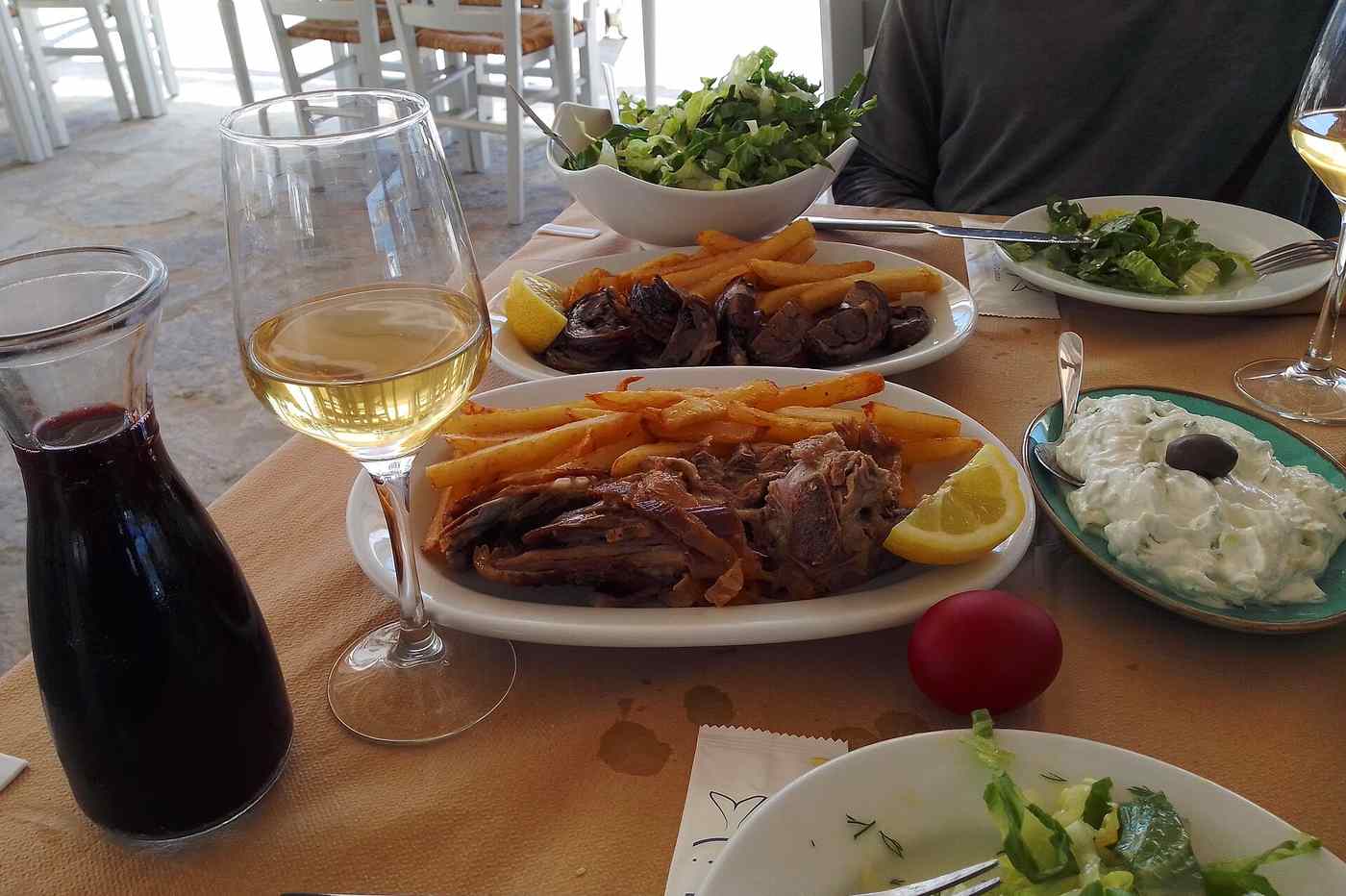
Easter Sunday breaks the fast with the richest feast of the Greek year. The spit-roast lamb takes pride of place, spitted whole and set turning over glowing charcoal soon after dawn. Men of the family tend the fire and the slow turning for many hours, basting the meat as it browns. The aroma of roasting lamb drifts across every village and garden on the island by late morning. Kokoretsi, seasoned offal wrapped in intestine, roasts alongside the lamb on a second spit. Neighbours call across fences to compare their fires and share the first tastes. The shared labour of the roast is as much part of the day as the meal that crowns it.
Tables fill the courtyards and gardens under the mild spring sun by early afternoon. Whole families gather, three generations together, at long boards laden with food and wine. Roast lamb, kokoretsi, salads, cheese and fresh bread crowd the table from end to end. Local wine and tsipouro flow freely, poured in celebration of the risen Christ. Red eggs return for another round of the cracking game between cousins and grandparents. Children dart between the tables while the elders linger over coffee and quiet conversation. Sweets such as tsoureki and koulourakia close the meal out on the terrace. The feast stretches lazily through the afternoon, in no hurry to end on the greatest holiday of the year.
Music and dancing carry the celebration on once the eating slows in the afternoon. Traditional instruments strike up, and villagers of every age link hands for circle dances in the yard. Songs passed down the generations fill the gardens, gathering pace as the wine flows. Larger villages hold open gatherings in the square, where the whole community dances together. Coastal towns such as Limenas add music and celebration along the waterfront through the afternoon. Visitors are drawn into the dancing without ceremony, hands linked with strangers turned friends. The joy of the Resurrection spills from the family table into the shared life of the whole village.
Hospitality reaches its yearly peak on Easter Sunday across the island. Households press food and wine on any guest, and a passing visitor is quickly pulled to a chair at the table. Sharing the lamb with a stranger honours the generosity that the day itself proclaims. Tavernas that stay open serve full Easter menus of lamb, kokoretsi and magiritsa to travellers without a local family. The welcome extends to everyone, Orthodox or not, who meets the day with warmth and respect. A traveller who accepts a seat at an Easter table carries home the warmest memory the island can give. This open-handed feasting is the truest expression of the Thassos Easter spirit.
Which Thassos villages best show Easter traditions?
The mountain villages of Thassos hold the most vivid Easter, above all Panagia, Theologos and the Kazaviti settlements. Their stone lanes frame the candlelit Epitaphios and midnight Resurrection, while whitewashed island churches gather the whole community for the services of Holy Week.
Panagia ranks as the most celebrated village for Easter on the whole island. Stone houses with slate roofs crowd the hillside above Golden Beach, threaded by running water and narrow lanes. The Good Friday procession winds through these steep streets in a scene of rare atmosphere. Springs and plane trees shade the central square where the community gathers after the services. Pilgrims fill its lanes from Holy Thursday onward, and shuttered houses reopen for returning families. The village church of the Virgin stands at the heart of every rite through Holy Week. Visitors staying nearby reach the celebrations with an easy drive up from the coast. The union of setting, faith and tradition makes Panagia the first choice for witnessing a Thassos Easter.
Theologos, the old capital of Thassos, guards Easter customs with equal devotion. The long village stretches along a green valley in the island’s south, far from the modern resorts. Traditional stone mansions and the tall church tower give the processions a stately backdrop. Locals here take special pride in decorating the Epitaphios and in the solemn chants of Holy Week. The village keeps an unhurried, old-fashioned character that suits the mood of the season perfectly. Tavernas roast lamb on the spit through Easter Sunday along the main lane. Woodsmoke from the Easter fires hangs over the valley through the long Sunday afternoon. Theologos offers a deeply traditional Easter, rooted in the history of the island’s former capital.
Mikros and Megalos Kazaviti, twin villages also called Prinos, sit among chestnut and plane forests inland. Restored stone houses and quiet squares make these hamlets a serene setting for Holy Week. Fewer visitors reach them, so their Easter keeps an intimate, village-only character. Candlelit processions thread the shaded lanes on Good Friday with barely a tourist in sight. The midnight Resurrection draws the small community together outside the parish church. Springs and old walnut trees frame the squares where families gather after the service. The cool mountain air still carries a hint of winter over the celebrations here. Travellers seeking the quietest and most authentic Easter find it in these forested inland villages of Thassos.
Coastal towns offer a gentler Easter for visitors based near the beaches. Limenaria, Potos and Limenas hold full services and Sunday feasting within easy reach of the resorts. Whitewashed churches along the shore gather worshippers for the midnight Resurrection above the sea. Fireworks over the water make the coastal Anastasi a memorable spectacle in its own right. Hotels and tavernas that reopen for Easter cater warmly to travellers without a village base. A short drive links these coastal centres to the richer traditions of the mountain villages inland. The choice between shore and summit lets every visitor find the Easter that suits their trip to Thassos.
Why is Easter such a special time to visit Thassos?
Easter is a rewarding time to visit Thassos because spring brings mild weather, green hillsides and wildflowers, with none of the summer crowds. Travellers witness heartfelt Orthodox traditions, enjoy quiet beaches and low rates, and see the island wake gently for the new season.
Spring wraps the whole island in green during the Easter season. Winter rains leave the hills lush and the mountains bright with wildflowers by April. Poppies, daisies and orchids scatter the meadows, and the forests wear their freshest foliage of the year. Days grow warm and clear, though the sea stays cool and the evenings keep a light chill. The landscape looks nothing like the parched gold of high summer that most visitors picture. Anyone weighing the seasons can compare them in our guide to the best time to visit Thassos. The green, blossoming island of spring is a sight the summer crowds never see.
Quiet defines the island at Easter, long before the summer season arrives. Beaches lie almost empty, and the famous coves belong to the handful of travellers who come early. Roads stay clear, parking is simple, and the villages move at their own unhurried pace. Tavernas and hotels reopen gradually through spring, welcoming their first guests of the year with genuine warmth. Room rates sit well below the summer peak, and tables never need booking ahead. Cafe owners have time to talk, and the pace of a spring day drifts easily. The island feels lived-in and local rather than given over to tourism. This calm, spacious mood is one of the great rewards of choosing Easter over the crowded months.
Culture rewards the Easter traveller as richly as the scenery does. The full drama of Orthodox Holy Week unfolds in village churches open to any respectful guest. Candlelit processions, the midnight Resurrection and the Sunday feast reveal the faith at the core of island life. Spring is also a fine season for walking the mountain trails and exploring the archaeological sites in comfort. Cooler days make hiking through the forests and to the ancient ruins far easier than in the summer heat. The living traditions of Easter set this season apart from the beach holidays of July and August. A spring trip trades sunbathing for a deeper encounter with the real character of Thassos.
Planning an Easter visit calls for a little forethought around the movable date and the spring reopening. Ferries from Kavala and Keramoti run on the winter timetable, thinner than the summer service, so checking sailings ahead pays off. Some hotels and tavernas open only from Holy Week onward, so booking a place that operates over Easter matters. Mild days still turn cool after dark, so warm layers help at the midnight service and on mountain evenings. Cash is handy in the villages, where not every taverna takes cards in the quiet season. A trip built around the Greek Easter date lands a traveller in the island’s most heartfelt spring. Careful timing turns an ordinary break into the finest week Thassos offers all year.
Frequently Asked Questions
When is Orthodox Easter celebrated in Greece?
Orthodox Easter follows the Julian reckoning of the Greek Church, so its date differs from the Western holiday most travellers know. Pascha usually lands a week or more after Catholic and Protestant Easter, and in some years a full month later. The feast is movable, falling between early April and early May depending on the spring full moon after the equinox. Greeks call the day Pascha, and the celebration spans a full week from Palm Sunday to the Sunday feast. Travellers planning a Thassos trip do well to confirm the Orthodox date in advance, since it rarely matches the Easter printed on Western calendars. Ferries, hotels and tavernas time their spring reopening around this movable feast, making the exact date the first thing to check when booking a visit.
What is the Epitaphios on Good Friday?
The Epitaphios is a carved and gilded wooden bier that represents the tomb of Christ, central to the Good Friday rites. Young women of each parish smother it in fresh spring flowers through the morning, banking roses, lilies and wildflowers over the frame. An embroidered cloth showing the dead Christ lies at its heart beneath the blooms. Worshippers gather at nightfall for the lamentation service, then carry the bier in procession through the village lanes by candlelight. Chanted dirges and slow-tolling bells accompany the march, which symbolises the funeral of Christ. The faithful stoop to pass beneath the returning bier for a blessing at the church door. On Thassos the mountain villages stage the most atmospheric processions, their stone streets framing the candlelit march through the spring night.
What do Greeks eat at Easter on Thassos?
Roast lamb sits at the centre of the Thassos Easter table, spitted whole and turned over charcoal from dawn on Easter Sunday. Kokoretsi, seasoned offal wrapped in intestine, roasts alongside it on a second spit. Magiritsa, a soup of lamb offal, spring onions, dill and egg-lemon avgolemono, breaks the long Lenten fast after the midnight service. Red eggs dyed deep red on Holy Thursday appear for the cracking game, and tsoureki, the sweet braided bread, rounds out the feast. Local wine and tsipouro flow freely once the fast ends. Salads, cheese and koulourakia biscuits fill out the long Sunday meal. The rich spread stands in deliberate contrast to the plain, bloodless Lenten dishes eaten through the fasting weeks before Easter arrives.
What is magiritsa?
Magiritsa is the traditional Greek Easter soup eaten after the midnight Resurrection service to break the Lenten fast. Cooks build it from the offal of the Easter lamb, chiefly the liver and intestines, finely chopped and simmered. Spring onions, fresh dill and rice go into the pot, and the soup is finished with avgolemono, a sauce of egg and lemon. The dish uses the parts of the lamb not saved for the Sunday roast, wasting nothing of the animal. Families eat it in the small hours, returning from church with lit candles to a warm bowl. The gentle soup eases the stomach back onto rich food after weeks of fasting. Magiritsa marks the true first taste of Easter, bridging the solemn fast and the feast that follows.
Is Thassos a good place to spend Easter?
Thassos ranks among the finest Greek islands for an authentic Orthodox Easter, thanks to its devout mountain villages and green spring landscape. Panagia, Theologos and the forested Kazaviti hamlets stage candlelit processions and midnight Resurrection services of rare atmosphere. Spring cloaks the island in wildflowers, and the beaches lie empty long before the summer crowds arrive. Room rates fall well below the peak season, and tavernas reopen with warm, unhurried hospitality. Travellers witness heartfelt local traditions rather than a staged show, sharing lamb and wine at Easter tables across the villages. Cooler days suit walking the trails and exploring the ancient sites in comfort. The island offers a quiet, genuine Greek Easter, well suited to visitors who want culture and calm over the heat of high summer.
What is the weather like on Thassos at Easter?
Spring weather on Thassos at Easter is mild, green and changeable, a world away from the parched heat of summer. Daytime temperatures climb to pleasant, comfortable levels, ideal for walking and sightseeing. Evenings and nights stay cool, so warm layers help at the midnight Resurrection and on mountain village terraces. Winter rains leave the hills lush and bright with poppies, daisies and orchids through April. The sea remains too cold for most swimmers, though sheltered coves tempt the hardy. Occasional spring showers pass quickly, freshening the forests and meadows. Clear, sunny spells dominate as the season advances toward May. The gentle spring climate makes Easter a fine time for exploring the villages, trails and archaeological sites of Thassos before the summer heat sets in.