
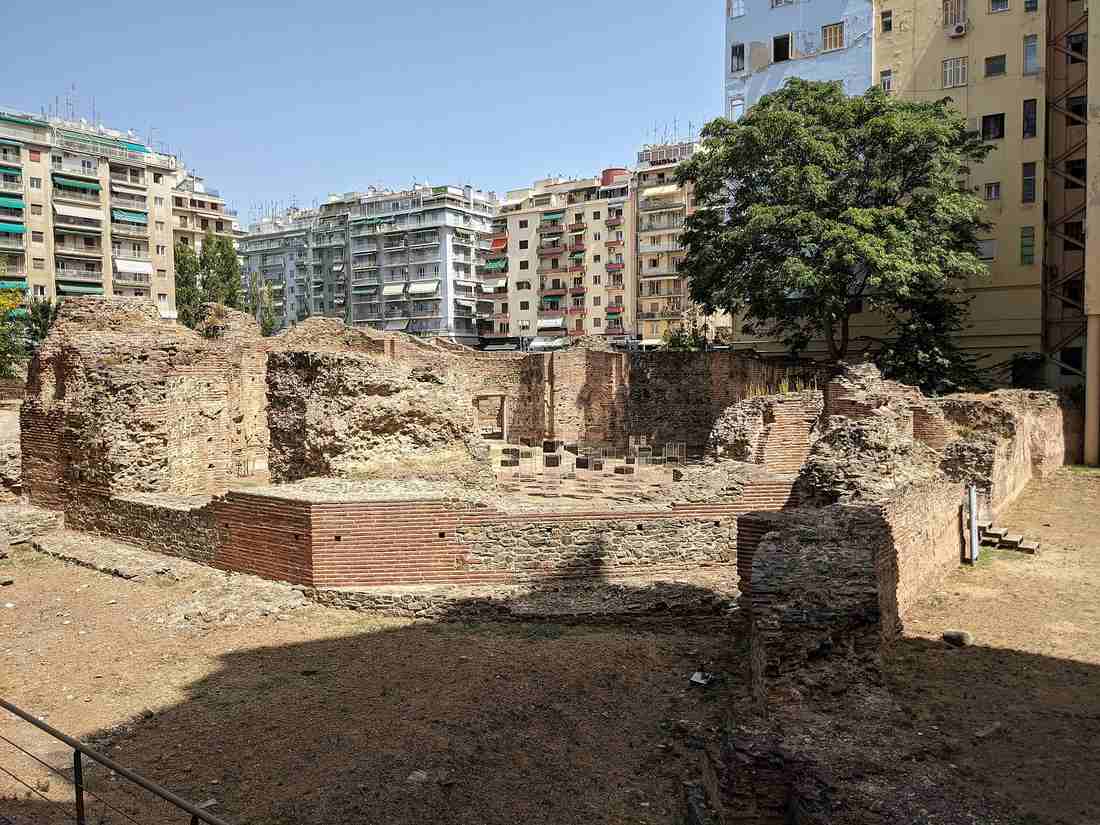
The Palace of Galerius, an architectural marvel from the Roman era, stands as a testament to the grandeur of imperial Thessaloniki. Nestled in the bustling Navarinou Square, this palace was part of a larger tetrarchic complex that included the Arch of Galerius and the Rotunda. The remnants of this once-splendid structure include an octagonal audience hall, a large ceremonial basilica, and a peristyle courtyard with intricate mosaics. A hippodrome once lined its side, showcasing chariot races and imperial displays. Today, the ruins sit gracefully among cafes and student bars, offering a unique blend of history and modern life. Explore this ancient site with My Greece Tours.
The Palace of Galerius is central to understanding the rich history of Thessaloniki. It offers insight into the Roman imperial presence in the region. The sections below cover the architectural features, historical significance, and surrounding attractions of this remarkable site. Visitors can also explore related landmarks like the Arch of Galerius and the Rotunda, which together form an impressive tetrarchic quarter. For a comprehensive experience, consider joining Thessaloniki tours that delve into the city’s ancient past and vibrant present.
What is the historical significance of the Galerius Palace?
The Galerius Palace represents the pinnacle of Roman imperial architecture in Thessaloniki, reflecting the city’s importance in the Roman Empire.
The Palace of Galerius was constructed as part of a grand tetrarchic quarter, signifying Thessaloniki’s prominence in the Roman Empire. This strategic location allowed Galerius to establish a powerful presence in the region, enhancing his influence over the eastern provinces. The palace complex, alongside the Arch of Galerius and the Rotunda, formed a cohesive architectural unit, highlighting the city’s role as a major administrative and military hub. These structures embodied the authority and grandeur of the Roman Empire, showcasing its architectural prowess and cultural influence. The palace’s construction was a testament to the city’s role as a major administrative and military hub. Its strategic position along a major trade route further highlighted its significance, serving both political and cultural functions.
Galerius, one of the four rulers of the Roman Tetrarchy, chose Thessaloniki as his base, making the city a pivotal point in the empire’s governance. The palace served as a residence and a ceremonial space, highlighting the emperor’s status and power. Its strategic placement along with the Arch of Galerius and the Rotunda reinforced the city’s significance and its connection to the broader imperial network. This architectural ensemble was designed to reflect the power dynamics and political ambitions of the era, serving as a visual representation of the emperor’s influence. The interconnectedness of these structures underscores the deliberate planning involved in their construction.
The palace complex not only served political purposes but also played a cultural role in the city’s development. It attracted artisans, architects, and scholars, contributing to Thessaloniki’s growth as a cultural centre. The ruins of the palace, along with the Arch of Galerius and the Rotunda, remain an enduring symbol of the city’s rich historical tapestry. Visitors today can explore these remnants to gain insight into the architectural and cultural achievements of the Roman Empire in Thessaloniki. The site continues to draw historians and tourists alike, eager to explore its storied past. Its enduring legacy is evident in the continued interest and study of its architecture.
What can visitors see at the Galerius Palace site?
Visitors can explore the Octagon, the apsed basilica, the peristyle courtyard with mosaics, and the palace’s service wings.
The Galerius Palace site offers a fascinating glimpse into Roman architectural ingenuity. Visitors can explore the Octagon, believed to be an audience hall adorned with coloured marble. This structure served as a central gathering place for imperial meetings and ceremonies, highlighting its importance in the palace complex. The octagonal shape was a distinct architectural choice, reflecting the emperor’s desire for grandeur and innovation. Its remains, though weathered, still convey the opulence that once characterised the hall. The Octagon’s design and materials highlight the advanced engineering skills of Roman builders, who were adept at creating both functional and aesthetically pleasing structures.
The apsed basilica, another significant feature of the palace complex, stands as a testament to Roman engineering. This large, open space with its semicircular apse served ceremonial purposes, likely hosting important gatherings and events. The design of the basilica emphasized the use of large, open spaces suitable for accommodating large audiences, showcasing the palace’s role as a hub of political and social activity. The basilica’s design was influenced by Roman architectural principles, emphasizing symmetry and functionality. Visitors can imagine the grandeur of imperial ceremonies held within its walls, as they walk through its remnants. The craftsmanship evident in the basilica’s construction speaks to the skill and artistry of Roman builders.
A peristyle courtyard, adorned with intricate mosaic floors, adds to the site’s allure. The courtyard’s design reflects the Romans’ appreciation for aesthetics and their skill in creating harmonious spaces. Mosaic art was a popular decorative element in Roman architecture, and the surviving fragments at the Galerius Palace offer insight into the artistic techniques of the time. The courtyard would have been a place of leisure and contemplation, providing a serene environment amidst the bustling palace complex. The mosaics tell stories of mythological and daily life themes, demonstrating the Romans’ ability to capture both the mundane and the divine in their art. The preservation of these mosaics offers a tangible connection to the past.
How is the Galerius Palace connected to other historical sites in Thessaloniki?
The Galerius Palace is directly linked to the Arch of Galerius and the Rotunda, forming a cohesive imperial complex.
The architectural layout of the Galerius Palace demonstrates its integral connection to the Arch of Galerius and the Rotunda. These three sites were constructed along a single axis, creating a unified imperial quarter in Thessaloniki. This deliberate alignment was designed to reflect the power and influence of the Roman Empire in the region. The palace served as the residential and administrative heart, while the arch and the Rotunda complemented its ceremonial and religious functions. Their strategic alignment underscores the cohesive planning of Roman urban design, which sought to integrate various elements into a harmonious whole. This planning reflected the empire’s broader goals of unity and control.
The Arch of Galerius, located a short distance from the palace, served as a triumphal monument celebrating Galerius’s victories. Its proximity to the palace highlights the interconnectedness of military triumph and imperial authority. The arch’s intricate reliefs depict scenes of conquest and power, reinforcing the emperor’s image as a victorious leader. Visitors can explore the Arch of Galerius to appreciate its artistic and historical significance. Its presence further emphasizes the symbolic and functional unity of the imperial complex. The arch’s detailed carvings provide insights into the historical events and figures of the time.
The Rotunda, another key component of the imperial complex, was originally intended as a mausoleum for Galerius. However, its function evolved over time, serving religious purposes in later eras. Its circular design and massive dome reflect Roman engineering expertise and the adaptability of Roman architecture. The Rotunda’s connection to the palace underscores the blend of political, ceremonial, and religious elements in the imperial quarter. Exploring the Rotunda offers insight into the diverse roles these structures played in Roman Thessaloniki. The Rotunda stands as a testament to the adaptability and continuity of Roman architecture, highlighting the empire’s ability to repurpose structures to meet changing needs.
What role did the hippodrome play in the Galerius Palace complex?
The hippodrome was a venue for chariot races and imperial displays, emphasizing the palace’s role as a centre of entertainment and power.
The hippodrome adjacent to the Galerius Palace was a crucial element of the imperial complex, serving both entertainment and political purposes. Chariot racing was a popular sport in Roman culture, drawing large crowds and showcasing imperial splendour. The hippodrome’s location next to the palace allowed the emperor to host grand events, reinforcing his status and power. Spectators would gather to witness thrilling races, celebrating the emperor’s prowess and the empire’s glory. The noise and excitement of these events would have been palpable, creating an atmosphere of festivity and competition that was central to Roman social life.
Imperial displays and public ceremonies were common at the hippodrome, further emphasizing its importance in the palace complex. These events were not merely for entertainment; they were political tools used to secure loyalty and demonstrate the emperor’s authority. The hippodrome provided a space where the emperor could engage with the populace, strengthening the bond between ruler and subjects. This interaction was vital for maintaining stability and control in the empire. The visual spectacle of the races also served as a reminder of the empire’s power and the emperor’s ability to provide for his people.
The presence of the hippodrome also highlights the cultural and social dynamics of Roman Thessaloniki. It was a place where diverse groups gathered, reflecting the city’s cosmopolitan nature. The events held at the hippodrome were occasions for socializing, networking, and exchanging ideas. Visitors today can explore the area where the hippodrome once stood, imagining the vibrant atmosphere that characterised these public spectacles. The hippodrome’s role as a social hub made it a vital part of the community’s cultural life, providing a space for interaction and entertainment that was integral to the Roman way of life.
How did the Galerius Palace reflect Roman architectural trends?
The Galerius Palace showcased Roman architectural trends with its symmetrical layout, use of coloured marble, and incorporation of mosaic art.
Roman architectural trends are evident in the design and construction of the Galerius Palace. The palace complex featured a symmetrical layout, a hallmark of Roman architecture that emphasized balance and harmony. This design principle was applied throughout the complex, from the arrangement of rooms to the alignment with other imperial structures. The use of symmetry created a sense of order and grandeur, reflecting the power and stability of the Roman Empire. The palace’s layout demonstrated the architects’ mastery of spatial organization, which was crucial for creating functional and impressive imperial spaces.
Coloured marble was extensively used in the palace, particularly in the Octagon. This choice of material was typical of Roman architecture, symbolizing luxury and sophistication. Marble facing was not only decorative but also a statement of wealth and influence. The palace’s marble-clad surfaces would have gleamed in the sunlight, enhancing its majestic appearance. Today, visitors can still see remnants of these marble elements, offering a glimpse into the opulence of the Roman era. The use of marble underscored the empire’s economic and artistic prowess, showcasing its ability to source and transport valuable materials from across the empire.
Mosaic art was another prominent feature of the palace, particularly in the peristyle courtyard. Roman mosaics were renowned for their intricate designs and vibrant colours, often depicting scenes of mythology, daily life, and abstract patterns. The mosaics at the Galerius Palace depicted various themes, showcasing the artistic skills of Roman craftsmen. These artworks were not merely decorative; they conveyed cultural and symbolic meanings, serving as a testament to the empire’s artistic achievements. Exploring the surviving mosaics provides insight into the artistic and cultural values of the Roman Empire. The mosaics’ detailed craftsmanship highlights the era’s artistic achievements and the skill of the artisans who created them.
What is the current state of the Galerius Palace ruins?
The Galerius Palace ruins lie open at street level, integrated into the vibrant urban landscape of Thessaloniki.
The ruins of the Galerius Palace are situated in the heart of Thessaloniki, amidst the lively cafes and bars of Navarinou Square. This integration into the modern urban landscape allows visitors to experience history and contemporary life simultaneously. The palace’s walls and foundations lie below street level, offering a unique perspective on Roman architectural remains. Walking among the ruins, visitors can imagine the grandeur of the past while enjoying the vibrant atmosphere of the present. The juxtaposition of ancient and modern creates a unique cultural experience, blending Thessaloniki’s rich historical heritage with its dynamic urban life.
Conservation efforts have focused on preserving the integrity of the site while making it accessible to the public. Information boards and guided tours provide context and historical background, enhancing the visitor experience. These efforts aim to protect the ruins from further deterioration while allowing people to appreciate their historical significance. The open nature of the site encourages exploration, inviting visitors to engage with the past in a dynamic and interactive way. The preservation work highlights the importance of maintaining cultural heritage and the ongoing efforts to safeguard these valuable remains for future generations.
The Galerius Palace ruins are a testament to Thessaloniki’s rich historical heritage. They offer a tangible link to the city’s Roman past and its evolution over the centuries. As part of the broader imperial complex, the ruins are best appreciated in conjunction with nearby landmarks such as the Arch of Galerius and the Rotunda. Exploring these interconnected sites provides a comprehensive understanding of Thessaloniki’s role in the Roman Empire and its enduring legacy. The historical narrative of the site continues to captivate visitors and scholars alike. Its significance is highlighted by its inclusion in various educational and cultural programs aimed at promoting historical awareness.
Why should tourists include the Galerius Palace in their Thessaloniki itinerary?
The Galerius Palace offers a unique blend of history and culture, providing insight into Roman Thessaloniki’s architectural and political significance.
A visit to the Galerius Palace is essential for anyone interested in Roman history and architecture. The site offers a rare opportunity to explore the remnants of a once-majestic imperial complex. Visitors can walk through the ruins, imagining the grandeur of the Roman era and gaining insight into the city’s historical significance. The palace, along with the Arch of Galerius and the Rotunda, forms a cohesive narrative of Thessaloniki’s role in the Roman Empire. The site’s accessibility makes it a convenient addition to any itinerary, allowing tourists to easily integrate it into their travel plans. The historical context provided by the ruins adds depth to the understanding of Thessaloniki’s past.
The surrounding area of Navarinou Square adds to the appeal of the Galerius Palace. The square is a vibrant hub of activity, with cafes, shops, and cultural events that attract locals and tourists alike. This lively atmosphere provides a stark contrast to the ancient ruins, offering a unique blend of past and present. Exploring things to do in Thessaloniki nearby enhances the overall experience, allowing visitors to immerse themselves in the city’s diverse offerings. The square’s energy complements the historical exploration, providing opportunities for relaxation and enjoyment after a day of sightseeing.
Incorporating the Galerius Palace into a Thessaloniki itinerary enriches the travel experience, providing a deeper understanding of the city’s historical and cultural landscape. The palace’s proximity to other key landmarks makes it an ideal starting point for a Thessaloniki walking tour. This approach allows tourists to discover the interconnectedness of the city’s ancient sites, creating a comprehensive and memorable exploration of Thessaloniki’s rich heritage. The itinerary can be tailored to suit various interests and time constraints, ensuring that visitors can fully appreciate the historical and cultural significance of the city. The inclusion of the palace in travel plans offers a unique opportunity to engage with Thessaloniki’s past.
Frequently Asked Questions
Where is the Galerius Palace located?
The Galerius Palace is located in the south of Thessaloniki, around the modern Navarinou Square. It is part of a larger imperial complex that includes the Arch of Galerius and the Rotunda. The site is easily accessible and integrated into the city’s urban landscape.
What are the main features of the Galerius Palace?
The main features of the Galerius Palace include the Octagon, the apsed basilica, a peristyle courtyard with mosaic floors, and service wings. These elements highlight the architectural and ceremonial aspects of the palace, showcasing Roman design and cultural practices.
How can visitors explore the Galerius Palace?
Visitors can explore the Galerius Palace on foot, as the ruins are open at street level. Information boards provide historical context, and guided tours are available for those interested in a more detailed exploration. The site is part of a broader imperial complex worth visiting.
Is the Galerius Palace suitable for families?
The Galerius Palace is suitable for families interested in history and architecture. The open-air site allows for leisurely exploration, and children can learn about Roman history in an engaging environment. Nearby cafes and shops provide additional amenities for family visits.
What should tourists bring when visiting the Galerius Palace?
Tourists should bring comfortable walking shoes, a hat, and sunscreen, as the site is open-air and involves walking. A camera is recommended for capturing the ruins and nearby attractions. Water and snacks are also advisable for a comfortable visit.
Are there other historical sites near the Galerius Palace?
Yes, the Galerius Palace is near other historical sites such as the Arch of Galerius and the Rotunda. These sites form part of the same imperial complex. Additionally, the Roman forum is another nearby attraction worth exploring.