
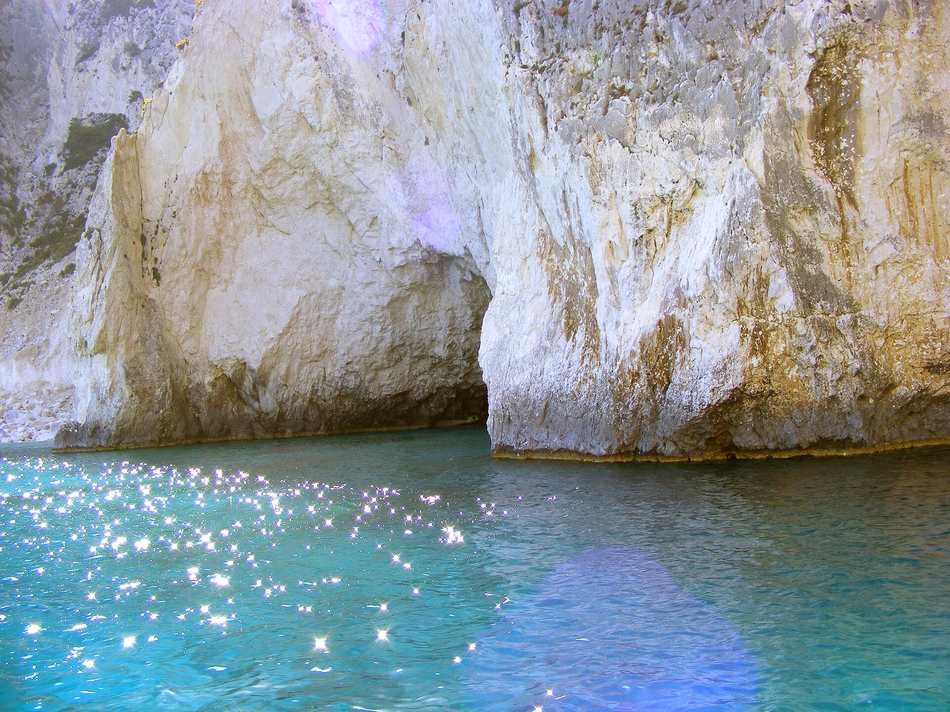
The Keri Caves rank among the natural highlights of southern Zakynthos, a group of sea caves, tunnels and natural rock arches at the far south of the Ionian island. Wind and waves have carved the pale cliffs into grottoes and a large stone arch known as Kamara, where the clear water shines in shades of blue and green. Below the hill village of Keri and its lighthouse, these formations line the coast in pale stone, shaped over centuries of erosion. Small boats reach the caves from the harbour at Limni Keriou nearby, weaving under the arches and into the openings. Discover the best of this coastline with My Greece Tours.
Offshore rise the Mizithres, two pointed white rocks named for their likeness to a local cheese, a landmark of the south coast. The caves lie close to the turtle island of Marathonisi and the marine park waters of Laganas Bay. The Keri lighthouse above offers sweeping sunset views over the Ionian Sea. For a broader look at the island, our Zakynthos travel guide covers every corner. The sections below cover the geology, the boat trips, the swimming, the Mizithres rocks, and the lighthouse viewpoint at the southern tip of the island.
Where are the Keri Caves located in Zakynthos?
The Keri Caves sit at the far south of the Ionian island of Zakynthos, below the hill village of Keri and its lighthouse. They line the pale cliffs of the southern coast, facing the open Ionian Sea.
The Keri Caves occupy a remote stretch of coastline at the southernmost point of Zakynthos, directly below the hill village of Keri. This part of the island faces the open Ionian Sea, where wind and waves have spent centuries carving the pale limestone cliffs into grottoes, tunnels and natural rock arches. The largest of these arches, known locally as Kamara, frames a window of turquoise water that glows in sunlight. Visitors approaching by boat from the harbour at Limni Keriou can see the full extent of the erosion, with openings at every level of the cliff face.
The same geological processes that formed these caves also shaped the Blue Caves on the northern coast, though the southern formations feel quieter and less visited by comparison.
The position of the caves below the village of Keri means they are best appreciated from the water. The lighthouse above the village marks the highest point of the headland and offers a useful landmark for boats navigating the coast. From the harbour at Limni Keriou, the journey to the caves passes along cliffs that drop straight into deep, clear water. The rock here is pale and soft, which is why the sea has been able to hollow it out so dramatically.
On the far side of the island, Navagio Beach draws the biggest crowds, but the southern coast offers an equally dramatic landscape without the same pressure of visitor numbers, making the Keri Caves a rewarding stop for those exploring the less travelled shore.
The Keri Caves line the southwestern tip of Zakynthos below Cape Keri, where the island’s highest sea cliffs drop straight into deep blue water. The caves stretch along the promontory of Marathia, a headland of pale limestone that the sea has hollowed into arches, tunnels, and grottoes. Access comes only by water, from Keri village above or by boat from Limni Keriou and Laganas. The cliffs here rise higher than anywhere else on the coast, giving the caves a dramatic backdrop of sheer white rock. The water below stays clear and cool, coloured turquoise where light bounces off the pale seabed.
Kayak groups and small boats both explore the caves, following the base of the cliffs past rock formations that mark the southern edge of the island.
How do boat trips reach the Keri Caves from Zakynthos?
Small boats reach the caves from the harbour at Limni Keriou nearby, weaving under the arches and into the openings. Trips depart throughout the day and take a short route along the southern coast to the cave entrances.
Boat trips from Limni Keriou harbour are the standard way to visit the Keri Caves, and the journey takes only minutes along the southern coast. The boats are small enough to enter the grottoes and pass through the natural arches, giving passengers a close view of the coloured water inside the caves. Skilled captains steer the vessels into narrow tunnels where the light turns the sea into shades of blue and green. Most operators also combine the caves with a visit to Marathonisi, the turtle island lying just offshore in Laganas Bay.
Booking one of the organised Zakynthos boat tours is the easiest approach, as these trips include the caves, the island and the Mizithres rocks in a single morning or afternoon on the water.
The boats that serve the Keri Caves are typically small motor launches operated by local families from Limni Keriou. The size of these vessels matters, since the cave openings are narrow and the tunnels require a boat that can manoeuvre in tight spaces. Passengers sit close to the waterline, which means the experience feels intimate and the views of the rock formations are unobstructed. The trip usually includes a slow pass along the cliff face so that passengers can photograph the arches and the coloured water inside the grottoes. The same coastline features the finest Zakynthos beaches, with hidden coves that are inaccessible by road.
This combination of geology and shore makes the southern route one of the most rewarding boat journeys on the island.
Boat trips to the Keri Caves set out from the small harbour at Limni Keriou, a sheltered cove below Keri village on the south coast. Skippers guide their craft along the base of the cliffs, easing into the larger caves where the walls glow with reflected light. The route often pairs the caves with a stop near the Mizithres rocks and a swim in a quiet cove. Trips last between one and three hours depending on the operator and the number of stops. Sea kayak tours offer a slower, closer view, letting paddlers slip through narrow arches that larger boats cannot enter.
Both options begin from the Keri side of the bay, and tickets are sold at the harbour. Calm morning water gives the smoothest ride and the best light inside the caves along this exposed southern shore.
What is the Kamara stone arch at the Keri Caves?
Kamara is a large natural stone arch carved by wind and waves from the pale cliffs at the southern tip of Zakynthos. The clear water beneath the arch shines in shades of blue and green, creating a striking visual effect.
The Kamara arch is the most photographed feature of the Keri Caves, and its name comes from the Greek word for arch or bridge. The formation spans a gap in the cliff where the rock has been worn away completely, leaving a curved frame of pale stone above the waterline. Boats can pass through the arch on calm days, giving passengers a view straight up at the underside of the rock. The light that filters through the opening illuminates the water in shifting tones of turquoise and emerald, changing with the angle of the sun.
The arch is a product of the same coastal erosion that has created grottoes and tunnels all along this stretch of the southern shore, where the soft limestone yields readily to the constant action of the sea.
The water inside the Kamara arch and the surrounding caves takes its colour from the pale limestone beneath the surface. Light reflects off the white rock and back up through the water, producing the intense blues and greens that make this stretch of coast so distinctive. The effect is strongest around midday, when the sun is high and the light penetrates directly into the grottoes. Swimmers who enter the water under the arch report that the colour surrounds them completely, giving the experience an almost unreal quality. The caves and arches continue below the waterline, where the rock formations create an underwater landscape that snorkellers can explore on trips that include a stop for swimming inside the grottoes.
The combination of pale stone and clear water defines the character of the southern coast.
The Kamara arch stands among the most striking formations at the Keri Caves, a natural bridge of stone that boats can pass beneath. The sea carved the opening over long stretches of time, leaving a curved span of rock framing the water below. Sunlight filtering through the arch turns the sea a vivid turquoise, and the shade beneath offers a cool pause on a hot day. Skippers slow their boats to let passengers photograph the arch from the water, and kayakers paddle through the gap for a closer view. The formation marks one of the highlights of any Keri Caves trip, a place where the scale of the cliffs becomes clear.
The rock here is soft and pale, the same limestone that shapes the whole southwest coast into arches, tunnels, and hidden grottoes.
Can you swim and snorkel at the Keri Caves in Zakynthos?
Yes, boat trips to the Keri Caves stop for swimming and snorkelling inside the grottoes. The clear water and pale rock below the surface create good conditions for exploring the underwater formations along the southern coast of the island.
Boat operators at Limni Keriou offer trips that include a swimming stop inside one of the larger grottoes along the coast. The water here is calm and sheltered by the rock walls, which makes it suitable for swimmers of all abilities. Snorkellers can see the pale limestone formations continuing below the surface, where fish gather around the rock shelves and the light creates shifting patterns on the stone. The marine park waters of Laganas Bay lie just east of the caves, and the whole area forms part of a protected zone designed to safeguard the loggerhead turtles that nest on the beaches of the bay.
Visitors should always respect the rules of the marine park and avoid disturbing the wildlife that depends on this habitat.
The swimming stops at the Keri Caves are typically brief, lasting around twenty minutes, which is enough time to enter the water, look around and climb back aboard. The water temperature is warm from late spring through early autumn, and the sheltered nature of the grottoes means there is little wave action inside the caves. The proximity of the caves to Laganas Bay means that boat trips often combine the two areas, and passengers can see the full range of the marine park in a single outing.
The long sweep of Laganas Beach lies just around the headland from the caves, and the contrast between the open sandy bay and the enclosed rock formations of the southern cliffs gives a clear sense of the varied coastline of the island.
Swimming at the Keri Caves happens in deep, clear water at the base of the cliffs, usually during stops on a boat or kayak trip. The sea stays cool here, shaded by the tall rock walls and fed by the open water of the Ionian. Snorkellers find rocky ledges and small fish along the cliff base, and visibility often reaches well beyond ten metres on calm days. The caves themselves invite exploration, though swimmers should stay clear of boat traffic and follow their skipper’s guidance. Life jackets are provided on organised trips, and the deep water suits confident swimmers rather than beginners.
The lack of a beach means swimming happens straight from the boat or kayak into the sea. Water shoes help when clambering back aboard, and a waterproof bag keeps cameras safe from spray along the exposed coast.
What are the Mizithres rocks near the Keri Caves?
The Mizithres are two pointed white rocks that rise offshore from the southern coast near the Keri Caves. They take their name from their likeness to Mizithra, a local cheese, and serve as a landmark of the south coast.
The Mizithres are the most recognisable landmark of the southern coast of Zakynthos, and they appear on nearly every postcard and travel guide for the island. The two rocks rise sharply from the sea just west of the Keri Caves, their white peaks resembling the conical shape of Mizithra cheese that gives them their name. Boat trips from Limni Keriou pass close to the rocks, and the view from the water gives a clear sense of their height and their isolation from the mainland cliffs.
The Keri lighthouse stands on the headland above the rocks, and the sunset view from this point across the Ionian Sea is one of the finest on the island, drawing visitors to the southern tip of Zakynthos each warm evening.
The Keri lighthouse above the Mizithres offers sweeping sunset views over the Ionian Sea and the western horizon. The village of Keri sits on the hillside behind the lighthouse, and tavernas here serve fresh fish and local dishes to visitors who come for the evening view. The combination of the caves, the Mizithres and the lighthouse makes the southern tip of Zakynthos a distinct destination from the busier resorts in the north and east of the island. The roads to Keri pass through olive groves and quiet vineyards, and the drive from Zakynthos Town takes about thirty minutes along the coast.
The area rewards a full day of exploration, with the caves by boat in the morning and the sunset from the lighthouse to close the day.
The Mizithres rocks rise from the sea near the Keri Caves, two conical stacks of pale stone named for their likeness to the local mizithra cheese. The formations sit just off the cliffs, framed by the deep blue water of the southern coast. Boats pass close to the stacks, and the sunset light behind them draws photographers to the clifftop above Keri village. The rocks mark a scenic anchor point on many Keri Caves trips, often paired with a swim in the clear water nearby. The clifftop viewpoint above the village looks down on the stacks and the wider sweep of the coast.
Seen from a boat, the Mizithres stand as sentinels at the island’s southern edge, their shape unchanged as the sea works slowly at the softer rock along the base of the towering cliffs.
Frequently Asked Questions
What is the best time of day to visit the Keri Caves?
The best time to visit the Keri Caves is in the late morning, when the sun is high enough to penetrate the grottoes and illuminate the water in shades of blue and green. The light inside the caves is at its most striking between eleven in the morning and one in the afternoon, and the coloured reflections on the pale rock are brightest during these hours. Boat traffic is lighter in the early morning, which means the water inside the caves is calmer and the experience feels more peaceful. The afternoon brings larger crowds at the harbour in Limni Keriou, and the boats tend to queue at the most popular cave openings.
The sunset view from the Keri lighthouse above the caves is spectacular, but the caves themselves are best seen in full daylight, since the colours fade as the sun drops toward the horizon. Visiting in late spring or early autumn offers warm water without the peak season pressure on boat availability.
How far are the Keri Caves from Marathonisi and Laganas Bay?
The Keri Caves lie very close to Marathonisi, the turtle island that sits in the marine park waters of Laganas Bay. A boat trip from the harbour at Limni Keriou can reach the caves in minutes, and the journey from the caves to Marathonisi takes only a short additional stretch along the coast. The proximity of these two attractions means that boat operators routinely combine them into a single trip, giving passengers the chance to see the caves, the arches and the turtle island in one outing. Laganas Bay itself extends eastward from the caves, and its protected waters form the core of the National Marine Park of Zakynthos.
The marine park was established to protect the nesting beaches of the loggerhead turtle, and the rules governing boat speed and access apply throughout the bay. The close relationship between the caves, Marathonisi and the marine park makes the southern coast a compact area rich in natural features.
Can you visit the Keri lighthouse and the caves on the same day?
The Keri lighthouse and the caves are close enough to visit on the same day, and the combination makes for a rewarding trip to the southern tip of Zakynthos. The lighthouse stands on the headland above the caves, and the drive from the harbour at Limni Keriou to the lighthouse takes under ten minutes by car or scooter. A typical day begins with a boat trip to the caves in the late morning, followed by lunch at a taverna in the village of Keri or at the harbour. The afternoon can be spent exploring the village, walking along the cliff paths, or relaxing by the water.
The sunset from the lighthouse is the natural conclusion to the day, offering sweeping views over the Ionian Sea and the Mizithres rocks as the sun drops below the horizon. This schedule takes full advantage of the short distances involved and gives a complete picture of the southern coast of the island.
Are the Keri Caves suitable for children on a boat trip?
The Keri Caves suit families who plan around the deep water and the boat-based access. Children join organised trips readily, as the boats carry life jackets and the skippers keep a steady pace along the cliffs. Swimming stops happen in deep water straight from the boat, so children who are strong swimmers gain the most, while younger ones stay aboard with a parent during the swims. The cave passages and the Kamara arch hold plenty of interest for children who enjoy watching the water change colour beneath the rock. Parents should pack sunscreen, hats, and water, as the open boats offer little shade under the midday sun.
A towel and swimwear cover the swim stops, and a light layer helps on the return if the wind rises. Booking a morning trip gives the calmest sea and the smoothest ride for younger passengers. Choosing a shorter one-hour tour keeps restless children content without a long stretch on the water.