
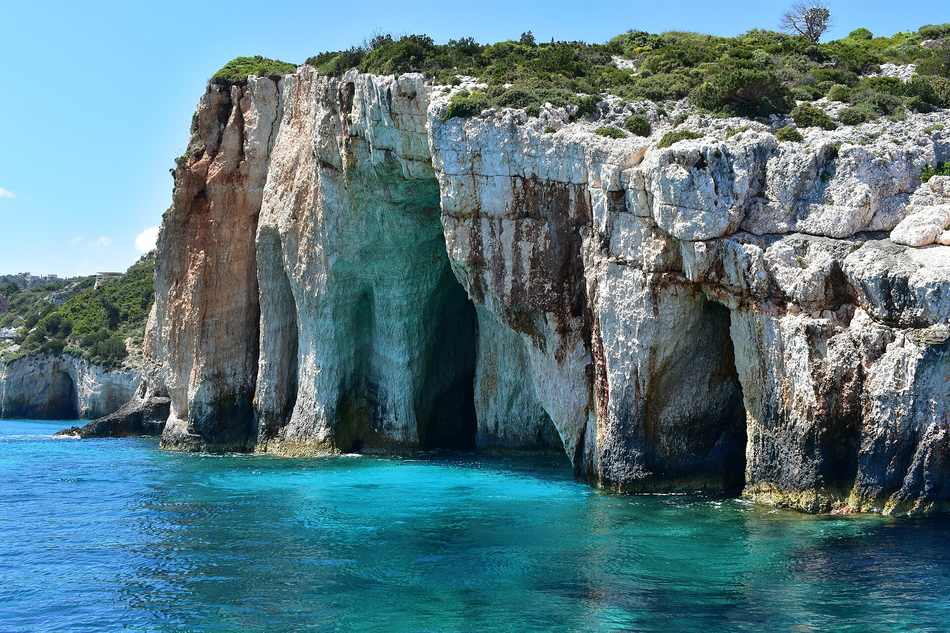
The Blue Caves of Zakynthos are a series of natural sea caves and rock arches carved into the white limestone cliffs on the northeastern tip of the Ionian island. Wind and waves shaped these formations over long ages, leaving hollows and grottoes at the waterline near Cape Skinari and the village of Agios Nikolaos. The name comes from the vivid blue colour the seawater takes on inside the caves, as sunlight reflects off the pale rock beneath the clear water and casts blue tones onto the cave walls. This colour is strongest in the early morning light. Plan your visit with My Greece Tours.
The sections below cover everything visitors need to know about reaching the Blue Caves, the best time of day to experience the vivid blue glow, what the boat journey involves, and what to expect from the rocky setting near the lighthouse at Cape Skinari. Boat tours depart from the harbours at Agios Nikolaos and Cape Skinari, passing under the arches and into the larger openings. The water is deep, clear and cool, and the setting is rocky rather than a sandy beach. Read on for practical details in this Zakynthos travel guide.
Where are the Blue Caves of Zakynthos?
The Blue Caves sit on the northeastern tip of Zakynthos, near Cape Skinari and the village of Agios Nikolaos. They lie close to the lighthouse at Cape Skinari on the north coast, carved into white limestone cliffs at the waterline.
The Blue Caves are tucked along the northeastern coastline of Zakynthos, where the white limestone cliffs meet the clear Ionian Sea. The formations cluster near the lighthouse at Cape Skinari on the north coast and the harbour village of Agios Nikolaos, both serving as the main departure points for boat trips that carry visitors to the grottoes. Wind and waves carved these arches and grottoes into the pale rock over long ages, leaving hollows at the waterline that boats can pass through and explore. The area around Cape Skinari ranks among the natural highlights of the island, standing alongside the dramatic cliffs and coves that draw travellers to this rugged corner of Greece.
The rocky shoreline here contrasts sharply with the smoother stretches of sand found further south along the coast.
The village of Agios Nikolaos sits a short distance from the caves and offers a harbour where small boats depart on a regular basis during the tourist season. Visitors gather here to board vessels that navigate along the rocky coast toward the lighthouse, reaching the first arches and grottoes within minutes of leaving the dock. The boatmen know the formations well and steer their craft under the arches and into the larger openings so passengers can see the glowing blue water from inside. Trips typically last between one and two hours, giving travellers ample time to photograph the limestone walls and the vivid reflections.
The journey from this harbour to the caves is short and straightforward, making the village a popular choice for families and day-trippers.
The northeastern corner of the island stands apart from the busier resorts on the eastern and southern shores. The Blue Caves lie in a quiet stretch of coast where the road ends near the lighthouse at Cape Skinari. Travellers reach the departure harbours by car or scooter along the winding coastal road that climbs above the sea. The drive from Zakynthos Town to Agios Nikolaos takes roughly forty minutes through hillside villages and olive groves. Parking sits close to both harbours, so drivers can leave their vehicles and board a boat within minutes. The rocky headland here rises steeply from deep water, and the caves hide at the base of these cliffs.
The setting rewards visitors who prefer natural scenery over the crowded beaches found further south along the coast.
What causes the vivid blue colour inside the caves?
Sunlight reflects off the pale limestone rock beneath the clear water and casts blue tones onto the cave walls. The effect is strongest in the early morning light, when the sun hits the water at the right angle.
The vivid blue that gives the caves their name is a natural optical effect rather than a pigment in the water. Sunlight enters the clear sea and strikes the pale limestone seabed beneath the cave openings. The light bounces upward, carrying the blue wavelengths with it and projecting those tones onto the white walls and arched ceilings above. Inside the larger grottoes the effect is dramatic, turning the water a luminous turquoise that shifts in intensity as the sun moves across the sky. Boat operators time their trips to reach the caves in the early morning, when the angle of the light produces the deepest and most vivid blue.
The clarity of the water plays an essential role, since particles or sediment would scatter the light.
The colour changes throughout the day depending on the position of the sun. Early morning light produces the strongest blue tones inside the caves, which is the reason tour boats schedule their first departures at dawn. By midday the angle shifts and the intensity of the colour softens, though the water remains clear and inviting. Photographers favour the very first trips of the day to capture the most striking images of the glowing arches and grottoes. The white limestone acts like a reflector, amplifying the blue wavelengths and bouncing them across the smooth surfaces of the rock.
The deep, cool water beneath the caves also contributes to the effect, as deeper water absorbs warmer colours and allows the blue tones to dominate the palette visible inside.
The blue effect depends heavily on the weather and the state of the sea on the day of a visit. Calm water produces the clearest and most even reflections, since a smooth surface carries the light without distortion. A choppy sea scatters the sunlight and dulls the colour, which is the reason boats avoid the caves on windy days. Cloud cover also weakens the effect, because the blue tones rely on direct sunlight reaching the pale seabed. The clearest results come on bright mornings with a settled sea and a cloudless sky overhead. The depth of the water beneath each opening shapes the exact shade of blue that appears.
Deeper pools glow with a richer navy tone, while shallower ledges near the rock show brighter turquoise.
How do visitors reach the Blue Caves from Zakynthos?
Small boats depart from the harbours at Agios Nikolaos and Cape Skinari and pass under the arches into the larger openings. Tour operators offer trips that combine the caves with other sights along the coast.
Travellers can book Zakynthos boat tours that depart from two harbours situated near the caves on the northeastern coast. The harbour at Agios Nikolaos is the busier of the two, with vessels leaving throughout the morning to carry passengers along the rocky shoreline. The departure point at Cape Skinari sits closer to the caves and offers a shorter ride to the first arches and grottoes. Both routes take visitors past the stone lighthouse and along the base of the white limestone cliffs, where the experienced boatmen navigate through the openings and pause inside the larger grottoes. Tickets are sold at kiosks near each harbour, and trips run daily during the high season weather permitting.
The boats are small enough to enter the caves comfortably and safely.
Boat tours that visit the Blue Caves frequently combine the trip with a stop at the famous shipwreck cove further down the west coast. That cove, home to Navagio Beach, is one of the most photographed spots in all of Greece and sits within easy sailing distance of the north cape. Combined tours typically depart in the early morning, visit the caves first to catch the best light, then travel south along the western coast to reach the shipwreck cove. Passengers stay on the boat at the shipwreck cove but can take photos from the deck as the vessel turns slowly in the bay.
The full circuit around the northern and western coastlines gives a complete picture of the dramatic natural scenery that defines this part of the island.
The two harbours suit different kinds of travellers depending on their plans for the day. The small dock at Cape Skinari offers the quickest route, with a ride to the first arches lasting only minutes. This option works well for visitors short on time who want to focus purely on the caves. The harbour at Agios Nikolaos serves as a hub for longer boat trips and larger vessels heading around the coast. Ferries to Kefalonia also depart from Agios Nikolaos, so the harbour stays busy through the morning hours. Independent travellers can rent a small self-drive boat at either harbour and explore the arches at their own pace.
Guided trips remain the simplest choice for those who prefer an experienced boatman at the helm.
What is the largest arch at the Blue Caves in Zakynthos?
The largest arch is known as the Kianoun or Blue Cave. It is the biggest opening in the limestone cliffs and allows boats to pass through into a spacious grotto where the blue reflections are particularly vivid.
The Kianoun, also called the Blue Cave, is the most impressive of all the natural formations along this stretch of coast. Its arch is wide and tall enough for small boats to glide through with room to spare, carrying passengers into a high cavern where the sunlight filtering through the opening turns the water an intense shade of azure. The walls inside are smooth and pale, maximising the reflective effect that gives the site its name. The Blue Caves rank among the natural highlights of Zakynthos alongside its beaches and cliffs, and the Kianoun is the centrepiece that visitors remember most.
Unlike the sandy Zakynthos beaches found elsewhere on the island, this setting is purely rocky, with deep clear water rather than sand beneath the boats.
Beyond the Kianoun, the coastline holds a string of smaller arches and hollows that the boatmen navigate in sequence. Each grotto has its own character, with varying ceiling heights and rock formations that change the way light enters the space. The pale limestone is uniform along this stretch, which means the blue effect appears in every opening where the water is deep enough to catch the reflected light. The largest formations are wide enough for three boats to enter at once during quieter periods of the morning. Passengers often describe the experience of passing through the arches as the highlight of their trip to the island.
The combination of bright sunlight, clear water and white rock makes the caves unlike anything else on the Greek coastline.
The rock along this coast belongs to the same pale limestone that forms the cliffs across the northern cape. This stone dissolves slowly where fresh water and seawater meet, which explains the arches and hollows carved at the waterline. The ceilings inside the larger grottoes rise several metres above the surface, giving small boats clearance to enter. Stalactite-like textures mark the older sections of rock where dripping water has shaped the stone over ages. The pale colour of the walls is essential to the blue effect, since darker rock would absorb the reflected light. Boatmen point out the individual formations by name as they guide their craft through the sequence of openings.
The largest arch draws the most attention, yet the smaller grottoes reward a closer and quieter look.
Can visitors swim inside the Blue Caves?
Boat trips occasionally stop so visitors can swim in the glowing blue water inside the caves. The water is deep, clear and cool, and the setting is rocky rather than a sandy beach, so swimmers should be confident.
Swimming inside the Blue Caves is an unforgettable experience for those who feel comfortable in deep water without a beach beneath their feet. The boats anchor near the larger openings and passengers slip into the sea directly from the side of the vessel. The water is cool and extremely clear, with visibility extending far down through the glowing blue depths toward the pale seabed below. There is no beach inside the caves, no sand underfoot and no gradual slope into the shallows. Swimmers climb back aboard using a ladder or steps at the stern of the boat.
The rocky walls of the grottoes rise straight out of the deep water on every side, creating a natural enclosure that blocks the wind and leaves the surface calm enough for a relaxed and memorable swim.
Visitors who prefer to stay dry still get a close look at the caves from the deck of the boat. The boatmen position their vessels beneath the arches and hold steady so passengers can lean over the rail and watch the light playing across the submerged rock. The colour of the water shifts from deep navy outside the caves to a brilliant turquoise inside the grottoes, and the transition is visible from the boat. Photography from the deck captures the full scale of the arches and the intensity of the reflections on the cave ceilings.
The experience is quieter and cooler than a day spent on the sandy shores further south, and the rocky setting offers a striking contrast to the rest of the island’s coastline.
Snorkelling inside the caves reveals a world beneath the surface that boat passengers rarely notice from above. The clear water allows swimmers to see the pale seabed far below, along with the fish that shelter near the rocks. A mask and snorkel bring the submerged sections of the arches into sharp focus, showing the blue light filtering down through the depths. The water stays cool even at the height of summer. Swimmers should judge their own comfort in open water, since there is no shallow ledge to rest on inside the grottoes. Life jackets are available on most boats for passengers who want extra support in the deep water.
A short swim near the arches leaves a lasting impression of the colour and clarity of the Ionian Sea.
Frequently Asked Questions
When is the best time to visit the Blue Caves of Zakynthos?
The best time to visit the Blue Caves is in the early morning, when the sunlight hits the water at the angle that produces the strongest blue tones inside the grottoes. Tour operators schedule their first departures from Agios Nikolaos and Cape Skinari shortly after sunrise to take advantage of this light. The colour inside the caves gradually softens as the sun climbs higher, so visitors who book the first boats of the day see the most vivid reflections on the walls and ceilings. The high season runs from June through September, when the weather is settled and the sea is calm enough for small boats to enter the arches.
Outside these months the boats run less frequently and rough seas can disrupt trips entirely. Visitors planning a longer stay on the island might also consider exploring the Keri Caves on the southern coast, which offer a similar experience in a different setting.
Are the Blue Caves suitable for children and non-swimmers?
The Blue Caves are suitable for children and non-swimmers who stay on the boat. The tour vessels pass through the arches and pause inside the grottoes without requiring anyone to enter the water. Children can watch the colour change from the deck and take photographs from the rail. The boats are stable and the ride from either harbour to the caves is short and gentle on a calm day. Swimming stops are optional, and passengers who prefer to remain aboard simply stay seated while others swim. The water inside the caves is deep and cool, so parents should keep young children away from the edge of the boat during these stops.
The rocky setting means there is no beach where children can wade, and the seabed drops away steeply from the base of the cliffs. Families bringing young children should choose a calm morning for the smoothest possible experience on the water around the caves.
How long do boat tours to the Blue Caves take?
Boat tours to the Blue Caves typically last between one and two hours, depending on the type of trip and the departure point. Tours that focus solely on the caves depart from the harbour at Cape Skinari, which is closer to the formations, and return within roughly an hour. Trips leaving from Agios Nikolaos take slightly longer because the harbour sits further along the coast and the boat passes additional scenery on the way to the caves. Combined tours that visit both the Blue Caves and the famous shipwreck cove on the west coast take three to four hours. The vessel travels around the northern tip of the island and down the western shore on this route.
These longer trips usually include a swimming stop and a pause at the shipwreck for photographs. Visitors should bring sunscreen, a hat and drinking water regardless of the tour length. The boats offer limited shade, and the morning sun reflects strongly off the white rock and the sea.
What should visitors bring on a Blue Caves boat trip?
Visitors heading to the Blue Caves should pack for three hours on an open boat under strong sun. Sunscreen, a hat and sunglasses guard against the glare that reflects off the white rock and the sea. A towel and swimwear are essential for anyone who plans to swim inside the grottoes during the tour. Water and a light snack keep energy up, since the boats offer limited shade and no refreshments on shorter trips. A waterproof case protects a phone or camera from spray while photographing the arches from the deck. Non-slip sandals help on the wet steps and ladder used to climb back aboard after a swim.
Cash is useful for buying tickets at the harbour kiosks, as card payment is not always available at the smaller docks. A light cover-up guards against the cool breeze on the water during the early morning departures that catch the best light. Passengers prone to seasickness may prefer the shorter route from Cape Skinari on a calm day.