
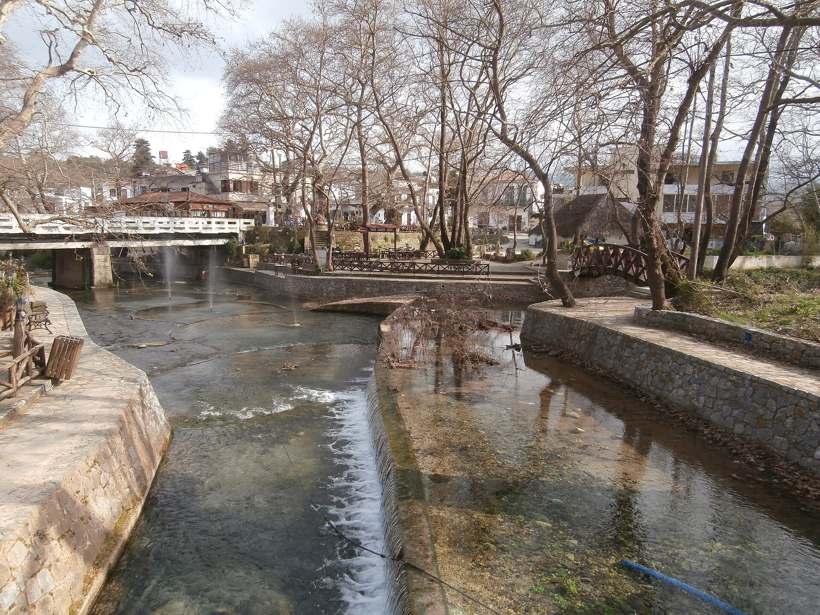
Vryses is a large, shaded village in the Apokoronas region of western Crete, built around a river fed by mountain springs and lined with tall plane trees. Its central square, where the clear water runs beneath the planes, draws travellers and locals alike for a slow coffee in the cool. Old stone bridges cross the stream, and cafes and tavernas gather along the water’s edge. The village is known across the island for its thick sheep’s-milk yogurt served with honey, a simple dish worth the stop alone. Olive groves and the White Mountains rise around it. Plan a shaded mountain-gateway stop with My Greece Tours.
Vryses stands at a natural crossroads. The main road west runs on to Chania, another turns north to the coast, and a third climbs south through the Krapi valley and the Askyfou plateau toward Sfakia and the Libyan Sea. That position has long made it a resting place, a spot to pause under the planes before the mountains or the sea. The sections below cover the springs and square, the famous yogurt, the region around it, the roads that meet here, and how Vryses fits a wider trip. For the full regional picture, our Crete travel guide sets the village against the island’s other mountain gateways.
Where is Vryses in Crete’s Apokoronas region?
Vryses lies in the Apokoronas region of the Chania district in western Crete, built around a spring-fed river under tall plane trees. Olive groves and the White Mountains rise around it, with roads running to Chania, the coast and Sfakia.
Vryses occupies a green pocket of the Apokoronas region, set in western Crete where the lowland olive country meets the rising flank of the White Mountains. A river fed by mountain springs runs straight through the heart of the village. Tall plane trees crowd both banks, throwing deep shade over the water even in the height of summer. Old stone bridges span the stream, linking the two sides of a settlement that has grown around its water rather than turned its back on it. This is a working village of everyday Cretan life, not a resort dressed for visitors, and that lived-in quality is a large part of its appeal.
Travellers pass through on the way between the coast and the mountains, and the village rewards those who stop for an hour under the cool green canopy of the planes.
The setting places Vryses within easy reach of the wider Apokoronas countryside, a gentle landscape of olive groves, small villages and long views toward the sea. The region spreads north from here across low hills toward the Souda bay coast, dotted with old settlements that keep their traditional character. Readers exploring the area in our guide to Apokoronas will find Vryses grouped with the inland villages that carry the region’s quieter, more authentic side rather than its beach resorts. The White Mountains loom close to the south, and their cold springs are the reason the village exists and thrives in the dry heat of the Cretan summer.
Vryses reads as a threshold, the last shaded, watered stop in the lowlands before the road begins its long climb into the high country of Sfakia.
What is the springs square at Vryses like?
The central square at Vryses sits beside the running water, deeply shaded by tall plane trees, with cafes and tavernas gathered along the banks. Old stone bridges cross the stream, and travellers stop here for a cool, slow coffee.
The square is the living heart of Vryses, and it belongs entirely to the running water and the tall old planes. Spring-fed streams run clear and cold through the centre of the village, and the great plane trees arching overhead hold the temperature down on the hottest afternoons. Cafes and tavernas line the banks, their tables set close to the edge so the sound of moving water carries under every conversation. Old stone bridges step across the stream, and locals cross them through the day on their ordinary everyday errands. This is a genuine village square rather than a staged attraction built for a season.
Much of the pleasure lies in sitting among people going about their real everyday lives while the running water and the deep shade do their quiet work all around you.
A coffee under the planes is the classic reason to break a journey at Vryses, and the ritual is worth the stop on its own. The cool draught off the spring water, the green light through the leaves, and the unhurried rhythm of village life combine into a natural pause. Ducks paddle the shallows and the stream runs on beneath the bridges, keeping the whole square fresh through the long dry summer. Travellers heading up toward the mountains or down toward the sea use the square as a threshold, a last cool breath before the road changes character.
Those hunting the island’s quieter corners and hidden gems in Crete often rate this shaded, water-cooled square among the most restful and welcome stops in the whole of the west.
Why is Vryses famous for yogurt and honey?
Vryses is known across Crete for thick sheep’s-milk yogurt served with honey, a rich, traditional dish tied to the mountain pastures nearby. Cafes and tavernas by the water serve it, and the pairing draws travellers to the square.
Thick sheep’s-milk yogurt is the dish that carries the name of Vryses across the island, and it draws travellers off the main road. The yogurt is dense and rich, a world away from the thin commercial kind. It arrives topped with a generous drizzle of local honey that cuts the tartness with a slow sweetness. The pairing owes everything to the land around the village. The sheep graze the mountain slopes above, and the honey comes from hives set among the wild herbs and blossom of the same high country. Cafes and tavernas around the shaded square serve it through the day.
A bowl eaten slowly beside the running water is one of the small, memorable rituals of a trip through this green corner of Crete.
The yogurt sits within a wider tradition of Cretan cooking built on what the land gives up close at hand. Beyond the famous bowl, the tavernas along the stream serve the honest mountain fare of the region: cheeses from the high pastures, olive oil pressed in the surrounding groves, garden vegetables and slow-cooked meat. Meals stretch out in the unhurried island way, generous and rooted in place. Readers keen to understand the wider table will find the village set in context in our overview of Cretan food. There the thick sheep’s-milk yogurt of Vryses stands as one of the region’s true signature tastes, tied firmly to the hills above.
To eat it at the source, in the deep shade by the running spring, is to taste the surrounding landscape itself.
What lies near Vryses toward the mountains?
South of Vryses the road climbs through the Krapi valley to the Askyfou plateau and on to Sfakia and the Libyan Sea. This route opens the high country of the White Mountains, with olive groves and villages along the way.
The land south of Vryses rises quickly into the White Mountains, and the village is the gateway to it. The road leaves the shaded square and follows the Krapi valley steadily upward, a green, narrow corridor of olive groves and small stone settlements hemmed in on both sides by the rising slopes. Higher still it reaches the Askyfou plateau, a wide upland bowl ringed by peaks and dotted with hamlets, a striking change of scale after the low coast. The air cools further with the height, and the whole landscape opens out into wide green pasture and bare grey stone. This climb ranks among the classic mountain drives of western Crete.
Vryses marks its true beginning, the last watered, plane-shaded stop before the road commits fully to the high country.
Beyond the plateau the road drops toward the south coast and the wild region of Sfakia, where the mountains meet the Libyan Sea in cliffs and gorges. This is dramatic country, remote and proud in its character, and Vryses is the natural place to pause and rest before the long descent. The full run from the village to the southern shore carries a traveller from cool spring water through high pasture to open sea in a single memorable drive. Travellers use Vryses as the hinge of such a day, a shaded rest at the foot of the climb and again on the way back down.
The village earns its keep as the meeting point of lowland ease and mountain adventure, sitting close to both yet remaining fully part of neither.
Why stop at Vryses on a Crete trip?
Vryses rewards travellers after shade, spring water, traditional food and a handy base between the north coast and the mountains of Sfakia. The plane-shaded square, the famous yogurt and the crossroads position make it a natural, restful stop.
The case for stopping at Vryses rests on its rare mix of comfort and position. Few places on the island offer such deep, natural shade and such cool running water in the heat of summer. The plane-lined square delivers both the moment you step out of the car. Add the famous sheep’s-milk yogurt with honey, the honest tavernas by the stream, and the easy mood of a real working village, and the reasons to pause stack up fast. This is not a destination that performs for visitors; it simply gets on with its own life beside the water. Travellers are welcome to join it for an hour or an afternoon.
The reward is genuine refreshment, of body and pace alike, in the green heart of Apokoronas.
Position seals the argument for Vryses as more than a coffee stop. The village sits at a true crossroads, within easy reach of Chania and the north coast, the beaches of Apokoronas, and the long mountain road south to Sfakia. That makes it a convenient base or a natural hinge in a touring day, a shaded anchor from which the whole west opens up. Travellers weighing a full itinerary and the wider run of things to do in Crete will find Vryses a useful fixed point, cool and central. That central position turns a simple stop into a genuine base for the whole region.
People who stop here tend to stop again, drawn back by the deep shade, the cold running water and a bowl of thick yogurt that tastes of the hills above.
Frequently Asked Questions
How do you get to Vryses and where does the road lead?
Vryses sits at a crossroads in the Apokoronas region of western Crete, reached most easily by road from Chania to the west. A hire car gives the most freedom here, since the village is above all a place to pause and to branch out from. From the shaded square, one road runs north to the coast and the beaches of Apokoronas. Another turns south and climbs through the Krapi valley to the Askyfou plateau and on to Sfakia and the Libyan Sea. That southern route is one of the classic mountain drives of the west, opening the high country of the White Mountains stage by stage.
The final approach brings you off the main road and down among the plane trees to the running water. Vryses works best as a threshold you settle into for a while, a cool stop before the mountains or the sea, and a natural place to break a long touring day.
What is there to eat in Vryses beyond the famous yogurt?
Thick sheep’s-milk yogurt with honey is the dish that made Vryses famous, and it remains the reason travellers turn off the road. The tavernas by the stream serve far more than that. The kitchens lean on the produce of the surrounding land: cheeses from the mountain pastures above, olive oil pressed in the local groves, garden vegetables, and slow-cooked meat in the honest mountain style. Meals stretch out in the unhurried Cretan way, generous and rooted in the place, and the setting beside the spring-fed water adds to every plate. Cafes around the shaded square pour strong coffee through the day for those who want only a cool pause under the planes.
The village makes a fine lunch stop on a touring day, close to the main road yet far enough into its own rhythm to feel like a genuine taste of inland Crete. To eat the yogurt at the source, in the shade by the spring, is the classic experience here.
Is Vryses a good base for exploring western Crete?
Vryses makes a sound base for exploring western Crete, and its crossroads position is the main reason. The village sits within easy reach of Chania and the north coast, the beaches and villages of the Apokoronas region, and the mountain road that climbs south to Sfakia. That spread lets a traveller settle in one shaded, watered spot and drive out to strikingly different country each day: a city and a coast one morning, a high plateau and a wild southern shore the next. The plane-lined square gives a cool, restful place to return to in the evening. The tavernas by the stream serve honest food after a day on the road.
Olive groves and the White Mountains frame every view. For travellers who value a quiet, authentic anchor over a busy resort, Vryses offers refreshment, real character and a central fix on the map, tying the coast and the mountains of the west together in one well-placed village.