
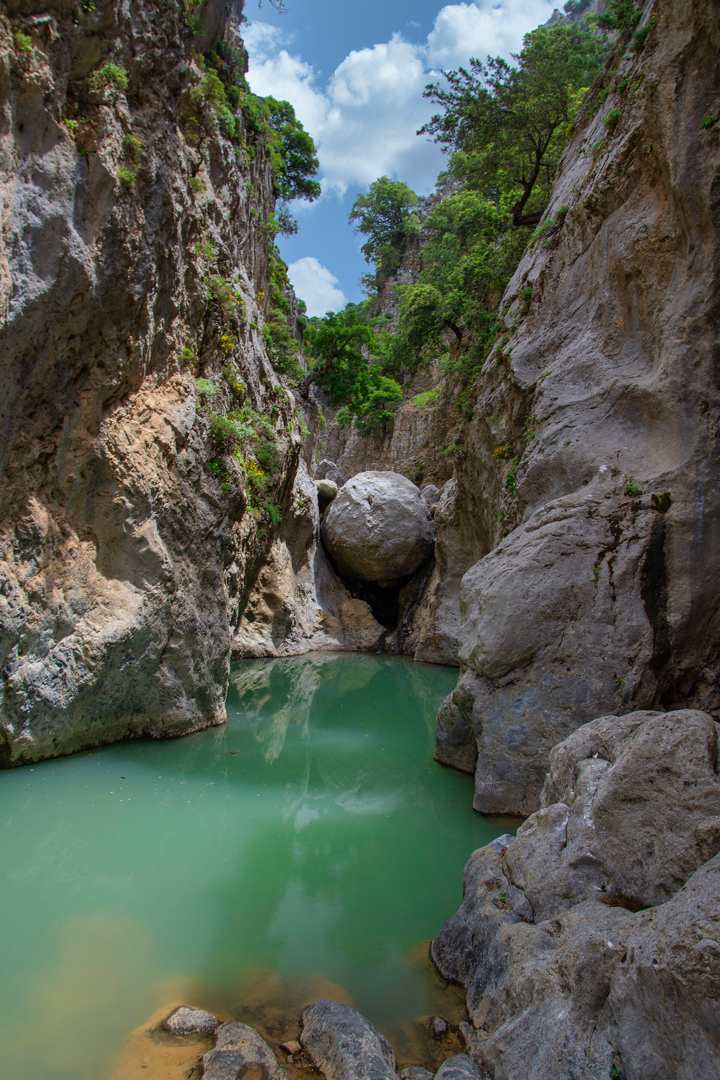
Havgas Gorge is one of the wildest short canyons in eastern Crete, a dark slot cut into the eastern flank of the Dikti mountains in the Lasithi district. Water draining from the Katharo plateau above Kritsa has sliced a sheer channel barely a metre or two wide, broken by waterfalls, deep pools and jammed boulders. The gorge sits in remote mountain country above the Ierapetra plain, near the village of Males. It is a technical descent, not a footpath, and it draws canyoners who want the island at its most raw. Plan your Cretan mountain adventure with My Greece Tours.
Havgas is short in length yet ranks among the more demanding descents anywhere on the island, a route measured in ropes and cold pools rather than kilometres. The sections below cover where the gorge lies and how it forms and what a guided canyoning descent involves. They also weigh whether walkers without ropes can still enjoy the setting, note the rare plants that cling to its dripping walls, and show how Havgas fits into a wider tour of the region. Read it alongside our Crete travel guide before you commit to the mountains around Males and the Katharo road.
Where is Havgas Gorge in Crete and how did it form?
Havgas Gorge lies on the eastern side of the Dikti mountains in the Lasithi district of eastern Crete, near the village of Males and below the Katharo plateau above Kritsa. Draining plateau water carved its deep, narrow slot.
The gorge belongs to a wild band of mountain country that rises between the Ierapetra plain and the high Katharo plateau. Rain and meltwater gather on the plateau above Kritsa, then pour off its eastern rim toward Males, and over an immense span of time that flow has ground a channel into the limestone. The result is a dark, sheer slot barely a metre or two wide in places, so tight that daylight struggles to reach the streambed. Waterfalls, deep pools and boulders wedged between the walls break the descent into a series of drops.
The upper entrance sits near the mountain road that climbs from Males toward the plateau, which makes the top of the canyon easier to locate than the hidden depths below it.
Reaching the trailhead means driving into genuinely remote terrain, so a canyoning day here pairs naturally with the wider list of things to do in Crete in the eastern districts. The nearest village of any size is Males, a small settlement clinging to the slopes above the Ierapetra plain, and the road on toward Katharo is narrow and winding. The landscape reads as pure Cretan highland: bare grey rock, scattered oak, and long views down toward the coast. This isolation is part of the appeal. The gorge sees only a fraction of the visitors who crowd the famous walking canyons farther west.
Its mountain silence is almost total once the road is left behind, and the sense of remoteness deepens with every hairpin bend the car climbs above the plain.
What does a guided canyoning descent of Havgas involve?
Havgas is a technical canyoning route, not a walking trail. It demands ropes, wetsuits and a qualified guide, and it ranks among the more demanding descents on the island, mixing abseils down waterfalls with cold swims through deep, narrow pools.
A descent begins near the upper entrance off the Males road, where the party gears up before the walls close in. From there the canyon drops through a chain of obstacles: waterfalls that must be abseiled, pools too deep to wade and cold enough to demand a wetsuit, and boulders jammed across the slot that force careful downclimbing. The passage is barely a metre or two wide in the tightest reaches, so the group moves one at a time, threading ropes through anchors and lowering each member past the drops. This kind of terrain sits well beyond ordinary hiking in Crete.
The reward is a stretch of the island almost no walker ever sees, a hidden corridor deep inside the mountain where the stone presses close on both sides and every step must be earned with rope and technique.
Experienced canyoners on a guided descent are the only people who should attempt Havgas, and even strong parties treat it with respect. A guide handles the anchors, judges the water and reads the weather, since a mountain storm can turn a dry slot into a torrent within the hour. The reward for that seriousness is exceptional: shafts of light dropping into a black corridor, the roar of falls magnified by close stone, and pools of startling clarity beneath the boulders.
Havgas draws adventurers who have exhausted the standard routes and want something raw, so it earns a place on any serious list of hidden gems in Crete that reward hard effort with solitude and a taste of the island untouched. The memory endures long after the ropes are coiled and packed away.
Can walkers without ropes still enjoy the Havgas area?
Walkers without canyoning gear cannot descend Havgas itself, yet they can still savour the setting. Ordinary visitors admire the wild mountain scenery and the villages around it from the road above, enjoying highland views without technical risk.
The slot is off limits to anyone lacking ropes and a guide, but the country around it rewards a gentler visit. The road between Males and the Katharo plateau climbs through classic eastern highland scenery, passing the upper entrance and offering long views back down toward the Ierapetra plain. Travellers can pause at viewpoints, wander the lanes of Kritsa lower down, and picture the hidden canyon threading the rock below. The mountain villages here keep an unhurried rhythm, with small tavernas, stone houses and orchards on the terraced slopes. For most visitors this scenic drive, taken slowly with occasional stops, captures the spirit of Havgas without ever entering the dangerous depths of the gorge.
The rim itself is reward enough, and the sound of unseen water far below adds a quiet thrill.
A road trip to the rim also links neatly to the broader highland circuit above Kritsa. The same route carries on to the Katharo plateau, a remote upland basin ringed by peaks and famous for its clear air and seasonal pasture. Drivers can string together the plateau, the gorge overlook and the old villages into a single day out, turning a technical canyon they will never enter into the centrepiece of a memorable mountain loop. The contrast is the draw: a savage slot invisible from the tarmac, wrapped in open, sunlit highland that anyone can enjoy.
Bring water, a full tank and patience for slow roads, and the wild heart of eastern Crete opens up without a single abseil. The whole loop feels like a discovery, even for travellers who never touch a rope.
What rare plants grow on the walls of Havgas Gorge?
Rare plants cling to the shaded, dripping walls of Havgas, thriving where constant moisture and deep shadow shelter them from the harsh Cretan sun. The permanent damp of the slot creates a rich refuge unlike the dry slopes above.
The permanent shade and trickling water inside the slot build a micro-habitat wholly unlike the parched mountainside around it. Where the sun almost never reaches the streambed, ferns, mosses and specialised rock plants take hold on the wet stone, and the walls stay green and glistening even as the surrounding highland bakes. Deep gorges like this act as natural strongholds for unusual flora, sheltering species that vanished long ago from the exposed slopes. On Crete, whose mountains hold an exceptional share of plants found nowhere else on earth, these damp clefts matter far beyond their size. Havgas, though short, packs its walls with life, and every dripping ledge becomes a hanging garden clinging to the near-vertical rock.
The greenery seems all the more striking against the grey stone and the sun-scorched country stretching away overhead.
This botanical richness gives the canyon a value beyond sport, turning a technical descent into a passage through a living archive of the mountain. The same qualities that make Havgas dangerous, its depth, its narrowness and its constant moisture, are exactly what let rare plants survive. Careful canyoners tread lightly on the ledges and leave the vegetation undisturbed, aware that a single slot can shelter treasures the wider slopes have lost. For lovers of wild nature, the gorge sits comfortably beside the region’s other Ierapetra attractions and the botanical corners of the eastern mountains. It is a reminder that the island rewards curiosity in its hidden places as much as on its celebrated beaches and famous ancient sites.
A gorge measured in metres can still hold wonders that a whole coastline of resorts will never quite offer the traveller.
How does Havgas Gorge fit into a wider Crete tour?
Havgas anchors a wild-mountain leg of any eastern Crete itinerary. Adventurous travellers pair a guided descent with visits to Kritsa, the Katharo plateau and the Ierapetra coast, while cautious visitors enjoy the scenery from the road above.
The gorge slots neatly into the eastern corner of the island, close enough to the coast to combine with a beach base yet deep enough in the mountains to feel worlds apart. A typical plan sets out from the Ierapetra plain, climbs toward Males and the plateau, and devotes a full day to either the technical descent or the scenic drive. Around it lie the historic village of Kritsa, the byzantine chapels of the slopes and the high pasture of Katharo, so the canyon rarely stands alone on an itinerary.
Adventure operators treat it as the wild set piece of an eastern loop, the moment when a gentle touring holiday briefly turns serious and the group tests itself against genuine mountain terrain. The descent becomes the story everyone retells around the taverna table that night.
Fitting Havgas into a broader trip means being honest about who is descending. The technical route belongs to experienced canyoners with a guide, while everyone else builds the day around the drive, the villages and the views. Either way the gorge adds a note of untamed drama that the coastal resorts cannot match, a reminder that eastern Crete keeps its wildest ground well back from the sea. Travellers who want that edge without the ropes still come away satisfied, having stood on the rim of one of the island’s fiercest little canyons.
Havgas, in short, turns an ordinary eastern circuit into an adventure, whether you rope into its depths or simply salute it from the sunlit road high above the slot. That flexibility is why the gorge earns its place on the map.
Frequently Asked Questions
Is Havgas Gorge safe to visit without a guide?
Havgas Gorge is not safe to descend without a qualified canyoning guide. The route is technical rather than a walking trail, and it ranks among the more demanding descents on the whole island. Progress depends on ropes, wetsuits and sound judgement, as the party must abseil waterfalls, swim cold pools and downclimb past boulders jammed across a slot barely a metre or two wide. A guide sets the anchors, reads the weather and manages the cold water, all of which lie beyond an unsupported visitor’s control. A sudden mountain storm can flood the narrow channel with terrifying speed, turning a manageable descent into a trap. Walkers who lack gear should never enter the gorge itself.
They can still enjoy the wild mountain scenery and the villages around it in complete safety from the road above. That road climbs between Males and the Katharo plateau and offers long views without any technical risk at all.
How does Havgas compare with the famous walking gorges of Crete?
Havgas differs sharply from the island’s celebrated walking gorges. Where the great tourist canyons offer marked footpaths that ordinary hikers follow on foot, Havgas is a dark, sheer slot that demands full canyoning technique. It is short in length yet extremely deep and narrow, broken by waterfalls, deep pools and jammed boulders that no walker could pass. That makes it a specialist’s objective, appealing to canyoners who have worked through the standard routes and crave something raw and genuinely challenging. The setting is wilder too, buried in remote mountain country on the eastern side of the Dikti range, above the Ierapetra plain and below the Katharo plateau.
Visitors comparing options should treat Havgas as an adventure sport rather than a day hike. Those seeking a classic walkable canyon will look elsewhere, while thrill-seekers will find in this narrow eastern slot a descent that rewards experience with solitude, cold water and raw mountain drama.
When is the best time to attempt Havgas Gorge?
The best window for Havgas falls in the warmer, drier stretch of the year, once the heaviest mountain rains have passed and water levels in the slot have settled. Timing matters intensely here, as the gorge collects drainage off the Katharo plateau, and a storm on the high ground can send a dangerous surge through the narrow channel with little warning. Experienced parties therefore favour stable, settled weather and always plan around the forecast rather than a fixed date. Even in the friendly season the pools stay cold, so a wetsuit remains essential for the swims and abseils.
The upper entrance near the Males road stays accessible through much of the year, yet the descent itself should wait for the right conditions and an available guide. Booking through a reputable canyoning operator who knows this eastern country well is the surest way to pick a safe day and enjoy the wild heart of the gorge at its finest.