
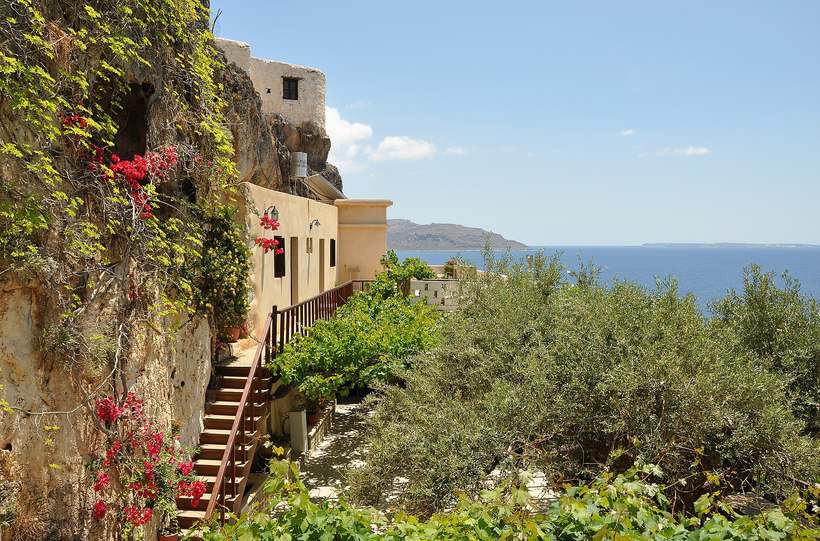
Kapsa Monastery is one of the most striking places on the far southeast coast of Crete, a white cluster of buildings that clings to a cliff at the mouth of the Perivolakia gorge above the Libyan Sea. Dedicated to Saint John the Baptist, it sits in the Sitia area of the Lasithi district, near the village of Goudouras and well beyond the reach of the resorts. Its walls are built straight into the rock, and its cave church and quiet courtyard reward travellers who make the long drive down empty roads. Plan a visit to this remote corner of the island with My Greece Tours.
This clifftop retreat rewards curiosity rather than crowds. A working monastery with a resident community, Kapsa holds the tomb of the monk Gerontogiannis, a healer revered across eastern Crete whose relics still draw pilgrims through the year. The setting, wedged between the mountains and the sea, looks out toward the islet of Koufonisi and the open water beyond. The sections below cover how to reach the monastery, what to see inside its cliff-hugging chapels, the gorge that climbs behind it and the wild beaches nearby. Fold Kapsa into a wider tour of the region using our Crete travel guide.
Where is Kapsa Monastery on Crete?
Kapsa Monastery stands on the remote southeast coast of Crete, in the Sitia area of the Lasithi district, above the sea near Goudouras. It clings to a cliff at the mouth of the Perivolakia gorge, facing the open Libyan Sea.
The monastery occupies a dramatic ledge where the Perivolakia gorge meets the coast, its white buildings wedged so tightly against the rock that they seem to grow from it. This is the far southeast corner of the island, a long way from the airports and the busy resorts of the north. The nearest settlement is Goudouras, a scatter of houses and greenhouses along a quiet shore, while the larger town of Sitia lies further up the coast. Travellers piecing together a route through this district often pair the monastery with other things to do in Crete that lie off the main tourist trail. Empty beaches, half-forgotten chapels and inland villages fill out a day here.
Each stop feels like a discovery earned by the long, winding drive down to the southern shore.
The position feels deliberately hidden, and that is much of its appeal. The Libyan Sea stretches south from the cliff toward the islet of Koufonisi, a low green shape on the horizon on a clear day. Behind the buildings the gorge climbs steeply inland, cutting a shaded corridor into the hills. The whole scene, mountains dropping straight into the water with the monastery clinging to the join, ranks among the most memorable on the island. The regional hub of Sitia makes a natural base for reaching this coast, with its harbour, its shops and its road running south toward the wilder shores. From there the tarmac unwinds through farmland and coastline.
It delivers you, almost at the end of the driveable road, to the gate of the monastery itself above the surf.
How do you reach Kapsa Monastery in Crete?
A rough but scenic road reaches Kapsa Monastery from Sitia and Makrigialos, running south past greenhouses and empty beaches to Goudouras. The final stretch is narrow and winding, so allow extra time and drive with real care.
Most visitors arrive by car, and the drive itself becomes part of the experience. From the north the route drops down toward the south coast and follows the shore past plastic-covered greenhouses, small chapels and beaches where you may not see another soul. The road narrows as it nears Goudouras, then twists along the cliff to the monastery gate. The resort of Makrigialos works well as a launch point, with its long sandy bay, tavernas and easy parking before the quieter final leg. Fill up on fuel and water in town, because services thin out sharply once you turn onto the coastal road toward Kapsa.
The scenery more than repays the effort, unrolling one wide sea view after another as the tarmac hugs the edge of the wild southern shore.
The last kilometres call for patience rather than nerve. The surface is uneven in places and the lane hugs the drop, so a slow, steady pace pays off, and meeting an oncoming vehicle means easing into a wider spot. Reward comes at the end, where a small area lets you leave the car before the short walk to the entrance. Explorers who enjoy this kind of remote driving tend to collect other hidden gems in Crete on the same trip, linking coves, gorges and lonely monasteries into a single unhurried route. Set out early to enjoy the coast in soft light and to reach the monastery before the midday heat settles over the exposed southern rock.
An early start also means a calmer walk up to the gate and a quieter courtyard once you arrive at the cliff edge.
What can you see inside the monastery?
Inside you find white buildings built into the rock, a cave church cut into the cliff, and the tomb of the monk Gerontogiannis, a nineteenth-century healer revered across eastern Crete. His relics still draw pilgrims to this working monastery.
The heart of the site is the church, part of which burrows into the living cliff so that bare rock forms the walls of a small chapel. Lamps and icons glow in the dim interior, and the contrast between the sunlit courtyard and the cool cave space gives the visit its particular character. The tomb of Gerontogiannis draws the steadiest stream of visitors, and pilgrims come to honour a man remembered across the east of the island as a holy healer. He lived and worked here in the nineteenth century, and stories of his cures and his simple, ascetic life have kept his memory alive along this coast for generations.
Icons, oil lamps and worn stone steps carry the weight of that long devotion, and the hush inside the chapel makes the history feel close and present rather than distant.
This remains a living community rather than a museum, so a respectful, modest approach matters, with covered shoulders and knees and a quiet voice in the church. Whitewashed cells, a small courtyard and simple terraces open onto huge views of the sea, and the sound is mostly wind and water. Pause on the terrace to take in the sweep toward Koufonisi before heading on to explore the coast around Xerokambos, a low-key bay of pale sand and turquoise shallows a little further along the southeast shore. The pairing of sacred cliff-side stillness and open beach captures the mood of this whole quiet corner of the island in a single, unhurried day.
Linger long enough and the place rewards you with a rare, restorative sense of calm above the restless southern water.
Can you hike the Perivolakia gorge from Kapsa?
Yes. The Perivolakia gorge climbs inland behind the monastery, giving walkers a quiet route into the hills above the coast. The path threads between rock walls and offers shade and solitude away from the exposed shoreline below.
The gorge begins almost at the monastery door and heads north into the mountains, following the line of a seasonal stream bed. The walls close in as you climb, throwing welcome shade across the route on hot days, and the trail passes rock pools, oleander and the occasional small chapel tucked against the cliff. It is a walk for solitude rather than crowds, and you may have the whole gorge to yourself outside the busiest weeks. Anyone drawn to this landscape can string the route into a wider programme of hiking in Crete, from short coastal strolls to the long, famous canyons that cut through the island’s mountainous spine.
The Perivolakia route stays gentle and intimate by comparison, a green seam of shade and birdsong hidden between the dry hills and the bright, exposed southern coast below.
Come prepared, because this is remote country with little shade at the lower end and no shops once you leave the coast. Carry enough water, wear proper footwear for the loose, stony ground and start early to avoid the fierce southern sun. The upper gorge eventually reaches the small inland village of Perivolakia, and stronger walkers can arrange a return along the road or a pick-up rather than retracing the whole climb. The reward is a rare sense of space, the smell of wild herbs on warm rock and the slow reveal of the sea again as you turn back toward the monastery.
Check the forecast first, since flash flooding can make any gorge dangerous after heavy rain, and tell someone your plans before you set off into this empty, sun-scorched inland country alone.
Is Kapsa Monastery worth the trip?
For travellers after solitude, a working monastery and the wild coast of the far southeast, Kapsa rewards the effort richly. Its clifftop setting, cave church and gorge combine into one of the most memorable stops on the island.
Kapsa suits a particular kind of visitor, the one who values quiet, distance and a strong sense of place over easy access and beach-bar comforts. The long drive filters out the casual crowds, so those who make the journey often find the site almost to themselves, sharing it only with a scattering of pilgrims and the resident monks. The combination of sacred history, dramatic geology and open sea is hard to match elsewhere, and the memory of the white walls against the cliff tends to outlast busier, brighter days.
Set aside enough time to sit on the terrace, walk a little way up the gorge and simply absorb the silence before the road pulls you back toward the resorts. This is a place that repays patience and a slow, attentive pace rather than a hurried tick on a list.
The visit works best as the centrepiece of a slow day on the southeast coast rather than a rushed detour. Bring water, snacks and a full tank, respect the modest dress code and the rhythm of a living community, and give yourself room to linger. Combined with a swim at a nearby beach and a meal in a coastal taverna, Kapsa becomes the kind of experience that defines a trip to this end of the island. It stands as proof that the wilder, emptier corners of Crete still hold surprises for anyone willing to leave the well-worn tourist track.
Follow that rough road all the way to its end above the Libyan Sea, and the clifftop monastery repays the miles with a stillness and a view that stay with you long after the journey home.
Frequently Asked Questions
Who was Gerontogiannis and why do pilgrims visit his tomb?
Gerontogiannis was a monk who lived at Kapsa in the nineteenth century and became known across eastern Crete as a healer and holy man. Accounts describe a former layman who turned to a strict ascetic life and rebuilt the monastery after years of decline, gaining a reputation for cures, prophecy and simple wisdom. His memory endured in the villages and along the coast, and his relics, kept at the monastery, still draw pilgrims who come to pray, light candles and honour him. Worshippers arrive on his feast day and at major religious festivals, when the quiet site fills with people from the surrounding district.
For visitors of any faith the tomb offers a window onto the deep religious tradition of this remote coast. Holy sites and everyday life have stayed closely woven together here for generations. The steady devotion around his tomb explains why Kapsa remains a place of pilgrimage as much as a scenic stop for travellers.
What should I wear and know before visiting the monastery?
Dress modestly, because Kapsa is a living monastery rather than a tourist attraction. Cover your shoulders and knees, keep your voice low inside the church and follow any guidance from the monks or the signs at the gate. Opening hours can vary with the seasons and the community’s routine, so aim to arrive in the morning and be ready to find the site closed during a midday rest. There are no shops or cafes at the monastery itself, so bring water and snacks, and fill your fuel tank before leaving the last town. The road in is narrow and rough in places, which suits an unhurried pace and a small, manageable car.
Photography inside the church may be restricted, so ask first and switch off any flash. A calm, respectful approach lets you enjoy the extraordinary setting without disturbing the pilgrims and monks who make Kapsa their spiritual home. It also leaves the place as peaceful as you found it for those who follow you down that coastal road.
How does Kapsa fit into a wider trip around southeast Crete?
Kapsa pairs naturally with the other quiet highlights of the far southeast, forming the anchor of a relaxed touring day well away from the crowds. From a base up the coast you can drive down past empty beaches to the monastery in the morning, then swim, walk a gorge or explore a village in the afternoon. The wider district rewards slow travel, with hidden coves, low-key resorts and inland settlements that see few foreign visitors. Combine the monastery with a stretch of coast walking, a long lunch by the water and an unhurried return in the evening light. You then have a day that captures the character of this remote end of the island.
This is a region for travellers who prefer space and authenticity to organised entertainment. Kapsa, with its cliff, its cave church and its sweeping sea views, makes an unforgettable centrepiece for that kind of gentle journey. Give it the time it deserves and the southeast reveals itself as one of Crete’s most rewarding corners.