
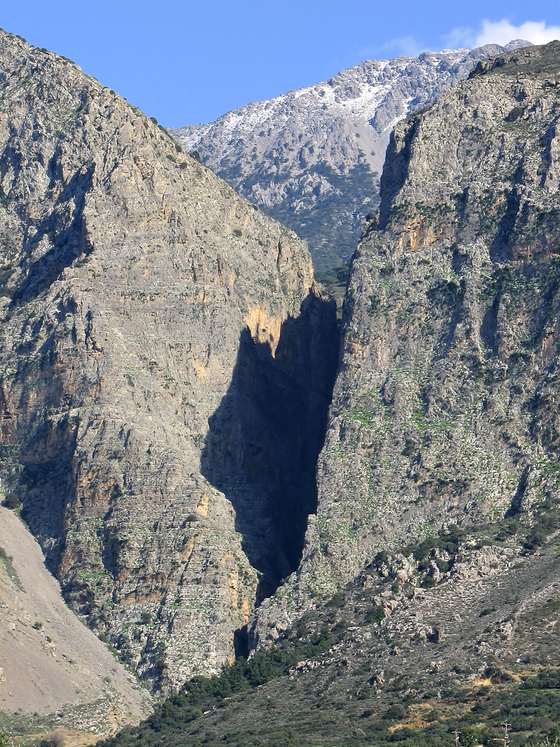
Ha Gorge, known locally as Faragi Ha, slices the western face of the Thripti mountains above the Ierapetra plain in eastern Crete. Its huge dark cleft is visible for kilometres across the plain. The gorge is a near-vertical slot, barely a couple of metres wide in places. A chain of waterfalls and deep pools breaks the descent. It ranks among the most difficult and spectacular canyons in Greece, a route for roped, technical descent rather than an ordinary walk. The Lasithi district holds few sights this raw. Plan your eastern Crete adventure around this striking natural landmark with My Greece Tours.
This guide explains what Ha Gorge is and who can descend it. It also shows where the ravine sits and how to reach the viewpoints across the Ierapetra plain. The sections below cover the geography of the ravine and the canyoning skills it demands. They also cover the waterfall that pours from its mouth after heavy rain, the rare plants shielded within its Natura conservation zone, and the cool plateau village of Thripti above. For wider trip planning across the island, our Crete travel guide connects this canyon to the beaches, towns and mountains around it.
What is Ha Gorge in Crete?
Ha Gorge is a narrow gorge cutting the western face of the Thripti mountains above the Ierapetra plain in eastern Crete. It is a near-vertical slot, barely a couple of metres wide, broken by waterfalls and deep pools.
Faragi Ha slices the western wall of the Thripti mountains. It drops steeply toward the Ierapetra plain in the Lasithi district of eastern Crete. The gorge is a slot canyon in the strictest sense, a fissure barely a couple of metres wide in places. Its sheer walls close overhead and shut out the sun for long stretches of the descent. A chain of waterfalls and deep pools breaks the route down. Progress means dropping from one plunge pool to the next rather than walking a marked path. The scale of the cleft is startling from a distance.
The ravine anchors a memorable list of things to do in Crete for travellers drawn to the wild eastern mountains and their hidden canyons. It stands well apart from the beaches and towns that fill most island itineraries.
The gorge ranks among the most difficult and spectacular canyons in the whole of Greece. Its reputation rests on that combination of vertical drops and confined space. Seen from below, the huge dark cleft in the mountain face is visible for kilometres across the flat Ierapetra plain. The gash marks the mouth of the ravine and guides the eye toward the mountain. The nearest town, Ierapetra, spreads along the southern coast below. The gorge sits within a short drive of it. This closeness to a sizeable town makes Ha unusual. So demanding a canyon lies within easy reach of a beach resort rather than buried deep in remote wilderness.
The road up climbs quickly from sea level into the pine slopes of the Thripti range above the plain.
How difficult is canyoning in Ha Gorge?
Ha Gorge ranks among the most difficult canyons in Greece and demands ropes, harnesses, wetsuits and technical skill. Only experienced canyoners descend it, almost always with a specialist guide, since it is no walking route.
The descent of Ha Gorge belongs firmly to technical canyoning rather than hiking. Experienced canyoners equipped with ropes, harnesses and wetsuits work down the ravine. They abseil past waterfalls and swim through cold, deep pools where the walls press in on both sides. The narrowness that makes the gorge so spectacular also makes it committing. Escape from the slot is rarely possible once the descent has begun in earnest. This is not a route for ordinary hikers. It sits far from the gentler walking trails covered under hiking in Crete. On those trails, marked paths and open gorges welcome walkers across a broad range of ages and fitness levels.
Ha demands rope work from the first drop, and it rewards only prepared, well-equipped teams who know the sequence ahead of them.
A specialist guide accompanies almost every descent, and for good reason. The sequence of drops, the cold water and the confined space all reward technical skill and local knowledge. A guided canyoning trip is the standard way adventurous travellers experience the ravine from the inside. Travellers without rope skills are far better served admiring the gorge from the plain. The full height reveals itself against the dark mountain face. For those seeking wilder corners of the island, Ha slots naturally among the hidden gems in Crete. It is a landmark far off the mainstream sightseeing circuit. Anyone crossing the Ierapetra plain on the coastal road below can still spot it high on the slope.
That makes it an easy sight to add to a driving day through eastern Crete.
What does the Ha Gorge waterfall in Crete look like?
A tall waterfall pours from the mouth of Ha Gorge after heavy rain, streaming down the mountain face toward the Ierapetra plain. The huge dark cleft that channels it stays visible for kilometres, a striking marker across the plain.
Rainfall transforms the lower gorge in a way dry-season visitors rarely picture. Heavy rain sends a tall waterfall pouring from the mouth of the ravine. The bright thread of water drops down the dark rock. It feeds the streams that cross the Ierapetra plain toward the sea. The sight draws the eye from far off. The same huge cleft that carries the water is visible for kilometres across the open farmland. Even in the driest spells the cleft remains an unmistakable landmark, a vertical scar splitting the mountain face above the plain. Roads climbing toward the interior pass natural viewpoints where the whole gorge stands framed.
Walkers and drivers get a clear, memorable look at the ravine without any need for ropes or technical climbing gear. The scene changes with every fresh storm on the Thripti range.
The water that shapes Ha also shapes the country around it. The town of Agios Nikolaos lies within a short drive to the north. The gorge sits close enough to combine a canyoning trip or a viewpoint stop with a relaxed coastal day. The interior around the ravine rises steadily toward high ground. Travellers exploring the wider eastern uplands often pair the gorge with the Lasithi Plateau. That fertile highland basin lies ringed by mountains further west in the same district. The pairing shows the sheer range of the Lasithi interior. It runs from a plunging waterfall canyon to a broad cultivated plateau of windmills and orchards.
Both sit within one compact corner of eastern Crete, a short drive apart on winding mountain roads that reward unhurried exploration.
What plants grow on the walls of Ha Gorge?
Rare plants cling to the shaded, dripping walls of Ha Gorge, sheltered by the deep shade and constant moisture of the narrow slot. A Natura conservation zone protects this vegetation, marking the ravine as an ecological refuge.
The confined depth of the gorge creates a habitat found nowhere on the sunbaked plain below. That contrast explains its ecological value. Rare plants cling to the shaded, dripping walls. They root in cracks where seeping water and permanent shade hold moisture. The surrounding slopes lose that moisture quickly to the fierce summer heat. The slot acts as a cool, damp refuge. Its specialised flora reflects that sheltered microclimate through the year. A Natura conservation zone protects the gorge, recognising both its dramatic geology and the vegetation on its walls. That protected status underlines why Ha matters beyond the thrill of the descent.
The ravine safeguards living communities of plants that could not survive out on the open, wind-scoured Ierapetra plain in the fierce sun of high summer.
This ecological value shapes how the gorge should be approached by everyone who comes. The Natura designation asks visitors to tread lightly. Canyoners in the slot and watchers at a viewpoint alike help the rare wall plants endure. Their fragile footholds depend on that care for the future. Responsible canyoning operators respect the conservation zone. They keep their impact low as groups work down the ravine on a guided trip. The combination of extreme terrain and protected nature makes Ha a place to admire with real care. It takes its place among the wilder natural corners of the eastern uplands. Travellers keen on quieter, protected landscapes will find the gorge sits alongside the other lesser-known destinations.
Each rewards those willing to leave the crowded coastal resorts far behind them.
How do you reach Thripti above Ha Gorge?
The cool plateau and village of Thripti lie on the mountain directly above Ha Gorge, reached by mountain roads climbing from the Ierapetra plain. The high ground offers a fresh contrast to the coast and overlooks the ravine below.
Above the gorge the land opens into the cool plateau and village of Thripti. It sits high on the very mountain that the ravine splits in two. Roads climb from the Ierapetra plain through olive terraces and rising pine slopes to reach this upland. The air stays noticeably fresher than the hot coast far below. The plateau makes a natural base or stopping point for travellers exploring the eastern mountains. Its height gives sweeping views back over the plain and the shining sea. From the ground above, the sheer scale of the gorge is far easier to grasp. The cleft drops away from near the plateau toward the farmland far beneath.
It traces the exact line the roped canyoners follow down through the rock on their long descent.
The contrast between plateau and canyon captures what makes this corner of Crete so rewarding to explore. Thripti offers shade, cool air and quiet mountain villages. The ravine directly below delivers one of the hardest canyoning descents in the whole of Greece. A short drive links the high ground to Ierapetra on the coast. It also links Thripti to the wider road network of the Lasithi district. Adventurous travellers on a guided canyoning trip descend the slot itself. Those content to admire the gorge stop at viewpoints on the winding mountain roads. Others simply gaze up at the dark cleft from the plain below.
Either way, the pairing of the airy Thripti plateau with the plunging ravine gives eastern Crete one of its most distinctive mountain landscapes to remember.
Frequently Asked Questions
Can beginners walk through Ha Gorge in Crete?
No, Ha Gorge is not a walking route for ordinary hikers, and beginners cannot pass through it on foot. The ravine is a near-vertical slot barely a couple of metres wide in places. A chain of waterfalls and deep pools breaks it up. The only way down is a technical canyoning descent from top to bottom. That descent demands ropes, harnesses, wetsuits and real technical skill. It is undertaken almost always with a specialist guide who knows the sequence of drops and pools intimately. The gorge ranks among the most difficult and spectacular canyons in the whole of Greece. That places it far beyond any casual hike.
Beginners and travellers without rope skills are best served admiring the gorge from the Ierapetra plain, where its huge dark cleft is visible for kilometres. The viewpoints on the mountain roads toward Thripti offer another safe, rewarding way to take in the ravine.
When is the best time to see the Ha Gorge waterfall?
The tall waterfall at the mouth of Ha Gorge appears after heavy rain. The wetter periods give the strongest chance of seeing water pour from the ravine toward the Ierapetra plain and the sea. In the driest spells the flow drops away sharply. The huge dark cleft that channels the water still stays visible for kilometres across the plain. That holds regardless of the season or the weather. The cleft itself is the constant landmark, an unmistakable vertical scar in the western face of the Thripti mountains above the farmland. Travellers hoping to catch the falls at full strength should time a visit to follow a spell of rain.
They can then view the gorge from the plain or from the mountain roads climbing toward Thripti above. The town of Agios Nikolaos and the town of Ierapetra both sit within a short drive. Either makes a flexible coastal base for waiting on the weather to turn and the streams to swell.
Where is Ha Gorge and how far is it from Ierapetra?
Ha Gorge sits on the western face of the Thripti mountains above the Ierapetra plain. It lies in the Lasithi district of eastern Crete, high on the mountain slope. The gorge is within a short drive of the town of Ierapetra on the south coast. The town of Agios Nikolaos to the north is also within a short drive. The ravine is easy to reach from either coastal base. The cool plateau and village of Thripti lie on the mountain directly above the gorge. Mountain roads climb steadily to link them with the plain. From below, the huge dark cleft is visible for kilometres across the flat Ierapetra farmland.
That makes the gorge simple to locate even from a great distance. Adventurous travellers on a guided canyoning trip descend the slot itself. Others admire it from the plain or pair it with the fertile Lasithi Plateau further west in the same mountainous district of eastern Crete, a short and scenic drive away on quiet roads.