
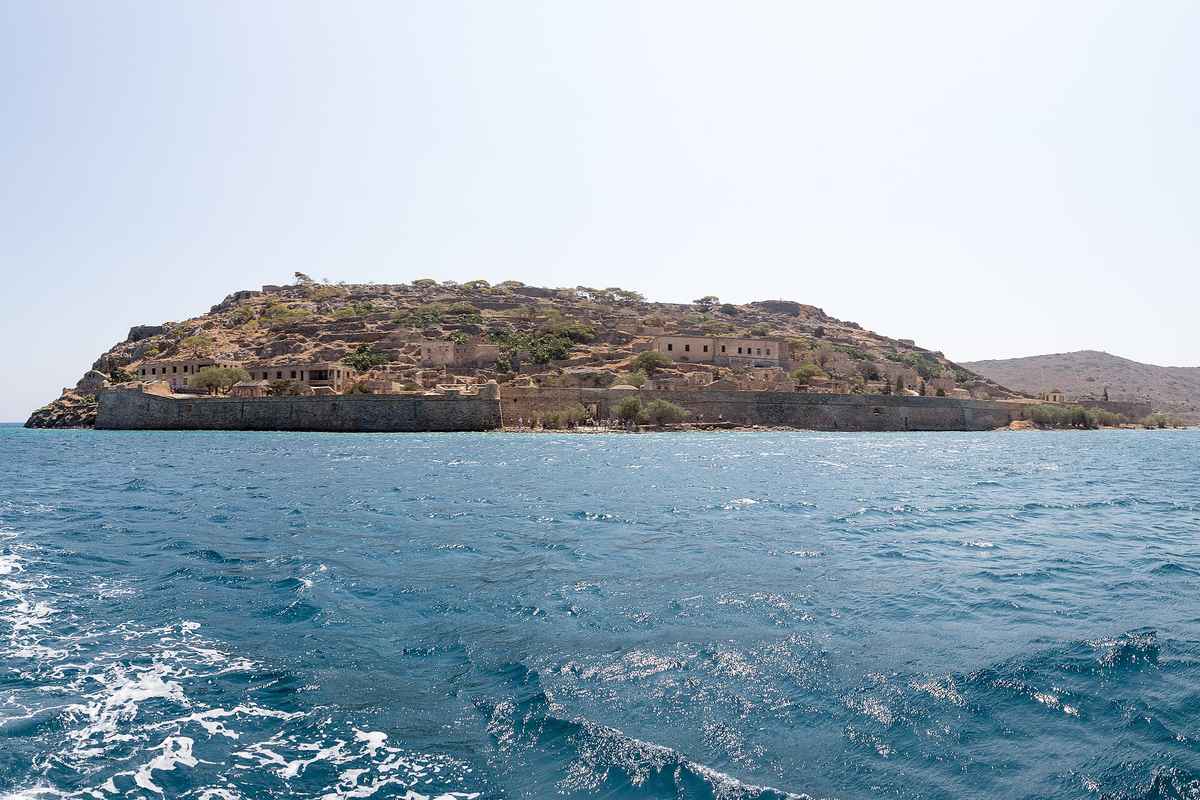
Spinalonga is a small rocky islet at the mouth of Elounda bay, in the Gulf of Mirabello on the eastern side of Crete. Its official name is Kalydon, though almost everyone uses the older name. A powerful Venetian sea fortress crowns the rock, and later a village, a church and a leper colony filled the ground behind the walls. Today the whole islet stands empty and open to visitors, who cross by boat and walk a loop past the ruins. This guide covers how to reach it, what to see and how it fits a wider trip planned with My Greece Tours.
The island rewards a couple of unhurried hours, so it slots neatly into a day around Mirabello Bay rather than a rushed dash. Our wider Crete travel guide places Spinalonga within the eastern circuit, alongside the resort towns and beaches that share the same corner of the island. The sections below cover the fortress and its history, the boat crossings from Elounda, Plaka and the harbour, what a walk through the ruins involves, the leper-colony story and Victoria Hislop’s novel, and the nearby sights that round out a full day in the east of Crete.
What is Spinalonga island in Crete?
Spinalonga is a fortified islet in the Gulf of Mirabello off eastern Crete. The Venetians built a sea fortress on it, and a village, church and former leper colony survive behind the walls, all reached by short boat trips.
Spinalonga sits at the mouth of Elounda bay, a rocky islet guarding the entrance to a sheltered natural harbour. The Venetians recognised the value of that position and, in the sixteenth century, raised a powerful sea fortress on the rock to control the anchorage and the shipping lanes around the Gulf of Mirabello. Thick ramparts follow the shoreline, bastions jut out over the water, and the walls climb the slope in tiers. The islet later held an Ottoman village, and small stone houses spread across the ground behind the defences. Much of that layered past still stands, weathered but legible, which is part of what draws visitors across the short stretch of sea.
A trip here pairs naturally with the other things to do in Crete along the eastern coast.
The islet reads as a compact open-air site rather than a single monument. You land at a small jetty below the walls and pass through a dark, tunnel-like gate into the enclosed ground. From there a loop leads past the ruined houses, a church, a cemetery and the ramparts that ring the shore. The scale suits a relaxed visit: the whole circuit takes a modest walk, with plenty of sea views along the way. The whole islet is uninhabited, so the atmosphere stays quiet and slightly haunting, especially away from the busiest midday boats. Firm shoes and sun cover help on the exposed, stony paths.
The best photographs come from the higher stretches of the wall, where the fortress, the empty village and the blue bay all sit in one frame.
How do you get to Spinalonga from eastern Crete?
Short boat trips run to Spinalonga from Elounda, Plaka and Agios Nikolaos, with no bridge to the islet. Plaka offers the quickest hop across the narrow channel, while Elounda and the town harbour add a scenic cruise around the bay.
There is no bridge, so every visit begins with a boat. The shortest crossing leaves from Plaka, a small village that faces the islet directly across a narrow channel, where the hop takes only a few minutes each way. Elounda, the polished resort just down the coast, runs frequent departures too, with a slightly longer ride that curves across the sheltered bay. Boats also set out from the harbour at Agios Nikolaos, the lively main town of the east, turning the trip into a fuller cruise with commentary and sea views along the way.
Fares and timetables vary by operator and season, so it pays to check departures on the day rather than assume a fixed schedule for the crossing you want.
Choosing a departure point comes down to the kind of day you want. Plaka suits travellers who prefer the least time on the water and the most time on the islet, and it works well for families with young children. Elounda and Agios Nikolaos turn the outing into a relaxed half-day on the sea, which appeals to anyone based in a resort along Mirabello Bay. Many boats leave through the morning and early afternoon, so an early start beats both the heat and the largest crowds on the walls.
Give the round trip a comfortable window: the sailing, a couple of hours ashore and the return add up, and rushing the last boat back turns a calm outing into a scramble at the jetty.
What can you see on a walk around Spinalonga?
A loop leads in through the tunnel-like Dante’s Gate, then past the old stone houses, a church, the cemetery and the fortress ramparts. The circuit is short and mostly gentle, with wide views over Mirabello Bay throughout.
The walk begins at Dante’s Gate, a low, tunnel-like passage cut through the fortress wall. Its shadowed entrance opens onto the enclosed village beyond, and the sudden change from bright quay to dim tunnel to open ruins gives the arrival real drama. Beyond the gate a single main street runs through the settlement, lined with the roofless shells of houses, shops and a bakery. A church stands among them, restored and still used for occasional services. The path is signed and easy to follow, so there is little chance of missing the main sights on the loop.
Interpretive boards along the way explain what each building once was, which helps the empty stone rooms make sense as a living village rather than a random field of ruins.
Past the houses the route climbs gently toward the ramparts and the cemetery, where simple graves recall the islet’s last residents. From the higher wall the outlook stretches across the channel to Plaka and out over the wide blue sweep of the bay. The full circuit is a modest walk on uneven, stony ground, so sturdy footwear and water matter more than any great level of fitness. Shade is scarce once you leave the tunnel, which makes a hat and sun cream sensible for a summer visit. Set aside a couple of unhurried hours to take it all in.
That is enough to trace the whole loop, linger on the walls and still catch a comfortable boat back to the mainland harbour.
Why was Spinalonga a leper colony?
In the early twentieth century Spinalonga became a leper colony, one of the last in Europe, isolating patients on the sealed islet. It closed in the mid twentieth century, leaving the abandoned village that visitors walk through today.
The islet’s isolation, so useful to the Venetian defenders, later made it a place of enforced separation. In the early twentieth century Spinalonga became a leper colony, and people with the disease from across Crete and beyond were sent to live on the sealed rock. The old fortress village gave them houses, a main street, a bakery, shops and a church, so a real community formed behind the walls despite the hardship. It grew into one of the last leper colonies in Europe. The colony operated for several decades before a cure changed everything, and it closed in the mid twentieth century, after which the last residents left and the village fell silent.
Those layers of history sit within the wider story told across our Heraklion and eastern-Crete guides.
That human story is what gives Spinalonga its unusual pull, well beyond the appeal of the fortress walls alone. The novel The Island by Victoria Hislop, set on the islet and in nearby Plaka, brought the colony’s history to a huge international audience and turned the rock into a place many travellers come specially to see. A Greek television series based on the book widened that reach again. Walking the same main street the patients used, past their houses and their small cemetery, lends the visit a weight that few ruins carry.
The result is a site that works on two levels at once: a striking Venetian sea castle, and a moving memorial to the community that lived out its days behind the walls.
What else can you visit near Spinalonga?
Spinalonga pairs well with the eastern circuit: the resort bays around Elounda, the mountain villages of the Lasithi Plateau, the palm-fringed sands of Vai, and long swims off Agios Nikolaos, all within a manageable drive.
Spinalonga rarely fills a whole day on its own, so it slots easily into a wider tour of the east. Elounda and Plaka, the two villages nearest the crossing, both reward a slow lunch by the water before or after the boat. Inland, the Lasithi Plateau spreads across a high, green bowl ringed by mountains, dotted with old stone windmills and quiet farming villages that feel a world away from the coast. The drive up winds through orchards and hairpins, and the cool air makes a pleasant contrast to the beach.
Pairing the islet with the plateau gives a single day both a sea story and a mountain one, without a great deal of time behind the wheel between the two.
Further afield, the far east of the island holds one of its most famous beaches. The palm-backed sands of Vai beach sit at the road’s end past Sitia, a longer drive that suits a dedicated outing rather than an add-on to the Spinalonga crossing. Closer to hand, the resort coast around the bay offers calm swimming, harbour cafes and easy boat trips, so a base in the east keeps most of these sights within comfortable reach. Travellers who prefer town life can anchor the day on the waterfront, its inner lake and its lively evening scene, then treat the fortress island and the plateau as day trips.
That mix of ruins, mountains and beaches is what makes the eastern corner such a rewarding part of Crete.
Frequently Asked Questions
How long do you need to visit Spinalonga?
Most visitors give Spinalonga around two to three hours in total, counting the boat crossing and the walk around the islet. The circuit itself is short: you land at the jetty, pass through Dante’s Gate, and follow a signed loop past the houses, the church, the cemetery and the ramparts. A relaxed walk with time for photographs and the interpretive boards takes roughly an hour and a half ashore. Add the sailing at each end and any waiting for the boat, and a comfortable visit stretches to a half-day outing rather than a quick stop.
Crossings from Plaka are the fastest, which trims the total, while trips from Elounda or the town harbour add scenic time on the water. An early start helps you beat both the midday heat and the busiest boats. Set aside the morning, keep an eye on the last return sailing, and you can see the whole islet without any rush at the jetty.
Is Spinalonga suitable for children and older visitors?
Spinalonga suits most families and older travellers, though the ground calls for a little care. The main loop is a modest walk on uneven, stony paths, with some gentle slopes up toward the ramparts and the cemetery. There are no steep climbs or long stairways, so a steady pace handles it well, but the surfaces reward sturdy footwear over sandals. Shade is limited once you pass through the tunnel gate, which makes a hat, sun cream and water sensible in summer, especially for young children and anyone who feels the heat.
The short crossing from Plaka is the easiest option for families, since it keeps time on the boat to a minimum and lands you close to the entrance. Pushchairs are awkward on the rough paths, so a carrier works better for babies. With those small preparations, the islet makes a rewarding outing across the generations, blending an easy walk with a memorable fortress, sea views and a genuine slice of history.
Do you need to book a Spinalonga boat trip in advance?
You can often buy Spinalonga boat tickets on the day at the harbours in Plaka, Elounda and Agios Nikolaos, where operators run frequent departures through the morning and early afternoon in the main season. In quieter months a walk-up ticket is usually straightforward. During the busy summer weeks, though, the popular midday sailings and any guided cruises fill up faster, so it helps to check times early and, for a specific boat or tour, to reserve ahead. Fares and timetables vary by departure point and operator, and the shorter Plaka hop typically costs less than the longer scenic cruises from the town harbour.
Note that a separate admission applies to the islet itself, on top of the boat fare. Aim to arrive at the quay in good time, confirm the last return sailing before you cross, and keep some flexibility in your plans, since strong winds can occasionally disrupt the crossing. With a little forethought the trip slots smoothly into a day around Mirabello Bay.