
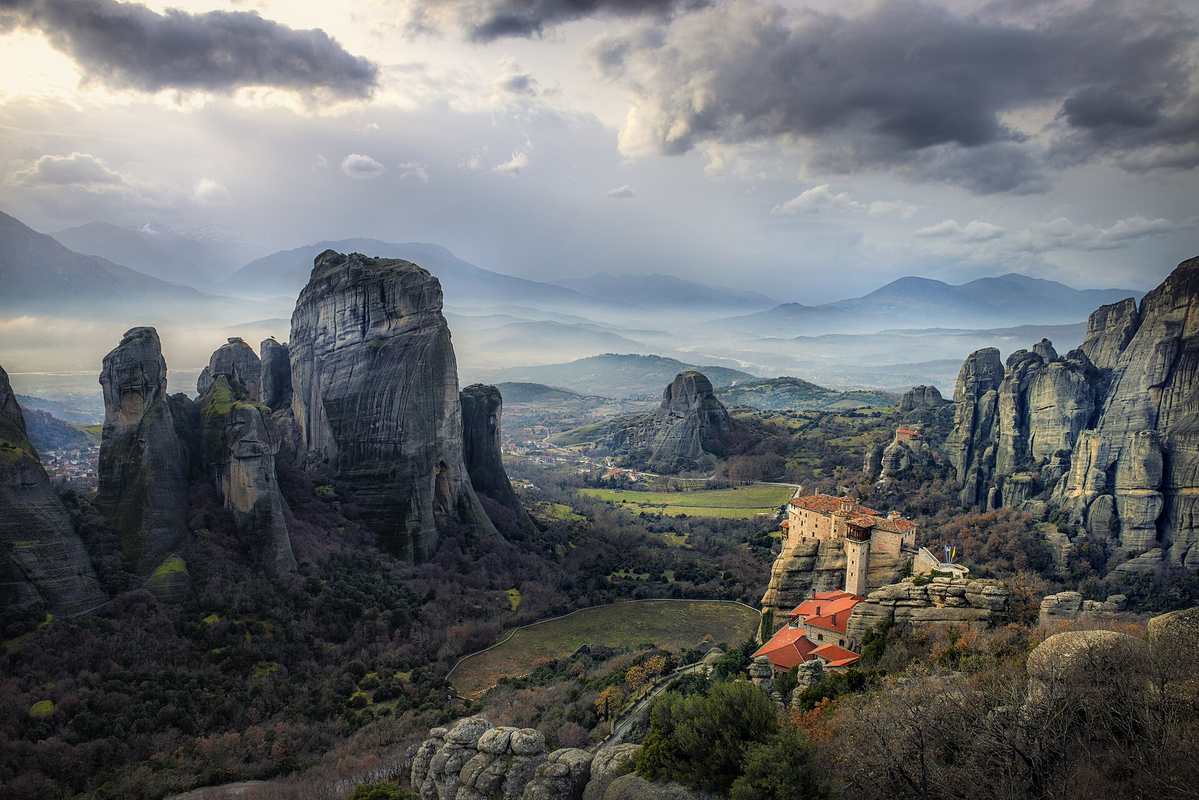
Meteora crowns central Greece with six active Eastern Orthodox monasteries perched on giant sandstone-conglomerate pillars. The rocks rise sheer above the town of Kalabaka and the village of Kastraki in Thessaly. Monks settled these summits from the fourteenth century, turning inaccessible caves and crags into places of prayer. The complex earned UNESCO World Heritage status for both its natural drama and its living monastic tradition. Each monastery keeps its own character, its own feast, and its own opening rhythm. A visit rewards early risers, patient walkers, and travellers who respect the sacred use of these buildings. Plan your route to these towering monasteries with My Greece Tours.
Six monasteries remain open to visitors today, each reachable by carved steps that replaced the old rope nets and windlasses. Great Meteoron sits highest, Saint Stephen sits easiest to reach, and the others fill the ridges between them. This overview pairs practical planning with the story behind the stones, and it links to a fuller Meteora travel guide for deeper trip planning. The sections below cover what these monasteries are, how the six differ, how monks built and reached them, the rules and fees that govern a visit, and the ways to see the site on foot, by car, or on a guided route.
What are the Meteora monasteries and where do they stand?
The Meteora monasteries are six active Eastern Orthodox houses of prayer built atop natural sandstone-conglomerate pillars above Kalabaka and Kastraki in Thessaly. They form a UNESCO World Heritage landscape of rock and faith.
Meteora means “suspended in the air,” and the name fits the setting exactly. Grey rock towers push hundreds of metres above the Thessalian plain, their rounded summits crowned by red-tiled roofs and whitewashed walls. The town of Kalabaka spreads at the foot of the cliffs, while Kastraki nestles closer among the pinnacles. The pillars formed from an ancient river delta, then were shaped over millions of years by water and weather into the sheer columns seen today. Monks recognised the summits as natural fortresses, safe from raiders and worldly distraction. Their choice created one of Europe’s most striking marriages of geology and devotion, and it draws travellers who research Meteora tours long before they arrive.
The six monasteries share a landscape yet keep distinct identities. Each stands on its own rock, linked to the others by ridge paths and a modern loop road. Great Meteoron and Varlaam anchor the northern cluster on the tallest formations. Rousanou perches on a slender pinnacle nearby, while Saint Nicholas Anapausas guards the western approach from Kastraki. Holy Trinity rises on a dramatic isolated column, and Saint Stephen closes the eastern edge above Kalabaka. Walkers who study the terrain often plan a day of hiking in Meteora to connect the rocks by the old monk trails rather than the tarmac. The paths reveal viewpoints that road travellers miss entirely.
Which are the six Meteora monasteries and how do they differ?
The six are Great Meteoron, Varlaam, Rousanou, Saint Nicholas Anapausas, Holy Trinity, and Saint Stephen. They differ in size, elevation, gender of the community, ease of access, and the treasures each preserves.
Great Meteoron, or Megalo Meteoro, stands as the largest and highest of the six, founded by Saint Athanasios in the fourteenth century. Its museum, old kitchen, and cellar reward a slow visit. Varlaam sits close by on a neighbouring rock and holds richly frescoed churches painted in the sixteenth century. Rousanou, dedicated to Saint Barbara, functions as a convent and perches on a slim pinnacle reached by a short bridge. Saint Nicholas Anapausas is the smallest, its compact church decorated by the Cretan painter Theophanes. Reading the history of the Meteora monasteries before a visit makes each fresco and relic far easier to place within the wider monastic story.
Holy Trinity, Agia Triada, crowns a bold isolated tower and gained fame from a James Bond film shot on its heights. A steep flight of carved steps leads to its gate, rewarding the climb with sweeping views over Kalabaka. Saint Stephen, a convent above the town, ranks as the easiest to reach because a small bridge crosses straight to its entrance with no long stair. Its terrace opens onto the plain and the distant Pindus mountains. Choosing among the six depends on time and stamina, and travellers deciding where to stay in Meteora often base themselves in Kalabaka to keep the closest monasteries within a short drive or walk each morning.
How did monks build and reach the monasteries?
Hermit monks first settled the caves and rocks from around the fourteenth century, hauling materials and people up by rope nets, ladders, and hand-cranked windlasses. Carved steps and a road later replaced these perilous original methods.
The earliest monks lived as hermits in the caves and clefts of the pillars, gathering for worship in simple rock churches. Organised monastic building began in the fourteenth century as communities formed under the first founders. Workers raised stone, timber, and provisions using nets and baskets attached to ropes, then hoisted them by windlass from platforms far below. New monks and pilgrims ascended the same way, swinging above the void in a knotted net. Tradition held that the ropes were replaced only when the Lord let them break. The engineering was crude yet effective, and it kept the communities defended during centuries of upheaval across the region and the wider Greek lands.
Access changed slowly over the centuries as the danger eased and pilgrim numbers grew. Monks and local craftsmen carved staircases directly into the rock faces, replacing the nets for everyday use. A road built in the twentieth century finally connected the monasteries to Kalabaka and Kastraki, opening the site to modern visitors. The old windlass towers still survive at several monasteries, and supplies today travel by small cable cars strung across the gaps. Visitors climb the carved steps that monks cut generations ago, tracing the same routes by foot. Anyone booking Meteora tours will hear these stories at the gate, where guides point out the surviving hoist platforms above the entrances.
What should you know before visiting Meteora?
Each monastery closes one day a week and keeps seasonal hours, so check schedules first. Modest dress is required, a small fee applies at each gate, and covered shoulders and long skirts are expected of every visitor.
The monasteries stagger their closing days so that visitors can always find several open on any given date. Hours shift with the season, running longer through the warmer months and shorter in winter, and gates close in the early afternoon on some days. A small entrance fee applies at each monastery, paid separately at every gate. Planning matters, and a route that groups nearby rocks saves backtracking on the loop road. Great Meteoron and Varlaam pair well together, as do Rousanou and Saint Nicholas Anapausas. Saint Stephen and Holy Trinity sit on the eastern side. Checking the current schedule against a reliable Meteora tours itinerary prevents arriving at a closed gate after a long climb.
Dress rules are enforced at every entrance because these remain working houses of prayer. Women cover shoulders and wear long skirts, and wraps are usually provided at the gate for those who arrive in trousers or shorts. Men wear long trousers and covered shoulders. Photography is often restricted inside the churches, and quiet respect is expected throughout. Comfortable shoes help on the carved steps, which can be steep and uneven. Choosing which monasteries to visit depends on energy and interest, with the largest sites needing more time. A quiet ending to the day comes with the Meteora sunset, watched from a viewpoint on the rocks as the pillars glow amber above the plain.
How can you see the Meteora monasteries on your visit?
Visitors reach the monasteries on foot by the old monk paths, by car along the loop road, or on a guided tour from Kalabaka. Each option suits different levels of time, fitness, and interest.
Walking remains the most rewarding way to experience the rocks. Old monk trails climb from Kalabaka and Kastraki through the pinnacles, linking the monasteries by shaded paths and viewpoints. A dedicated day of hiking in Meteora lets travellers approach the summits the way pilgrims once did, on stone steps rather than tarmac. The routes vary in difficulty, so sturdy footwear and water are essential. Driving suits those short on time or stamina. The loop road connects all six monasteries with parking areas near each gate, allowing a full circuit in a single unhurried day. Cyclists and e-bike riders also tackle the climbs when the weather stays mild across the ridges.
Guided visits ease the planning burden and add depth to the frescoes and relics. A local guide explains the founders, the paintings, and the monastic rhythm that shaped each building. Several operators run half-day and full-day Meteora tours from Kalabaka, timed around the staggered opening days so that guests never face a closed gate. Sunset trips finish on a viewpoint above the plain, and photography outings chase the soft morning light on the pillars. Deciding where to stay in Meteora shapes the whole itinerary, since a base in Kalabaka or Kastraki puts every rock within easy reach and leaves the mornings free for the quietest gates.
Frequently Asked Questions
How many Meteora monasteries can you visit?
Six monasteries remain active and open to visitors at Meteora. They are Great Meteoron, Varlaam, Rousanou, Saint Nicholas Anapausas, Holy Trinity, and Saint Stephen. Each monastery closes on a different day of the week, so the number open on any given date is usually four or five rather than the full six. A well-planned day allows a fit visitor to see three or four, since the carved staircases and separate entrance fees at each gate slow the pace. Grouping nearby rocks helps, pairing Great Meteoron with Varlaam and Rousanou with Saint Nicholas Anapausas. Saint Stephen and Holy Trinity sit close together on the eastern side above Kalabaka.
Checking the current closing days before setting out prevents a wasted climb. Most travellers who want to see all six spread their visits across two days, leaving time to rest, photograph the pillars, and enjoy the surrounding trails.
What is the dress code for the Meteora monasteries?
Modest dress is required at every Meteora monastery because each remains a working house of prayer with resident monks or nuns. Women must cover their shoulders and wear a long skirt reaching below the knee. Trousers and shorts are not acceptable for women inside the gates, though wrap-around skirts are usually provided at each entrance for those who arrive unprepared. Men wear long trousers and keep their shoulders covered, avoiding vests and sleeveless tops. The rule applies year-round, including through the hottest summer weeks, so light layers help travellers stay both comfortable and compliant. Quiet behaviour is expected throughout the churches and courtyards, and photography is often restricted inside the sanctuaries.
Comfortable, closed shoes matter on the steep carved steps that lead to each gate. Dressing correctly before arriving saves time and shows respect for the living monastic community that welcomes visitors into these remarkable clifftop buildings.
Which Meteora monastery is best to visit?
The best Meteora monastery depends on what a traveller most wants from the day. Great Meteoron suits those seeking scale and history, standing as the largest and highest of the six with a museum, an old kitchen, and a fascinating cellar. Varlaam rewards lovers of religious art with its vivid sixteenth-century frescoes. Holy Trinity offers the most dramatic setting and famous film heritage, though its steep staircase demands strong legs. Saint Stephen ranks as the easiest to reach, crossed by a short bridge with no long climb, which makes it ideal for visitors with limited mobility or time.
Rousanou charms with its slender perch and convent atmosphere, while Saint Nicholas Anapausas offers an intimate church painted by a Cretan master. First-time visitors often pair Great Meteoron with Varlaam for the fullest introduction. Combining two or three monasteries gives a richer sense of the whole sacred landscape than any single stop.