
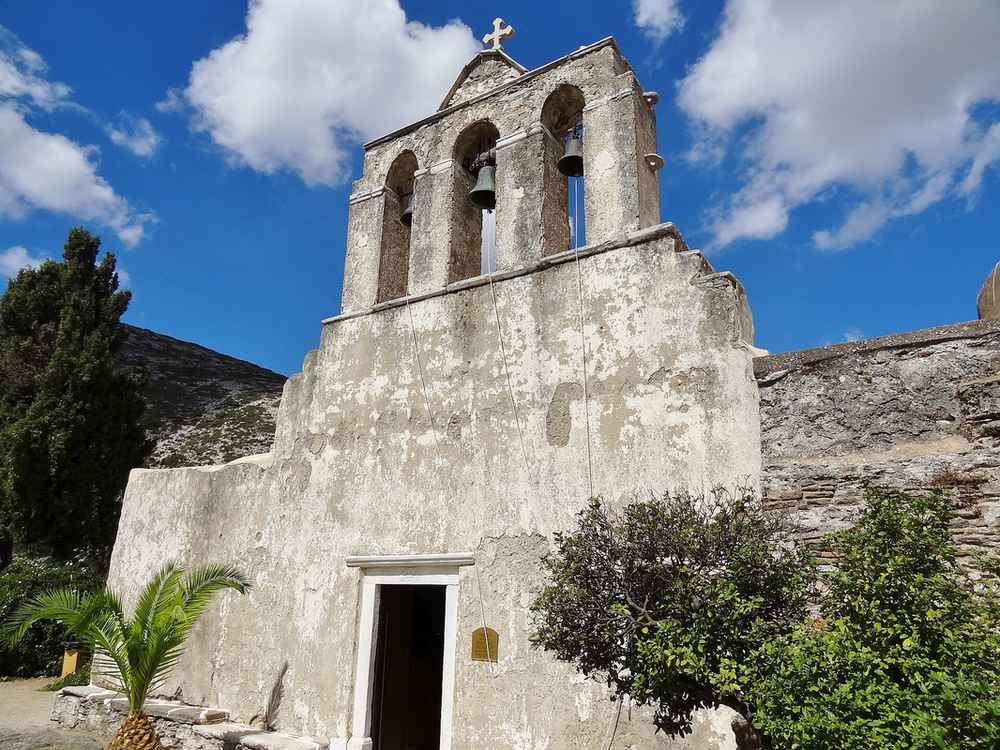
The Panagia Drosiani is one of the oldest and most moving Byzantine churches you can visit in Greece, tucked into the green Tragaea valley below the village of Moni on Naxos. Its rough stone walls, clustered domes and dim, incense-scented interior feel almost impossibly ancient, and its layered wall paintings rank among the earliest surviving Christian frescoes in the Aegean. Limited monuments capture the deep, unbroken religious life of the island so completely, which is why it draws pilgrims and travellers in equal measure. It is well worth exploring the Panagia Drosiani with My Greece Tours on a guided visit if you want to understand its layers of history without missing the details.
This page sits within our wider Naxos travel guide and focuses on the church itself, the frescoes, the architecture and the practicalities of getting there. The sections below cover what the Panagia Drosiani actually is, why its frescoes matter so a great deal of, what makes its architecture unusual, the church’s long history and meaning, and how you can visit it respectfully today.
What is the Panagia Drosiani?
The Panagia Drosiani is an early Byzantine church near Moni in the Tragaea valley of Naxos, counted among the oldest surviving Christian churches in Greece and the Balkans, and one of the limited in continuous worship since late antiquity.
The Panagia Drosiani stands just outside the village of Moni, in the fertile heart of central Naxos known as the Tragaea. It is a small, low, stone-built church whose thick walls and huddled domes give it the look of something grown from the hillside rather than designed on paper. The dedication is to the Virgin Mary, and the church has served as a place of worship for well over a millennium, making it a rare example of a Christian site that has never fully fallen silent.
Its modest scale hides its importance: scholars regard it as one of the earliest surviving churches not only on Naxos but across the whole Balkan peninsula, a genuine survivor from the first centuries of Byzantine faith.
What makes the Panagia Drosiani feel so exceptional is the sense of continuity that surrounds it. The building has been repaired, extended and re-plastered over a wide range of generations, yet its core remains startlingly old, and the atmosphere inside is one of quiet, weighty antiquity. Set among olive groves and stone terraces, it belongs to a landscape dotted with historic hamlets. It forms a natural stop when exploring the villages of Naxos that fill the interior of the island. To appreciate why the church matters beyond its age, though, you have to step inside and look up at the walls, because it is the frescoes that turn an old building into a treasure of world importance.
Why are its frescoes so important?
Its frescoes include part of the earliest surviving Christian wall paintings in Greece, applied in a cluster of distinct layers over centuries, so that removing or studying them reveals a rare visual record of how Byzantine religious art developed on the island.
The frescoes of the Panagia Drosiani are the single greatest reason art historians treasure the church. The walls carry paintings from very early in the Byzantine period, images so old that they predate most of what survives elsewhere in the region. They show the transition from the art of late antiquity into the mature Byzantine style. Among the most striking figures is a rare depiction of Christ shown with two faces, an unusual iconographic idea that fascinates specialists and pilgrims alike.
They have bonded with the wall itself and endured through centuries of damp, candle smoke and repeated worship, leaving colours that still glow faintly in the low light of the interior because the pigments were applied straight onto plaster in the fresco technique.
What makes the site truly unusual is that the frescoes exist in a handful of superimposed layers. Later generations painted new scenes over older ones, so that in places the earliest images survive beneath more recent work, like pages in a stone book as the church aged. Careful study and conservation have revealed these hidden earlier layers, giving scholars an almost unmatched chance to trace how faith, taste and craftsmanship changed across generations in a single building. The result is not a museum display but a living wall, worn and irregular, where the sacred images feel deeply personal.
That same spirit of accumulation and survival is echoed in the church’s remarkable architecture, which is every bit as unconventional as its painted walls.
What is unusual about its architecture?
The church is built from rough undressed stone and crowned by a cluster of small stone-domed conches rather than a single dome, with tiny side chapels added over time, giving it an irregular, organic form unlike conventional cross-in-square Byzantine churches.
Architecturally, the Panagia Drosiani breaks almost every expectation of a tidy Byzantine church. Instead of the neat symmetry of the later cross-in-square plan, it presents an irregular grouping of spaces capped by a series of small stone domes, or conches, sitting close together over the eastern end. These low, rounded roofs are built directly in stone rather than brick, and from a distance they read as a bumpy, rocky silhouette that merges with the landscape. The walls themselves are made of rough, undressed local stone, thick and heavy, pierced by only a handful of small openings, so the interior stays cool, shadowy and intimate.
This muscular, almost primitive construction is part of what gives the church its air of extreme age and its powerful, cave-like presence.
Over the centuries the building grew by accretion rather than grand design. Small side chapels were added onto the original core, each a modest cell with its own tiny apse. That the plan today is a cluster of linked spaces rather than one unified hall. This piecemeal growth mirrors the layered frescoes inside, each generation leaving its own mark in stone as well as paint. The effect is a church that feels handmade and deeply local, shaped by the needs and faith of the community rather than by imperial fashion. Understanding how the structure came together over so long naturally leads to the wider story of the church’s history and meaning, and how it earned its evocative name.
What is the church’s history and meaning?
The Panagia Drosiani dates to the early Byzantine centuries and has links to monastic life on Naxos, while its name, connected to the Greek word for dew or coolness, is tied to a local legend of a miraculous icon that never dried out.
The history of the Panagia Drosiani reaches back into the early Byzantine centuries, making it a witness to almost the entire Christian story of Naxos. It is thought to have been connected with monastic and communal religious life in the Tragaea. The nearby village of Moni, whose name itself means monastery, hints at a landscape once shaped by devotion and quiet withdrawal from the world. Through changing rulers, raids and long stretches of hardship, the church kept its role as a focus of worship for the surrounding farming communities, its thick walls offering both spiritual and physical shelter.
This unbroken use is what gives it such an aura of deep antiquity, a place where prayer has echoed almost without interruption for a very long time.
The name Drosiani carries its own legend. It is linked to the Greek idea of dew, freshness or coolness. Tradition holds that a sacred image of the Virgin here remained mysteriously moist, as if touched by dew, never drying out even in the summer heat. To the faithful this was a sign of grace and living presence, and it helped fix the church’s reputation as a place of miracles and comfort. Whether taken as history or as devout story, the legend expresses the tenderness people have long felt toward this small building.
That enduring spiritual pull is exactly why so a wealth of travellers now make the effort to reach it, and knowing how to visit well makes all the difference.
How do you visit the Panagia Drosiani?
The church lies just below Moni in the Tragaea valley, an easy detour on the main road across central Naxos. Entry is generally free with a donation welcomed, opening hours are limited, and modest, respectful dress is expected inside this active place of worship.
Reaching the Panagia Drosiani is straightforward, as it sits just below the village of Moni in the green Tragaea valley, roughly in the middle of Naxos on the route that climbs toward the mountain villages. Most visitors arrive by car or on an organised tour that threads through the island’s interior, often combining the church with the handsome stone hamlets nearby. A short signposted track leads down to the church from the road, and there is space to stop close by. It rewards a slow, quiet visit rather than a hurried glance.
Pairing it with the wider circuit of things to do in Naxos makes for a rich day inland away from the beaches because the interior is small and dim.
Practical details are simple but worth respecting. The church is usually open during daytime hours, though opening can be limited and occasionally depends on a caretaker, so it helps to visit in the morning or early afternoon. There is normally no fixed admission fee, but a donation toward upkeep and lighting is welcomed and appreciated. It calls for modest dress that covers shoulders and knees, quiet voices and no flash photography near the fragile frescoes as an active place of worship. Dozens of travellers combine the visit with the mountain village of Apeiranthos higher up the same road, turning a short stop into a memorable inland journey. Plan your visit and tours through our Naxos travel guide.
Frequently Asked Questions
How old is the Panagia Drosiani?
The Panagia Drosiani dates to the early Byzantine period and is generally regarded as one of the oldest surviving Christian churches in Greece and across the wider Balkans. Rather than giving a precise construction date, it is more accurate to say the church belongs to the first centuries of Byzantine worship, with its core structure and earliest frescoes reaching back into deep antiquity. What sets it apart from a wide range of other old churches is not simply the age of the building. The fact that it has remained in continuous religious use ever since, surviving raids, changes of rulers and long periods of hardship.
The layered frescoes on its walls reinforce this sense of age, because later generations painted over earlier images, leaving a stack of successive works that spans a very long stretch of time. For visitors, the practical takeaway is that you are standing inside a genuinely ancient monument, one whose walls have absorbed prayer and paint for well over a thousand years, making it one of the most historically significant small churches you can enter on Naxos or in the Cyclades.
Can you take photos inside the Panagia Drosiani?
Photography rules at the Panagia Drosiani reflect its dual role as both a precious monument and an active place of worship, so a respectful approach is essential. In general, flash photography is discouraged or forbidden inside, because the intense light can damage the extremely fragile early frescoes that make the church so important. The interior is deliberately dim, lit mainly by small openings and candles, and that low light is part of both its atmosphere and the preservation of the paintings. Visitors are usually welcome to look closely and take quiet, non-flash photographs for personal memories. You should always follow any signs or the instructions of a caretaker or guide who may be present.
Avoid using a tripod, keep your movements gentle around the walls, and never touch the painted plaster. It is polite to put the camera away entirely if a service or prayer is taking place. Treating the church as a living sanctuary rather than a photo backdrop ensures both that the frescoes survive for future travellers and that your own visit feels calm, unhurried and genuinely memorable.
Is the Panagia Drosiani worth visiting on Naxos?
For anyone interested in history, art or simply the atmosphere of an ancient sacred place, the Panagia Drosiani is one of the most rewarding stops on Naxos. It offers something quite different from the island’s famous beaches and lively main town: a small, dimly lit church whose rough stone walls and clustered domes have stood since the early Byzantine centuries. Whose layered frescoes count among the oldest Christian wall paintings in the region. The setting adds to the appeal, as the church sits in the fertile Tragaea valley near Moni, surrounded by olive groves, stone terraces and traditional villages that reveal the quieter, greener heart of the island.
It is easy to include on a day exploring inland, often combined with mountain villages and scenic drives because it lies on the main road across central Naxos. Visitors who slow down and take time inside almost always find it moving, a rare chance to feel the depth of Naxos’s living history. The Panagia Drosiani is very considerable worth the detour if your itinerary allows even an hour.