
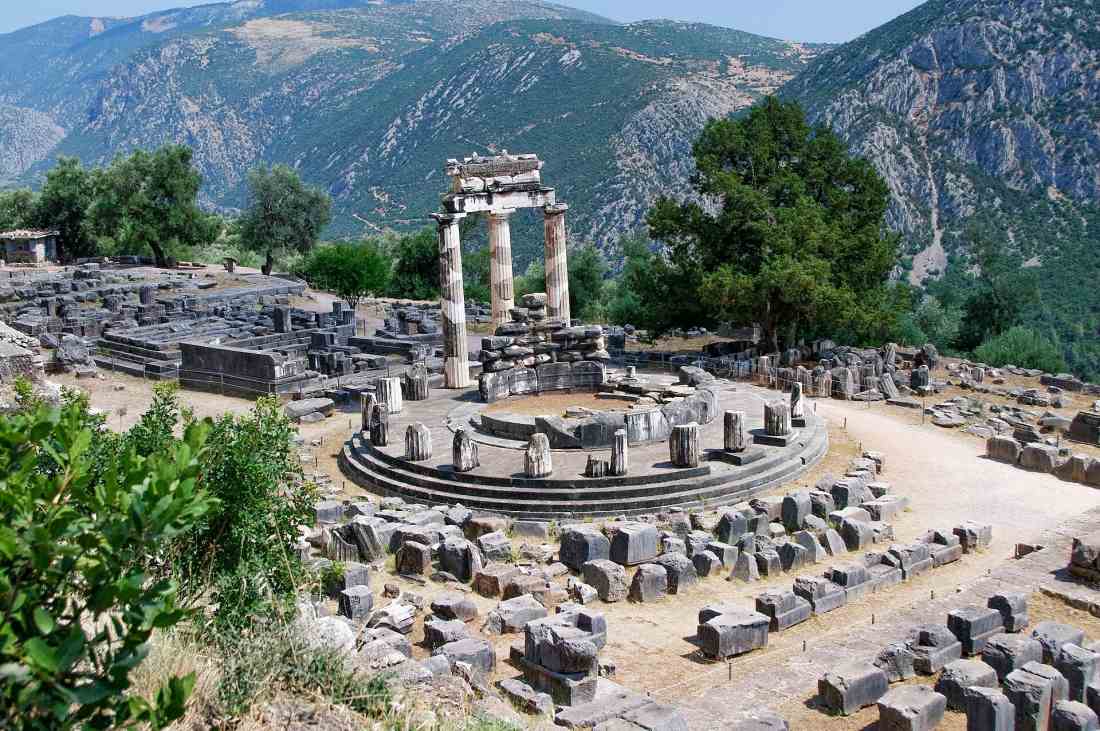
The Sanctuary of Athena Pronaia sits on a green terrace at the foot of Delphi, just below the great sanctuary of Apollo, and it is the first sacred ground pilgrims reached as they arrived from the east. Its most beloved feature is the Tholos, a slender circular rotunda whose three re-erected columns rise against a backdrop of olive groves and the slopes of Mount Parnassus. For centuries this graceful ruin has been the emblematic image of Delphi, appearing on postcards, book covers, and travel posters the world over. To hear the whole story told on site, you can walk this terrace with a knowledgeable guide on a tour arranged through My Greece Tours. Plan the whole trip with Greece Tours.
This page belongs to our wider Delphi travel guide, which links every monument, museum, and practical detail of the site into one place. The sections below cover what the Sanctuary of Athena Pronaia actually was, the famous Tholos rotunda and why it is so celebrated, the other temples and monuments that share the terrace, how the sanctuary connected to the main site and the oracle, and exactly how visitors experience this quiet, photogenic corner of Delphi today.
What was the Sanctuary of Athena Pronaia at Delphi?
The Sanctuary of Athena Pronaia was the lower sacred precinct at Delphi, dedicated to Athena in her role as guardian standing before the temple of Apollo. It welcomed pilgrims arriving from the east and is known today as Marmaria.
The name Pronaia means “before the temple,” and it captures exactly what this sanctuary was: the sacred threshold that every visitor crossed before reaching Apollo higher up the mountain. Athena here was honoured as a protective figure, a guardian who watched over the approach to the oracle and blessed the traveller before the serious business of consulting the god began. The precinct occupied a natural terrace on the slope, ringed by retaining walls, and it grew over generations into a busy complex of temples, altars, treasuries, and votive offerings. It was a place of arrival, welcome, and preparation rather than the dramatic climax of the pilgrimage.
Because the ancient road approached Delphi from the east, along the valley below Mount Parnassus, this lower sanctuary was literally the first thing pilgrims encountered. They paused here to acknowledge Athena, and then continue upward toward the main site. Today the area carries the evocative local name Marmaria, meaning “the marbles,” a reminder that for centuries villagers quarried the fallen stones of these ruins for building material. That long history of dismantling and rediscovery only deepens the sense of layered time you feel walking the terrace. The single monument that most rewards that walk, and the reason many people come at all, is the beautiful circular building at its heart.
What is the Tholos of Delphi and why is it famous?
The Tholos of Delphi is a circular marble rotunda in the Sanctuary of Athena Pronaia. Three of its columns and part of the entablature have been re-erected, making it the most photographed and emblematic monument at the entire archaeological site.
The Tholos was a round building of white marble ringed on the outside by twenty Doric columns, with a more richly decorated Corinthian order used inside. This blend of the sturdy Doric exterior and the elegant Corinthian interior gave it a refined, almost jewel-like quality that set it apart from the boxy rectangular temples elsewhere on the slope. The roof was conical, crowned with sculpted details, and the whole structure sat on a stepped circular platform. Its exact purpose remains genuinely uncertain; scholars have suggested it honoured a hero, sheltered a cult of the earth, or served some ritual function tied to Athena, but no single explanation has ever been proven, which only adds to its quiet mystery.
What visitors see now is a partial reconstruction: three graceful columns standing side by side, joined by a curved section of the entablature they once supported, with the circular foundation spread out around them. That fragment is enough to suggest the elegance of the complete building and to make an unforgettable silhouette against the green valley and the mountains beyond. Photographers love the low afternoon light here, when the marble glows warm and the columns cast long shadows across the terrace. More than the ruins of Apollo’s grand temple, it is this small rotunda that has become the postcard face of Delphi. Yet the Tholos never stood alone, for temples and treasuries once crowded the ground around it.
What other monuments stand in the sanctuary?
Besides the Tholos, the sanctuary held two successive temples of Athena, several treasuries, and altars, while a large gymnasium with a running track and wrestling ground lay nearby, used by athletes preparing for the Pythian Games.
The terrace held an older temple of Athena, built in an archaic Doric style, and a later temple that replaced it after the earlier one was damaged; the foundations and scattered column drums of both can still be traced on the ground. Around these stood small treasuries, elegant miniature buildings in which visiting cities stored their dedications and displayed their devotion, along with altars where offerings were made to Athena and other deities honoured here. Even in ruin, the layout tells a clear story of a working sanctuary that accumulated wealth and architecture across many generations, each city and each era leaving its own mark on this crowded, sacred terrace beside the road.
A short distance away, on its own set of terraces cut into the slope, lay the gymnasium of Delphi. This was a training complex complete with a long covered running track, an open track for use in fair weather, and a palaestra, the square wrestling ground surrounded by rooms, together with bathing facilities fed by mountain water. Athletes and pilgrims used these spaces to prepare their bodies before the athletic contests of the Pythian Games, the great festival held at Delphi in honour of Apollo. The gymnasium ties the sanctuary firmly into the wider religious and sporting life of the site. To understand that fuller picture, it helps to see how this lower precinct related to the main sanctuary and the oracle above.
How does the sanctuary relate to the main Delphi site and the oracle?
The Sanctuary of Athena Pronaia guarded the eastern approach to Delphi. Pilgrims passed it first, purified themselves at the nearby Castalian spring, and then climbed to the main sanctuary to consult the oracle at the temple higher up the mountain.
Delphi worked as a sequence of stages, and the Pronaia was the opening one. Having honoured Athena the guardian on the lower terrace, pilgrims continued along the road toward the great sanctuary, where the Sacred Way climbed past treasuries and monuments to the Temple of Apollo at Delphi. That temple was the beating heart of the site, the place where the priestess delivered the god’s responses. The Pronaia’s position at the threshold gave Athena a clear and honoured role: she stood before the temple, watching over everyone who came to seek Apollo’s word and marking the boundary between the ordinary road and the sacred ascent.
Between the two sanctuaries lies the Castalian spring, gushing from a cleft in the towering Phaedriades cliffs. Here pilgrims stopped to wash and purify themselves, cleansing body and spirit before they were fit to approach the god. Only after this ritual bath did they climb to the main precinct and wait their turn to consult the Oracle of Delphi, whose cryptic pronouncements shaped the decisions of kings, cities, and ordinary people across the ancient world. Seen this way, the Pronaia was the doorway to one of antiquity’s most powerful spiritual experiences. Knowing that role makes the terrace far more rewarding to explore, which brings us to how travellers actually visit it today.
How do visitors see the Sanctuary of Athena Pronaia today?
Visitors reach the Sanctuary of Athena Pronaia by a short walk down the road from the main Delphi entrance. It sits below the road on its own terrace, quieter than the main site, with the Tholos as the standout photo highlight.
The sanctuary lies a little way east of the main archaeological site, below the modern road, and a short, pleasant walk connects the two. Because most visitors focus on the Sacred Way and the temple above, this lower terrace often feels calmer and less crowded, which makes it a lovely place to slow down and take in the views across the olive-covered valley toward the sea. A sensible plan is to pair it with the main site and the excellent Delphi Archaeological Museum, where finds from the whole area are displayed, so that the standing ruins and the recovered sculptures illuminate each other. Many travellers fit all three into a single unhurried day, often as a Delphi day trip from Athens.
Practically, wear sturdy shoes for the uneven ground and bring water, sun protection, and a hat, since the terraces are open and shade is limited. The Tholos is the obvious highlight for photographs, best captured in the softer light of morning or late afternoon when the marble takes on a warm glow. Give yourself time simply to stand among the ruins and imagine the pilgrims who once paused here on their way to the oracle, because that sense of arrival is the real magic of the place. The sanctuary is compact enough to enjoy at a gentle pace yet rich enough to reward a thoughtful, lingering visit. Plan your visit and tours through our Delphi travel guide.
What is the architecture of the Tholos in detail?
The Tholos is a circular temple built in the early fourth century BC, ringed by an outer peristyle of twenty Doric columns on a three-stepped marble platform, with an inner circle of ten Corinthian half-columns set against the wall of its round cella. The building rises from a circular crepidoma of three marble steps, and the outer colonnade carries a Doric entablature of triglyphs and sculptured metopes that runs the full circumference above the column capitals.
The architect Theodoros of Phokaia designed the Tholos and wrote a treatise on its construction, a text cited by Vitruvius in the first century BC. The design combines two orders in one structure: the Doric peristyle stands outside, while the Corinthian half-columns stand inside against the curved wall of the cella. The masonry sets white Pentelic marble against dark Eleusinian limestone, so the pale columns and steps contrast with the grey stone of the foundations and lower courses. A conical roof of marble tiles closed the round chamber above the cella wall.
The elements that define the building are these:
- an outer peristyle of twenty Doric columns on a three-stepped marble crepidoma;
- an inner ring of ten Corinthian half-columns engaged in the cella wall;
- a carved Doric frieze of triglyphs and metopes above the outer columns;
- walls of white Pentelic marble set against dark Eleusinian limestone;
- a conical marble roof over the round cella.
Three columns of the outer peristyle, a stretch of the entablature and part of the frieze stand re-erected on the site, which fixes the diameter and proportions of the round plan. The circular form links the Tholos to the older tradition of the round tomb and the round council house, and its refined mixture of orders places it beside the Temple of Apollo at Delphi as a landmark of fourth-century BC Greek building.
What cults and legends belong to Athena Pronaia?
Athena received worship here as Pronaia, “she who stands before the temple” of Apollo, and by the related title Pronoia, “forethought,” in the first precinct that pilgrims reached as they climbed from the east along the road from the coast toward the main sanctuary. The name marks the position of her ground on the approach: her sanctuary opened the sacred way before the traveller came to the terrace of Apollo above.
Herodotus records the legend that Athena Pronaia defended her own precinct during the Persian invasion of the early fifth century BC. When the army of Xerxes marched on Delphi to plunder its treasures, the local heroes Phylakos and Autonoos rose against the invaders, and a rockfall broke from the twin cliffs of the Phaedriades above the sanctuary and crushed the Persian column. Herodotus names Athena and Apollo as the powers who sent the thunder and the falling crags that drove the enemy back from the gorge. The two heroes held precincts near the sanctuary, and the story bound the goddess to the protection of Delphi itself.
The precinct held rich archaic offerings dedicated to the goddess, among them ivory and gold work, bronze shields, and a series of votive statues set before her altars, together with two earlier temples of Athena that preceded the classical shrine on the terrace. Worshippers reached this ground first and left their gifts to Athena before ascending to the oracle, so her cult framed the entrance to the whole complex. Her sanctuary and the oracular precinct of Apollo formed the two poles of the sacred landscape of Delphi, joined by the road that ran between them. The Marmaria terrace, named for the marble later quarried from its ruins, keeps the foundations of both temples of Athena, the treasuries of the Massaliotes and the Dorians, and the altars where the first sacrifices of a Delphic visit were made before the climb to the oracle.
Frequently Asked Questions
Is the Sanctuary of Athena Pronaia free to visit, and is it separate from the main Delphi site?
The Sanctuary of Athena Pronaia occupies its own terrace below the modern road, a short walk east of the main archaeological site of Delphi. It is an open, unenclosed area that most travellers explore freely as part of their wider Delphi visit, since it lies alongside the road rather than behind the main ticket gate. Because it sits apart from the crowded Sacred Way, it tends to be quieter and more peaceful, which many visitors find is one of its greatest charms. To be certain of current arrangements, opening hours, and any combined-ticket details, it is always worth checking official information before you go, as practical conditions at archaeological sites can change. Most people simply walk down from the main entrance, spend a relaxed half hour among the ruins photographing the Tholos, and then continue to the main sanctuary and museum to complete the full Delphi experience in one visit.
Why is the Tholos the symbol of Delphi rather than the Temple of Apollo?
Although the Temple of Apollo was the religious heart of Delphi and the seat of the oracle, its ruins survive mostly as foundations and a few standing columns, spread across a large platform that is hard to grasp in a single image. The Tholos, by contrast, is a small, self-contained circular building whose three re-erected columns and curved entablature form a complete, graceful shape that photographs beautifully against the green valley and the slopes of Mount Parnassus. Its round form is unusual and immediately memorable, and its setting on the lower terrace gives it an open, uncluttered backdrop. These qualities have made the Tholos the emblematic picture of Delphi, appearing on countless postcards, guidebooks, and posters. In short, it is not the most important monument at the site, but it is the most photogenic and instantly recognisable, and that is why it has become the enduring symbol of Delphi.
How long do you need at the Sanctuary of Athena Pronaia?
For most visitors, a relaxed thirty to forty-five minutes is enough to enjoy the Sanctuary of Athena Pronaia thoroughly. The terrace is compact, so you can walk the whole precinct without much climbing: circle the Tholos to photograph it from several angles, trace the foundations of the two temples of Athena, and look across toward the nearby gymnasium on its lower terraces. Those with a deeper interest in ancient architecture, or who simply want to sit and soak up the atmosphere and the valley views happily linger longer. Because the sanctuary lies just below the road on the way to or from the main site, it slots naturally into a broader Delphi itinerary rather than demanding a separate trip. A good approach is to combine it with the main sanctuary and the archaeological museum across a single unhurried day, giving each part the time it deserves while still allowing plenty of room to pause at this graceful, quieter corner of Delphi.