
Rhodes is the largest of the Dodecanese islands, and its size shapes every decision about moving around once you arrive. The east coast holds the busy resorts and famous beaches, the west coast carries the airport and the windswept archaeological sites, and a quiet, mountainous interior of villages and forest sits between them. Distances are real here: the drive from Rhodes Town down to Lindos takes the better part of an hour, and the far south feels genuinely remote. Choosing the right mix of transport, rather than relying on a single mode, is what keeps a Rhodes trip relaxed instead of frustrating. This guide explains each option in plain terms, so you can match it to your plans and your budget, brought to you by My Greece Tours.
The options range from a hire car, which gives you the most freedom, to the cheap KTEL public buses, taxis, scooters and your own two feet inside the walled Old Town. Each suits a different kind of day, and most visitors combine two or three across a week. For the wider context on planning a stay here, our Rhodes travel guide sets the scene. The sections below cover hiring a car, the bus network, taxis and transfers, two-wheeled options, and exploring on foot.
Why is hiring a car the most flexible way to get around Rhodes?
A hire car is the most flexible option on Rhodes because it reaches the places public transport cannot. The mountain villages, the wooded interior and the remote southern beaches all sit off the main bus routes, and only your own vehicle lets you visit them on your own schedule.
Rhodes rewards exploration, and much of what rewards it lies away from the coastal resorts. Inland villages such as Embonas and Apollona, the valley of the butterflies, and the long string of empty beaches running down towards Prasonisi are awkward or impossible to reach by bus. With a car you can string several of these together in a single day, stop where a view or a taverna catches your eye, and return to your base whenever you like. The road network is generally good on the main axes, and a small car copes well with the climbs into the interior. For families and small groups the cost per head often undercuts repeated taxi fares.
Booking ahead in the high season is sensible, because demand outstrips supply and the cheapest categories sell out first. A compact petrol car is the practical default; you rarely need anything larger unless your group is big or you are carrying a lot of luggage. Pick the vehicle up at the airport or in Rhodes Town to start exploring straight away, fill the tank before the climbs into the hills, and read the fuel and insurance terms carefully before you sign anything. Our guide to Rhodes car rental covers choosing a category, insurance and pick-up points, and the next section covers the public bus network.
How does the KTEL public bus network work on Rhodes?
The KTEL public buses run from two stations beside the New Market in Rhodes Town, one serving the east coast and one the west. They are cheap and reliable on the main resort routes, but services thin out towards the interior and the far south, so always check current timetables.
The two stations sit close together near the New Market, on the edge of the New Town, which makes connecting between them straightforward. The east-coast services head down to the big resorts and beaches, calling at Faliraki and continuing to Lindos, the route most visitors use. The west-coast services run past the airport and on towards the ancient site of Kamiros, useful if you are flying in or out or want to reach the western archaeology without a car. Tickets are inexpensive and you can usually buy them at the station kiosk or on board; fares and frequencies change with the season, so confirm the current ones before you travel.
Buses are an excellent value way to reach the popular spots, but they are built around the main coastal corridors rather than the whole island. Frequencies drop sharply outside the summer peak, the interior villages see few if any services, and the deep south is poorly connected, so a day trip to Prasonisi by bus is impractical. If your plans centre on Rhodes Town, Faliraki and Lindos, the bus may cover almost everything you need. Our guide to things to do in Rhodes covers the sights these routes reach, and the next section covers taxis and pre-booked transfers.
When should you use taxis or a pre-booked transfer on Rhodes?
Taxis and pre-booked transfers suit airport runs, evenings out and trips where you do not want to drive. A transfer arranged in advance gives a fixed price and a driver waiting on arrival, while metered taxis work well for short hops and late returns when buses have stopped.
Taxis are easy to find at ranks in Rhodes Town, at the airport and in the larger resorts, and your accommodation can usually call one for you. They come into their own for the journey from the airport to your hotel with luggage, for an evening when you want a glass of wine with dinner, and for getting home after the last bus has gone. For longer or one-off trips, agreeing the fare before you set off avoids any confusion, since rates vary by distance, time of day and luggage. Always confirm the price for a long run rather than assuming, and keep small notes handy for the fare.
A pre-booked transfer is the calmer choice for arrival and departure, especially with an early flight or a large group. You reserve in advance, the driver meets you with a sign, and the cost is fixed regardless of traffic, which removes the guesswork of finding a taxi at a busy terminal. Families with young children, travellers with a lot of luggage, and anyone landing late at night tend to value this certainty most. Our guide to how to get to Rhodes covers flights and ferries to the island, and the next section covers scooters and quad bikes.
Are scooters and quad bikes a good option on Rhodes?
Scooters and quad bikes work well for short hops around a resort and along the nearby coast, where they make parking easy and add a sense of fun. They are less suited to long distances, mountain roads or carrying luggage, and they demand caution and the right licence.
In the bigger resorts you will find plenty of rental outlets offering scooters, mopeds and quad bikes, and they are a popular way to nip between a beach, a taverna and your hotel without the bother of car parking. For a self-contained base like Faliraki, where most of your days stay within a short ride, a two-wheeler can be all the transport you need. Quad bikes in particular appeal to those who want something playful for pottering around the local coast. Check that the rental includes helmets, that the machine is in good order, and that your travel insurance and licence actually cover the category you are hiring.
Where they fall down is on the longer, faster and steeper roads. A run to Lindos or up into the interior is tiring and exposed on a scooter, and the mountain bends reward four wheels and a roof over your head. Wind, summer heat and unfamiliar roads all raise the risk, so ride well within your experience, wear the helmet at all times, and avoid carrying more luggage or passengers than the machine is built for. Our guide to Lindos covers reaching and exploring the island’s most famous village, and the next section covers getting around on foot.
How easy is it to explore Rhodes on foot?
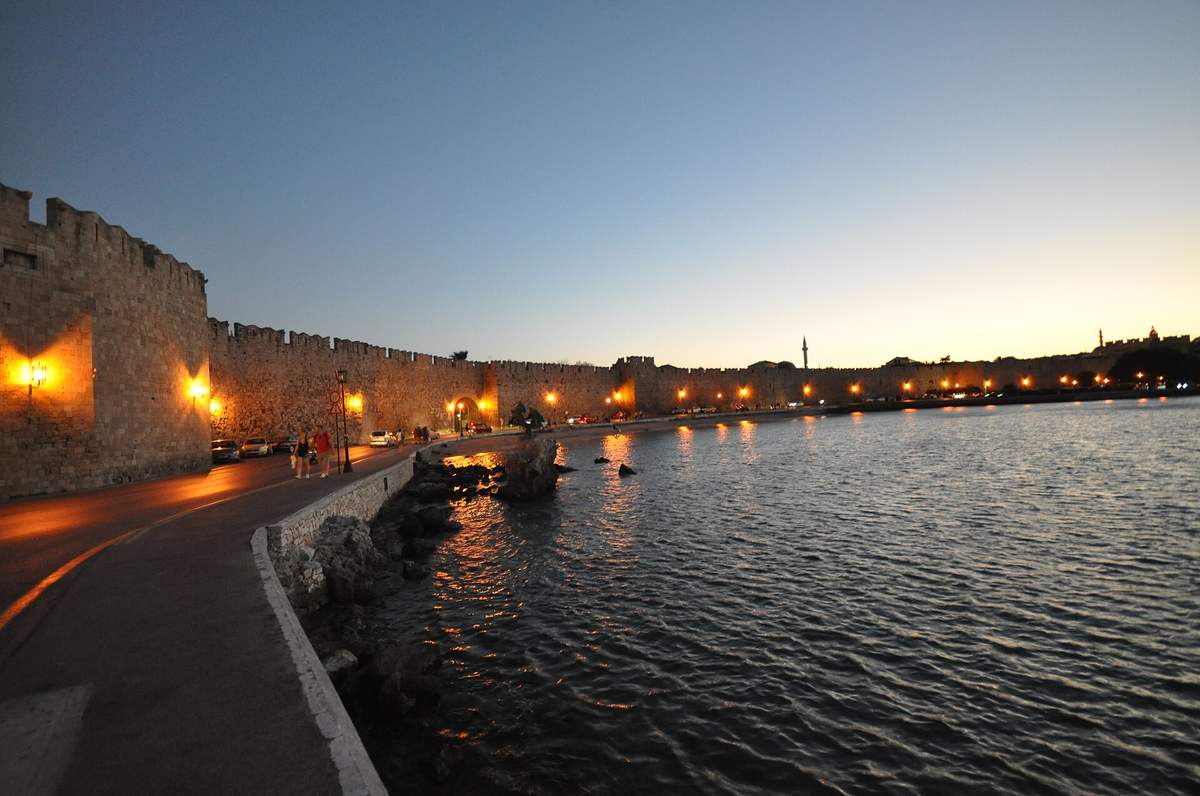
The walled medieval Old Town of Rhodes is pedestrianised, so the best way to see it is simply to walk. Its cobbled lanes are closed to general traffic, distances inside are short, and wandering on foot is both the easiest and the most rewarding way to take it in.
Within the great stone walls, the Old Town is a maze of cobbled streets, small squares and quiet courtyards that reveal themselves only to walkers. The Street of the Knights, the main market lanes and the hidden back alleys are all an easy stroll apart, and cars are kept out of the historic core, which makes exploring on foot calm and safe. Wear comfortable shoes, because the cobbles are uneven and worn smooth in places, and allow more time than the map suggests, since you will stop often. Early morning and evening are the pleasant hours to walk, before and after the heat and the day-trip crowds.
Driving inside the Old Town is best avoided altogether; the lanes are narrow, parking within the walls is very limited, and you will spend longer looking for a space than the walk would take. The same caution applies in Lindos, whose steep, whitewashed lanes are also effectively pedestrian, with parking pushed to the village edge. Leave the car outside, walk in, and enjoy both places at their proper pace. Our guide to Rhodes Old Town covers the walls, the Knights’ quarter and the bazaar on foot. Plan your visit and tours through our Rhodes travel guide.
Frequently Asked Questions
Do I need a hire car to enjoy Rhodes?
You do not strictly need one, but it depends on what you want from the trip. If your holiday centres on Rhodes Town, Faliraki and a day or two in Lindos, the cheap KTEL buses, the occasional taxi and walking will cover almost everything comfortably and keep costs down. If you want to explore the mountain villages, the wooded interior or the remote southern beaches such as those near Prasonisi, a hire car becomes close to essential, because public transport simply does not reach those places on a useful schedule. Many visitors strike a balance: they rely on buses and walking for the town and the main resorts, then take a car for two or three days to see the parts of the island that lie off the coastal routes. Booking the car in advance during the busy season is wise, as the cheaper categories sell out early.
How long does it take to drive from Rhodes Town to Lindos?
The drive from Rhodes Town down the east coast to Lindos takes roughly an hour, depending on traffic, the season and how much of the route is the faster main road. It is the single most common journey on the island, since Lindos with its acropolis and bay is the headline excursion for most visitors, and the road is well used and generally in good condition. By KTEL bus the same trip is longer, because services make intermediate stops along the coast, and frequencies fall outside the summer peak, so check the current timetable before you set out. Allow extra time in high season, when the roads and the village fill up. Remember that parking in Lindos itself is limited and pushed to the edge of the village, with the steep lanes effectively pedestrian, so you will walk the final stretch whichever way you arrive. Setting off early helps you beat both the heat and the crowds.
What should I know about driving and parking on Rhodes?
In Greece you drive on the right, and you should carry your driving licence with you whenever you are at the wheel, along with the rental documents. The main coastal roads are good and easy, but the island also has narrow village lanes and winding climbs into the interior that ask for care, patience and a steady speed. Watch for oncoming traffic on the tightest bends, for scooters and pedestrians in the resorts, and for the occasional rough surface away from the main routes. Parking is the other thing to plan for: it is genuinely limited in the Old Town, where cars are kept out of the walled core, and tight in Lindos, where you leave the vehicle on the edge and walk in. In the resorts and at the bigger beaches you will usually find space, though it fills up at peak times, so arrive earlier in the day when you can.