
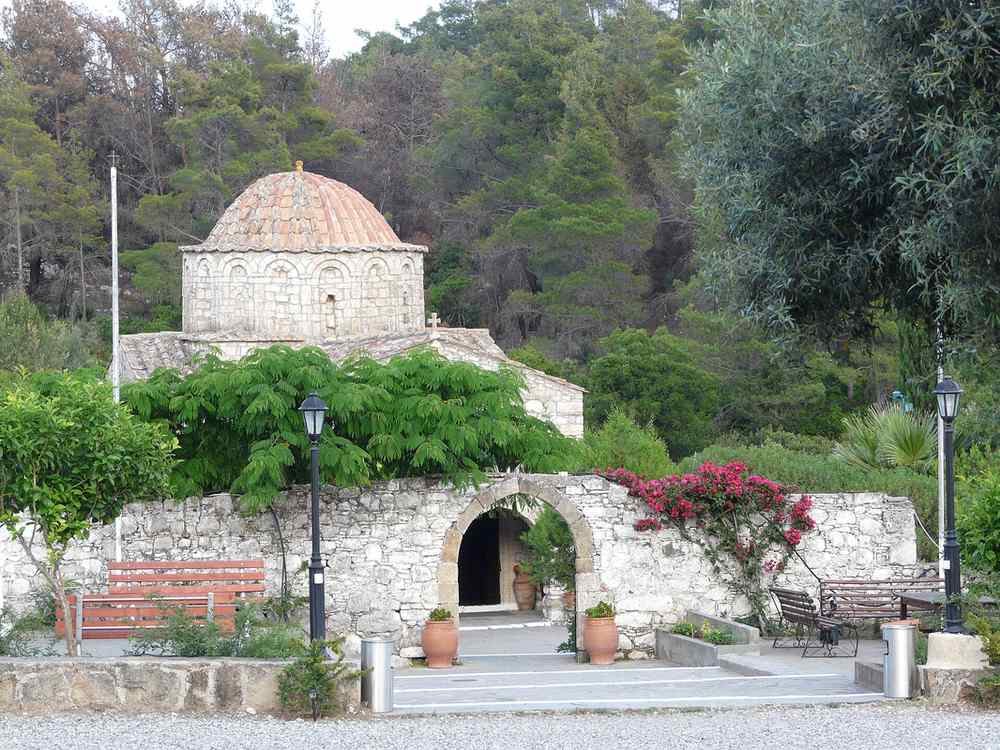
Thari Monastery (Moni Thari) is a Byzantine monastery in the south-central interior of Rhodes, dedicated to the Archangel Michael (Taxiarchis Michael) and regarded as the oldest and one of the most important on the island, celebrated for its layered medieval frescoes and forest setting. Plan tickets and tours through My Greece Tours.
For wider context on the island, see our Rhodes travel guide. The sections below cover what Thari Monastery is, what its frescoes and church are like, where it is and how you reach it, what visiting feels like, and the practical tips that help you make the most of the trip.
What is Thari Monastery?
Thari Monastery, or Moni Thari, is a Byzantine monastery in the wooded interior of Rhodes, dedicated to the Archangel Michael. It is widely regarded as the oldest and one of the most significant monasteries on the island, and today functions again as a living, working religious community.
Thari Monastery sits deep in the south-central uplands of Rhodes, hidden within a dense pine forest near the inland village of Laerma rather than on the busy coast. Its full dedication is to Taxiarchis Michael, the Archangel Michael, a powerful protective figure in Orthodox tradition, and the site has carried spiritual weight for many centuries. The monastery is celebrated above all for the antiquity of its foundation: among the Byzantine religious houses scattered across Rhodes, Thari is held to be the eldest, a status that gives it particular importance in the island’s medieval Christian heritage and in the story of how faith took root across the interior.
Far from a ruin, Thari is a functioning monastery that was re-established as an active community after long periods of varied use through the centuries. Monks live and worship here, so the atmosphere is devotional rather than purely touristic, and the buildings are maintained as a place of prayer first. This dual character, an important historic monument and a genuine spiritual home, shapes everything about a visit, from the quiet expected of guests to the modest dress required indoors. Our guide to Asklipio village covers another inland heritage site nearby, and the next section covers the frescoes and church.
What are the frescoes and church like?
The katholikon is a domed, cross-in-square Byzantine church, the classic medieval plan crowned by a central cupola. Inside, its walls carry layers of remarkably well-preserved frescoes spanning several phases of Byzantine art, depicting Christ, the Archangels, saints and biblical scenes in rich, devotional detail.
The church at the heart of Thari is a cross-in-square katholikon, the dominant form of mature Byzantine architecture, in which four arms radiate from a central square space topped by a dome. This compact, vertical design draws the eye upward and creates a luminous interior surface ideal for painted decoration. At Thari the walls and vaults are covered with wall paintings applied across more than one period, so visitors effectively read several chapters of Byzantine artistic development on a single set of surfaces, from earlier, more austere figures to later, more expressive and narrative compositions that reflect changing tastes and techniques over the centuries.
The fresco programme is the monastery’s great treasure. Christ appears in majesty, the Archangels stand as guardians befitting the dedication to Michael, and ranks of saints and scenes from scripture unfold around the church in the ordered hierarchy typical of Orthodox iconography. The state of preservation is unusually good, allowing the colours, gestures and inscriptions to be appreciated closely, which is why art historians value Thari so highly. Photography rules inside are often restricted to protect the paintings, so check on arrival. Our guide to Lindos and its acropolis covers another layered monument on Rhodes, and the next section covers where Thari is and how you reach it.
Where is Thari Monastery and how do you get there?
Thari Monastery lies in the south-central interior of Rhodes, set in a pine forest near the inland village of Laerma, well away from the coastal resorts. The practical way to reach it is by car along winding inland roads, and many travellers fold it into a wider tour of the south of the island.
Geographically, Thari belongs to the green, hilly heart of Rhodes rather than its famous shoreline. The nearest settlement is Laerma, a small inland village, and the monastery sits below it among pines that screen it from view until the final approach. Because it is inland and surrounded by forest, the setting is cool, shaded and quiet, a marked contrast to the beaches and the medieval town in the north. Reaching this part of the island means leaving the coast road and following secondary roads that climb and curve through woodland, so a degree of planning and a reliable vehicle make the journey far smoother.
A hire car is by far the most flexible option, as public transport into this remote interior is limited and infrequent. Drivers usually combine Thari with other sights in the south, threading the monastery into a day that also takes in inland villages, viewpoints and forest scenery. Allow generous time for the slow, scenic roads rather than rushing. Our guide to things to do in Rhodes covers wider sightseeing across the island, and the next section covers what the experience of visiting is actually like.
What is the experience of visiting like?
Visiting Thari is a calm, contemplative experience defined as much by the forest as by the art. You arrive into deep pine shade, step from bright sun into the cool, painted interior, and move quietly through a working monastery where prayer, not tourism, sets the tone for the day.
The peaceful forest setting is a central part of Thari’s appeal. After the long drive through woodland, the monastery reveals itself in a clearing of pines, and the soundscape is birdsong and wind rather than traffic or crowds. The contrast between the strong Aegean light outside and the dim, fresco-lined church within heightens the sense of entering another world, where centuries of devotion are written across the walls. Many visitors describe the atmosphere as genuinely restorative, a place to slow down, lower the voice and simply look, and that meditative quality distinguishes Thari sharply from the busier monuments closer to the coast.
Because Thari is a living community, the rhythm of the site is shaped by the monks who keep it. Services and quiet hours mean visitors are guests in a home of prayer, and respectful, unhurried behaviour is expected throughout. This is not a place to tick off quickly; it rewards those who linger, study the paintings and absorb the stillness. The combination of important Byzantine art, a beautiful natural setting and an authentic spiritual presence makes a visit memorable in a gentle, understated way. Our guide to a suggested Rhodes itinerary covers how to fit such stops into a trip, and the next section covers the tips that help you visit.
What tips help you visit Thari Monastery?
Dress modestly with shoulders and knees covered, behave quietly and respectfully as in any working monastery, and travel by hire car with time to spare for the winding inland roads. Check photography rules on arrival, and combine the visit with other sights in the south of Rhodes.
Modest dress is the single most important practical point, because Thari is an active religious community. Cover your shoulders and knees, keep voices low, switch phones to silent and follow any guidance from the monks about where you may and may not go. Photography inside the church is frequently restricted to protect the fragile frescoes, so ask before raising a camera and respect the answer. These courtesies are not mere formalities; they are the conditions on which visitors are welcomed into a genuine place of worship, and observing them keeps the experience open for everyone who follows.
On logistics, treat the journey as part of the day rather than an obstacle. Bring water, fuel up before heading inland, and allow extra driving time for the slow, twisting forest roads to and from Laerma. Cooler parts of the day and shoulder seasons can be especially pleasant given the shade and altitude, and pairing Thari with nearby inland villages turns a single stop into a rewarding south-Rhodes circuit. Plan your visit and tours through our Rhodes travel guide.
Frequently Asked Questions
Why is Thari Monastery considered so important?
Thari Monastery is widely regarded as the oldest Byzantine monastery on Rhodes and one of the most important religious sites in the island’s interior, which alone gives it considerable historic standing. Its significance rests on two pillars. First is its great age and its continuous spiritual role across the centuries, anchoring Christian heritage in the wooded heart of the island rather than on the more famous coast. Second is its art: the katholikon preserves layers of remarkably intact frescoes from several phases of Byzantine painting, making the church a valuable record of how the tradition evolved over time. Together, the antiquity of the foundation, the quality and preservation of the wall paintings, and the survival of the site as a living, working monastery dedicated to the Archangel Michael combine to make Thari a landmark of both faith and art. For visitors, this means a stop that offers more than scenery: a direct encounter with centuries of devotion and craftsmanship in a single, serene location.
What should I wear to visit Thari Monastery?
Because Thari is an active, working monastery, modest dress is essential rather than optional. Both men and women should ensure their shoulders and knees are covered before entering the church and the monastic grounds, so lightweight trousers or a long skirt and a top with sleeves are sensible choices, with a shawl or wrap easy to carry for extra cover. Avoid beachwear, vests, very short shorts and anything revealing, which would be inappropriate in a place of worship. Beyond clothing, respectful behaviour matters just as much: keep your voice low, move calmly, silence your phone and follow the monks’ guidance about access and conduct. Photography inside the church is often restricted to protect the centuries-old frescoes, so check the rules on arrival and never use flash where it is forbidden. Dressing and behaving appropriately is not only courteous but is usually a condition of entry, and it ensures that this living spiritual community can continue to welcome visitors while preserving its sacred character and its fragile painted treasures.
How do I get to Thari Monastery and how long should I allow?
The most practical way to reach Thari Monastery is by hire car, as it sits in the remote south-central interior of Rhodes near the inland village of Laerma, screened by pine forest and far from the coastal resorts. Public transport into this part of the island is limited and infrequent, so independent transport gives you the flexibility you need. The drive involves leaving the main coast road and following secondary roads that climb and wind through woodland, scenery that is beautiful but slow, so allow generous time and do not plan a tight schedule. Many travellers combine the monastery with other attractions in the south, building a relaxed day that takes in inland villages, viewpoints and forest landscapes rather than rushing from one site to the next. Fuel up before heading inland, carry water, and budget extra minutes for the curving roads in each direction. Treated this way, with the journey embraced as part of the experience, Thari becomes the tranquil highlight of a rewarding circuit through the green heart of Rhodes.